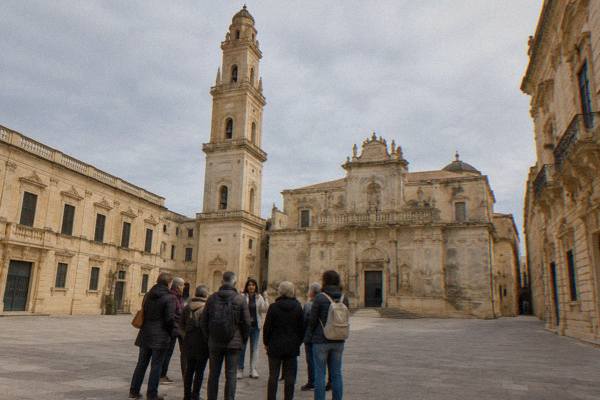
Piazza Sant Oronzo: The Column, The Sedile And The Arena
Piazza Sant Oronzo is the civic heart of Lecce in Puglia, where a Roman arena, a patron saint's column and a baroque trading hall share one open, ticket-free square.
Short answer
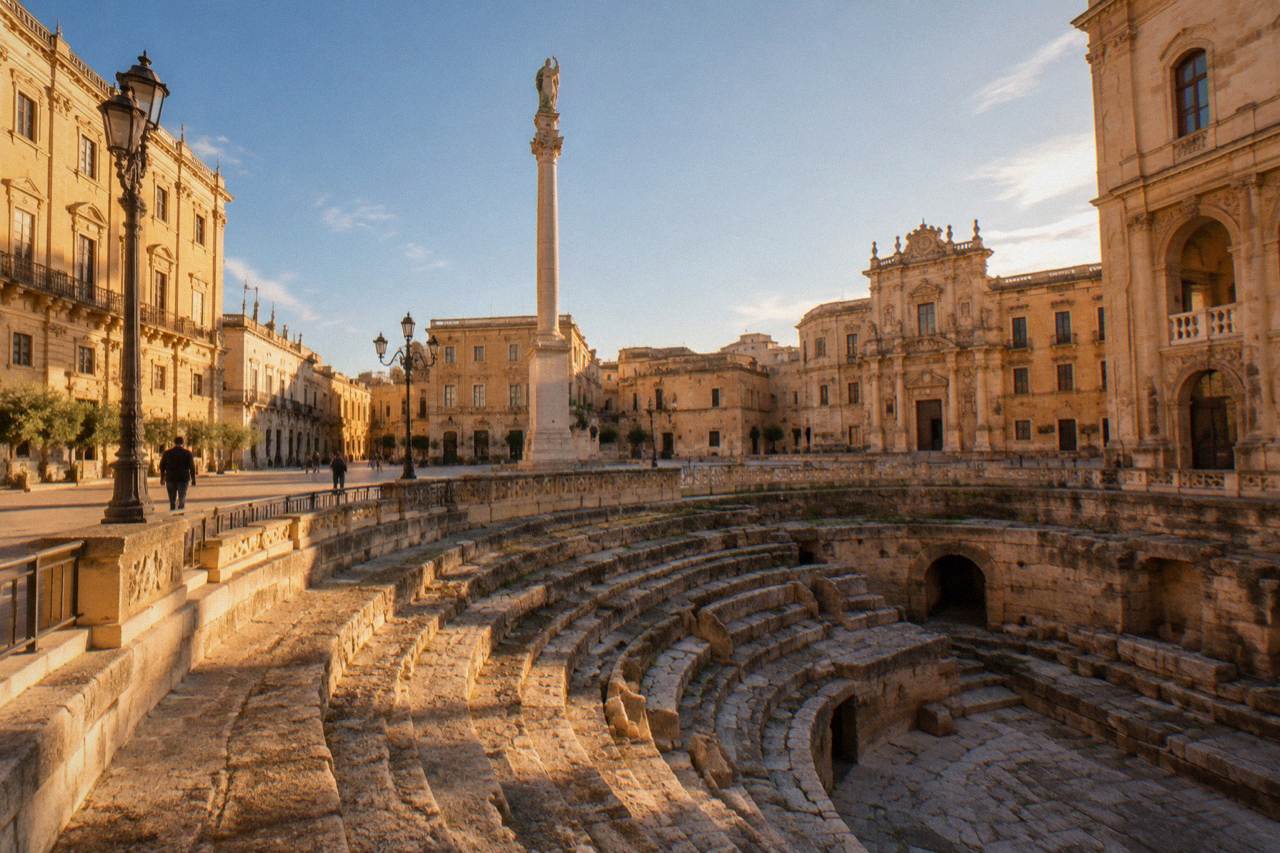
Piazza Sant Oronzo in Lecce is a free, always-open public square in the centre of the old town. It contains the excavated Roman amphitheatre (visible free from above, interior ticketed), the column of Sant Oronzo and the Sedile, and it sits within a five-minute walk of the Duomo and Basilica di Santa Croce.
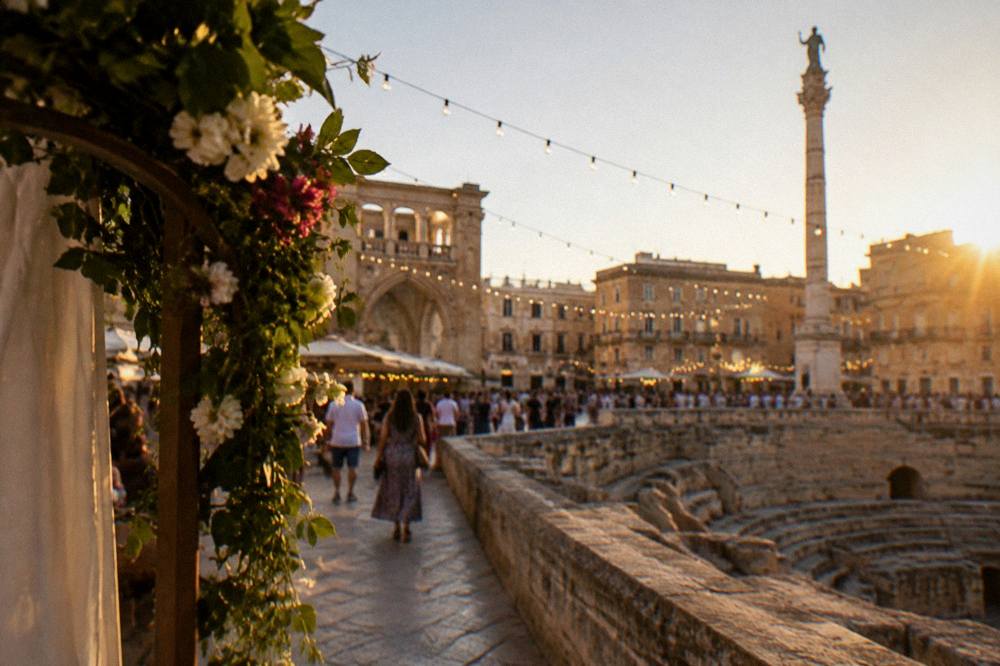
Piazza Sant Oronzo is the main square of Lecce, the baroque capital of Salento in Puglia, southern Italy, and it packs more history per square metre than almost anywhere else in the old town. A Roman amphitheatre lies half-excavated below street level, a marble column crowned by the city's patron saint rises at the centre, and the Sedile, the old trading hall, closes off one side. The square itself is open public space with no ticket and no closing time, which makes it the natural first stop on any Lecce walking tour and the anchor point for everything else you will do in the city. The Lecce Travel Guide covers the square's buildings, the amphitheatre's hours and tickets, the August feast that transforms the piazza, and the practical details of getting there.
What Is Piazza Sant Oronzo In Lecce, And Why Is It The Centre Of The City?
Piazza Sant Oronzo is Lecce's main civic square, a free, always-open public space in the middle of the old town where the Roman amphitheatre, the column of Sant Oronzo and the Sedile all stand within a few steps of each other. The square is the crossroads of the historic centre: the cardo and decumanus of the Roman city ran through or near this ground, and the modern street plan still bends around the arena below. No ticket gates, no fences and no opening hours apply to the piazza itself, only to the amphitheatre interior.
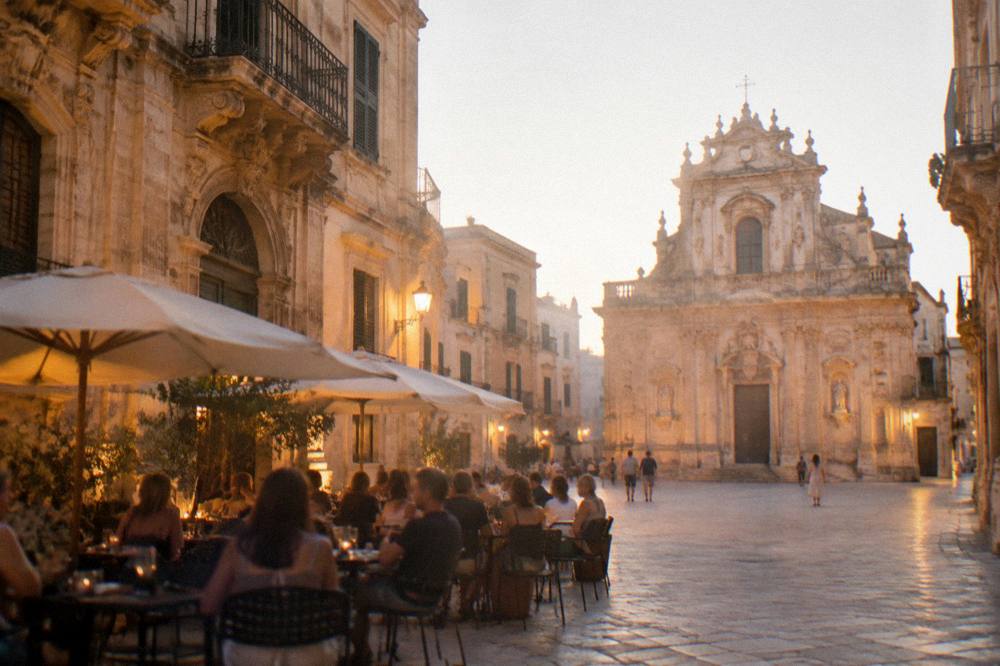
Lecce is a city of about 94,387 residents (1 January 2026 estimate), and the piazza behaves like its front parlour. Aperitivo tables spill across the paving in the evening, the excavated arena sits quietly roped off a few metres away, and the facade of the church of Santa Maria delle Grazie closes the eastern side. Caffè Alvino, whose roots trace to about 1880 and which is often described as the first bar in Lecce, still occupies its corner of the square.
The square's other name, Piazza del Popolo, appears on some older maps, but everyone in Lecce, locals and visitors alike, calls it by the saint's name. Sant'Oronzo, one of the city's three patron saints together with San Giusto and San Fortunato, is honoured each August with the feast described further down this page.
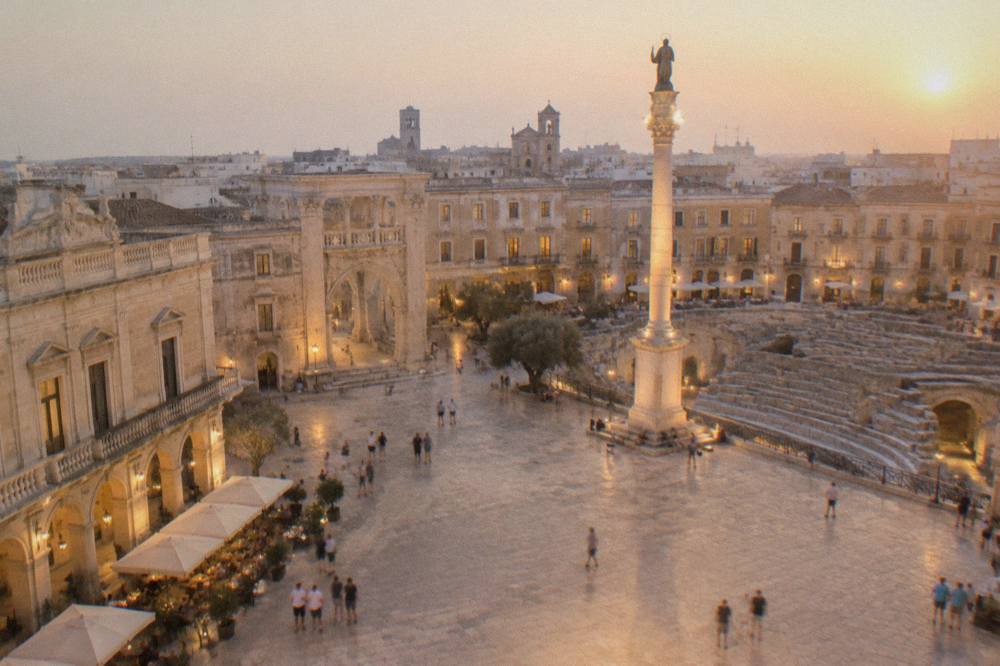
The square also works as an orientation device. Straight down Via Giuseppe Libertini you reach Piazza del Duomo and the cathedral; a short walk northeast brings you to Piazza Mazzini, the modern shopping district; and the whole baroque core of the city sits inside a belt of roughly fifteen minutes on foot. If you build your day around the piazza you will rarely need a map.
What Can You See From Piazza Sant Oronzo In Lecce Without A Ticket?
Everything at ground level in Piazza Sant Oronzo is free to see: the square itself, the column of Sant Oronzo, the Sedile's exterior, the flank of the Roman amphitheatre seen from above, and the facades that ring the piazza, all of it open public space with no ticket, according to the site listing that confirms the square among Lecce's free sights. Only stepping down into the amphitheatre itself, or entering the ticketed churches, costs anything.**
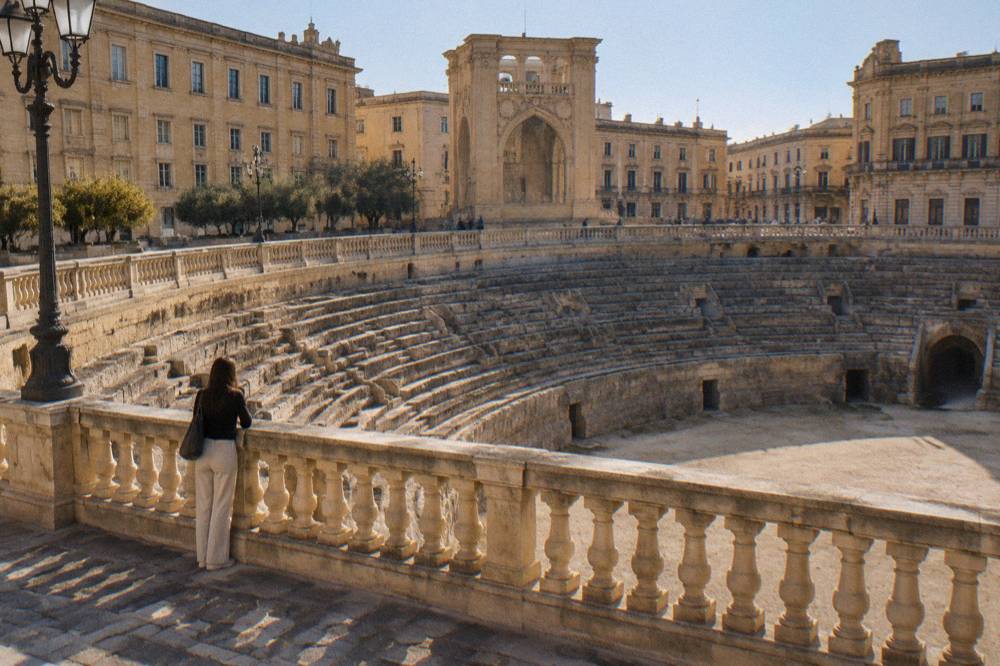
The free list around the piazza is short but dense. The amphitheatre is visible from the balustrade at street level, and that view alone gives you the scale of the Roman arena. The Sedile, the elegant loggia building on the square's southern side, is best appreciated from outside. The column, the cafe terraces and the daily passage of leccesi going about their business cost nothing at all.
Within a short walk, the free list grows. Porta Napoli, the triumphal arch on the western edge of the centre, is open public space. The Villa Comunale, the public gardens, is similarly free. The exterior facades of the Basilica di Santa Croce and the Palazzo dei Celestini can be studied at length without spending anything, and the courtyard of the Palazzo dei Celestini is free to enter.
The line between free and paid matters in Lecce because so much of the city's interior heritage now sits on one combined ticket. The LeccEcclesiae circuit covers the Duomo and crypt, Santa Croce, San Matteo, Santa Chiara and the Museo d'Arte Sacra, but none of those churches stands on this square. The piazza's own sights split neatly: everything you see from the paving is free, and only the amphitheatre's interior has its own ticket.
A guided walk ties the free exteriors together with the paid interiors. The Tour of Lecce with a visit to the basement of the ancient synagogue covers the piazza and the old town and includes the underground space linked to the city's Jewish quarter, a layer of Lecce's history that is easy to miss without a guide. You can also Check availability for your dates.
How Much Does The Roman Amphitheatre In Piazza Sant Oronzo Cost?
The Roman amphitheatre in Piazza Sant Oronzo costs 5 EUR for a full ticket and 2 EUR reduced, with winter hours of 10:00 to 17:00 Tuesday to Sunday and Monday closed, per the Direzione regionale Musei Puglia listing; seeing the arena from street level, without going inside, is free. A cumulative museum card at 6 EUR also exists on the same ticketing page. The site reopened with a new accessible entrance and ramp following a restoration project funded with 1,500,000 EUR under the PNRR programme.**
The amphitheatre is the piazza's buried treasure in the literal sense. Only about half of the original ellipse was excavated, because the rest lies beneath the surrounding streets and buildings. What is visible, rows of seating sinking below the modern paving, is enough to read the arena's shape from the balustrade. Inside, the scale becomes obvious.
| Item | Detail |
|---|---|
| Full ticket | 5 EUR |
| Reduced ticket | 2 EUR |
| Museo cumulative card | 6 EUR |
| Winter hours (1 Oct to 31 Mar) | Tue to Sun, 10:00 to 17:00, last entry 16:30 |
| Summer hours (1 Apr to 30 Sep) | Tue to Sun, 10:00 to 13:00 and 17:00 to 21:00, last entry 20:30 |
| Monday | Closed |
| View from street level | Free |
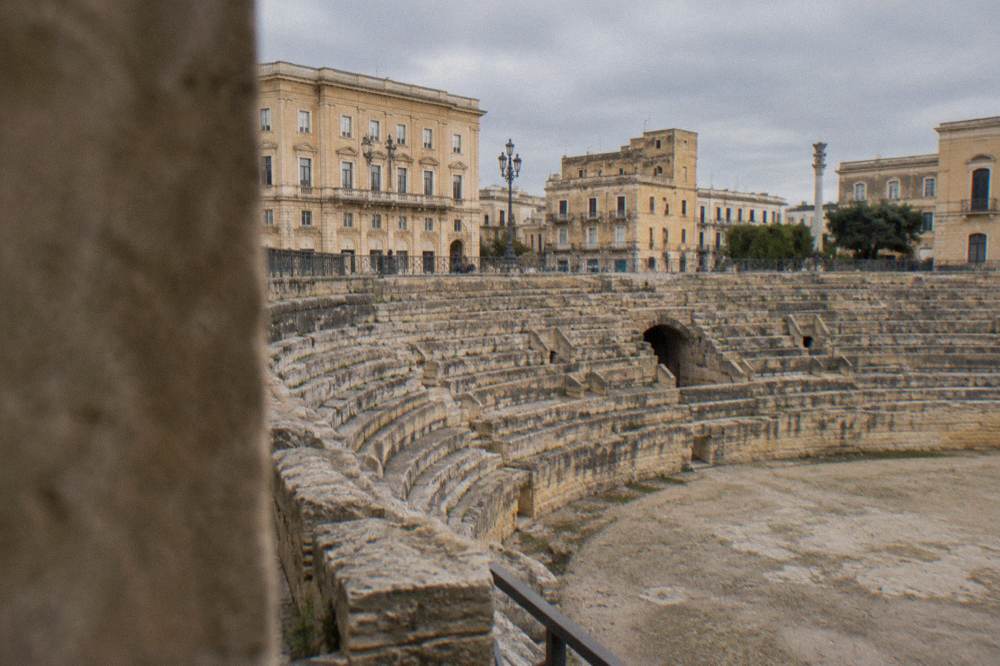
The site is one of two Roman venues in the city, and the pairing is worth understanding before you buy anything. The Teatro Romano, a smaller performance theatre, sits a few streets away with its own small museum, open Monday to Saturday 9:30 to 13:00 with afternoons by reservation and a ticket of about 3 EUR. The amphitheatre hosted spectacles; the theatre hosted plays. Both lie hidden inside the modern fabric of the city, which is the recurring surprise of Lecce's archaeology.
Whether the amphitheatre ticket is worth it depends on your patience for archaeology. The full Roman Amphitheatre guide covers the details; the short version is that the view from above already delivers the essential geometry, and the interior adds the seating, the arena floor level and the new accessible route. For more on the city's layers generally, the Museo Faggiano nearby, at 5 EUR and open daily 9:30 to 20:00, is a house excavated down through two millennia of occupation.
What Is The Column Of Sant Oronzo And What Does It Carry?
The column of Sant Oronzo carries a statue of Lecce's patron saint, and it remains the visual and symbolic centre of the piazza; the statue shows the saint blessing the city, and it is the focal point of the August patronal feast that takes its name from him. The column is part of the free, open public space of the square and cannot be climbed or entered.**
Tradition connects the column's shaft to Roman spolia, reused stone from the city's ancient monuments, though the details of its provenance are a matter of local tradition rather than a settled record, so treat the origin story as the telling of it goes. What is certain is what it does now: it gives the square its name, its orientation point and its festival anchor.
Every 23 to 26 August the square and the surrounding streets fill with the Festa di Sant Oronzo, the city's patronal feast for Oronzo, Giusto and Fortunato. The 2026 edition ran 23 to 26 August with processions, luminarie, concerts, a fair and a luna park, per the comune's own programme. In late August the square is transformed; for the rest of the year the column stands quietly over cafe tables and passing tricycles.
What Is The Sedile, And What Role Does It Play In Piazza Sant Oronzo?
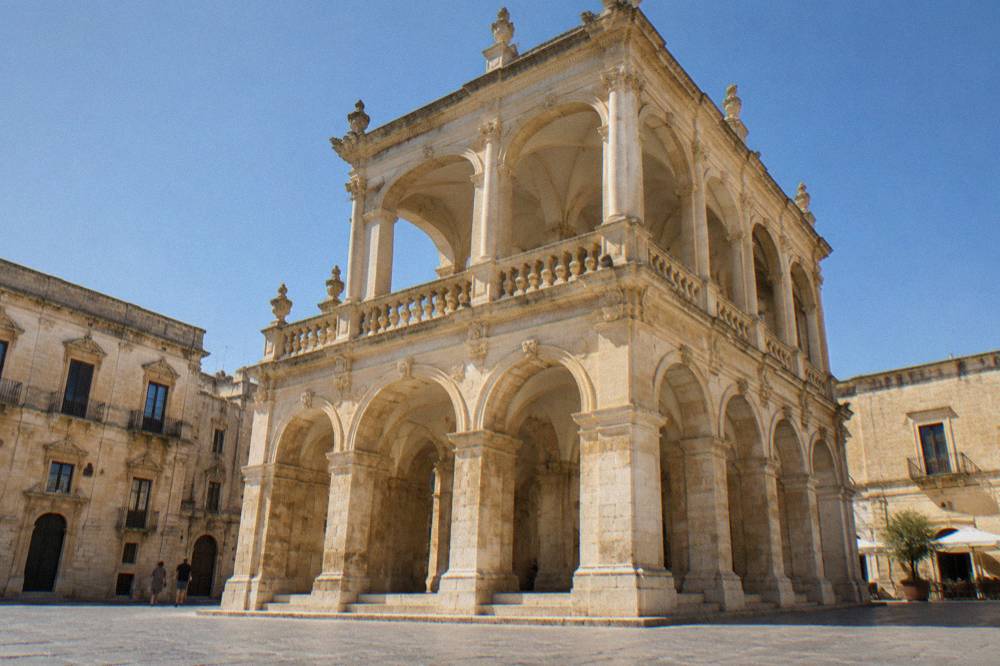
The Sedile, also called Palazzo del Seggio, is the arcaded loggia building on the piazza's southern side, historically the seat of the city's medieval council and trading administration, and today one of the square's most photographed facades; its exterior is free to view, and the building itself now serves civic and commercial functions rather than operating as a ticketed attraction. No published visitor hours or entry ticket for it appear in the official sources for the square.**
The building's name comes from its function: a seggio was a seat, in both the furniture and the political sense, and cities across Puglia built such halls where merchants and magistrates met. Lecce's Sedile presents a ground level of open arcades and an upper loggia, all in the local pietra leccese that gives the whole city its honey colour. The soft Miocene limestone is easy to carve when quarried and hardens on exposure, which is why Lecce's baroque facades carry such deep ornament.
Practically, the Sedile today is something you look at rather than enter. Its arches frame views across the square, and its terrace line makes the standard photograph of the piazza: the loggia on one side, the column in the middle, the amphitheatre trench in the foreground. Around it stand the other buildings that complete the square, including the Banca d'Italia palace and the church of Santa Maria delle Grazie on the eastern edge.
A block north, the Chiesa di Sant'Irene adds another baroque facade to the ensemble around the piazza, its dedication to another Salento saint matching the horticultural and civic piety that produced the column. The dense cluster of churches around the square is the reason the LeccEcclesiae combined ticket exists at all: eleven euros standard, valid fifteen days, covering five churches plus the sacred art museum.
When Is The Best Time Of Day To Visit Piazza Sant Oronzo In Lecce?
Piazza Sant Oronzo is freely accessible at every hour, so the timing question is about comfort and atmosphere rather than access: the square is quietest in the early morning, busiest in the evening aperitivo hours, and the amphitheatre interior keeps fixed hours of 10:00 to 17:00 Tuesday to Sunday in winter. The ERA5 reanalysis, 1991-2020, gives Lecce a mean daily high of 31.3 C in August and 21.8 C in October, so summer visits favour morning and evening.**
The square changes character three times a day. In the morning it belongs to cafe regulars and delivery vehicles, and the amphitheatre's shadows are longest. At midday in July and August the paving radiates heat; the reanalysis puts the mean daily high at 31.0 C in July and 31.3 C in August, with rainfall of only 15.3 and 18.1 mm respectively. By evening the tables fill, the column is lit, and the piazza does what Italian main squares do best.
| Month | Mean High C | Mean Low C | Rain mm |
|---|---|---|---|
| Jan | 12.4 | 6.7 | 63.1 |
| Mar | 15.4 | 8.3 | 64.9 |
| May | 23.4 | 14.7 | 39.9 |
| Jul | 31.0 | 21.7 | 15.3 |
| Aug | 31.3 | 22.2 | 18.1 |
| Oct | 21.8 | 15.4 | 91.3 |
| Nov | 17.3 | 11.7 | 93.7 |
Figures are ERA5 reanalysis, 1991-2020, a modelled grid cell rather than a weather station record, with November showing the highest monthly rainfall total in the series at 93.7 mm. What that means for the piazza is simple: spring and autumn deliver the pleasant middle ground, summer rewards the evening visit, and a rainy November day still leaves the cafes, the churches and the MUST museum within a few minutes' cover.
How Do You Get To Piazza Sant Oronzo In Lecce?
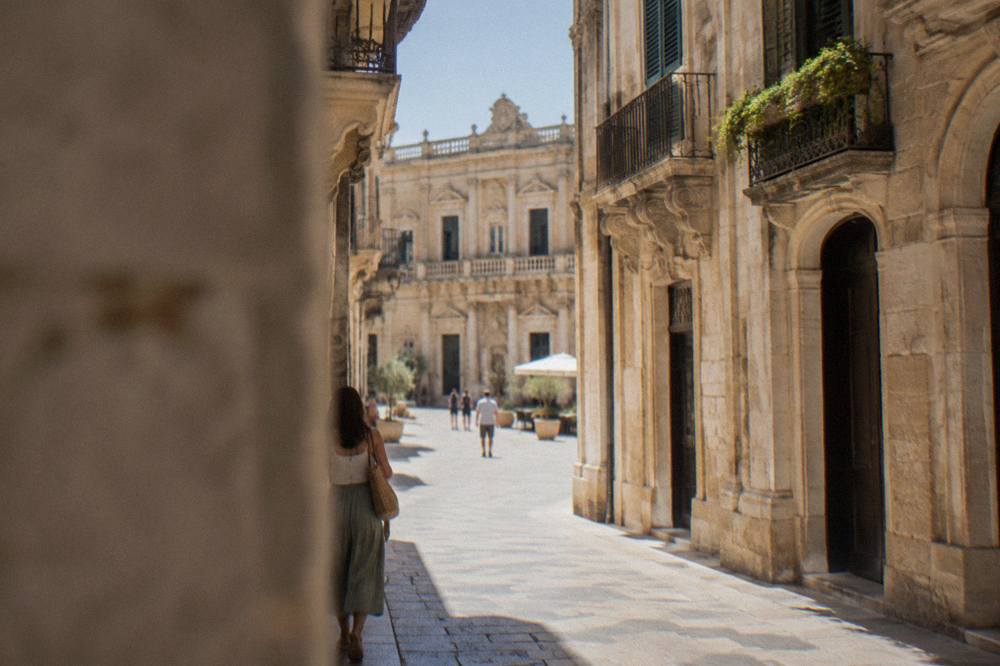
Piazza Sant Oronzo sits in the pedestrianised core of Lecce's old town, about a ten-minute walk from Lecce train station, and the practical rule is to arrive on foot or by bus: the historic centre is a camera-policed ZTL, active on weekdays roughly 13:00 to 16:30 and 20:00 to 10:00 and all day Sunday, with fines of 83 to 332 EUR, so drivers should park outside the zone and walk in. The Park Liberty underground car park, with 466 spaces near the centre, is the main option.**
Lecce has no commercial airport. The gateway is Brindisi, about 47.6 km and roughly 43 minutes by road from the square, with an airport bus at 6.50 EUR one way and a journey of about 40 minutes into Lecce. From the station, the walk to the piazza is flat and direct through the new town. Within the city, SGM buses run on a 60-minute ticket of about 1.20 EUR, 1.50 EUR bought on board, with a day ticket at about 3 EUR.
| Journey | Method | Time | Cost |
|---|---|---|---|
| Brindisi Airport to Lecce | Airport bus | about 40 min | 6.50 EUR one way |
| Lecce station to the piazza | On foot | about 10 min | free |
| City centre | SGM bus, 60-min ticket | valid 60 min | about 1.20 EUR |
| SGM day ticket | Bus | one day | about 3 EUR |
| Parking near centre | Park Liberty, 466 spaces | n/a | hourly rates apply |
If you are staying outside Lecce for the day, the surrounding towns connect by rail: Otranto with a change at Maglie, about 1h33 to 2h or more, from about 4 EUR, and Gallipoli direct on the FSE line, about 1h18 to 1h43, from about 5 EUR. In summer only, the Salento in Bus network ran 13 June to 13 September in 2026, with fares of 1.10 to 5 EUR; the 2027 dates have not been announced. Drivers arriving from Bari should allow about 118 minutes for the 152.6 km route in free-flow conditions.
Ask your accommodation to register your number plate with the ZTL system if you are driving; the camera hours are reported rather than guaranteed, and the exemption process is the accommodation's to handle.
What And Where Should You Eat Around Piazza Sant Oronzo In Lecce?
Around Piazza Sant Oronzo you eat the classics of Salento: caffè in ghiaccio con latte di mandorla, the iced espresso with almond milk credited to Antonio Quarta of Quarta Caffè in the 1940s to 1950s, pasticciotto, and rustico leccese, the savoury puff pastry filled with bèchamel, mozzarella and tomato; Caffè Alvino, with roots to about 1880, stands on the square itself in Piazza Sant'Oronzo, and Pasticceria Natale, family-run since 1978, is a short walk away. A pasticciotto at Natale lists at 2.20 EUR for its signature version, per the shop's own menu.**
The square is the natural place to try the caffè leccese, the iced coffee that entered Italy's traditional food list around 2026. The drink is built in layers: espresso over ice cubes, almond milk syrup poured on top, no sugar by tradition, stirred only when you decide. It is a summer ritual, and the piazza's tables are where it is most often photographed.
| Food or drink | What it is | Where it fits |
|---|---|---|
| Caffè in ghiaccio con latte di mandorla | Iced espresso with almond milk syrup, credited to Quarta Caffè | Piazza cafe tables |
| Pasticciotto | Shortcrust custard tart; the 1745 Galatina origin is the shop's own claim | Pasticceria Natale, since 1978 |
| Rustico leccese | Puff pastry with bèchamel, mozzarella and tomato | Bakeries around the centre |
| Salice Salentino | Negroamaro-based DOC established 1976 | Enotecas and tastings |
Two cautions from the sources. The pasticciotto invention date of 1745 belongs to Pasticceria Ascalone of Galatina, not Lecce, and historians dispute it, so the shop's claim is what you will hear rather than a settled fact. And the rustico's own origin is uncertain, with late 18th to 19th century attributions circulating, none documented firmly enough to print as fact.
For a deeper run at the city's food culture, the Lecce food tour guide and the what to eat in Lecce page cover the territory, and the things to do in Lecce overview places the piazza in the full context of a visit.
What Events Fill Piazza Sant Oronzo In Lecce During The Year?
The event that owns Piazza Sant Oronzo is the Festa dei Santi Patroni, held each year in late August in honour of Oronzo, Giusto and Fortunato, with the 2026 edition running 23 to 26 August in processions, luminarie, concerts, a fair and a luna park; beyond it, the square hosts the Christmas season, when the Fiera dei Pupi, the papier-mache fair, follows an early-December-to-24-December pattern, with 2026 dates not yet published. No 2027 dates for the major festivals had been announced at the time of checking.**
The patronal feast is the piazza's transformation moment. For four days the square becomes the stage for the city's identity: the statue's procession, the light archways over the streets, the fairground in the surrounding lanes. The comune's own programme for the 2026 edition listed the full schedule of processions and concerts.
| Event | Timing | Status of dates |
|---|---|---|
| Festa dei Santi Patroni, Lecce | late August; 23 to 26 Aug 2026 | annual pattern, per comune |
| Fiera dei Pupi, Lecce | early Dec to 24 Dec (2025 pattern) | 2026 dates not published |
| Notte della Taranta Concertone, Melpignano | 22 Aug 2026, 29th edition | 2027 not announced |
| Festa di San Rocco, Torrepaduli | 14 to 17 Aug 2026 | annual pattern |
The Notte della Taranta, the great pizzica festival at Melpignano about half an hour from Lecce, arrives in the same late-August window, and the piazza serves as a way-station for the whole Salento music season. The tarantism tradition behind the pizzica is folklore and anthropology, a matter of legend and healing ritual, and belongs to the region's intangible culture rather than to any single venue.
Common Questions About Piazza Sant Oronzo In Lecce
Is Piazza Sant Oronzo in Lecce free to visit?
Yes. The square is open public space with no ticket and no closing time. The Roman amphitheatre seen from above is also free; only the amphitheatre interior has a ticket, at 5 EUR full and 2 EUR reduced.
How do I get to Piazza Sant Oronzo from Lecce train station?
On foot, in about ten minutes, flat and direct through the new town. City buses run on a 60-minute ticket of about 1.20 EUR if you prefer not to walk.
Can you go inside the Roman amphitheatre in Piazza Sant Oronzo?
Yes, during opening hours: Tuesday to Sunday, 10:00 to 17:00 in winter (1 October to 31 March) and 10:00 to 13:00 plus 17:00 to 21:00 in summer, closed Mondays. The ticket is 5 EUR full and 2 EUR reduced, with a 6 EUR cumulative museum card also available.
What is the column in Piazza Sant Oronzo?
A Roman column carrying a statue of Sant'Oronzo, Lecce's patron saint, blessing the city. It is the focal point of the square and of the patronal feast held each late August, which ran 23 to 26 August in 2026.
When is the Festa di Sant Oronzo held in the square?
In late August each year, honouring Oronzo, Giusto and Fortunato. The 2026 edition ran 23 to 26 August with processions, luminarie, concerts, a fair and a luna park, per the comune's programme.
Is Piazza Sant Oronzo walkable from the main sights of Lecce?
Yes. The Duomo and Piazza del Duomo lie a few minutes down Via Libertini, the Basilica di Santa Croce is within a short walk, and the entire baroque core sits inside roughly fifteen minutes on foot from the square.
Piazza Sant Oronzo rewards the slow approach: arrive in the morning for the empty light, come back for the aperitivo hour, and plan one late-August evening if the feast is on. Between the free square, the ticketed arena below it and the baroque city stacked around it, it is the single address in Lecce where every layer of the city is visible at once.