Teatro Romano: The Roman Theatre Behind The Houses
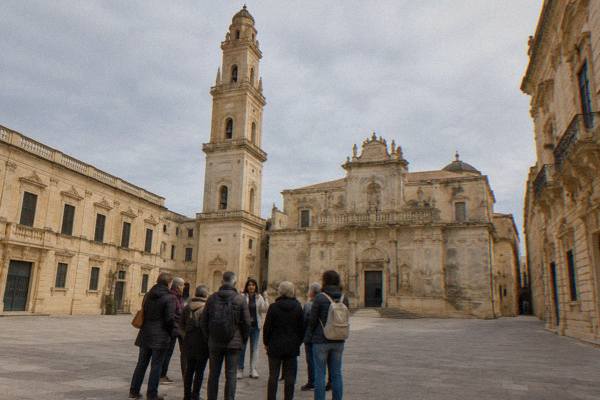
Lecce, the baroque capital of Salento in Puglia, southern Italy, hides a Roman theatre inside its street plan, tucked behind ordinary house fronts a few minutes from Piazza Sant'Oronzo.
Short answer
The Teatro Romano in Lecce is a small Roman-era theatre embedded in the historic centre, viewable from the street and from the adjacent Museo del Teatro Romano, which is open Monday to Saturday from 9:30 to 13:00, afternoons by reservation, with entry at about 3 euro.
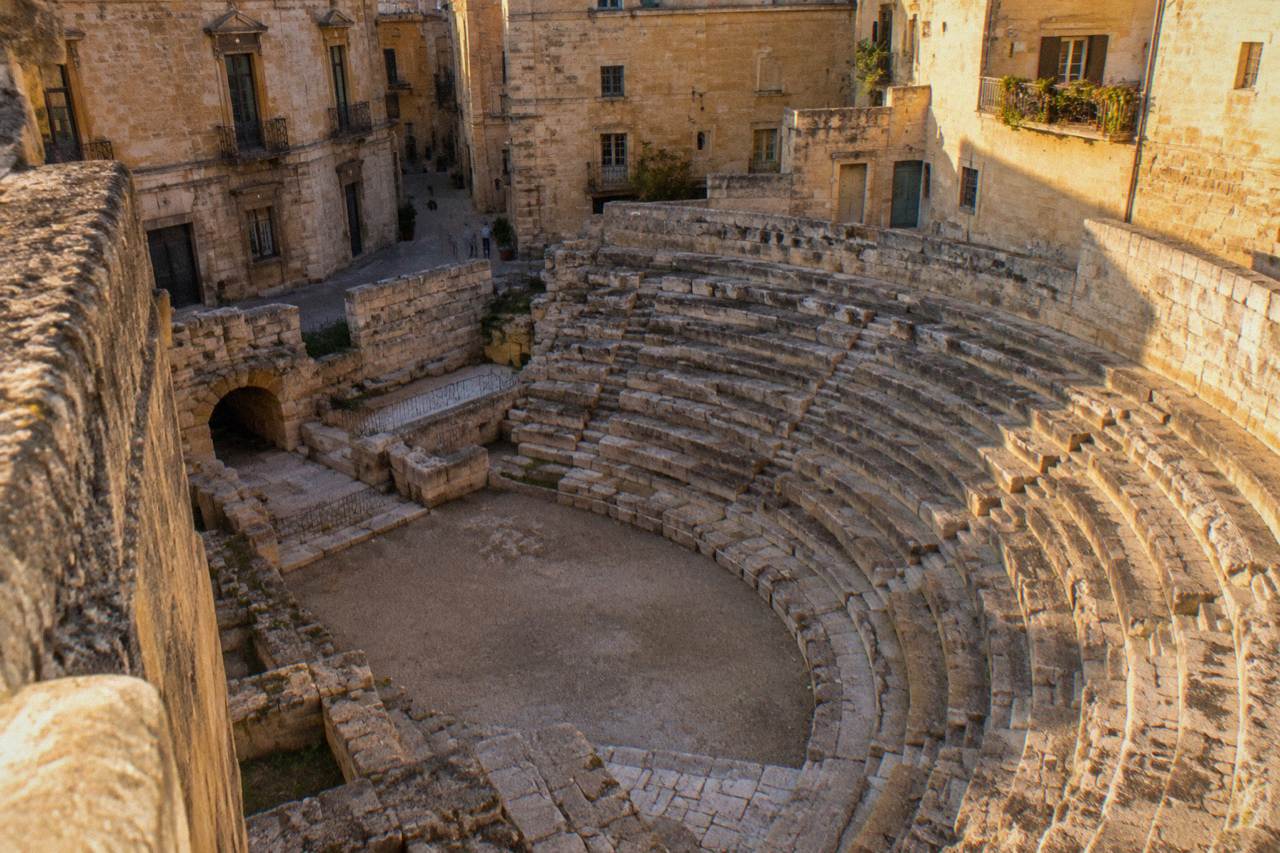
Lecce, in Puglia, southern Italy, is famous for its barocco leccese facades carved from honey-coloured pietra leccese, but the city's street plan carries something older than all of that. Behind the house fronts of the historic centre, a few minutes' walk from Piazza Sant'Oronzo, sits a Roman theatre, its curved seating sunk into the block and its stage area facing a small piazza. Passers-by can walk straight into the cavea without a barrier, because the theatre is not a fenced archaeological park: it is part of the neighbourhood, and houses were built over and around it centuries ago. This guide covers what the site is, how to visit it and its small museum, how it differs from the better-known Anfiteatro Romano, and what else sits within easy reach in the old city.
What Is The Teatro Romano In Lecce?
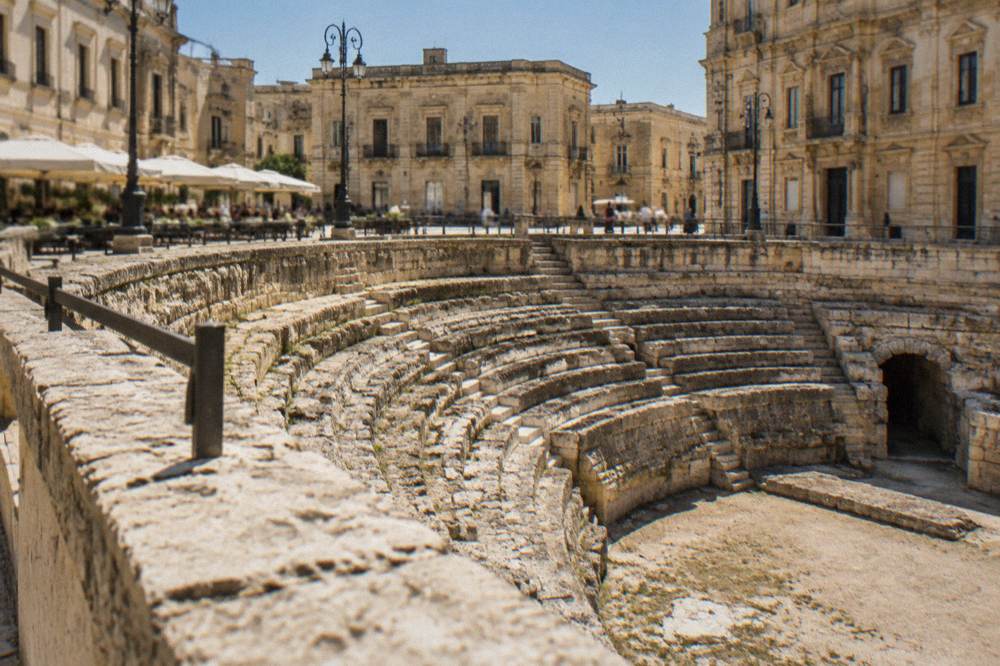
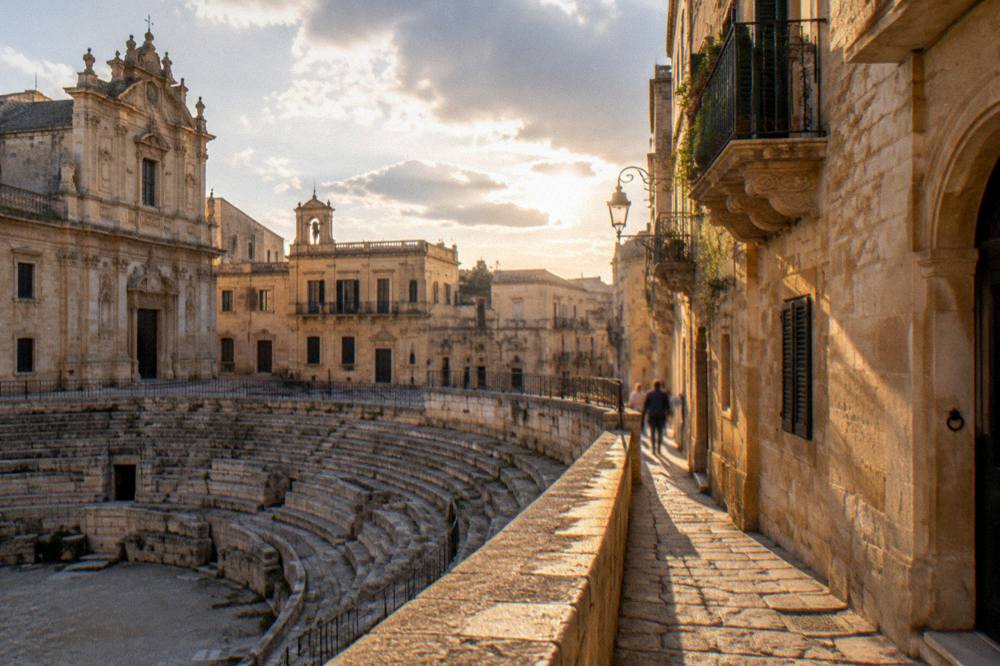
The Teatro Romano in Lecce is a compact Roman-era theatre set directly into the historic-centre street plan, with its semicircular seating rows, scaena wall footings and surrounding medieval and baroque houses all visible at once from a small piazza. Unlike the city's amphitheatre, it is not a ticketed open-air monument: the cavea can be viewed freely, and the adjacent Museo del Teatro Romano holds the artefacts and displays that explain the structure.
The theatre sits in the block bounded by Via degli Ammirati and Via del Teatro Romano, a short walk from the main squares. What strikes a reader of the accounts, and reportedly most first-time viewers, is the scale of the intrusion of ordinary life: apartment buildings rise immediately behind the top seating rows, and the scaenae frons foundations run along what is now a street. The theatre was built for stage performances, plays and recitations, which is the functional difference from an amphitheatre, built for spectacles in the round.
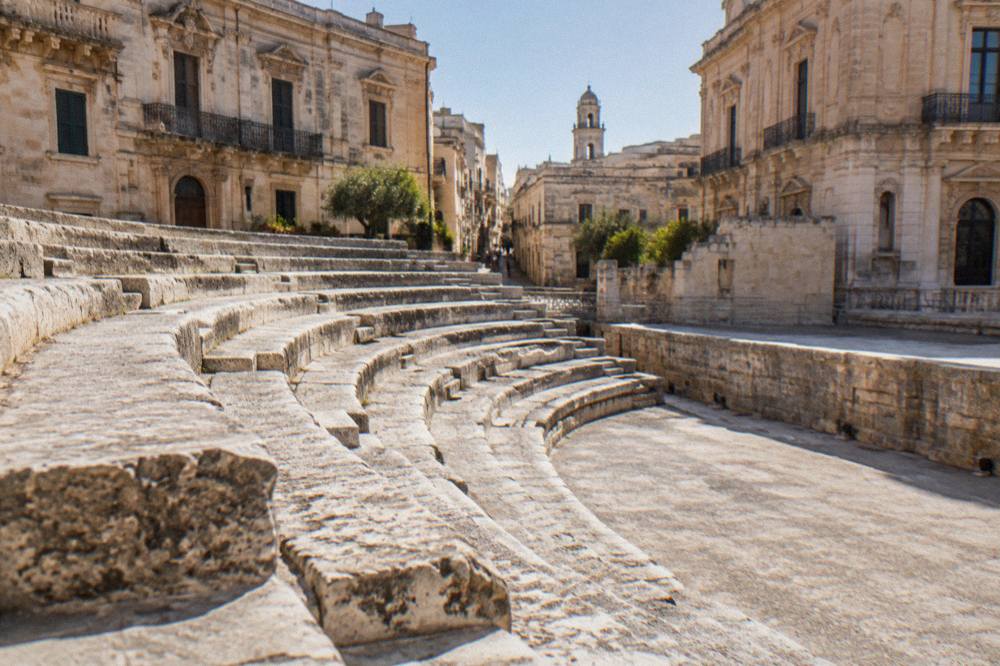
The structure is cut and built from the local stone that shaped everything else in the city, pietra leccese, the soft Miocene limestone that hardens on exposure and gave the Baroque carvers their medium a millennium and a half later. The seating rows visible today form part of the cavea, the tiered bowl that held the audience; the lower parts of the structure lie beneath the modern street level. No construction date for this theatre should be repeated as settled fact, because none is carried in the sources for this page, and Lecce's Roman monuments are often casually dated in tourist copy without a documentary basis. What the sources do support is simpler and just as interesting: a working Roman entertainment district sat here, buried under later building, and was progressively brought back to light.
How Do You Visit The Teatro Romano And The Museo Del Teatro Romano In Lecce?
The theatre itself is visible from the street without a ticket, while the Museo del Teatro Romano, the small museum beside the site, is reported open Monday to Saturday from 9:30 to 13:00, with afternoons by reservation only and Sundays closed, at about 3 euro entry, per the comune di Lecce's museum listing. Some listings offer a cumulative ticket of about 5 euro with the Anfiteatro. Confirm hours and the price on the day, since both are reported rather than guaranteed.
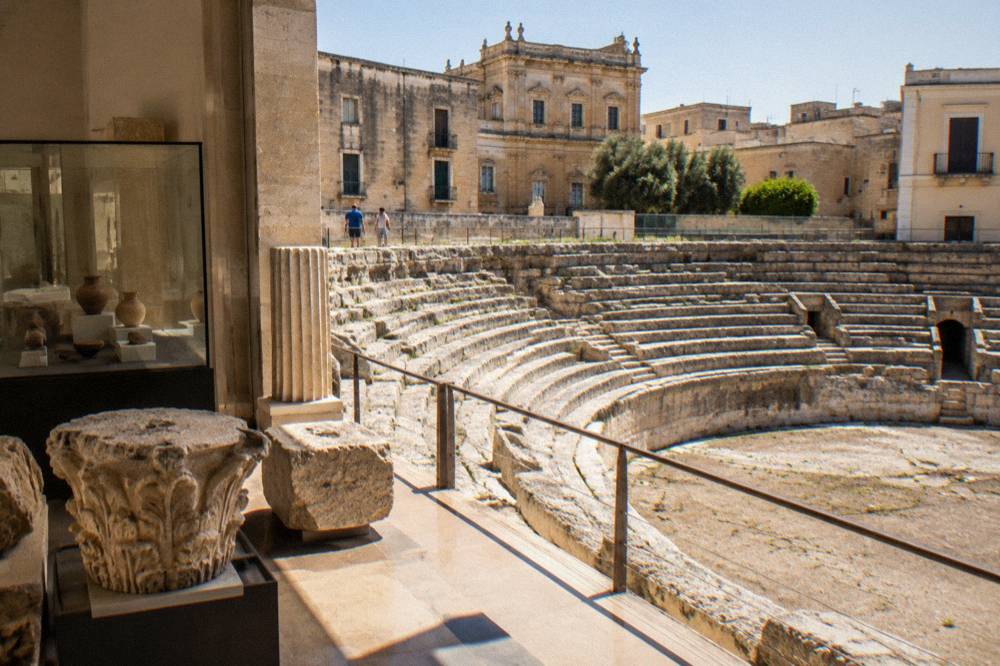
The museum is the interpretive half of the visit. It is run by the Fondazione Memmo and occupies spaces along Via degli Ammirati and Via del Teatro Romano. Inside, the displays cover the excavation history and the material recovered from the site, giving context the stones alone do not supply. Because the museum keeps morning-only hours, the practical planning advice is to treat it as a mid-morning stop rather than an afternoon one: after 13:00 the option is reservation only, and on Sunday the museum is closed, though the theatre cavea itself remains viewable from the street in daylight hours.
For a sense of how the two Roman institutions of the city compare in practical visiting terms, the table below gathers the reported figures for both:
| Site | Type | Access | Reported hours | Reported ticket |
|---|---|---|---|---|
| Teatro Romano | Roman theatre, in the street plan | Cavea visible freely from the street | Street viewing in daylight | Free from street |
| Museo del Teatro Romano | Museum beside the theatre | Ticketed interior | Mon-Sat 9:30-13:00, afternoons by request, closed Sun | About 3 euro; cumulative with Anfiteatro about 5 euro in some listings |
| Anfiteatro Romano | Roman amphitheatre in Piazza Sant'Oronzo | Visible free from above; interior ticketed | Winter (1 Oct-31 Mar) Tue-Sun 10:00-17:00; summer 10:00-13:00 and 17:00-21:00; closed Mon | 5 euro full, 2 euro reduced |
The amphitheatre interior recently reopened with a new accessible entrance following a 1,500,000 euro restoration under the PNRR programme, per the Direzione regionale Musei Puglia. The theatre has no equivalent programme reported, and its public face remains the street, the cavea and the museum.
If the morning hours fit your plan, a guided walk that threads the old town's Roman and baroque layers together is one way to cover the theatre without organising it yourself; the site's Lecce walking tour overview lists the options, and there is a dedicated guide to the Anfiteatro Romano here.
Teatro Romano Or Anfiteatro Romano In Lecce: Which Should You See?
Both are worth seeing and they sit within a few minutes' walk of each other, but they reward different expectations: the Anfiteatro Romano in Piazza Sant'Oronzo is the monumental, ticketed, freshly restored experience with published hours and a 5 euro ticket, while the Teatro Romano is a quieter, partially revealed structure best understood through its small museum, and the two together tell the story of a Roman city with two separate entertainment buildings.
The amphitheatre is the headline act of Roman Lecce. It occupies one side of the city's main square, and its surviving arc of seating is visible free from the square itself, which is why it features in nearly every photograph essay on the city. The theatre, by contrast, was built for spoken and musical performance rather than spectacle in the round, and its survival inside a residential block makes it the more unusual sight, even if the less dramatic one. A visitor with an hour and no ticket budget can see the theatre cavea from the street, look down into the amphitheatre from Piazza Sant'Oronzo, and have covered both Roman monuments for nothing.
A visitor who wants interiors should plan around the two schedules: the amphitheatre runs a Tuesday-to-Sunday schedule with a winter season from 1 October to 31 March (10:00 to 17:00) and a split summer day (10:00 to 13:00 and 17:00 to 21:00), closed Mondays, while the theatre's museum runs mornings only, Monday to Saturday. Doing both interiors on the same day therefore means starting at the theatre museum before 13:00 and moving to the amphitheatre afterwards.
What Can You Actually See Of The Roman Theatre Today In Lecce?
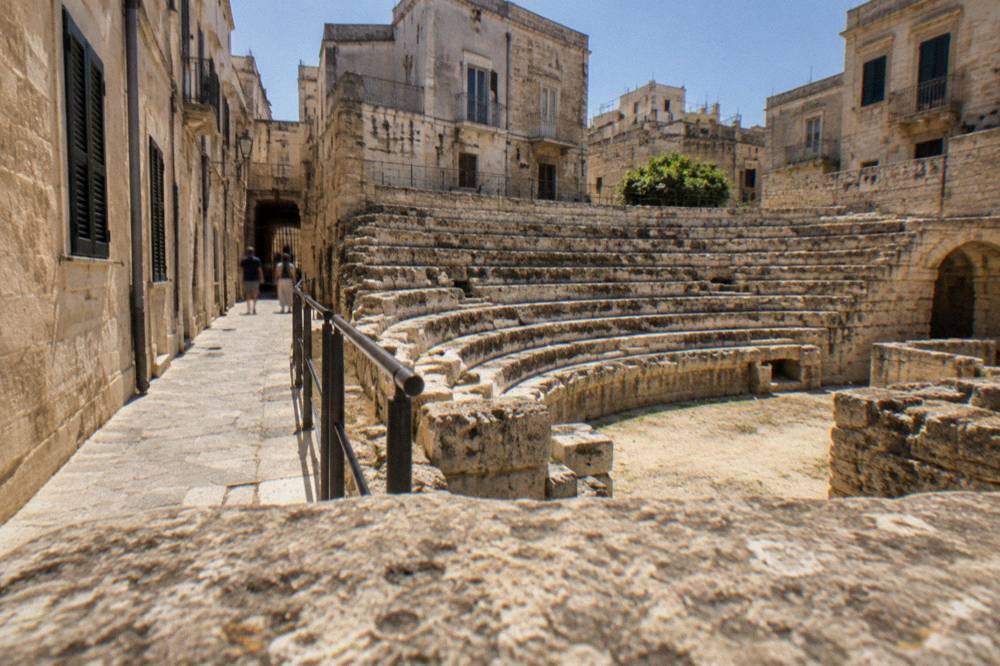
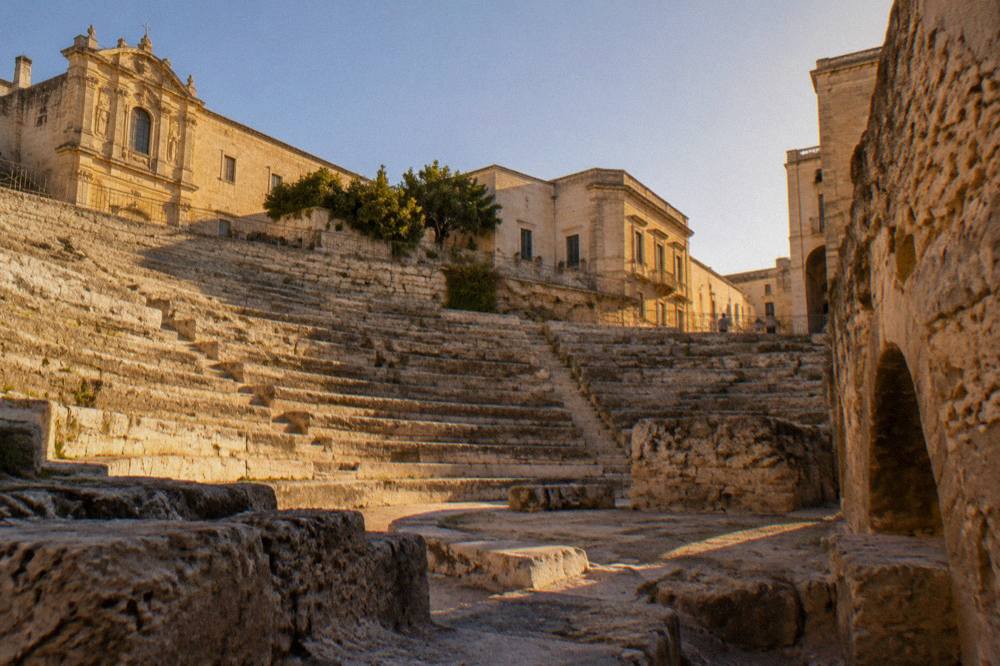
What is visible today is a semicircular array of seating rows in pietra leccese, the footings of the stage wall that now line a street, and the relationship between the ancient structure and the buildings stacked around it, together with the museum's displays of excavated material; the lower portions of the Roman building lie below modern ground level, and the theatre was progressively overlaid by later construction, so this is a partial monument read in section, not a complete one.
The cavea's curve is the signature view. Standing at the former orchestra level and looking up, the rows step back into the block, and the eye meets balconies and shutters above the topmost tier. The effect is the point: this is a Roman building that survived because it was absorbed, not because it was preserved on an open site. Walking around the block on Via del Teatro Romano shows how the cavea's outer wall became party walls for the houses, a common fate for ancient structures in continuously occupied Italian cities.
The museum displays the excavated finds and the history of the investigations that freed the visible parts of the structure. Because the price and hours are reported by secondary listing rather than an official tariff page, the practical line is the one above: about 3 euro, mornings, confirm on the day. Nothing in the sources for this page supports detail beyond that, such as guided tours of the theatre itself or evening openings, so none is offered here.
Where Is The Teatro Romano In Lecce And How Do You Reach It?
The Teatro Romano sits inside the historic centre of Lecce, in the block between Via degli Ammirati and Via del Teatro Romano, a short level walk from Piazza Sant'Oronzo and the Duomo, and because the whole old town is a compact pedestrian-scaled grid, it is reached on foot from anywhere in the centro storico; visitors arriving by car should note the ZTL camera zone covering the historic centre and park outside it, at garages such as Park Liberty with 466 spaces near the centre.
The reported ZTL arrangement runs camera enforcement on weekdays in two blocks, roughly 13:00 to 16:30 and 20:00 to 10:00, and around the clock on Sundays and holidays, with Porta Napoli always closed; fines run from 83 to 332 euro. The hours are reported rather than guaranteed, and the standing advice is to ask the accommodation whether plate registration is possible before driving in. Blue-zone and garage parking sits outside the restricted core, and SGM city buses serve the centre with a 60-minute ticket at about 1.20 euro, 1.50 euro bought on board.
For orientation, the theatre is one of a cluster of Roman and baroque points that all sit within the same few blocks:
| Nearby point | Segment of the old town | Reported access |
|---|---|---|
| Piazza Sant'Oronzo and Anfiteatro Romano | Main square | Open public space; amphitheatre interior ticketed, 5 euro full |
| Piazza del Duomo | Cathedral square inside the LeccEcclesiae circuit | Combined ticket 11 euro standard, valid 15 days |
| Basilica di Santa Croce | Baroque centrepiece | Included in LeccEcclesiae ticket |
| Museo Faggiano | Archaeological house-museum | Every day 9:30 to 20:00, 5 euro, ages 0 to 8 free |
| Parco archeologico di Rudiae | Messapian-and-Roman park outside the centre | Weekend guided visits, weekdays by booking, 5 / 4 euro |
Rudiae deserves the comparison because it is the other face of ancient Lecce: a Messapian-and-Roman archaeological park visited on guided weekend tours rather than an embedded city monument. The Rudiae park guide covers it in full, and the Museo Faggiano page does the same for the layered house-museum that shows how deep the stratification under the old town runs.
How Does The Teatro Romano Fit Into A Day In Lecce?
A workable morning pairs the Teatro Romano and its museum with the amphitheatre and Piazza Sant'Oronzo, then continues to Piazza del Duomo and the Basilica di Santa Croce on the LeccEcclesiae circuit, with the afternoon given to a museum such as the MUST or the Castello Carlo V; the theatre museum's morning-only hours make it the natural first stop, and the whole route is walkable end to end inside the historic centre.
The sequencing matters more than the distance, because the distances are trivial. The theatre museum opens at 9:30 and closes its counter at 13:00; the amphitheatre opens at 10:00 in winter; the LeccEcclesiae sites run daily 9:00 to 18:00 in the winter season and 9:00 to 21:00 from April to September, per the chieselecce.it listing. A visitor who starts at the theatre at 9:30 can be in Piazza del Duomo before 11:00 and still have the afternoon for the Castello, whose guided tours run Tuesday to Sunday with winter slots from 10:30, at 10 euro full per the castle's own page.
For weather planning, the ERA5 reanalysis, 1991-2020, for the grid cell near Lecce gives the background: mean highs from 12.4 C in January to 31.3 C in August, mean lows from 6.7 C in January to 22.2 C in August, with the year totalling about 652 mm of rain and November carrying the highest monthly total at 93.7 mm against July's 15.3 mm. None of this affects the theatre much, since the street viewing is a five-minute stop; it matters for how much of the day you spend walking the open squares.
| Month | Mean high C | Mean low C | Rain mm |
|---|---|---|---|
| January | 12.4 | 6.7 | 63.1 |
| April | 18.6 | 10.7 | 54.6 |
| July | 31.0 | 21.7 | 15.3 |
| October | 21.8 | 15.4 | 91.3 |
| November | 17.3 | 11.7 | 93.7 |
The wider framing, if the theatre is your entry point into the city as a whole, is available in the site's things to do in Lecce round-up, which orders the sights, beaches and day trips; this Lecce Travel Guide is the hub for all of it.
What Else Is Near The Teatro Romano In Lecce?
Within the same few blocks sit the Anfiteatro Romano, Piazza Sant'Oronzo, the Duomo and the LeccEcclesiae church circuit, the Basilica di Santa Croce, the Museo Faggiano and the columns of the baroque centro storico, so the theatre is best treated as one stop on a continuous walk rather than a destination in itself, and every one of those neighbours is reachable on foot in a city whose historic core is flat and compact.
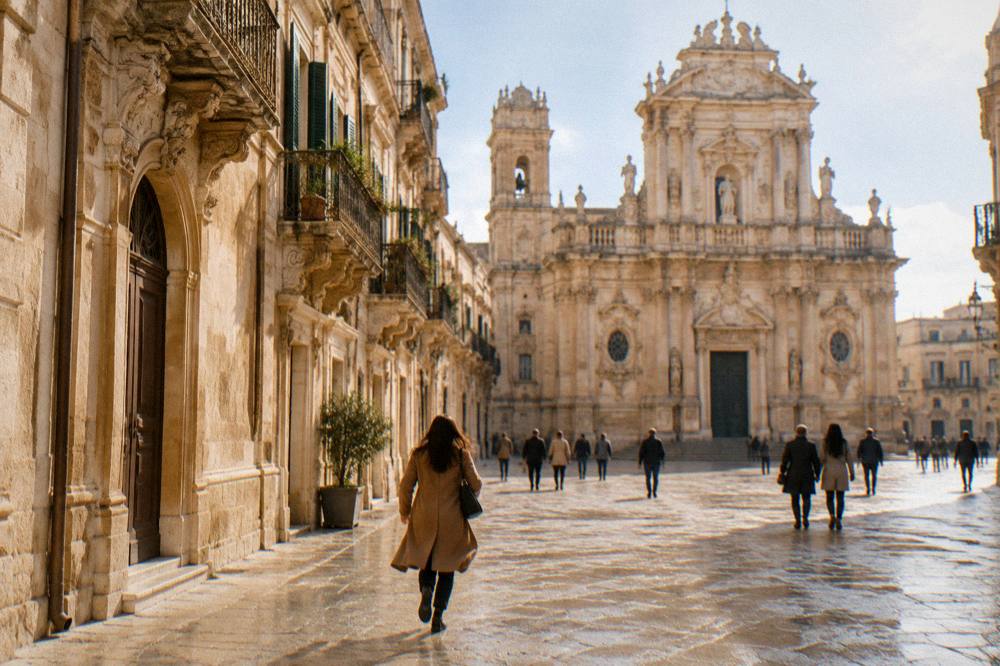
The baroque layer is what surrounds the Roman one. The Basilica di Santa Croce, the Chiesa di San Matteo, the Chiesa di Santa Chiara and the Antico Seminario with MuDAS are all on the single LeccEcclesiae ticket, 11 euro standard or 21 euro with the bell tower lift, valid 15 days, children under 12 free, per the chieselecce.it tariff page. The Duomo's square alone, Piazza del Duomo, is one of the set-piece spaces of southern Italian urbanism, closed on three sides and theatrical in a way the Roman theatre no longer is.
The Museo Faggiano makes the sharpest complement to the theatre, because it shows the same stratification in cross-section: a single residential building whose basement descents reveal layer after layer of the city's past, open every day from 9:30 to 20:00 at 5 euro, with ages 0 to 8 free and 8 to 16 at 3 euro, per the museum's tariff page. Between the theatre in the street and the museum in the basement, the depth of the city underfoot becomes concrete rather than rhetorical.
What Tours And Tastings Pair Well With The Teatro Romano In Lecce?
The most natural pairing is a tasting of Negroamaro-based Salento wines, the grape behind the Salice Salentino DOC established in 1976 across the provinces of Lecce and Brindisi, because the tasting rooms sit in the old town a short walk from the theatre; a cooking class or a guided city walk covers the same ground with food or a guide in front of it, and all three can be booked around a morning at the Roman sites.
The wine angle is the one this page recommends as its featured pairing. Salento's identity in the glass is Negroamaro, and a structured tasting of four wines from that land turns a morning of Roman stone into a full day of the region's two deep traditions, the ancient and the agricultural. The operator's live listing carries the current price and availability.
For a fuller sense of the options, the small band below collects the pairings that sit closest to a teatro romano lecce visit, in itinerary terms: a Negroamaro tasting, a pasta class in a family home, and a rickshaw tour of the city highlights for anyone who wants the Roman and baroque sights narrated.
If a guided walk is the preference, two further options cover the historic centre with the Roman layers included: a small-group history walk, and a budget walk that includes entry to the Duomo and the Basilica di Santa Croce. Both are walkable from the theatre district itself.
Common Questions About The Teatro Romano In Lecce
Is the Teatro Romano in Lecce free to see?
The theatre cavea is visible from the public street without a ticket. The adjacent Museo del Teatro Romano charges about 3 euro, with some listings offering a cumulative ticket of about 5 euro with the Anfiteatro Romano; confirm prices locally on the day.
What are the Museo del Teatro Romano opening hours?
The museum is reported open Monday to Saturday from 9:30 to 13:00, with afternoons available by reservation only, and it is closed on Sundays. Hours are reported rather than guaranteed, so confirm before a dedicated trip.
What is the difference between the Teatro Romano and the Anfiteatro Romano in Lecce?
A theatre, like this one, is a semicircular building for stage performance; an amphitheatre, like the one in Piazza Sant'Oronzo, is an oval bowl for spectacles in the round. In Lecce the amphitheatre is the larger, ticketed, freshly restored monument, while the theatre is the quieter structure embedded in a residential block.
How long does a visit to the Teatro Romano take?
The street viewing of the cavea takes minutes. With the museum, plan a short morning stop inside its 9:30 to 13:00 window, and pair it with the amphitheatre and Piazza Sant'Oronzo, which are a short walk away, for a half-day of Roman Lecce.
Is the Teatro Romano in Lecce accessible?
The viewing point from the street is level with the surrounding lanes of the flat historic centre. No accessible-entrance programme for the theatre has been reported; the Anfiteatro Romano, by contrast, reopened with a new accessible entrance after its PNRR-funded restoration.
The Teatro Romano will never have the profile of the amphitheatre across the square, and that is precisely its value: it is the monument you walk through rather than queue for, the one where the ancient city and the living one share the same walls. See it early, see the museum while it is open, and let the rest of Roman-baroque Lecce fill the hours around it.