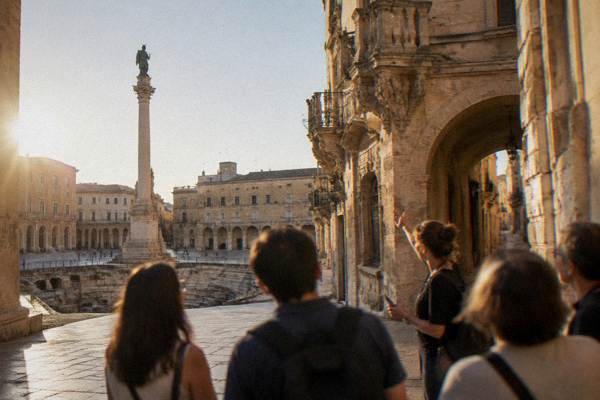
Porta Napoli: The Triumphal Arch And The Obelisk
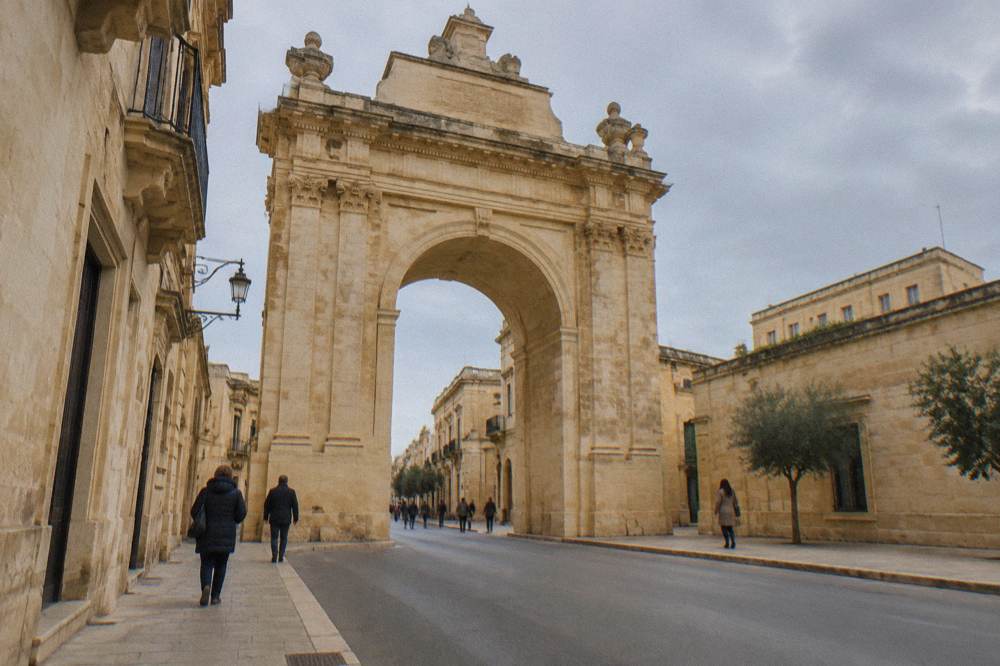
Porta Napoli is the monumental western gate of Lecce, in Puglia, southern Italy: a triumphal arch carved from pietra leccese, standing in open public space a short walk from the Villa Comunale and the baroque old town.
Short answer
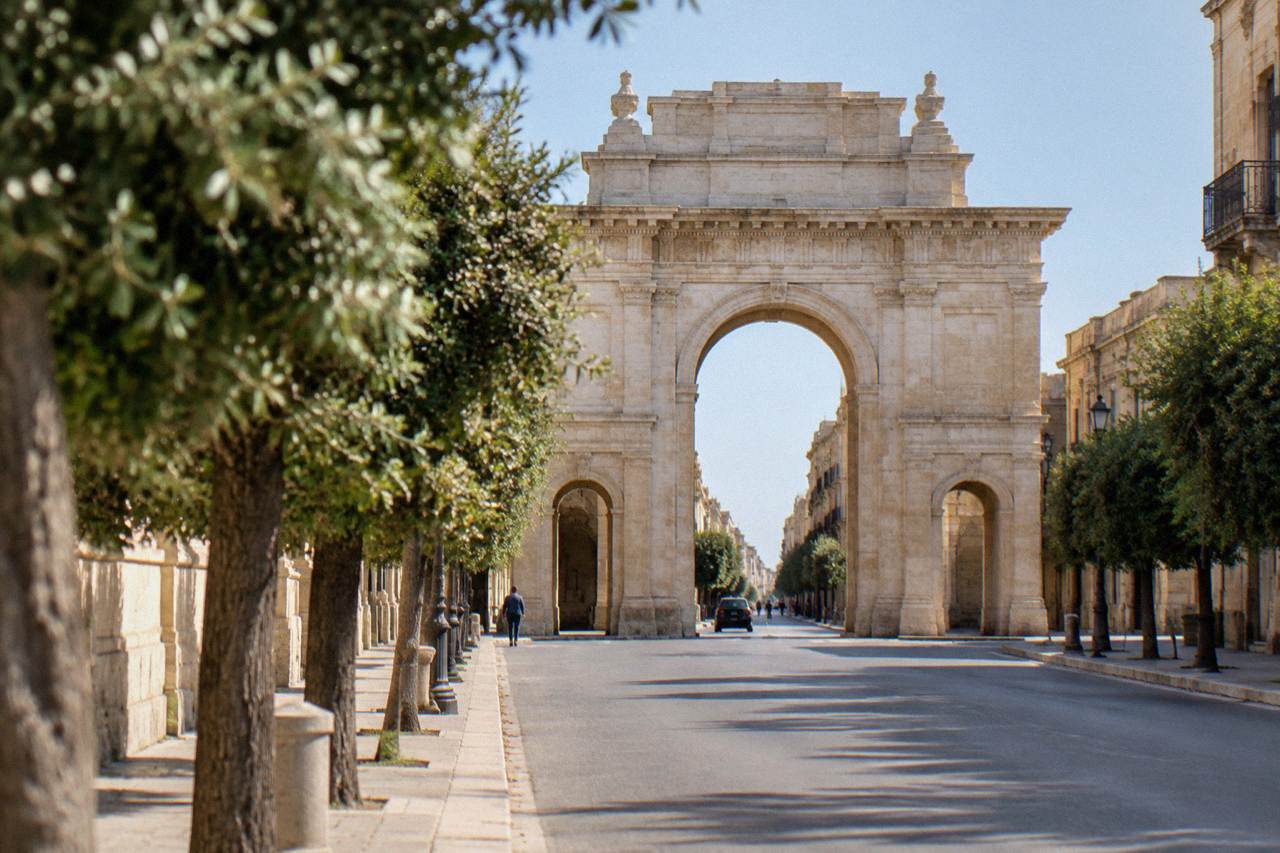
Porta Napoli is a free, always-visible triumphal arch gate in Lecce, carved from local pietra leccese limestone at the western edge of the centro storico, honoring Emperor Charles V. No ticket, no hours: it is open public space, and it sits inside the ZTL, where the gate itself is always closed to traffic.
Porta Napoli is the monumental western gateway of Lecce, the baroque capital of Salento in Puglia, southern Italy. It is a triumphal arch carved from pietra leccese, the honey-coloured Miocene limestone that gives the whole old town its colour, and it stands in open public space at the head of the street that leads into the centro storico. Unlike the ticketed churches on the LeccEcclesiae circuit or the guided-tour-only interior of Castello Carlo V, this is a sight with no queue, no counter and no opening hours: the gate belongs to the street. This page on Lecce Travel Guide sets out what the arch is, what the sources say about it, and how to fold it into a walk through the rest of the city.
What Is Porta Napoli In Lecce?
Porta Napoli is a triumphal arch city gate in Lecce, the baroque capital of Salento in southern Italy, built to honour Emperor Charles V, after whom the city's castle is also named. It is carved from pietra leccese, the soft local limestone that hardens on exposure, and it marks the western entrance to the old town. The gate takes its name from the road it faces: the route towards Naples, which in the era of the Spanish viceroys was the capital of the kingdom this city belonged to. Gates named for cities, rather than saints or patrons, are a common feature of southern Italian town planning from that period, and this one survives as the most monumental of Lecce's remaining gates.
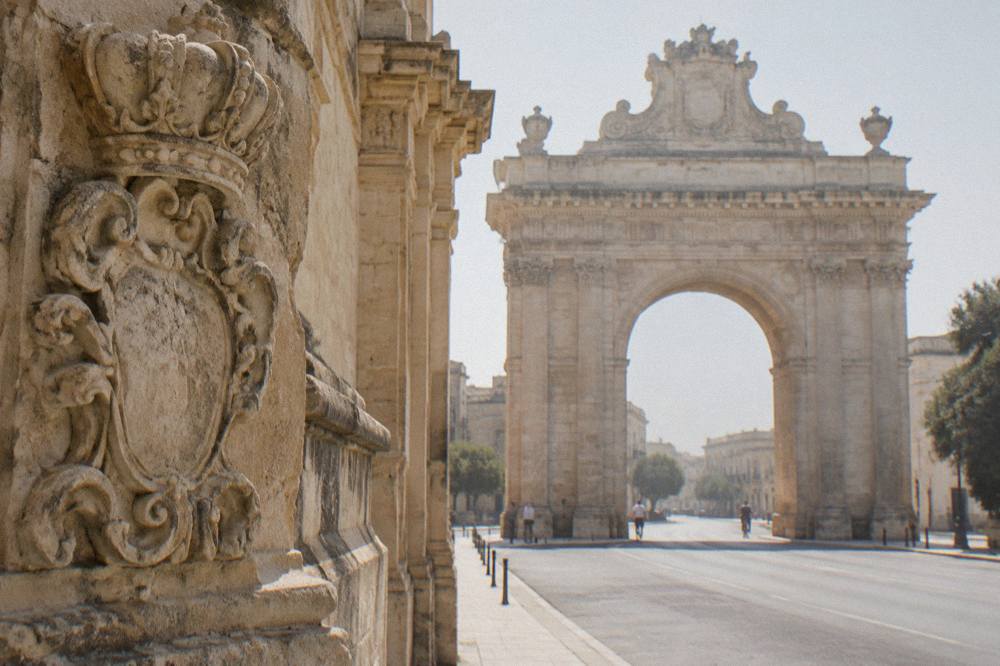
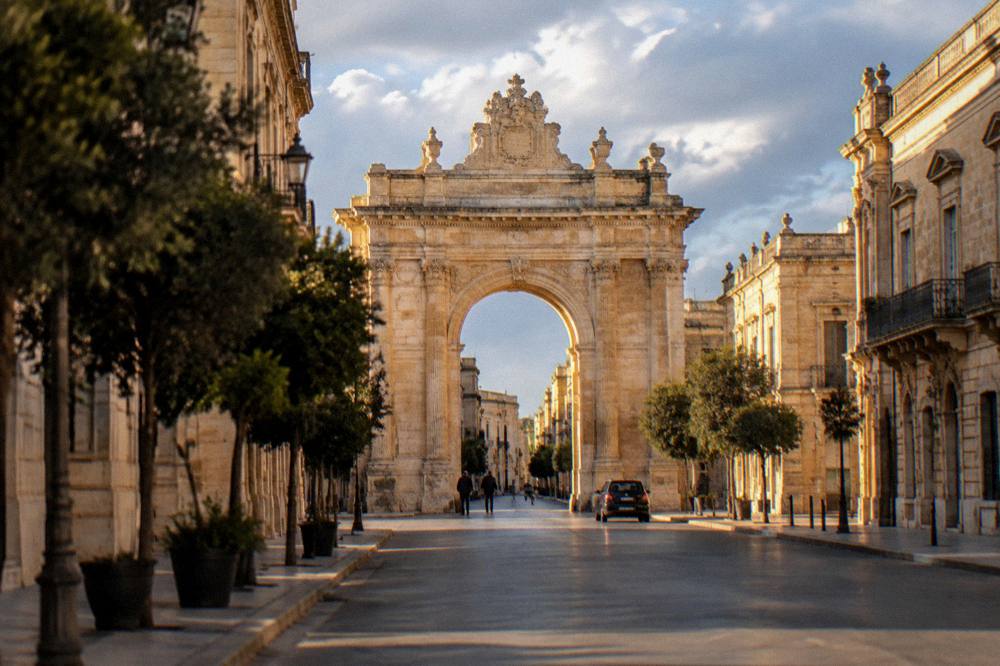
The arch is a piece of display architecture rather than a defensive work in the medieval sense. A triumphal arch says something about the power that funded it, and the iconography here, with its martial trophies and imperial references, does exactly that job. The stone itself deserves attention. Pietra leccese is a calcarenite, soft and workable when first quarried, which is why Lecce's facades carry such deep carving, and it hardens with exposure to air. That single property explains both the exuberance of Lecce Baroque and the warm, honeyed tone that photographs so well in the low light of late afternoon.
For a visitor, the practical point is this: Porta Napoli is one of the few major monuments in Lecce that costs nothing and never closes. The sources used for this site list it, together with the Villa Comunale and Piazza Sant'Oronzo, among the open public spaces of the city, with free exterior access and no ticket information because none is needed. You walk up, you look, you photograph, and you carry on into the old town, where the paid sights begin.
How Does Porta Napoli Compare With Lecce's Other Old Gates?
Lecce preserves more than one historic gate, and Porta Napoli is the most monumental of them, while Porta Rudiae, on the city's eastern side, is the other survivor a visitor can easily reach on foot. Both are free to view from the street, both are carved in pietra leccese, and neither has a ticket, an entrance or set hours. The comparison matters for planning because the two gates bracket the old town on roughly opposite sides, and a walk from one towards the other passes through the heart of the baroque centre. The detailed look at the eastern gate is covered in the guide to Porta Rudiae and its district.
Gates are also useful for orientation in a city whose street plan still follows its medieval perimeter. The centro storico inside the gates is compact and walkable, and the gates themselves, with Porta Napoli closed to through traffic at all times under the ZTL rules, act as fixed landmarks. Anyone exploring the centro storico area tends to navigate by them, by Piazza Sant'Oronzo and by the Duomo, rather than by street names.
| Lecce gate or landmark | Side of the old town | Access today |
|---|---|---|
| Porta Napoli | West | Open public space, free, no hours |
| Porta Rudiae | East | Open public space, free, no hours |
| Piazza Sant'Oronzo | Centre | Open public space, free |
| Villa Comunale | West, near Porta Napoli | Public gardens, free |
| Castello Carlo V | South-west of centre | Courtyard free, interior by paid guided tour |
A walk built around the gates makes a natural first circuit of the city, and it is exactly the kind of route a guided introduction covers. The historic center walking tour is this site's featured walk for that circuit.
What Can You See At Porta Napoli Today?
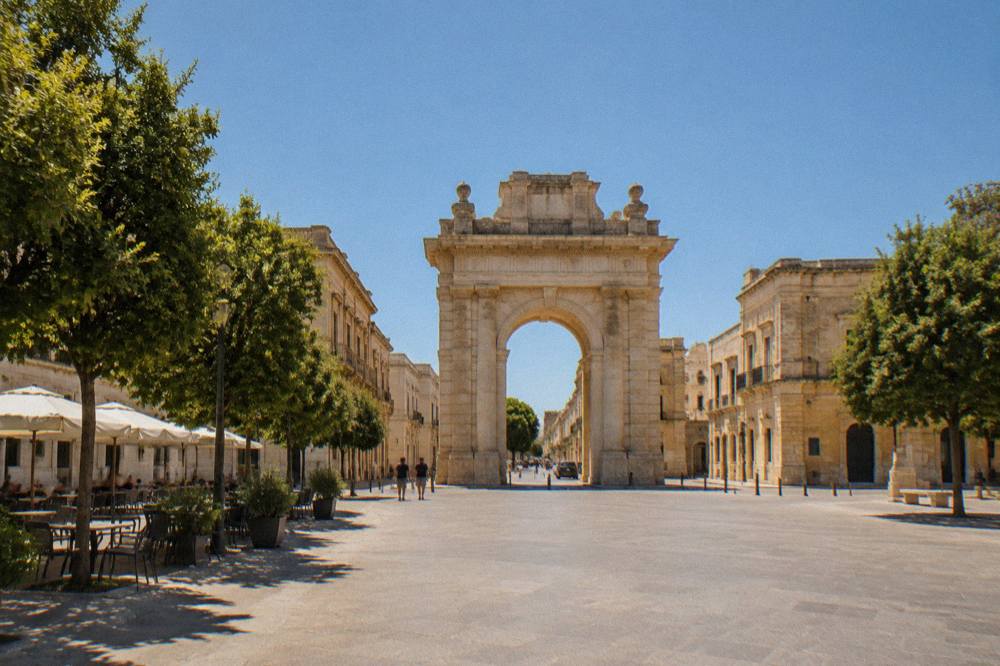
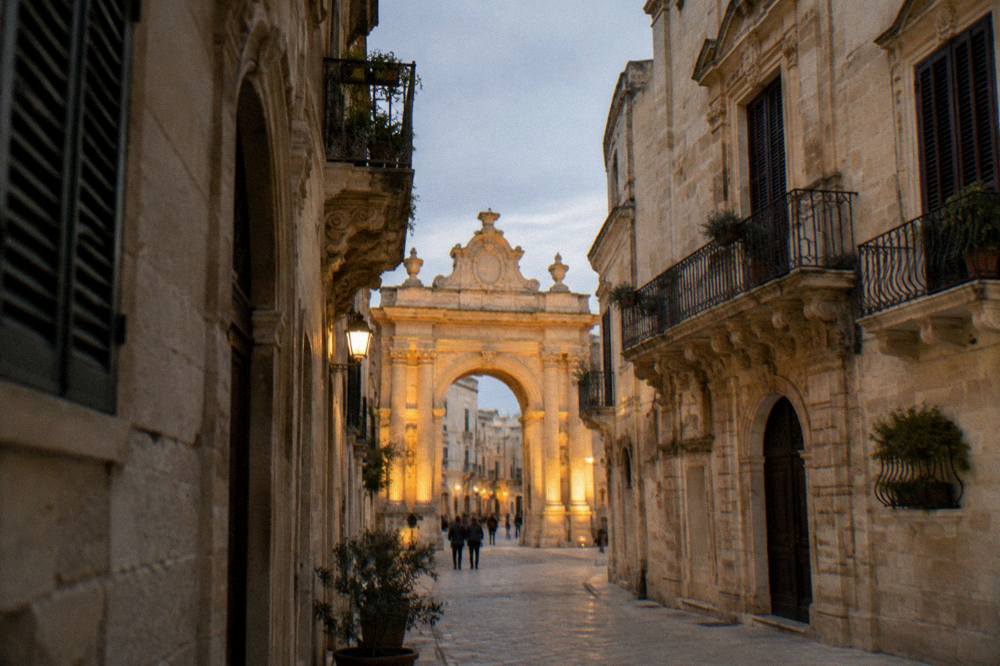
What you see at Porta Napoli today is the full arch as street architecture: three openings framed by pietra leccese carving, martial and heraldic ornament above the central passage, and the gate standing flush with the modern street rather than behind barriers. There is no interior to visit, no museum desk and no roped-off zone. The gate is integrated into the city around it, with traffic routed elsewhere under the ZTL, which is what makes photographs from the middle of the road possible in the quiet hours of the morning.
The detailing rewards a slow look. Like the facades of the Basilica di Santa Croce and the buildings around Piazza del Duomo, the carving here shows off the workability of the local stone: deep-cut ornament, animated figures and armour trophies that would be far harder to execute in a harder limestone. The same quality is why the city's artisans could later develop cartapesta, the papier mache craft, as a cheaper way of imitating stone carving, a story told in the Castello's own Museo della Cartapesta.
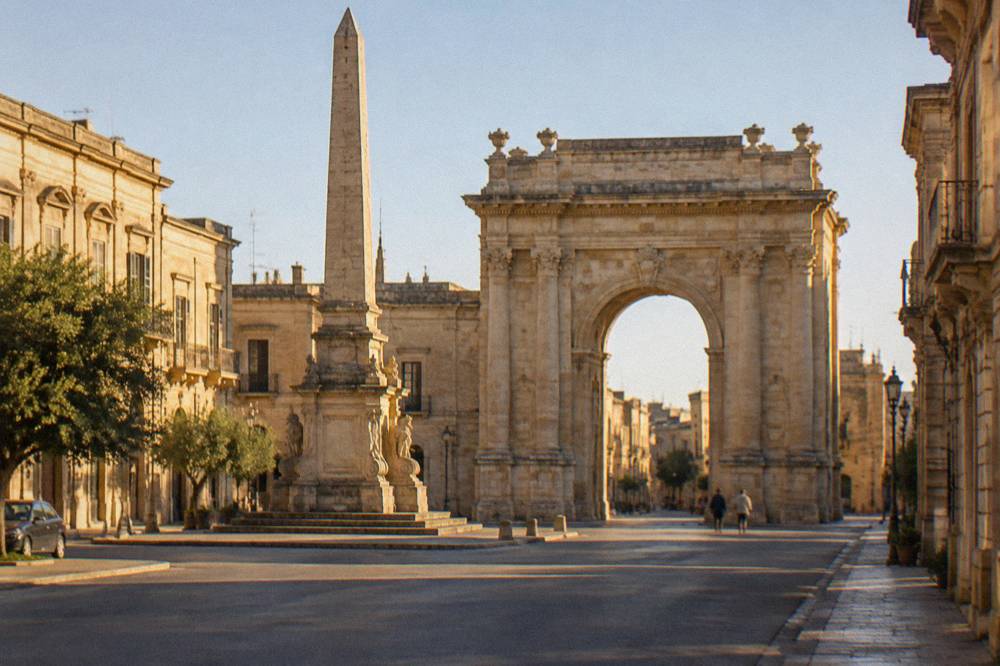
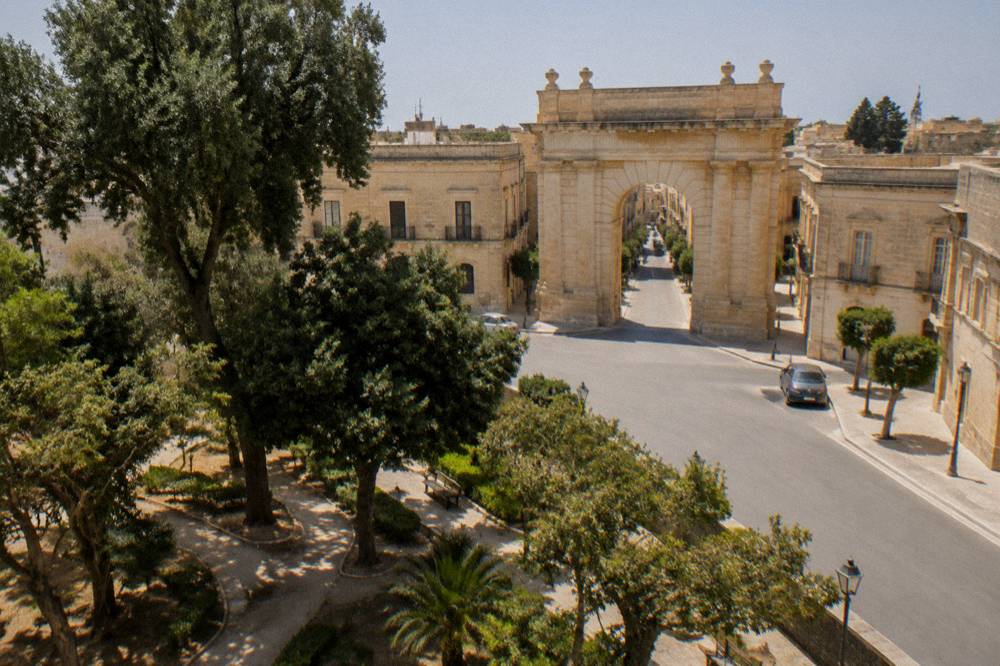
Around the gate, the foreground has its own interest. The obelisk that gives this page its title stands in the square outside the arch, and the gardens of the Villa Comunale begin a short walk away, towards Piazza Mazzini. The result is a corner of Lecce that mixes imperial monument, public greenery and ordinary city life within a couple of hundred metres, all of it free to wander.
Where Is Porta Napoli, And Can You Drive To It?
Porta Napoli stands at the western edge of Lecce's historic centre, at the boundary of the ZTL, the camera-policed limited traffic zone, and the gate itself is reported as always closed to vehicular traffic. Driving through or beyond it triggers camera fines reported between 83 and 332 euro, so arrival by car means parking outside the zone and walking in. The ZTL rules, as reported by the municipality's ordinances, restrict the historic centre on weekdays in the early afternoon and overnight windows, on Sundays and holidays around the clock, and at Porta Napoli specifically at all times. Hours are reported rather than guaranteed, and the standing advice is to ask your accommodation about registering a plate if any driving is involved.
For drivers, the practical plan is a peripheral car park followed by a walk. Park Liberty, an underground car park with 466 spaces near the centre, is one option reported in local coverage, and the SGM blue-zone street parking around the edge of the centre is another, tariffed by hour. The gate, the obelisk and the gardens are then all within a short flat walk.
| Arrival method | Notes for reaching Porta Napoli |
|---|---|
| On foot from the centre | Flat walk through the centro storico, no ticket or gate |
| Car, parked outside the ZTL | Park Liberty (466 spaces) or SGM blue zones, then walk in |
| City bus | SGM network serves the centre; single 60-minute ticket about 1.20 euro |
| Driving through the gate | Not possible: Porta Napoli reported always closed to traffic, fines 83 to 332 euro |
Public transport into Lecce arrives at the train station, south-east of the old town, and the walk from there to the gate crosses the whole centro storico, passing Piazza Sant'Oronzo and the amphitheatre on the way. The full arrival picture, including the airport bus from Brindisi, is covered in the guide to getting to and around Lecce.
Is Porta Napoli Free To Visit?
Yes, Porta Napoli is free to visit, with no ticket, no desk and no opening hours, because it is open public space: the sources for this site list it alongside the Villa Comunale and Piazza Sant'Oronzo as a sight with free exterior access. The contrast with the rest of Lecce's monument stock is worth understanding before you plan a budget. Several of the city's church interiors sit behind the LeccEcclesiae combined ticket, the Castello Carlo V interior is a paid guided tour, and museums such as MUST and Museo Faggiano charge their own admissions. The gate, the obelisk, the gardens and the exterior facades cost nothing.
That makes the western corner of the old town the natural free zone of a Lecce day. A circuit that starts at Porta Napoli, crosses the Villa Comunale, continues to Piazza Sant'Oronzo to see the Roman Amphitheatre from above, and ends in front of the Basilica di Santa Croce's facade takes in the city's display architecture without a single ticket, and it fits comfortably inside the plan described in Lecce in one day.
| Sight in Lecce | Admission |
|---|---|
| Porta Napoli and the obelisk | Free, open public space |
| Villa Comunale gardens | Free |
| Piazza Sant'Oronzo and amphitheatre view from above | Free |
| Church facades, including Santa Croce exterior | Free |
| LeccEcclesiae church circuit (Duomo, crypt, Santa Croce interior and more) | Standard ticket 11 euro, valid 15 days, under 12 free |
| Museo Faggiano | 5 euro full |
| Castello Carlo V | Courtyard free, guided tour 10 euro full |
The LeccEcclesiae prices above come from the ticket body's own published tariff, and the museum and castle prices from their own pages. Prices change: check each operator's current listing before you go.
What Is Close To Porta Napoli In Lecce?
Close to Porta Napoli are the Villa Comunale public gardens, Piazza Mazzini, the Archivo and court quarter, and, walking east into the old town, Palazzo dei Celestini in Piazza Sant'Oronzo, the Roman Amphitheatre and the baroque churches of the centre, all within a compact walk. The gate sits at the start of the axis that runs into the heart of the city, so nothing between it and the Duomo is more than a stroll apart. This flatness and density are why Lecce works so well as a walking city.
The immediate neighbours deserve their own stops. The Villa Comunale is the city's public garden, a green pause after the stone of the gate. Moving into the centre, Palazzo dei Celestini, today a government seat, offers courtyard access for free, one of the quieter ways to stand inside a grand Lecce building. Further on, the Museo Faggiano is a house turned archaeology museum, open daily with a 5 euro full ticket, and the Roman Amphitheatre is visible free from its piazza.
The full menu of stops, ticketed and free, is in the site's overview of things to do in Lecce.
When Is The Best Time Of Day To Photograph Porta Napoli?
The best light on Porta Napoli comes in the later part of the afternoon and around sunset, when the low sun warms the honey colour of the pietra leccese, and in the early morning, when the street is quietest and the gate can be photographed without crowds or traffic. Lecce's limestone reads warm at the ends of the day and flat, paler grey under the midday sun, a behaviour common to calcarenite facades everywhere. Because the gate faces a street axis rather than a closed square, the direction of the light changes the photograph more than the hour alone.
Climate shapes the visit too, and the figures below are ERA5 reanalysis, 1991-2020, a modelled grid cell rather than a weather-station record. July and August show mean daily highs of 31.0 and 31.3 C with the lowest monthly rainfall, 15.3 and 18.1 mm, while November carries the highest monthly rainfall total at 93.7 mm. October, the month this page's data reflects, shows a mean high of 21.8 C and 91.3 mm of rain.
| Month | Mean high C | Mean low C | Rain mm |
|---|---|---|---|
| January | 12.4 | 6.7 | 63.1 |
| March | 15.4 | 8.3 | 64.9 |
| May | 23.4 | 14.7 | 39.9 |
| July | 31.0 | 21.7 | 15.3 |
| August | 31.3 | 22.2 | 18.1 |
| October | 21.8 | 15.4 | 91.3 |
| November | 17.3 | 11.7 | 93.7 |
Can You Visit Porta Napoli On A Guided Tour Of Lecce?
Yes, Porta Napoli appears on guided walking tours of Lecce's historic centre, which typically fold the gate into a circuit that continues to Piazza Sant'Oronzo, the Duomo and the Basilica di Santa Croce; the listing for the featured walk on this site covers the historic centre's landmarks, and private baroque-and-underground options also run. A guide adds context the stone cannot give you on its own: the politics behind a triumphal arch, the logic of the ZTL boundary, and the way pietra leccese shaped the whole city. Tip-based walks also run locally, and where one is offered the tip is agreed with the guide directly.
Choosing between going alone and taking a tour is mostly a question of depth. The gate itself needs ten minutes of independent attention. The walk from the gate to the Duomo, taken slowly with someone who can explain it, turns the same stretch into the story of a city. Both approaches work, and the free sights along the axis mean the independent version costs nothing but time.
For readers who want to build the whole day around it, the Lecce walking tour guide sets out the options, from budget intro walks to private tours with underground access.
What Else Should You Know Before You Go?
Before visiting Porta Napoli, know three things: it is inside the camera-policed ZTL and always closed to through traffic, it is free with no hours because it is a street monument, and the nearest paid sights begin a few minutes' walk east into the old town, led by the LeccEcclesiae churches and the Castello Carlo V tour. Dress codes do not apply at the gate itself, but they do at the churches further along the walk: shoulders and knees covered, and tourist visits pause during services, per the ticket body's own visitor information.
Lecce itself rewards the small amount of planning. The city has no commercial airport; Brindisi, about 47.6 km and roughly 43 minutes by road, is the gateway, with an airport bus priced at 6.50 euro one way for the about 40-minute ride, per the operator's own page. The city is a university town with about 20,774 enrolled students, which keeps cafes and evening life lively outside the peak summer weeks. It is not a UNESCO World Heritage Site: "Salento and the Barocco Leccese" sits on Italy's Tentative List, and any claim otherwise should be read with caution.
Common Questions About Porta Napoli In Lecce
Is Porta Napoli in Lecce free?
Yes. It is open public space with no ticket, no desk and no opening hours, listed among Lecce's free sights alongside the Villa Comunale and Piazza Sant'Oronzo.
Can you walk through Porta Napoli?
Yes, on foot. The gate is closed to vehicular traffic at all times under the ZTL rules, which is why the street under and around the arch stays quiet for photographs.
How far is Porta Napoli from Piazza Sant'Oronzo?
The gate stands at the western edge of the historic centre and Piazza Sant'Oronzo at its heart, connected by a short flat walk through the centro storico; the whole old town is compact and pedestrian in scale.
What is the obelisk at Porta Napoli?
The obelisk stands in the square outside the arch and forms part of the same monumental ensemble. Like the gate, it is free to view at any time as street architecture.
Is Porta Napoli part of the LeccEcclesiae ticket?
No. The LeccEcclesiae combined ticket covers the Duomo with its crypt, the Basilica di Santa Croce, San Matteo, Santa Chiara and the Antico Seminario with the sacred art museum. Porta Napoli is not on that circuit and needs no ticket.
When is the best time to visit Porta Napoli?
Early morning for empty streets and late afternoon for warm low light on the pietra leccese. July and August bring the highest mean daily highs of the year, about 31 C per the ERA5 reanalysis, 1991-2020, so shoulder months make for a more comfortable walk.