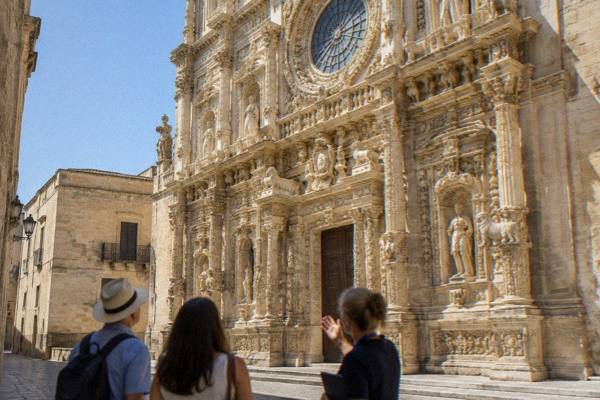
Centro Storico: The Walled Baroque Core
Lecce, in Puglia, southern Italy, keeps its baroque heart inside a compact walled centre of pietra leccese limestone. Here is what to see, what to book, what to eat and how to handle the ZTL.
Short answer
The Lecce historic centre is a compact, walkable baroque core organised around Piazza Sant'Oronzo and Piazza del Duomo. A LeccEcclesiae combined ticket, EUR 11 and valid 15 days, covers five churches; Roman ruins sit under the squares; the ZTL keeps cars out, so park outside and walk in.
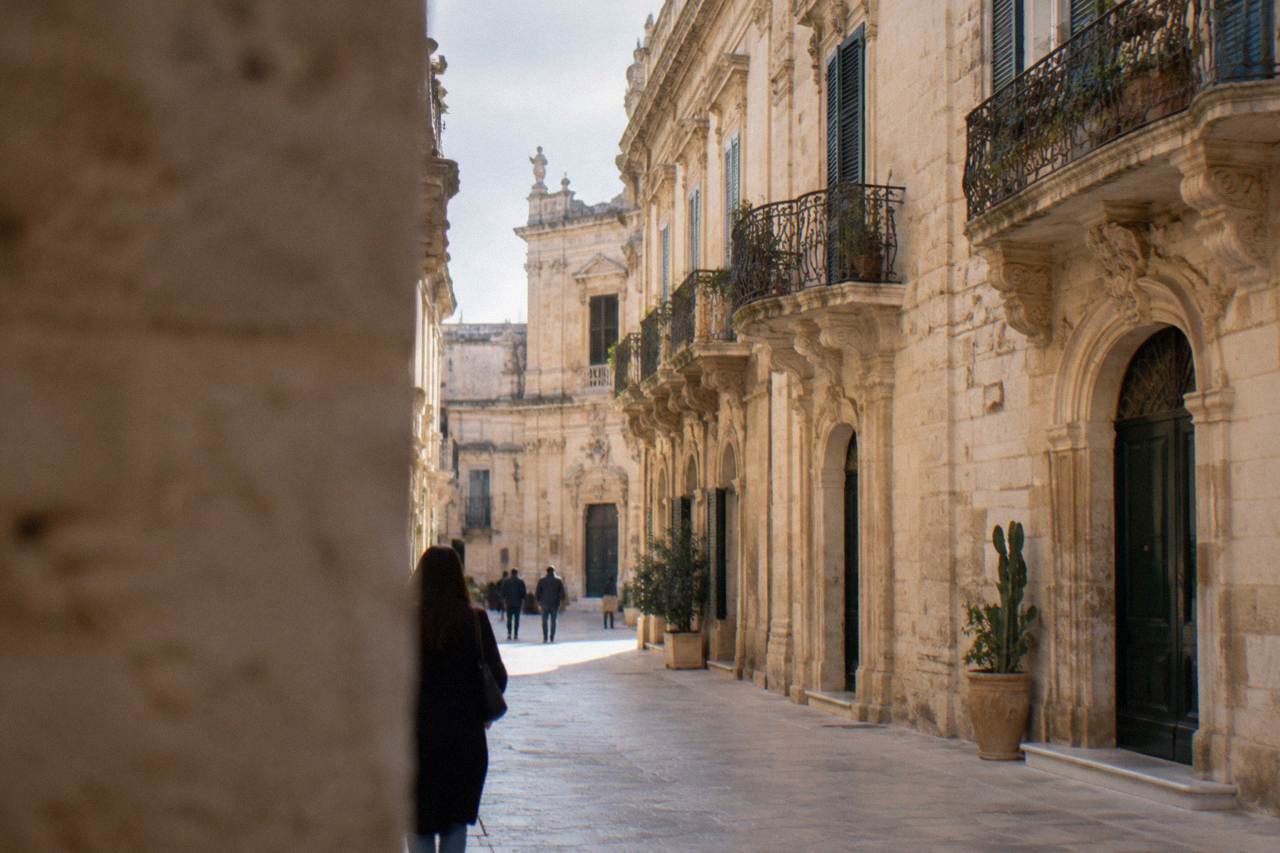
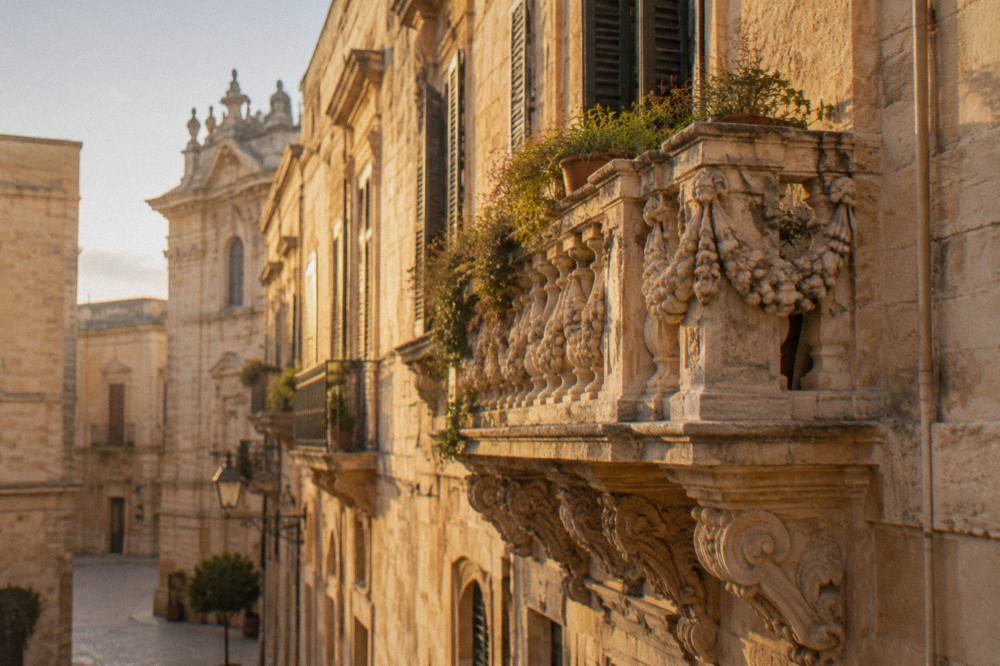
Lecce, the baroque capital of Salento in Puglia, southern Italy, concentrates nearly everything it is famous for inside one small walled core. The historic centre is a dense mesh of lanes carved from pietra leccese, the honey-coloured Miocene limestone that stays soft in the quarry and hardens in the air, which is exactly why its facades carry cherubs, garlands and foliage in such deep relief. The city sits a few kilometres inland, with San Cataldo, the nearest beach, about 13 km away, so this is a stone town rather than a beach town, and the old centre is where the day belongs.
What Is The Lecce Historic Centre?
The Lecce historic centre is the walled baroque core of the Salento capital: a tight web of lanes and small squares built from honey-coloured pietra leccese limestone, entered through gates such as Porta Napoli and organised around Piazza Sant'Oronzo and Piazza del Duomo. The style that fills it, Lecce Baroque, is the city's signature, and the stone that carries it is soft when quarried and hardens on exposure.
The centre is small enough that a visitor oriented in one morning rarely needs a map again. Streets run into each other at odd angles, a lane that looks like a service alley opens onto a full baroque facade, and the whole thing is pedestrian in scale. Lecce is often called the Florence of the South, a nickname whose origin is contested between two writers, so the phrase survives here only as "often called", with no name attached. The comparison is really about density of ornament: where Florence worked in stone and fresco, Lecce worked in a soft limestone that let sculptors undercut leaves and drapery almost like wood.
The city behind the walls is real, not a museum set. Lecce counts 94,387 residents by the citypopulation.de compilation of the ISTAT estimate for 1 January 2026, and about 20,774 students enrolled at the Università del Salento, so the old town mixes tourist traffic with ordinary commerce, university life and a working prefecture in the Palazzo dei Celestini. One correction worth carrying: Lecce is not inscribed on the UNESCO World Heritage List. "Salento and the Barocco Leccese" sits on Italy's Tentative List, submitted in 2006, which is a different status and should not be repeated as "UNESCO-listed". The rest of this Lecce Travel Guide covers the old town corner by corner, from the Porta Napoli guide to the beaches beyond the walls.
The landmarks sort themselves into a short list, and every one of them is either free or covered by one ticket. The table below is the orientation map in words.
| Landmark | What it is | Entry |
|---|---|---|
| Piazza Sant'Oronzo | Civic square over the sunken Roman Amphitheatre | Free from street level |
| Piazza del Duomo | Enclosed cathedral square | LeccEcclesiae ticket |
| Basilica di Santa Croce | The signature church of the Lecce Baroque style | LeccEcclesiae ticket |
| Castello Carlo V | Angevin castle; courtyard free, interior by guided tour | EUR 10 full tour ticket |
| Porta Napoli | Ceremonial city gate | Free |
| Villa Comunale | Public garden on the western edge | Free |
For the style itself, the deep dive is the Lecce Baroque style guide, which traces how one soft stone produced a whole decorative language.
What Are The Main Squares Of The Lecce Historic Centre?
Three squares carry the old town: Piazza Sant'Oronzo, the civic heart, where the sunken Roman Amphitheatre is visible free from street level; Piazza del Duomo, an enclosed stage holding the cathedral, its bell tower and the neighbouring Basilica di Santa Croce; and Piazza Mazzini, the commercial spine of the centre. Each one sits a few minutes' walk from the others, so the whole circuit works on foot.
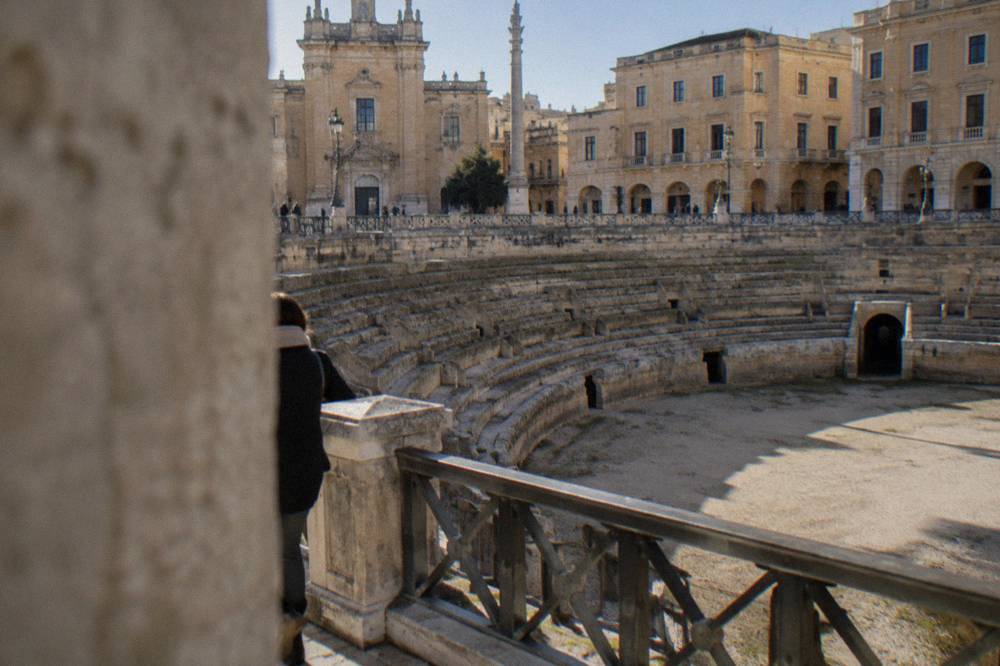
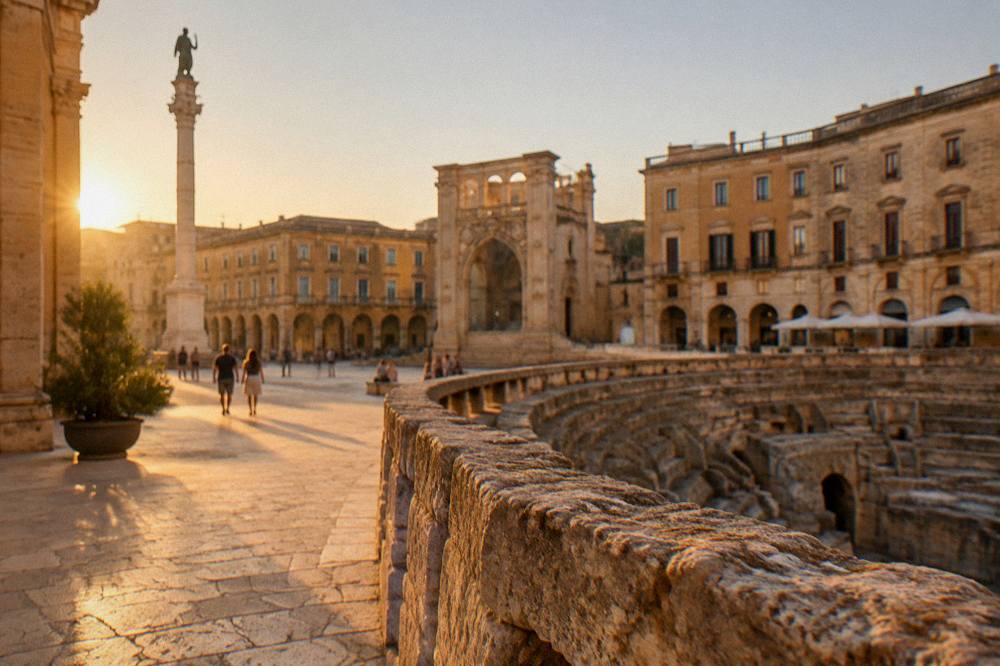
Piazza Sant'Oronzo is where the city proves its own age. The amphitheatre sits exposed below the paving, a partial ellipse you look down into from the square itself, and visits inside run on the museum schedule described below. The square is also where Caffe Alvino keeps its corner, a historic bar with roots traced to about 1880 by the Corriere Salentino's account of the Catamo family's business, and it is the natural first stop of a morning. The full picture of the square, the amphitheatre viewpoint and the surrounding palazzi is in the Piazza Sant'Oronzo guide.
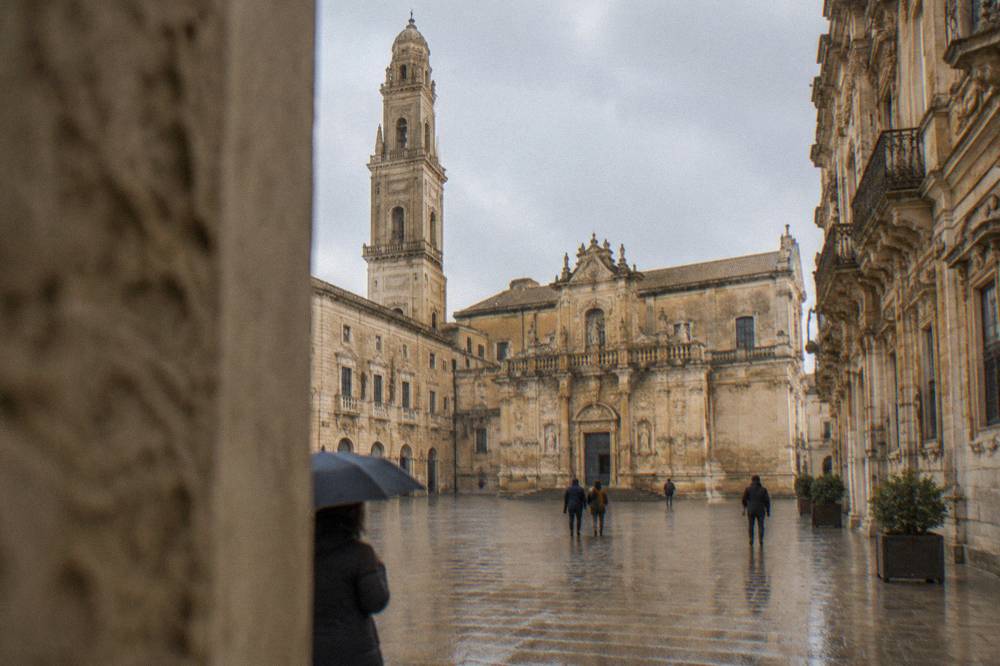
Piazza del Duomo is the opposite temperament: a closed theatrical space, entered through a gap rather than seen from a distance, with the cathedral set back so the facade reads as a stage flat. The bell tower belongs to the same composition, and the combined ticket that unlocks all of it is covered in the next section. Everything about the square, its closes and the seminary cloister is in the Piazza del Duomo guide.
Piazza Mazzini is the everyday one, the commercial spine where the market and shop life of the centre actually happen, and it is the square where the old town stops performing for visitors. It is worth crossing for the contrast alone, and the Piazza Mazzini area guide covers what sits around it.
| Square | Role in the centre | What to look for |
|---|---|---|
| Piazza Sant'Oronzo | Civic heart | Sunken amphitheatre, historic cafes |
| Piazza del Duomo | Religious stage | Cathedral, crypt, bell tower, seminary |
| Piazza Mazzini | Commercial spine | Market life, ordinary shopfronts |
Which Churches Can You Visit Inside The Lecce Historic Centre?
The LeccEcclesiae combined ticket is the practical answer: EUR 11 full, EUR 5 reduced for ages 12 to 17, EUR 24 for a family of two adults with minors aged 12 to 17, valid 15 days. It covers the Duomo with its crypt, the Basilica di Santa Croce, San Matteo, Santa Chiara and the Antico Seminario with the MuDAS museum. Children under 12 enter free.
The ticket is sold at Piazza Duomo 5 and at the Basilica di Santa Croce, and the chieselecce.it information page sets the hours for all the sites together: daily 9:00 to 21:00 in the April to September summer season, 9:00 to 18:00 across the October to March winter season, with last entry 15 minutes before closing. The standard ticket does not include the bell tower. The full ticket, branded "Up!", adds the campanile and costs EUR 21 full, EUR 13 reduced or EUR 48 for a family, with ascents run about every 20 minutes per the listing. Diocese residents enter free with ID, and access is limited during services, when the churches revert to their primary function.
Two practical rules from the same source page shape every visit. Shoulders and knees must be covered, which matters in a July heat the ERA5 reanalysis for Lecce puts at a mean daily high of 31.0 C for the 1991 to 2020 period. And tourist visits pause during religious services, so a Sunday morning arrival means checking the service times before planning the crypt and the bell tower. Beyond the combined ticket, a Lecce Artwork City Pass is listed at EUR 29 for seven days, bundling the LeccEcclesiae sites, the bell tower and extras such as the Palazzo Vernazza phygital experience.
| Ticket | Full | Reduced, ages 12 to 17 | Family, 2 adults plus minors | Validity |
|---|---|---|---|---|
| LeccEcclesiae standard | EUR 11 | EUR 5 | EUR 24 | 15 days |
| LeccEcclesiae with bell tower | EUR 21 | EUR 13 | EUR 48 | 15 days |
The churches reward a guide, because the ornament is argumentative rather than decorative, and a walk that explains the vocabulary of the style changes what the facades say. Three tours below cover the old town from different angles: the baroque architecture and underground rooms walk, a papier-mache class that teaches the craft the churches inspired, and a street food and sightseeing tour that mixes the two registers.
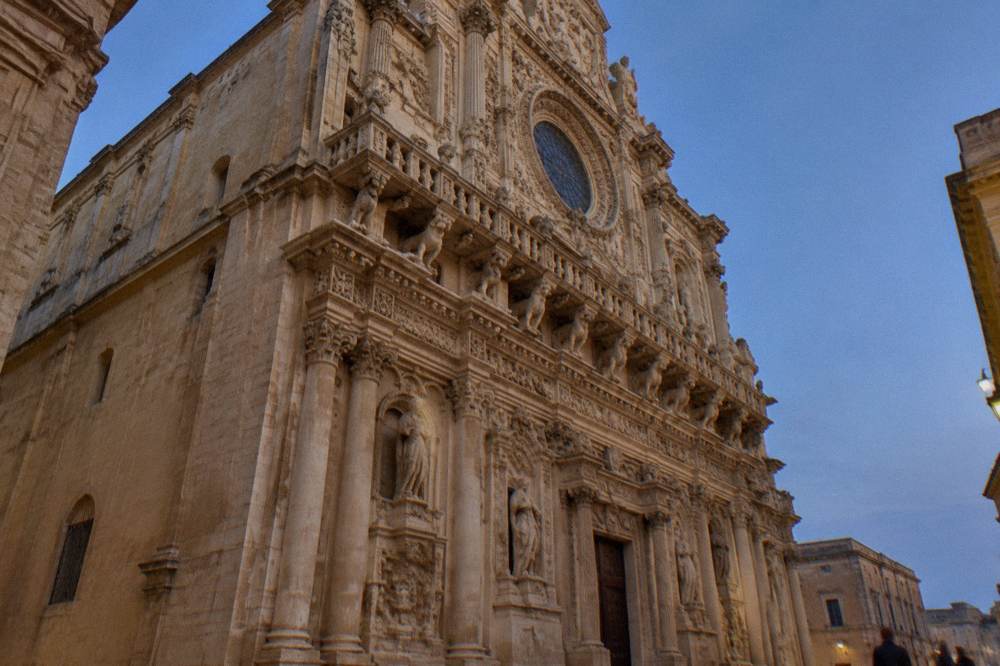
The dedicated page for the signature church, with its facade, its rose window and its place in the style's history, is the Basilica di Santa Croce guide.
What Lies Beneath The Lecce Historic Centre?
Four sites sit under or beside the old town: the Roman Amphitheatre in Piazza Sant'Oronzo (EUR 5 full, EUR 2 reduced, winter hours 10:00 to 17:00 Tuesday to Sunday, closed Monday), the Roman Theatre and its museum (mornings Monday to Saturday, about EUR 3), the Museo Faggiano (daily 9:30 to 20:00, EUR 5, ages 8 to 16 EUR 3) and the Rudiae archaeological park on the edge of the city.
Lecce is a Roman city with the Romans still in residence. The amphitheatre in Piazza Sant'Oronzo is the visible one, and it reopened after a 1,500,000 euro restoration under the PNRR programme's Measure 1.2, with a new accessible entrance and ramp added in the works the museipuglia.cultura.gov.it pages document. Winter visiting runs Tuesday to Sunday, 10:00 to 17:00 with last entry at 16:30; the summer season splits the day, 10:00 to 13:00 and 17:00 to 21:00. The Roman Amphitheatre guide covers the site itself.
The Roman Theatre hides a street away, and its small museum, run by the Fondazione Memmo, keeps morning hours Monday to Saturday, 9:30 to 13:00, with afternoons by reservation, at about EUR 3 per the comune's museum listing. Details are in the Roman Theatre guide. The Museo Faggiano is the famous one: a palazzo whose renovation kept turning up layers, from a Messapian tomb to a Roman road to a Templar grain store, open every day 9:30 to 20:00 at EUR 5, with children aged 8 to 16 at EUR 3 and under 8 free. The story is told properly in the Museo Faggiano guide.
Rudiae, the Messapian-and-Roman park on the city's edge, runs guided visits at weekends with weekday access by booking, EUR 5 full and EUR 4 reduced, free under 7. And the Jewish layer has its own map: the Giudecca quarter, whose history the Museo Ebraico tells on guided visits only, at EUR 5 full and EUR 4 reduced per the museionline listing. The quarter's context is in the Giudecca quarter guide.
| Underground site | Hours | Ticket |
|---|---|---|
| Roman Amphitheatre | Tue to Sun, winter 10:00 to 17:00; closed Mon | EUR 5 full, EUR 2 reduced |
| Museo del Teatro Romano | Mon to Sat 9:30 to 13:00, afternoons on request | About EUR 3 |
| Museo Faggiano | Daily 9:30 to 20:00 | EUR 5 full, EUR 3 ages 8 to 16 |
| Rudiae archaeological park | Weekend guided visits, weekdays by booking | EUR 5 full, EUR 4 reduced, under 7 free |
The underground layer is where a guide earns its fee, because the rooms explain themselves poorly and the stratigraphy is the whole story. The site's own featured walk covers the baroque architecture above ground and the rooms below it in one circuit, and it is the tour this page recommends for a first visit.
The full description and current price sit on the baroque and underground walk page, and you can also Check availability directly with the operator's live listing.
One more underground option belongs on the same shelf: a walking tour of Lecce that includes the basement of the ancient synagogue, which threads the Roman layers and the Jewish quarter into a single route. Whichever way you go, book the underground rooms early in a trip, because they recalibrate everything you look at afterwards.
What Crafts And Souvenirs Is The Lecce Historic Centre Known For?
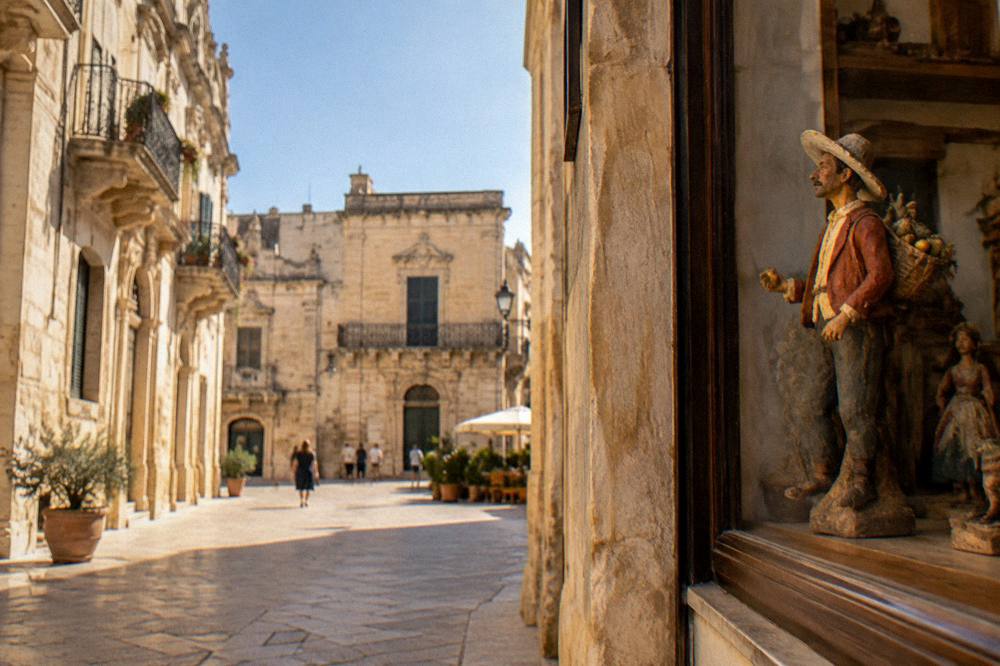
Cartapesta, the Lecce papier-mache tradition, is the signature craft of the historic centre: religious figures and nativity scenes shaped from paper, glue and moulds, sold from workshops in the old lanes and taught in practical classes. The Castello Carlo V keeps a Museo della Cartapesta inside its walls, included in the castle's guided tour. Workshop hours and class times vary, so confirm details when you book.
The craft exists because of the stone. The infolecce accounts of cartapesta describe a tradition that grew up around religious statuary, producing figures light enough to carry in procession, and the workshops of the historic centre still sell madonne, saints and presepi finished in oil paint. The connection to the architecture is direct: the same hands that modelled pulp for altarpieces were working in a city where the stone itself behaved like a modelling material. The Castello Carlo V, whose interior is visitable by guided tour only, EUR 10 full and EUR 6 reduced with the courtyard free, houses the Museo della Cartapesta as part of the tour, per the castle's own orari page. The castle's context is in the Castello Carlo V guide.
Taking a class rather than buying a finished piece is the deeper souvenir, and one practical session in the old town teaches the technique with a master. It is the second of the three picks on this page.
What the class covers, and its current price and availability, are on the papier-mache class page; you can also Check availability with the operator. Tip-based walks also run locally in the old town; if you take one, confirm the arrangement directly with the guide.
Where Do You Eat And Drink Inside The Lecce Historic Centre?
Order by the calendar of the city: pasticciotto, the custard-filled shortcrust tart that Pasticceria Ascalone in Galatina claims dates to 1745, a claim historians dispute; rustico leccese, savoury puff pastry filled with bechamel, tomato and cheese; and caffe in ghiaccio con latte di mandorla, the iced espresso with almond milk credited to Antonio Quarta of Quarta Caffe. Natale, a family pasticceria run since 1978, lists a Santo Pasticciotto at EUR 2.20.
The pasticciotto story needs its caveat attached. The 1745 date is Pasticceria Ascalone's own claim, the shop stands in Galatina rather than Lecce, and historians dispute the invention story, so it is presented here only as a claim by the shop. The tart itself needs no caveat: it is the morning currency of the old town, and Pasticceria Natale, family-run since 1978 per its own site, keeps the tradition in the centre. The rustico is the savoury counterpart, puff pastry around bechamel, mozzarella and tomato, with origins that the food writers of the region themselves describe as uncertain.
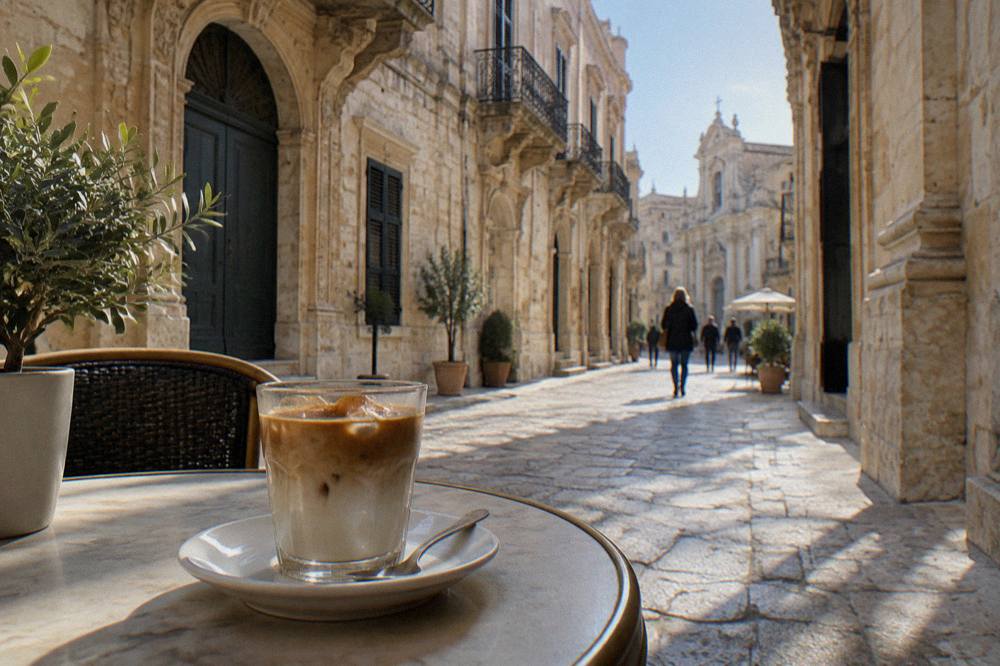
The caffe in ghiaccio con latte di mandorla is the one drink that belongs to Lecce specifically: espresso poured over ice with almond milk, credited to Antonio Quarta of Quarta Caffe, whose Bar Avio opened around 1978. Caffe Alvino, on Piazza Sant'Oronzo with roots traced to about 1880, is the other historic address, and the full run of the city's historic bars is in the Lecce cafes guide.
| Speciality | What it is | Note |
|---|---|---|
| Pasticciotto | Custard-filled shortcrust tart | 1745 is Ascalone's claim, in Galatina, disputed; Natale lists a Santo Pasticciotto at EUR 2.20 |
| Rustico leccese | Savoury puff pastry, bechamel, tomato, cheese | Origins uncertain |
| Caffe in ghiaccio con latte di mandorla | Iced espresso with almond milk | Credited to Antonio Quarta, Quarta Caffe |
| Cartapesta figures | Papier-mache devotional figures | Sold in historic-centre workshops |
A guided street food walk stitches the specialties to the sights, so the tasting and the architecture arrive together. It is the third pick of the three on this page.
The itinerary and the current from-price are on the street food and sightseeing tour page. Restaurant "best of" lists are outside this page's scope: no venue beyond the historic cafes named above carries a verified recommendation here, so choose by what is in front of you and confirm hours locally.
How Do You Reach The Lecce Historic Centre By Car, And Where Do You Park?
You generally do not drive in: the historic centre is a camera-policed ZTL, reported active on weekdays roughly from 13:00 to 16:30 and again from 20:00 to 10:00, and around the clock on Sundays and holidays, with Porta Napoli closed at all times. Fines run from EUR 83 to EUR 332, with a 30 percent discount if paid within five days. Park outside and walk in, and ask your accommodation to register your plate.
The ZTL hours are reported rather than guaranteed, and the ordinances shift, so the operative rule is simpler than the schedule: assume the cameras are live, park outside the walls, and have your hotel or B&B register your plate if you genuinely need to load or unload inside. The fine range, EUR 83 to EUR 332 with the 30 percent discount for payment within five days, comes from the tolltracker summary of the municipal ordinances. On the practical side, the Park Liberty car park near the centre offers 466 spaces per the LeccePrima report on its opening, and SGM's tariffed blue zones run at about EUR 1.10 per hour in the central bands, with hours typically Monday to Saturday in the daytime and evening windows.
Arriving without a car is straightforward. Lecce has no commercial airport; the gateway is Brindisi (BDS), about 47.6 km and about 43 minutes by road, and the Terravision airport bus to Lecce is listed at EUR 6.50 one way, about 40 minutes. By rail, Lecce connects direct to Brindisi in about 18 to 24 minutes from about EUR 3.40, and to Bari Centrale in about 1 hour 19 minutes to 1 hour 24 minutes on the fastest trains. The SGM city network covers the centre on a 60-minute ticket at about EUR 1.20, or EUR 1.50 bought on board, with a day ticket at about EUR 3.
| Option | Detail | Reported cost |
|---|---|---|
| Terravision bus, Brindisi Airport to Lecce | About 40 minutes | EUR 6.50 one way |
| Train, Brindisi to Lecce | About 18 to 24 minutes, frequent | From about EUR 3.40 |
| SGM city bus, 60-minute ticket | Urban network | About EUR 1.20, EUR 1.50 on board |
| Park Liberty car park | 466 spaces near the centre | About EUR 1.50 per hour, daytime |
| Blue-zone street parking | SGM tariffed zones | About EUR 1.10 per hour |
| ZTL fine | Camera enforced | EUR 83 to EUR 332 |
What Does One Perfect Day In The Lecce Historic Centre Look Like?
Start at Piazza Sant'Oronzo while the morning is cool, look down into the amphitheatre from the square, take the LeccEcclesiae churches before the midday pause, go underground at Museo Faggiano or the Roman Theatre in the afternoon, then join the evening passeggiata back through Piazza del Duomo and finish with a rustico and an iced coffee at a historic cafe. Church visits pause during services, so check the schedule first.
The sequence works because the centre is small and the day is long in summer. The amphitheatre viewpoint costs nothing and orients you immediately. The LeccEcclesiae circuit, EUR 11 and valid 15 days, does not need to be finished in one morning, which is the quiet genius of the ticket: buy it, do the Duomo and Santa Croce, and leave San Matteo and Santa Chiara for another day. Shops in the centre commonly pause in the early afternoon, roughly 13:00 to 16:00, though hours vary by business, so the underground museums, all open through the middle of the day, are the right slot for that window.
| Time | Place | Why it works |
|---|---|---|
| Morning | Piazza Sant'Oronzo, amphitheatre viewpoint | Free, orients the whole centre |
| Late morning | Piazza del Duomo, LeccEcclesiae churches | Beat the services and the midday pause |
| Early afternoon | Museo Faggiano or the Roman Theatre | Open through the riposo hours |
| Late afternoon | Castello Carlo V courtyard, Porta Napoli | Courtyard free, gate on the way out |
| Evening | Passeggiata, Piazza del Duomo | Winter hours run to 18:00 |
| After dark | A historic cafe | Rustico, pasticciotto, caffe in ghiaccio |
For a slower pace or a second day, the one-day Lecce itinerary expands this skeleton, and the full Lecce overview collects everything the city offers beyond the walls. If you would rather hand the day to someone who knows the lanes, the same three walks that run through this page cover the old town from the architectural, craft and food angles respectively.
However you assemble it, the centre rewards slow feet over fast ones. The ornament is cumulative, the underground layers keep revising the timeline, and the ticket that covers five churches stays valid for two weeks.
Common Questions About The Lecce Historic Centre
Is the Lecce historic centre walkable?
Yes. The walled core is compact, organised around Piazza Sant'Oronzo, Piazza del Duomo and Piazza Mazzini, and the squares sit a few minutes' walk from one another. Visitors generally park outside the ZTL and cover the whole centre on foot.
Do I need a ticket for the churches in Lecce?
The LeccEcclesiae combined ticket covers the Duomo with its crypt, the Basilica di Santa Croce, San Matteo, Santa Chiara and the Antico Seminario with MuDAS. It costs EUR 11 full, EUR 5 reduced for ages 12 to 17, EUR 24 for a family, and is valid 15 days. Children under 12 enter free, and the bell tower costs extra on the full ticket.
Can I drive into the Lecce historic centre?
The centre is a camera-policed ZTL, reported active on weekdays roughly 13:00 to 16:30 and 20:00 to 10:00, and around the clock on Sundays and holidays, with Porta Napoli always closed. Fines run from EUR 83 to EUR 332. Ask your accommodation to register your plate if you need access.
Is there a tourist tax in Lecce?
Yes, the imposta di soggiorno is collected by the accommodation. From 1 April 2026 the top reported rate is EUR 5 per person per night in the high season for the top category, with lower rates by category and season. Confirm your exact rate at booking.
Is Lecce a UNESCO World Heritage Site?
No. "Salento and the Barocco Leccese" is on Italy's Tentative List, submitted in 2006, but the city is not inscribed on the World Heritage List. Any guide that says "UNESCO-listed" is wrong.
When are the Lecce churches open?
All LeccEcclesiae sites keep the same hours: daily 9:00 to 21:00 in the April to September summer season, 9:00 to 18:00 from October to March, with last entry 15 minutes before closing. Visits pause during religious services, and shoulders and knees must be covered.
The walled core is the reason the city has its nickname, its ticket and its underground museums all in one place, and one unhurried day inside the walls is the honest minimum for it.