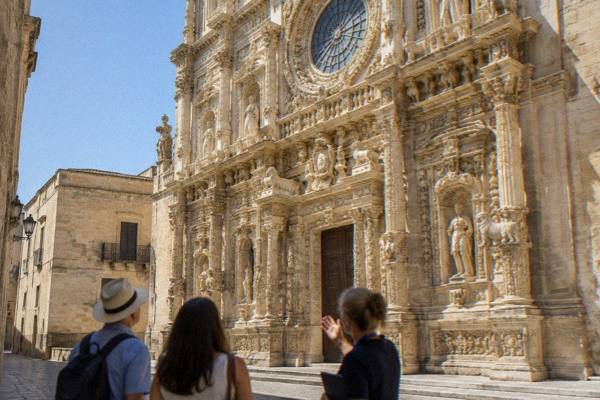
Roman Amphitheatre Of Lecce: What You Can See And Enter
The Roman Amphitheatre sits in a hollow in the middle of Piazza Sant'Oronzo, half-buried beneath the baroque city that grew over it. Here is what is actually visible, what you can enter, what it costs and when it opens, all from the official sources.
Short answer
The Roman Amphitheatre of Lecce in Puglia is a partly excavated Roman arena in Piazza Sant'Oronzo. You can see the surviving arcades free from the square above, and enter the site for 5 euro full, 2 euro reduced, Tuesday to Sunday, closed Monday.
Half of a Roman arena sits in a sunken bowl in the middle of Lecce, the baroque capital of Salento in Puglia, southern Italy, and the baroque city has simply grown around it. The Anfiteatro Romano di Lecce occupies one side of Piazza Sant'Oronzo, the main square, its stone arcades dropping below the modern pavement line so that passers-by look down into it over a railing. The monument is run by the Direzione Regionale Musei Puglia, and after a 1,500,000 euro PNRR restoration, Measure 1.2, it reopened with a new accessible entrance and ramp. This page lays out what the sources say you can see, what it costs to go inside, when it opens, and how the arena differs from the city's other Roman monument, the Teatro Romano. The Lecce Travel Guide desk reports only what the official and cited sources state.
What Is The Roman Amphitheatre Of Lecce?
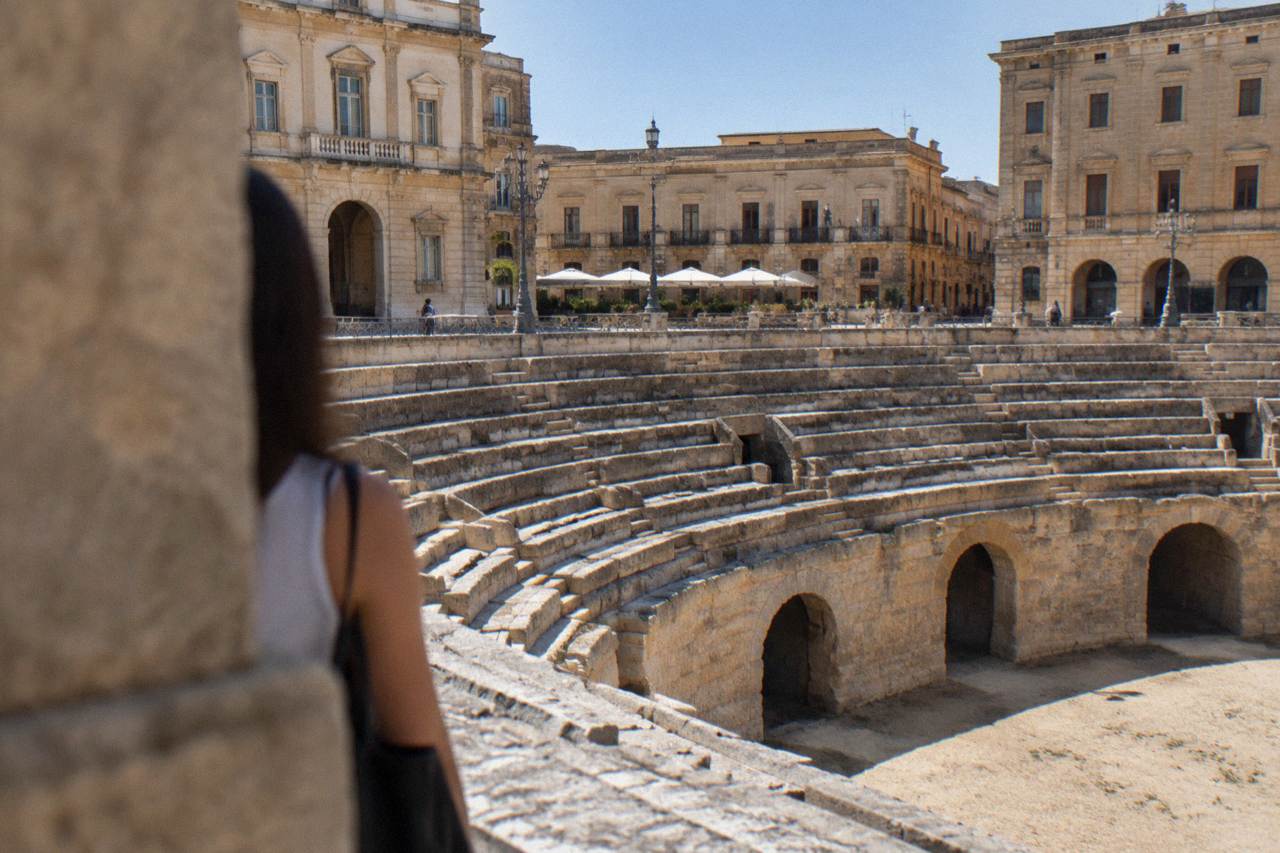
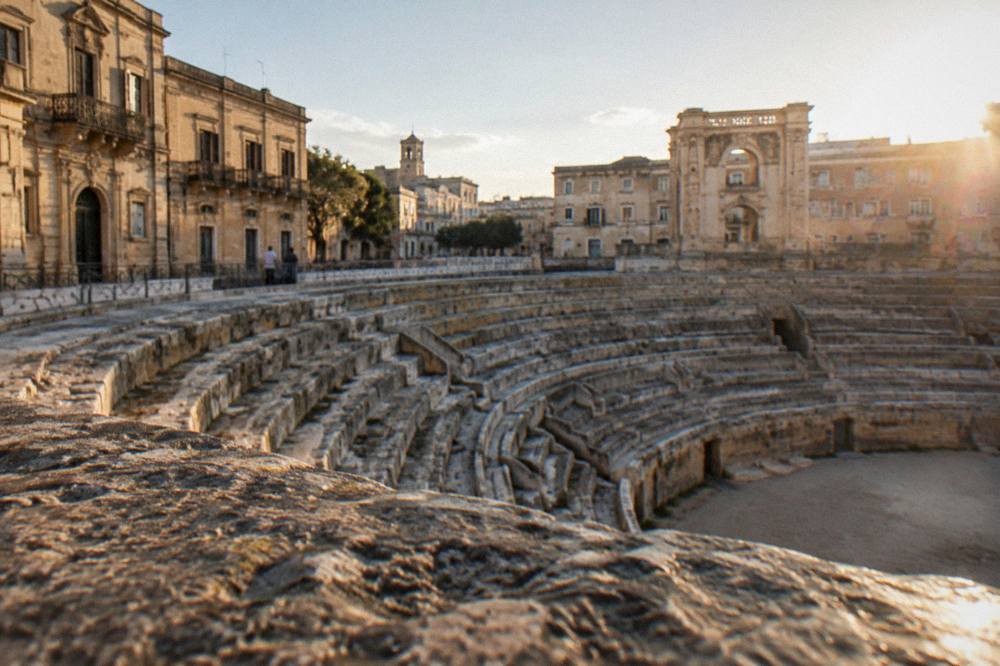
The Roman Amphitheatre of Lecce is a partly excavated Roman arena set in a hollow beside Piazza Sant'Oronzo in Lecce. Roughly half of its original oval lies beneath the square and surrounding buildings, so the visible portion is one end of the cavea with two tiers of arcades, viewed free from street level or by paid entry during opening hours.
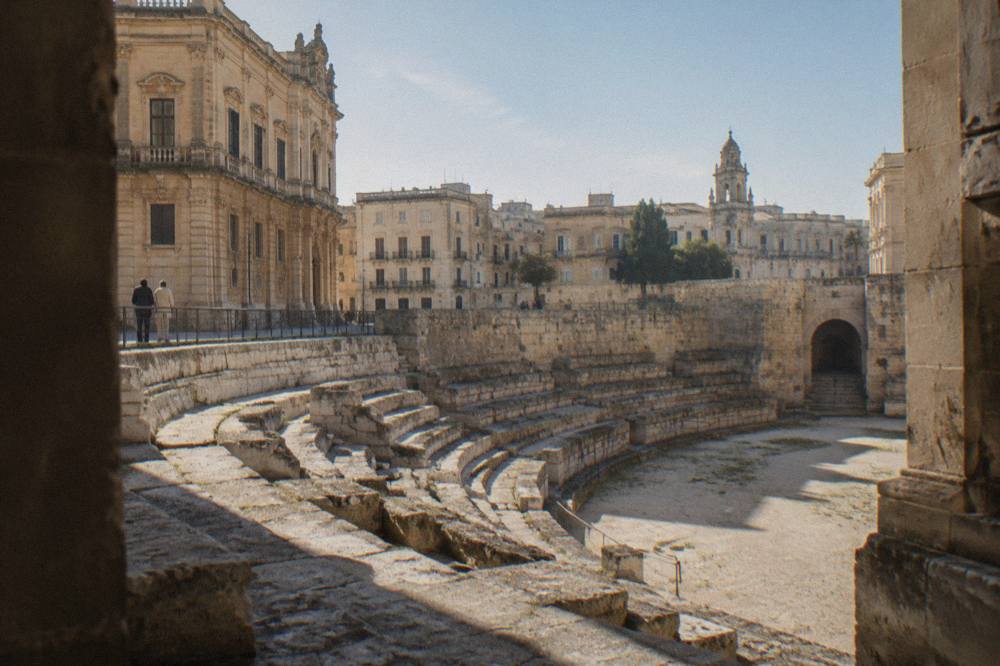
The arena was built into the natural hollow of the site, and the city that rose around it in later centuries, especially during the baroque rebuilding that gave Lecce its fame, simply covered the parts that were in the way. What a visitor sees today is the excavated section: rows of seating, the corridor arches that carried the cavea, and the footprint of the arena floor. The Ministry of Culture's Puglia museums directorate, which manages the site, describes it as the Roman Amphitheatre of Lecce and operates it as a ticketed monument alongside the Roman Theatre.
The stone is the same pietra leccese that carries the whole city: a Miocene limestone, soft and workable when quarried, that hardens on exposure. That softness is why the arcades read so weathered, with edges softened by centuries. The restoration project funded under the PNRR, the Italian national recovery plan, at 1,500,000 euro under Measure 1.2, restored the arcades and added the new accessible entrance, and the site is fully operational as of the latest reporting.
For orientation, the amphitheatre is one of two Roman monuments inside the old city, the other being the Roman Theatre, a smaller semi-circular theatre a few streets north. Both are within the centro storico, walkable in a single loop from the main square.
What Can You See At The Lecce Roman Amphitheatre Today?
From the square above, free of charge and at any hour, you can see the exposed curve of the cavea, two orders of arches, and the sunken arena floor from the railing line. Inside, on a ticketed visit, you walk the restored entrance ramp and move among the arcade corridors and seating rows at arena level, viewing the masonry face to face rather than from above.
The view from Piazza Sant'Oronzo is the one every passer-by gets: the amphitheatre reads as a bitten crescent of pale stone sunk two metres and more below the square, framed by the paving and the buildings on the far side. The seating rows step down toward the arena floor, and the arches of the lower tiers punch rhythmic openings into the retaining wall. Because about half the original structure is still buried under the square and the blocks around it, the monument ends abruptly where the excavation stopped, and that cut is itself part of the story: the modern city is literally sitting on the rest.
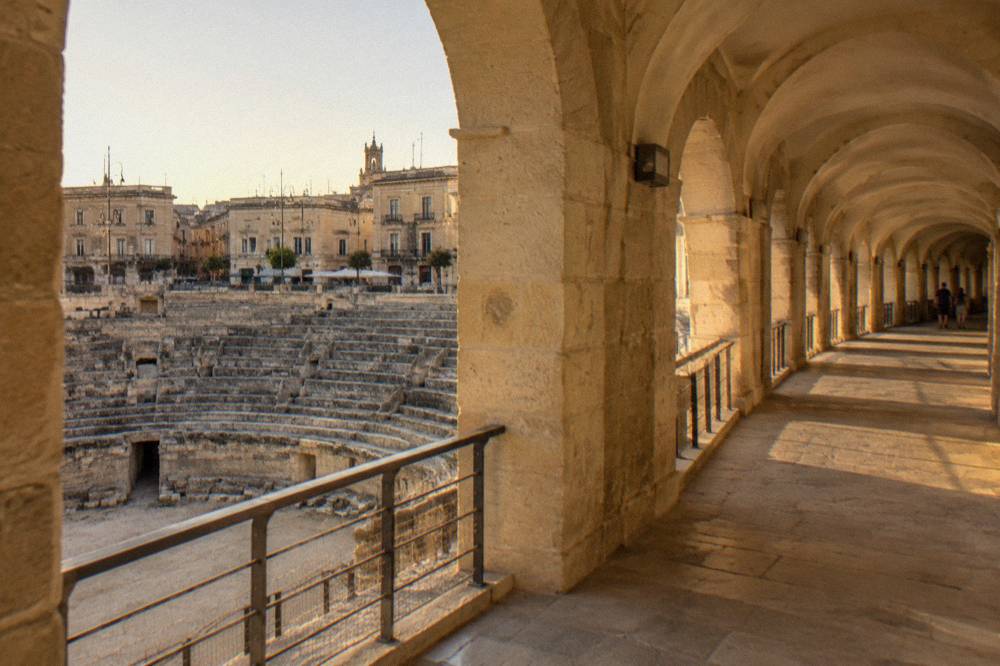
The paid visit takes you inside that crescent. The new accessible entrance and ramp, delivered by the PNRR restoration, brings visitors down into the monument without stairs. Inside, the scale of the arcades becomes clear in a way the overhead view cannot convey: the corridors, the thickness of the cavea wall, the stone laid for crowds that filled the seats when the arena was in use. The Ministry's regional museums page for the site is the operative source for what the visit includes, and the ticketing arrangements below reflect its published schedule.
A reasonable plan is to see the square view first, then decide on the interior. The square around the monument carries the column of Sant'Oronzo, the city's patron, and the former wheat market on the Seggio, so the amphitheatre sits inside one of the richest set-pieces in the city; the Piazza Sant'Oronzo guide covers the rest of it.
A guided walk ties the monument into the wider story of the city, and two options in the site's roster do that well, one pairing history with tastings and one focused on local stories.
The history-and-street-food walk is the natural companion to this monument, because it treats the old town, the amphitheatre included, as a single circuit and breaks it with the tastes Salento is known for: the rustico leccese, a savoury puff-pastry parcel, and the caffè in ghiaccio con latte di mandorla, the iced espresso with almond milk credited to Antonio Quarta of Quarta Caffè in the 1940s or 1950s. You can read more about the tastes of the city in the site's coverage of what to eat in Lecce's food sections, and book the walk directly: Check availability.
What Are The Opening Hours And Ticket Prices?
Entry to the Roman Amphitheatre of Lecce costs 5 euro full and 2 euro reduced, per the Puglia regional museums directorate. From 1 October to 31 March it opens Tuesday to Sunday, 10:00 to 17:00; in summer it splits to 10:00 to 13:00 and 17:00 to 21:00. It closes every Monday, and viewing from the square above is free at any time.
The two seasonal schedules matter more here than at most monuments, because the summer timetable shifts the afternoon opening to the evening, from 17:00 to 21:00, when the arcades sit in low light. Last entry in winter is 30 minutes before close, per the directorate's published times. The site is closed Mondays year-round.
| Period | Days | Hours | Notes |
|---|---|---|---|
| Winter, 1 Oct to 31 Mar | Tue to Sun | 10:00 to 17:00 | last entry reported 16:30 |
| Summer, 1 Apr to 30 Sep | Tue to Sun | 10:00 to 13:00 and 17:00 to 21:00 | split day, evening opening |
| Mondays | closed | view from the square still possible |
| Ticket | Price |
|---|---|
| Full | 5 euro |
| Reduced | 2 euro |
| View from Piazza Sant'Oronzo | free |
Prices and hours are as published by the Direzione Regionale Musei Puglia and reported in the site facts; check the directorate's page before a visit, since state-monument schedules can change with the season. A cumulative option with the Museo del Teatro Romano appears in some listings at 5 euro; treat that as a listing figure and confirm at the ticket point.
The amphitheatre can anchor a longer circuit of the city's ticketed sites, and a morning walk that starts here and ends with tastings is the most efficient way to cover both. Beyond the entry ticket, the site's featured experience adds a guide and the local food in one booking.
Booking terms, dates and prices render live at the listing, so nothing needs to be decided from memory. The walk starts in the old town, minutes from the arena.
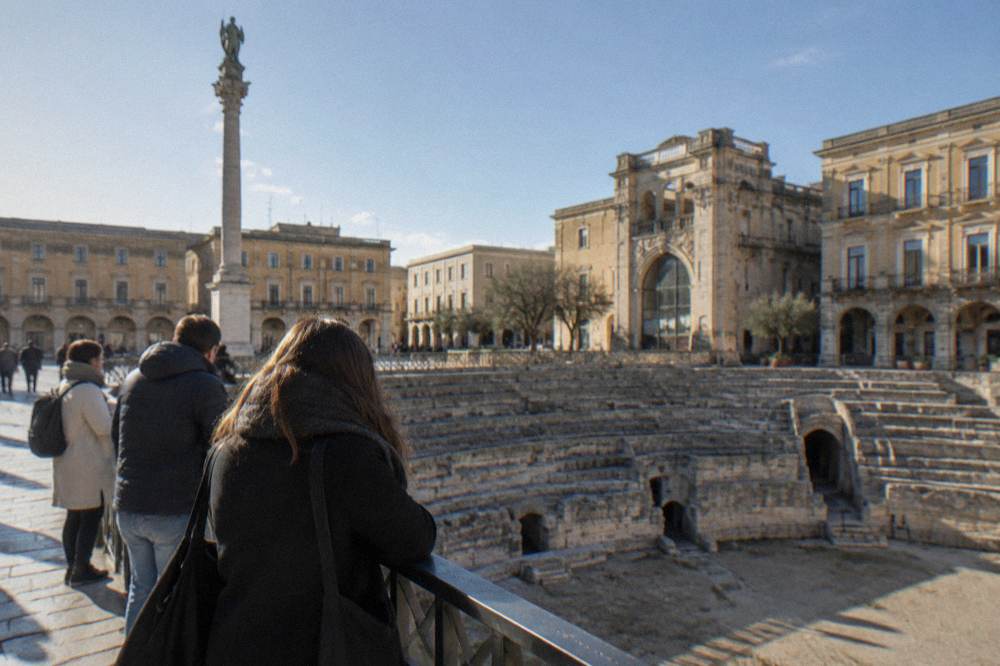
How Much Of The Amphitheatre Survives, And Why Is Half Buried?
Only about half of the amphitheatre's original circuit is excavated and visible; the remainder lies beneath Piazza Sant'Oronzo and the buildings around it, because the medieval and baroque city was built directly over the monument after it fell out of use, and later excavation could only recover the section not carrying the modern street fabric.
The visible portion is therefore a section, not the whole: the excavated end of the cavea with its seating and arcades, cut off where the square resumes. This is common for Roman amphitheatres under living Italian cities; the monument survived as foundations and lower masonry while the ground level rose around it. The pietra leccese masonry of the arcades is the original fabric, weathered but legible, and the PNRR restoration consolidated those arcades and reopened the site with the new entrance rather than rebuilding what is missing.
What that means practically: the overhead view from the square is the view that shows the monument's shape, while the interior visit delivers its scale and masonry. Neither shows a complete arena, because a complete arena is not there to show. The sources describe the monument as an amphitheatre of the Roman city that stood here, and the archaeological park at Rudiae, outside the walls, carries the older, Messapian-and-Roman layer of the area's ancient past for anyone who wants more depth.
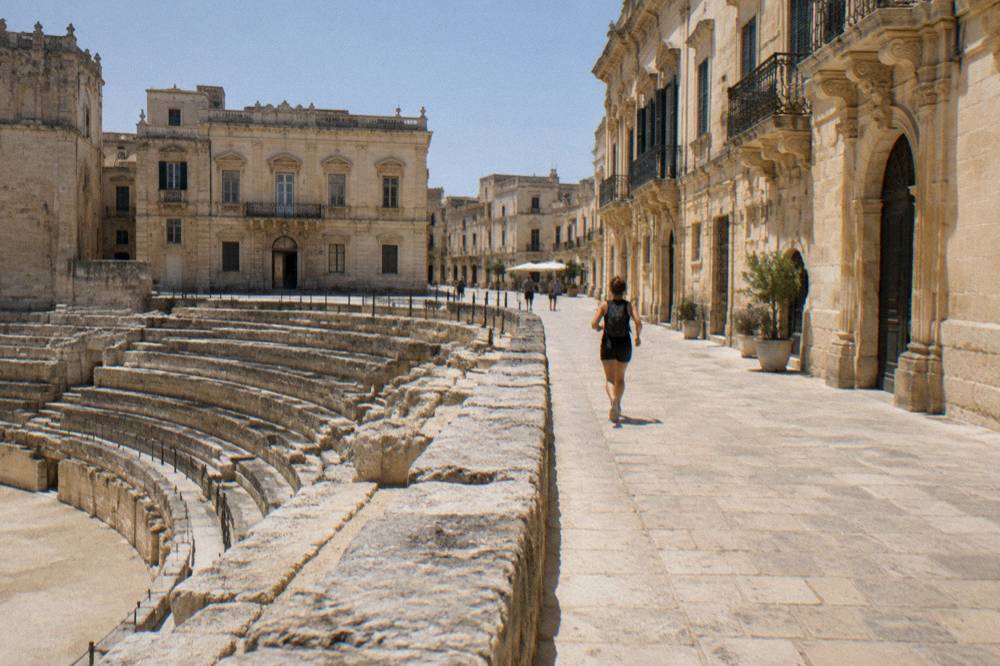
Is The Roman Amphitheatre Of Lecce Accessible?
Yes, step-free access to the interior is now provided through the new accessible entrance and ramp delivered by the 1,500,000 euro PNRR Measure 1.2 restoration, which reopened the monument with an accessible route down into the sunken area. The free view from Piazza Sant'Oronzo is at square level and needs no descent at all.
The restoration, verified on the Ministry's Puglia museums pages, is the operative fact: the new entrance and ramp were the headline deliverable of the project alongside the restored arcades. For anyone planning around mobility, the square itself is flat paving, the railing view needs no ticket or stairs, and the interior route uses the ramp. The directorate's site is the place to confirm any specific assistance requirement before a visit, since operational details beyond the published hours are not in the site facts.
Two practical notes from the surrounding area. First, the historic centre around the square is a limited traffic zone, the ZTL, camera-policed with reported weekday windows and Sunday restrictions; the Lecce ZTL and parking guide sits alongside the site's coverage of getting around, and travellers driving in should ask their accommodation about registering a number plate. Second, the square is compact and the amphitheatre takes up one whole flank, so the free overhead view involves almost no walking once you are there.
How Does The Amphitheatre Compare With The Roman Theatre Of Lecce?
The amphitheatre is the larger, oval, gladiatorial-type monument in the main square, entered on a state ticket; the Roman Theatre is a smaller semi-circular theatre a few streets north, seen with a small museum run by the Fondazione Mememo on a separate, cheaper ticket. They are different building types at different scales, and both fit in one morning's walk.
The distinction is the standard Roman one: an amphitheatre is an oval arena for spectacles in the round, while a theatre is a semicircular auditorium for staged performance. In Lecce you get both, which is unusual for a city of this size, and the pair is the core of the city's Roman layer.
| Roman Amphitheatre | Roman Theatre | |
|---|---|---|
| Type | oval arena | semi-circular theatre |
| Location | Piazza Sant'Oronzo | Via del Teatro Romano, north of the square |
| Managed by | Direzione Regionale Musei Puglia | Fondazione Mememo (private) |
| Hours | winter Tue to Sun 10:00 to 17:00; summer split timetable | Mon to Sat 9:30 to 13:00, afternoons by reservation |
| Ticket | 5 euro full, 2 euro reduced | about 3 euro (price from listings; confirm on site) |
| Closed | Monday | Sunday |
The theatre's museum hours and its roughly 3 euro price come from the comune's museum listing and secondary listings, so treat the price as approximate and confirm at the door. The theatre's depth is covered in the site's Roman Theatre guide. Walking between the two takes minutes; the theatre sits in the dense grid north of the square, near the Jewish museum quarter's edge.
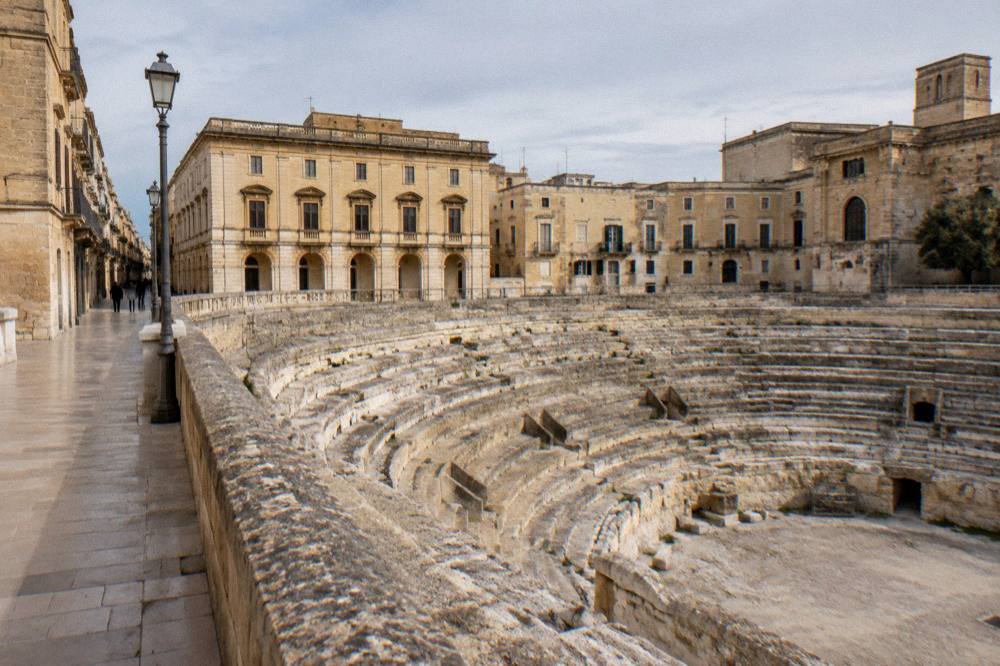
For visitors deciding which to enter on a short stay: the amphitheatre is the one in the main square, free to view from above and cheap to enter, and it pairs naturally with the baroque set-pieces around it. The theatre is quieter, more of a specialist stop, and its museum visit is a morning-only affair given the 13:00 close.
What Else Can You Combine With The Amphitheatre In Lecce?
Everything of note in the historic centre is within a short walk of Piazza Sant'Oronzo: the Duomo and the LeccEcclesiae church circuit, the Basilica di Santa Croce, Castello Carlo V, Museo Faggiano and the MUST city museum, plus the free squares and gates. A single base in the centro storico puts the amphitheatre, two museums and five baroque churches inside a loop of well under an hour's walking.
The following table gathers what the site facts report for the main ticketed sites, all of them walkable from the square. Hours are as published by each operator and can change by season; the church circuit runs summer and winter schedules, 9:00 to 21:00 from April to September and 9:00 to 18:00 from October to March, per chieselecce.it.
| Site | Reported hours | Reported ticket |
|---|---|---|
| Amphitheatre | winter Tue to Sun 10:00 to 17:00 | 5 euro, reduced 2 euro |
| LeccEcclesiae churches (Duomo, Santa Croce, San Matteo, Santa Chiara, Seminario) | daily, seasonal 9:00 to 21:00 or 9:00 to 18:00 | 11 euro standard, valid 15 days |
| Castello Carlo V | Tue to Sun, guided tours only | 10 euro full, 6 reduced |
| Museo Faggiano | daily 9:30 to 20:00 | 5 euro, children's rates apply |
| MUST city museum | winter Tue to Thu 9:00 to 19:00, Fri to Sun 9:00 to 20:00 | 5.50 euro, reduced 3.50 |
| Palazzo Vernazza | daily 15:30 to 21:00 | 10 euro, reduced 8 |
Free sights cluster just as tightly. The view into the amphitheatre from the square costs nothing, and neither do Porta Napoli, the Villa Comunale gardens, or the courtyard of the Palazzo dei Celestini, reported free as the Prefecture seat. The baroque showpiece of the Basilica di Santa Croce and the cathedral close at Piazza del Duomo carry the LeccEcclesiae ticket, which stays valid 15 days, long enough to cover a whole stay.
A sensible sequencing for one day: the square and the amphitheatre view in the morning light, the Duomo circuit before the midday pause, then either the Castello tour or Museo Faggiano in the afternoon, and the square again in the evening, when the arcades are lit. The site's one-day and longer itineraries cover the sequencing in detail.
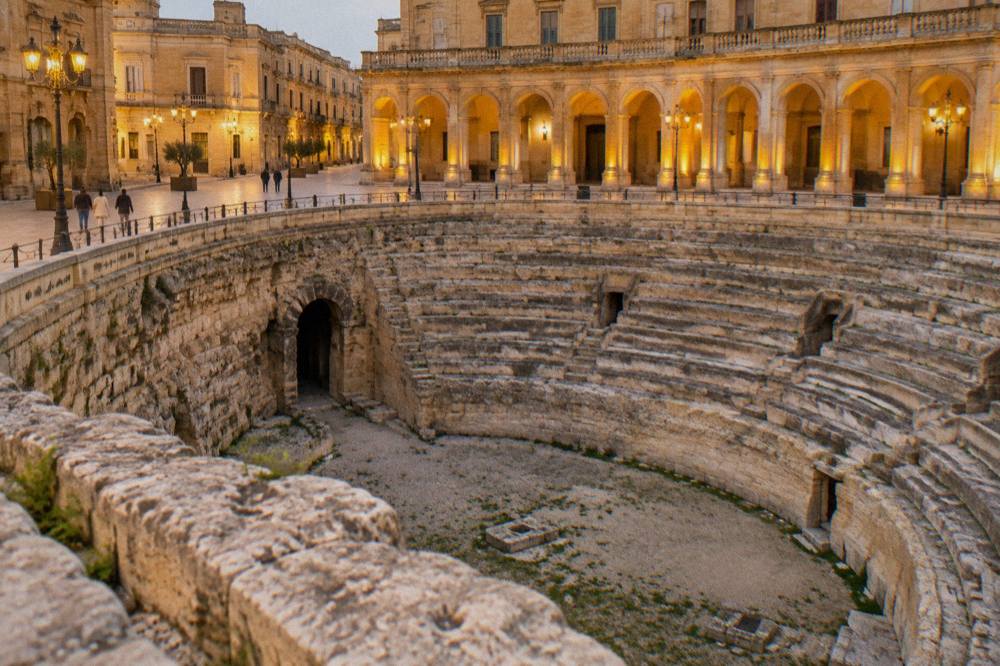
When Is The Best Time Of Day To See The Lecce Roman Amphitheatre?
Morning light from the square suits photography of the arcades, the summer evening opening from 17:00 to 21:00 puts the monument in low, warm light at arena level, and winter's single 10:00 to 17:00 block makes the afternoon the natural slot. The free overhead view, unlike the interior, is available at any hour, including after dark when the arcades are lit.
The climate frame comes from the ERA5 reanalysis, 1991-2020, for the grid cell near Lecce: mean highs run from 12.4 C in January to 31.3 C in August, with November carrying the year's highest monthly rainfall at 93.7 mm and July the lowest at 15.3 mm. In practical terms, midday in July and August is hot stone and thin shade, so the summer evening session is not just photogenic but comfortable; in the November-to-February window the morning is cooler and rain is more likely, and the 17:00 winter close limits late options. There is no sheltered waiting area at the monument itself, so in the wetter months the arcades of the surrounding square are the fallback.
| Season | Amphitheatre hours | Reading of the day |
|---|---|---|
| Winter, Oct to Mar | Tue to Sun 10:00 to 17:00 | morning entry, square view after dark |
| Spring and autumn shoulder | summer timetable applies from 1 Apr | midday break fits the Italian pause |
| July and August | 10:00 to 13:00 and 17:00 to 21:00 | evening session avoids the heat |
One planning note for December travellers: the Fiera dei Pupi, the papier-mâché Christmas fair, runs in the city in the weeks before Christmas, following the early-to-24-December pattern of past editions, and the square and its monuments sit at the centre of the seasonal activity.
Do You Need A Guide For The Roman Amphitheatre Of Lecce?
No, the amphitheatre is a compact monument that works well on a self-guided visit using the free square view and the cheap entry ticket, but a guided walk adds the context the site itself does not display, since the monument carries little interpretation on site. The small-group history walks in the site's roster cover the amphitheatre within a circuit of the old town, with a food-focused version adding tastings.
The honest trade-off is this: the interior visit delivers stone, scale and the restoration; it does not deliver a museum's worth of narrative. A guided circuit weaves the arena into the story of Roman Lupiae, the baroque rebuilding above it and the food culture around it, and it removes the need to plan the route. For visitors with one day, the guided option is the efficient one; for a longer stay, the ticket alone plus the city's other sites is enough.
The site's roster includes three options that fit here, and the small-group history and stories walk is the pure-context choice.
The history-and-street-food pairing earns its place for the afternoon, when the walk's route through the old town ends among the counters of the city's cafes and the tastes the site's food coverage describes: the rustico, the pasticciotto and the iced coffee with almond milk. For families or cooking-minded travellers, the pasta class in a 1400s-era courtyard turns the afternoon into dinner instead.
Common Questions About The Roman Amphitheatre Of Lecce
Can you see the Roman Amphitheatre of Lecce for free?
Yes. The view from Piazza Sant'Oronzo, looking down into the excavated arcades and seating from the railing, is free and available at any hour. Only the interior visit needs a ticket, at 5 euro full and 2 euro reduced as published by the Puglia museums directorate.
Is the Roman Amphitheatre of Lecce open on Mondays?
No. The site is closed every Monday year-round under the directorate's published schedule. The free view from the square is unaffected, since the square is public space.
How long does a visit to the Lecce Roman Amphitheatre take?
The visible monument is one end of the cavea with two tiers of arcades, so an interior visit is short compared with a large museum. Budgeting part of a morning or evening session, combined with the square itself and the surrounding sights, is the realistic plan; the exact pace is yours to set.
Why is only half of the Lecce amphitheatre visible?
The medieval and baroque city was built over the monument after it fell out of use, and excavation recovered only the section not carrying the modern square and buildings. The surviving circuit therefore ends where the paving of Piazza Sant'Oronzo resumes.
Is the Roman Amphitheatre of Lecce accessible?
Yes. The PNRR restoration delivered a new accessible entrance and ramp into the sunken monument, per the Ministry's Puglia museums pages. The square-level view needs no descent. Confirm any specific assistance requirement with the directorate before a visit.
What is the difference between the amphitheatre and the Roman Theatre in Lecce?
The amphitheatre is an oval arena for spectacles, set in the main square and run by the state museums directorate; the Roman Theatre is a smaller semi-circular theatre north of the square with its own small museum, open weekday mornings with afternoons by reservation. Both are within a short walk of each other.
The Roman Amphitheatre of Lecce is the rare monument you can audit from a cafe table: order an iced coffee, look down into two thousand years of stone, and only then decide whether to go inside. With the square's baroque flank, the Duomo circuit and a guided food walk all inside the same few streets, it anchors a full day in the old town without ever needing to leave it.