Lecce Walking Tour: Which Baroque Walk To Book
Lecce, the baroque capital of Salento in Puglia, is a city built on the scale of the pedestrian, and a guided walk is the most direct way into it. This guide covers the standard circuit, the ticket prices on the route, the free and tip-based options, and how to choose between them.
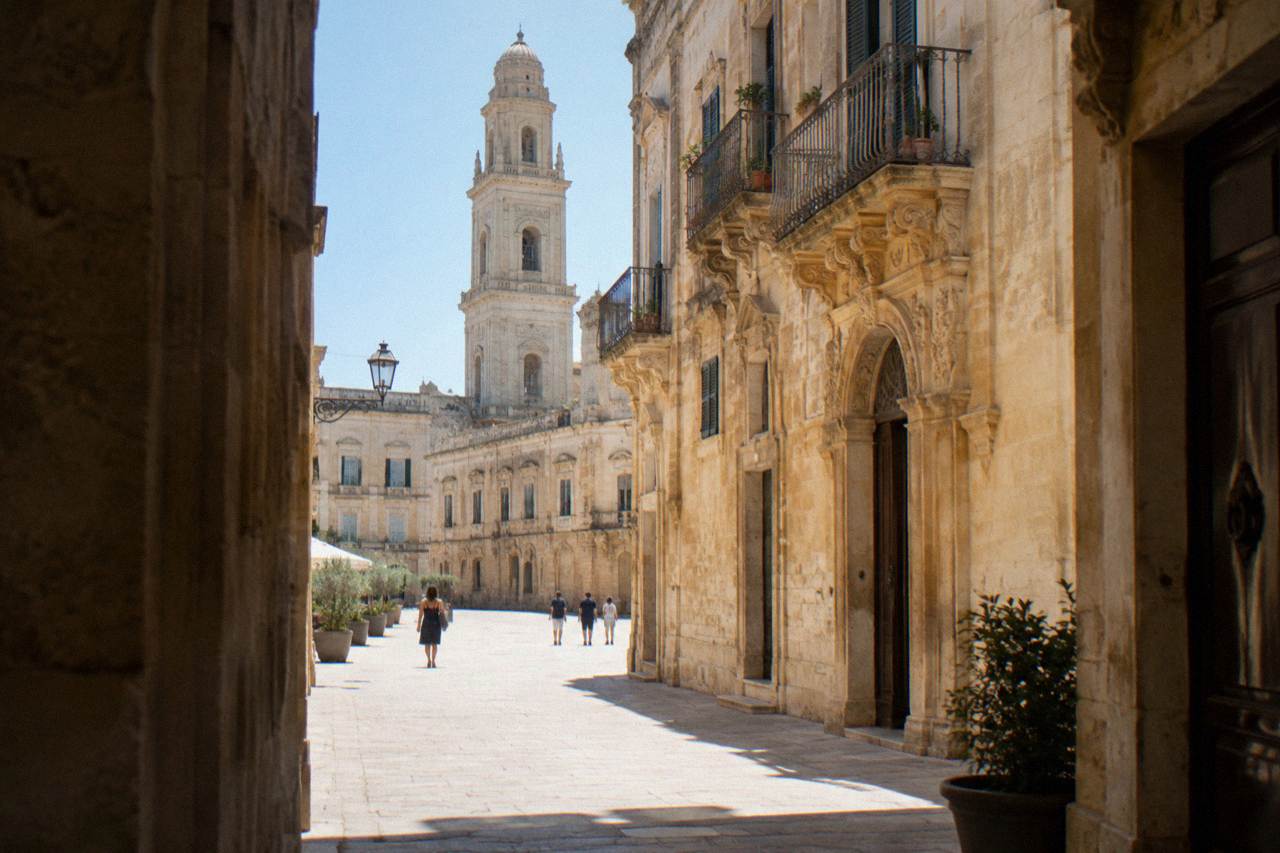
Short answer
Book a baroque-and-underground walk of the historic centre for a first visit: the Duomo, the Basilica di Santa Croce, Piazza Sant'Oronzo and one cellar stop are the core of the city, and all of it sits within walking distance. Budget for the LeccEcclesiae church ticket at 11 EUR and expect spring or autumn weather to suit the walk best.
Lecce, the baroque capital of Salento in Puglia, southern Italy, is a city built on the scale of the pedestrian. The historic centre is a compact grid of honey-coloured pietra leccese limestone, the nearest beach at San Cataldo sits about 13 km away on the Adriatic, and the signature sights cluster within a few hundred metres of one another. That geometry is why a walking tour is the most useful thing to book here: the format matches the city. This page, from the Lecce Travel Guide editorial desk, sets out what the walks cover, what the sights on the route cost, and how to choose between the formats on offer.
What Is A Lecce Walking Tour, And What Does One Cover?
A Lecce walking tour is a guided circuit of the historic centre on foot, usually taking in the Duomo and its piazza, the Basilica di Santa Croce, Piazza Sant'Oronzo with the Roman Amphitheatre below street level, and the café and papier-mâché streets between them. Lecce sits a few kilometres inland from the Adriatic, so this is an architecture walk rather than a coastal one, and the old town is compact enough that the core circuit fits inside a single morning.
The formats on sale differ more in emphasis than in geography. A baroque walk keeps the facades front and centre. An underground variant adds a cellar, crypt or museum stop, which in Lecce means descending below the modern street into layers of Roman and earlier building. A food walk covers the same squares but stops at counters and cafés along the way. A history walk leans on narrative over interiors. The streets are the same in every case; the pacing and the stops change.
Two practical facts shape the walking experience. First, the historic centre sits inside a camera-controlled limited traffic zone, the ZTL, which keeps the lanes quiet for pedestrians but catches unregistered hire cars, so anyone driving in should ask their accommodation about plate registration before parking. Second, the city has no commercial airport: the gateway is Brindisi, about 47.6 km and 43 minutes away by road, with an airport bus at 6.50 EUR one way and a journey of about 40 minutes per the operator. Rail arrivals come into the station a short walk from the walls, covered in detail on the Lecce train station guide.
One status point worth knowing before a guide tells you otherwise: Lecce is not inscribed on the UNESCO World Heritage List. "Salento and the Barocco Leccese" sits on Italy's Tentative List, submitted in 2006, and nothing more. The architecture is extraordinary regardless, and the city's own history, from Messapian Rudiae on the edge of town to the Roman theatre hidden below the streets, rewards a guide who knows which claims are documented and which are legend.
Which Sights Does A Walking Tour Of Lecce Pass?
The standard circuit strings together Piazza Sant'Oronzo, the Roman Amphitheatre seen from the square above it, the Duomo and its bell tower in Piazza del Duomo, the Basilica di Santa Croce, the church of San Matteo, Santa Chiara, the Castello Carlo V courtyard and the undergrounds of the Museo Faggiano, with the Roman Theatre and the lanes of the old Jewish quarter as optional extensions. Every stop sits inside the old centre, and the whole list is walkable end to end without transport.
| Stop | What a walker sees | Access |
|---|---|---|
| Piazza Sant'Oronzo | Roman Amphitheatre below the square, the column of Sant'Oronzo, a historic café with roots to about 1880 | Open public space, free |
| Roman Amphitheatre | The arena ring from inside, below modern street level | 5 EUR, Tue to Sun, closed Mon |
| Piazza del Duomo | The Duomo and crypt, the bell tower, the seminary cloister | LeccEcclesiae ticket |
| Basilica di Santa Croce | The facade and rose window in pietra leccese | LeccEcclesiae ticket |
| Chiesa di San Matteo | A facade of alternating concave and convex bays | LeccEcclesiae ticket |
| Chiesa di Santa Chiara | The monastic interior and cloister | LeccEcclesiae ticket |
| Castello Carlo V | The courtyard, the papier-mâché museum inside | Courtyard free, interior by guided tour |
| Museo Faggiano | Layered undergrounds beneath a palazzo | 5 EUR, open daily |
The walk usually opens at the civic heart. Piazza Sant'Oronzo is the main square, and its strangest feature is that a Roman amphitheatre sits half-exposed in its pavement, visible for free from the railings above and visitable inside on a 5 EUR ticket. Caffè Alvino, on the same square, traces its roots to about 1880 and is the classic first stop for a pasticciotto, the shortcrust custard tart that defines Salento's pastry counters.
From there the route bends to the ecclesiastical quarter. Piazza del Duomo is a theatrically closed composition, with the cathedral, its bell tower and the seminary arranged so the visitor enters through a gate and meets the facade side-on, an effect the baroque architects intended. The Basilica di Santa Croce a few streets away carries the most admired facade in the city, dense with cherubs, beasts and foliage worked in the soft local limestone. San Matteo and Santa Chiara extend the same vocabulary. All of these interiors are on the LeccEcclesiae combined ticket rather than free, a point the next section unpacks.
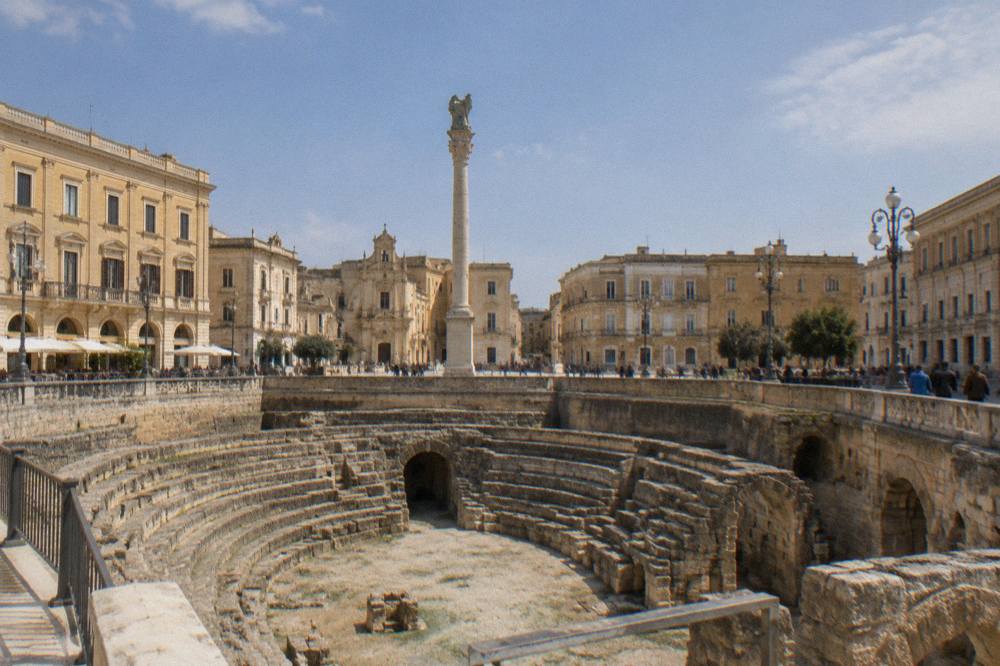
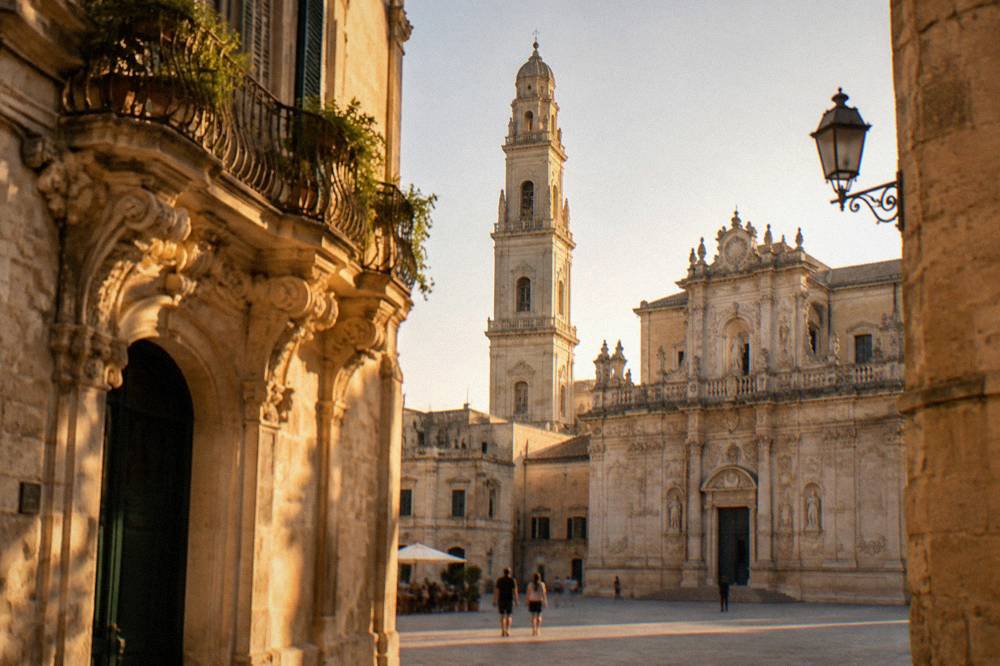
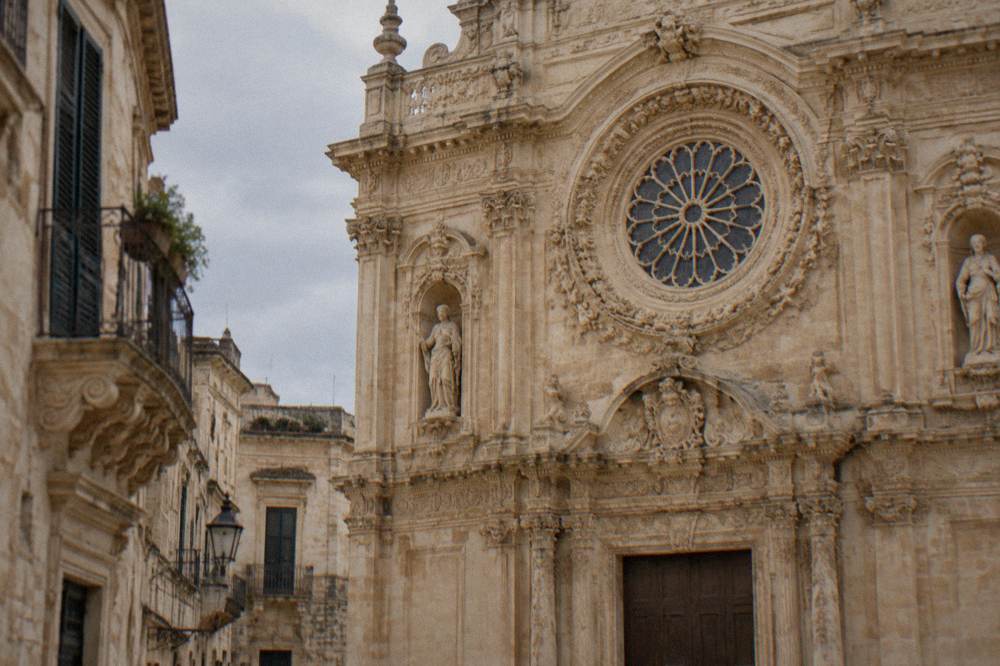
The underground half of the walk is what separates Lecce from other baroque cities. The Museo Faggiano is a palazzo whose cellars were found to hold a Roman street, a well, a Templar-era griffin and layers of Messapian, Roman and medieval occupation, all visitable for 5 EUR every day from 9:30 to 20:00. The Roman Theatre is a smaller sibling of the amphitheatre, tucked into the streets a few blocks south, with its own small museum open weekday mornings. The Castello Carlo V closes the loop on the edge of the centre: its courtyard is free to enter, while the interior, including the papier-mâché museum, is by guided tour only.
Which Lecce Walk Should You Book First?
For a first visit the walk to book is a baroque-and-underground circuit of the historic centre, the format that pairs the signature facades with a cellar or crypt stop, because Lecce's second layer below street level is the part a map alone does not explain. A street-food walk is the strong second choice for travellers who want the tastings built into the route, and a small-group history walk suits anyone who prefers stories over interiors. All three formats overlap on the same four or five squares.
| Walk format | What it focuses on | Where the time goes | Who it suits |
|---|---|---|---|
| Baroque and underground | Facades plus cellars, crypts and layered ruins | Duomo quarter, Santa Croce, one descent stop | First visits |
| History small group | The city's narrative and local stories | The lanes between the squares, fewer interiors | Story-first walkers |
| Street food walk | Tastings along the route | Café and counter stops across the centre | Eaters |
| Jewish quarter walk | The Giudecca and the old synagogue's basement | Streets south of the centre | History-minded visitors |
| Boat caves trip | The coast rather than the city | Departs from the shore, pairs with an afternoon walk | Coast pairings |
The baroque-and-underground format is the one this site rates first for a simple reason: the underground stops are hard to self-organise. The facades can be admired alone with a map, but knowing which palazzo hides a Roman cistern, and which guide holds the keys, is exactly the knowledge a booked walk buys. The site's featured walk for this page is the Baroque Architecture and Underground Rooms tour, which covers that ground; live dates and current pricing are on Check availability.
For travellers who want the narrative more than the interiors, the small-group history format is the alternative. It spends its time on the streets between the monuments, on the legends, the patron saint, the limestone quarries and the papier-mâché craft, and it works well for anyone who has already walked the squares independently.
A third format worth weighing is the Jewish-quarter walk, which is really a different city: the Giudecca, the streets of the old Jewish community, with a descent into the basement of the ancient synagogue. It is a quieter, more specific route than the baroque circuit and pairs well with a second day in town.
How Much Do The Ticketed Sights On The Walk Cost?
The ticketed sights on the standard walk cost modest fixed amounts: the LeccEcclesiae combined church ticket is 11 EUR standard or 21 EUR with the bell tower, the Castello Carlo V guided tour is 10 EUR, the Museo Faggiano is 5 EUR, the Roman Amphitheatre is 5 EUR and MUST is 5.50 EUR, all per person at the rates the operators publish. Children under 12 enter the churches free, and the LeccEcclesiae ticket stays valid for 15 days after purchase.
| Sight | Ticket | Hours | Notes |
|---|---|---|---|
| LeccEcclesiae circuit: Duomo and crypt, Santa Croce, San Matteo, Santa Chiara, Antico Seminario and MuDAS | 11 EUR standard, 5 EUR reduced for ages 12 to 17, 24 EUR family; 21 EUR / 13 EUR / 48 EUR with the bell tower | Daily 9:00 to 18:00 winter, 9:00 to 21:00 summer | Valid 15 days, under 12 free, access limited during services |
| Castello Carlo V | 10 EUR guided tour, 6 EUR reduced, free to age 11; castle plus exhibitions 15 EUR | Tue to Sun, closed Mon; Oct to May tours at 10:30, 11:30, 12:30, 16:00, 17:00, 18:00, 19:00 | Courtyard free; papier-mâché museum inside the tour |
| Museo Faggiano | 5 EUR, 3 EUR ages 8 to 16, free under 8 | Daily 9:30 to 20:00 | Underground archaeological layers |
| Roman Amphitheatre | 5 EUR, 2 EUR reduced | Winter Tue to Sun 10:00 to 17:00; summer 10:00 to 13:00 and 17:00 to 21:00 | Closed Mon |
| MUST, the city history museum | 5.50 EUR, 3.50 EUR reduced, free under 10 | Winter Tue to Thu 9:00 to 19:00, Fri to Sun 9:00 to 20:00 | Closed Mon |
| Museo del Teatro Romano | About 3 EUR, confirm on site | Mon to Sat 9:30 to 13:00, afternoons by request | Price from secondary listings |
| Lecce Artwork City Pass | 29 EUR for 7 days | Aligns with member sites | Includes the LeccEcclesiae sites and the bell tower |
The LeccEcclesiae ticket is the one that catches walkers out, because the basilicas on the circuit are working churches that nevertheless charge for sightseeing access. The combined ticket is sold at Piazza Duomo 5 and at the Basilica di Santa Croce, and it is the economical route if the walk will pass more than two of the included churches. Residents of the Diocese enter free with ID, and tourist access pauses during services, so a morning walk should check the service times as well as the hours.
The Castello deserves its own note because the free-courtyard claim travels badly. Only the courtyard is free. The interior, and the papier-mâché museum inside it, is a guided tour at 10 EUR full and 6 EUR reduced, free to age 11, with set tour times from October to May. Anyone planning the walk around a Castello interior stop should build the tour time into the route rather than arrive between slots.
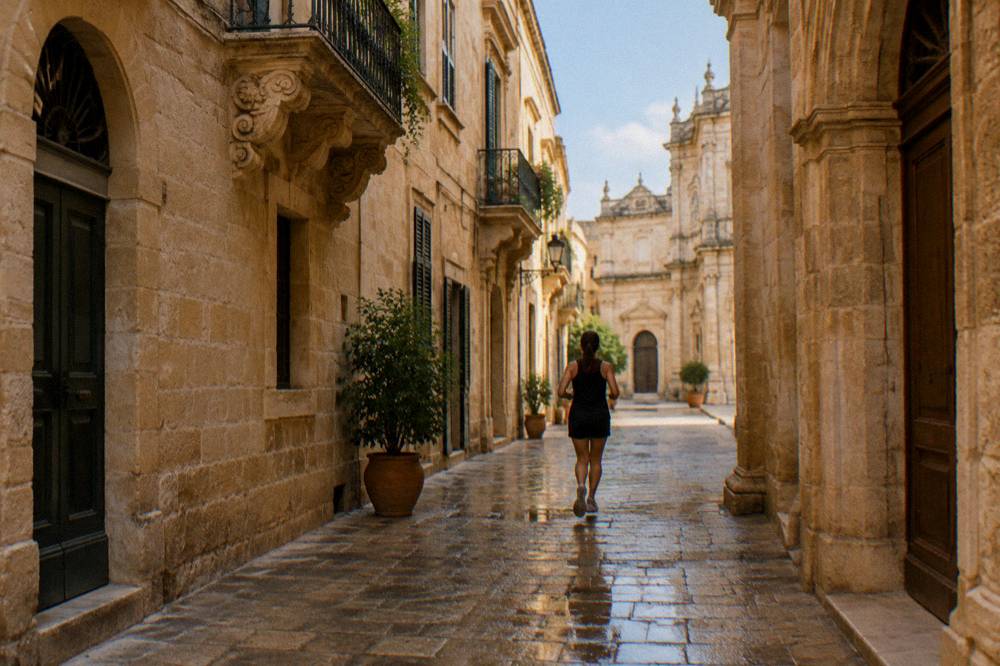
If the budget question is whether a guided walk replaces these tickets, the honest answer is that it depends on the tour: some walks include entry to specific sights, and the operator's live listing states which. The walk fee and the sight tickets are otherwise separate line items, and a day that includes the Duomo, the amphitheatre and Faggiano should carry both.
Are There Free Or Tip-Based Walking Tours In Lecce?
Tip-based walking tours do run in Lecce, offered by local guides on a pay-what-you-choose basis, and no platform listing for the city is named here, so the way to find one is to ask at your accommodation or a visitor point and confirm the meeting details and terms directly with the guide. The unpaid half of the city is real either way: Villa Comunale, Porta Napoli, Piazza Sant'Oronzo and the amphitheatre seen from above the square all cost nothing.
| Place | Why it costs nothing | What to look at |
|---|---|---|
| Piazza Sant'Oronzo | Open public square | The amphitheatre from the railings, the column, the café terraces |
| Porta Napoli | Open city gate on its piazza | The triumphal arch in pietra leccese |
| Villa Comunale | Public gardens | The tree-lined walks and benches |
| Palazzo dei Celestini courtyard | Prefecture seat with courtyard access | The courtyard and cloister frontage |
| Church exteriors | Facades visible from the street | Santa Croce, San Matteo, the Duomo flank |
| Castello Carlo V courtyard | Free courtyard area | The fortress walls, the inner court |
The tip-based format deserves a fair hearing. It suits travellers who want an orientation before exploring alone, and it suits tight budgets. What it does not suit is certainty: meeting points, coverage and language vary by guide, and the tip itself is unstated by design, so the total cost is unknowable in advance. Confirm everything with the guide before the start, including where the walk ends, because a route that finishes far from the start changes the rest of the day.
The site's own page on the free walking tour format in Lecce goes deeper on how these walks work and what to ask before committing. The synagogue-basement format below is another budget-adjacent option, since it trades a broad circuit for one deep, unusual stop.
When Is The Best Month To Walk Lecce?
The ERA5 reanalysis for Lecce, 1991 to 2020, puts the mean daily high at 31.0 C in July and 31.3 C in August against only 15.3 mm and 18.1 mm of rain, while November carries the highest monthly rainfall at 93.7 mm and October the second highest at 91.3 mm, so the comfortable walking seasons are spring and early autumn: April to June and September to October combine manageable highs with mostly dry streets, and July and August are hot but reliable.
| Month | Mean high C | Mean low C | Rain mm |
|---|---|---|---|
| Jan | 12.4 | 6.7 | 63.1 |
| Feb | 13.0 | 6.8 | 59.0 |
| Mar | 15.4 | 8.3 | 64.9 |
| Apr | 18.6 | 10.7 | 54.6 |
| May | 23.4 | 14.7 | 39.9 |
| Jun | 28.2 | 19.1 | 18.0 |
| Jul | 31.0 | 21.7 | 15.3 |
| Aug | 31.3 | 22.2 | 18.1 |
| Sep | 26.4 | 19.0 | 58.9 |
| Oct | 21.8 | 15.4 | 91.3 |
| Nov | 17.3 | 11.7 | 93.7 |
| Dec | 13.5 | 8.2 | 75.5 |
These are modelled normals from a reanalysis grid cell, not a weather-station record, and they describe the climate rather than any particular week. Read as a planning tool, they say three things. Summer walks are hot enough that the morning departure is the right one, with the 9:00 opening of the churches aligning with the coolest useful hour. Spring and autumn are the seasons a walker would design. Winter is mild, with January mean lows of 6.7 C, but October and November are the damp months, so an umbrella earns its place in the bag.
The events calendar also shifts the walking experience. The Festa dei Santi Patroni filled the city from 23 to 26 August 2026, and the Notte della Taranta Concertone in Melpignano fell on 22 August 2026, the 29th edition; both are annual, and 2027 dates had not been announced. August walks therefore share the streets with festival crowds, which is either the point or the problem, depending on the traveller.
How Many Days Of Walking Does Lecce Need?
One full day walks the core: the four main squares, the Duomo, Santa Croce, the amphitheatre and one underground stop fit into a morning and an early evening, with the Castello or a museum filling the afternoon. Two days add the Roman Theatre, the Giudecca, MUST and a café circuit at an unhurried pace, and three days leave room for a Salento day trip by train or bus to Otranto or Gallipoli.
The one-day shape is the commonest request, and the Lecce in one day itinerary on this site matches it: sights in the morning, a long lunch, an underground stop and the evening passeggiata. A guided walk slots best as the morning block of that day, because it front-loads the orientation, and everything after it goes faster for the context.
The two-day version is the better fit for anyone who wants the food stops and the architecture without choosing between them. The Lecce in two days itinerary splits the circuit from the extensions, and the second day is where the synagogue quarter, the Roman Theatre museum and the slower café mornings live.
The third day belongs to the peninsula. Otranto is about 46.7 km and 44 minutes away by road, and by rail it is a change at Maglie on the FSE network, with the cathedral's mosaic floor, dated 1163 to 1165 by the priest Pantaleone, as the sight at the end of the line. Gallipoli is about 41 km and 41 minutes by road, or a direct FSE train of roughly an hour and a quarter to an hour and three quarters. Either makes a clean contrast to the limestone lanes of Lecce.
What Should You Know Before The Walk?
Bring covered shoulders and knees for the churches, where tourist visits pause during services; expect the tourist tax to be collected by your accommodation at a top reported rate of 5 EUR per person per night for five-star high-season properties, to confirm at booking; and know that the historic centre sits inside a camera-policed ZTL active on weekdays and around the clock on Sundays, with fines from 83 to 332 EUR.
| Topic | What the sources say |
|---|---|
| Dress code | Shoulders and knees covered in the churches; visits suspended during services |
| Tourist tax | Top reported rate 5 EUR per person per night, five-star high season; collected by the accommodation; confirm at booking |
| ZTL | Camera-controlled historic centre, active weekdays and all day Sundays and holidays; fines 83 to 332 EUR; ask your accommodation about plate registration |
| City bus | SGM single 60-minute ticket about 1.20 EUR, 1.50 EUR bought on board |
| Beach bus | SGM line 32 to San Cataldo, about 20 minutes from the City Terminal in season |
| Luggage storage | App-network desks near the station, about 2.50 to 3.50 EUR per day |
| Emergency number | 112 |
The ZTL is the detail that ruins car-based plans, so it belongs on a walking page too, because the walk starts wherever the car was left. The cameras read plates, the fines are real, and the exemption process runs through the accommodation, not the driver. Park outside the zone and walk in; the centre deserves it anyway.
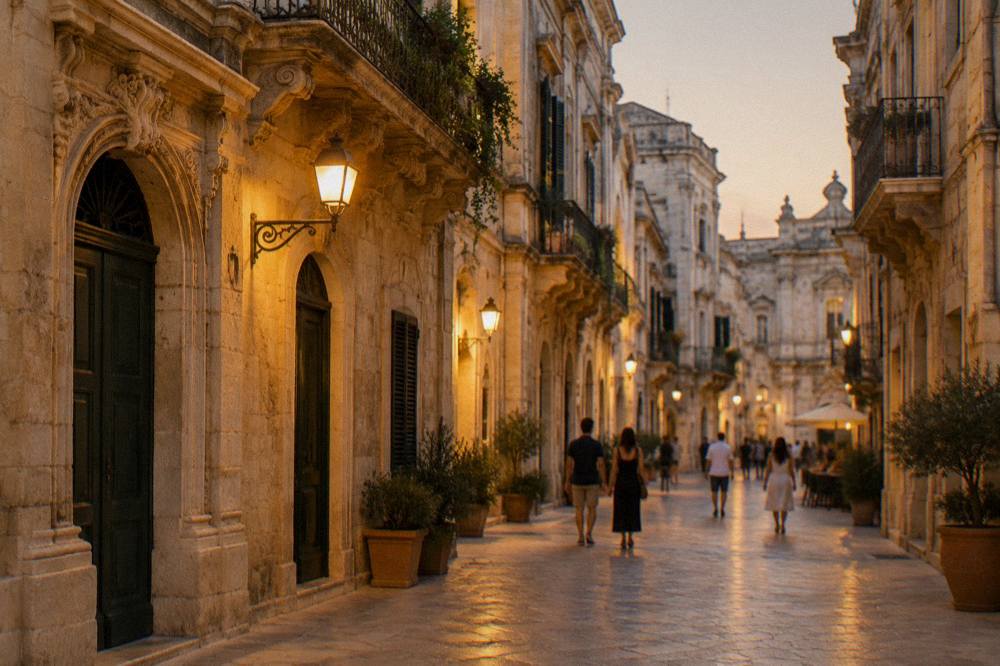
Safety is the last pre-walk question, and the answer is reassuring. Lecce is a university city of about 94,387 residents with roughly 20,774 students enrolled at the Università del Salento, which keeps the centre populated late into the evening, and the reported picture is one of low violent crime with petty theft as the main caution. The site's page on walking around Salento at night covers the specifics, including the sensible habits for any Italian city after dark.
Can The Walk Include Food, Wine Or The Sea?
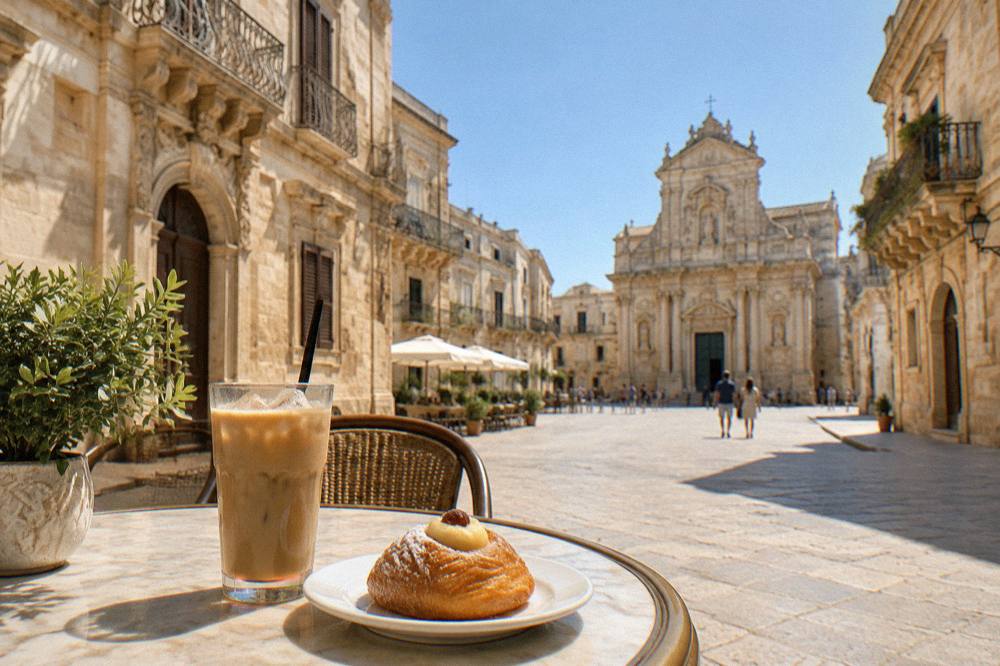
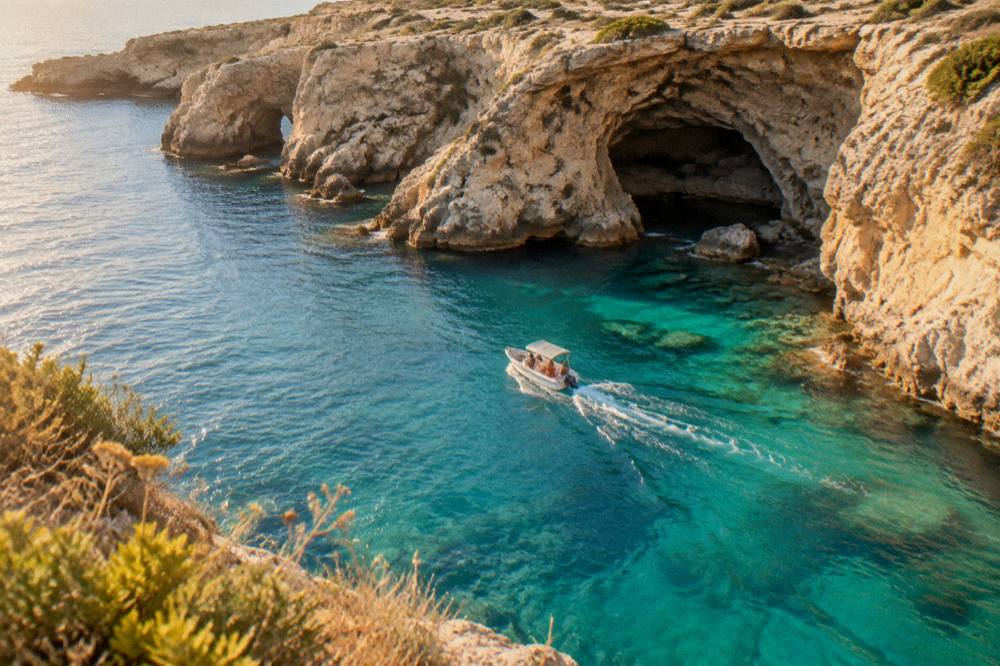
Yes, and the pairing is often the point: a street-food walk covers the same baroque streets while tasting rustico, pasticciotto and the iced coffee with almond milk that Lecce claims as its own, and the coast is close enough to add a boat trip, with cave tours running from Santa Maria di Leuca and snorkel trips from Porto Cesareo. The sea at San Cataldo is about 13 km and 14 minutes away by road, so a boat morning pairs cleanly with an afternoon walk.
The food walk deserves its popularity. The rustico leccese, a puff-pastry parcel of béchamel, mozzarella and tomato, is a savoury counterpoint to the pasticciotto, whose 1745 invention date is the claim of Pasticceria Ascalone in Galatina, not Lecce, and is disputed by historians; presented as legend, it is a good story on any route. The caffè in ghiaccio con latte di mandorla, espresso over ice with almond milk, is credited to Antonio Quarta of Quarta Caffè in the 1940s to 1950s, and it is the definitive Lecce café order. Pasticceria Natale, family-run since 1978, is the name that recurs on the pastry stops.
The site's Lecce food tour page covers the tasting formats in detail. The sea pairing is the other half of the question. Boat trips to the caves run from Santa Maria di Leuca at the tip of the peninsula, about 83 km and 78 minutes away by road, and snorkel trips with an aperitif run from Porto Cesareo on the Ionian side, about 28 km and 34 minutes. The sea itself runs about 22.5 C in June and 25 to 27 C at the August peak, per the regional sea-temperature figures.
The combination that works best on a short trip is a city walk on day one and a coast or boat day on day two, using the walks below as the booking shortcut. All three pair a different Salento with the same limestone city, and the operator's live listing carries the current dates, prices and cancellation terms for each.
Common Questions About Lecce Walking Tours
Is Lecce a good city for walking?
Yes. The historic centre is compact, flat and largely closed to through traffic by the camera-controlled ZTL, and the main sights sit within a few hundred metres of one another. The city is a few kilometres inland, so the walk is architectural rather than coastal, and the nearest beach at San Cataldo is about 13 km away.
Do you tip on a free walking tour in Lecce?
Tip-based walks run locally, and the tip is set by the guest rather than the listing. Confirm the meeting point, the route and the expected terms with the guide directly before the walk starts.
Are the churches in Lecce free to enter?
The main church interiors are on the LeccEcclesiae combined ticket, at 11 EUR standard or 21 EUR with the bell tower, valid for 15 days, with children under 12 free. Access is limited during services, and the dress code requires covered shoulders and knees. Church exteriors and the public squares cost nothing.
Do you need to book a Lecce walking tour in advance?
In spring and autumn, and around the August patronal festival, booked walks fill, so reserving a day or two ahead is the safer habit. Live availability and free-cancellation terms are on each operator's live listing, and the button on this page reads Check availability for exactly that.
Can you combine a walking tour with a day trip?
Yes. Otranto is about 44 minutes away by road or a change at Maglie by rail, and Gallipoli is about 41 minutes by road or a direct FSE train, so a city walk on one day and a coastal day on the next is a standard pattern for a three-day stay.
A walking tour is the one booking in Lecce that improves every other hour in the city, because it teaches the limestone, the layers below the streets and the logic of the squares in a single morning, and the rest of the visit simply goes deeper from there.