Is It Safe To Walk Around Salento At Night?
A practical, source-based answer to night safety in Salento: evening life in Lecce's old town, transport back from Otranto and Gallipoli, the ZTL, and the habits that matter after dark in Puglia.
Lecce, in Puglia at the heel of Italy, is the baroque capital of Salento: an inland city of honey-coloured pietra leccese limestone, about 13 km from the nearest beach at San Cataldo, with the Adriatic coast to the east and the Ionian to the west across the peninsula. Its evening question is a real one for travellers, because the region's social life moves outside at dusk and the old towns are at their liveliest after eight. The question "is it safe to walk around Salento at night?" deserves a straight answer, and the honest version is this: no source in this site's research rates Salento or Lecce with a safety verdict, and no crime figure appears on this page. What the verified facts do support is a practical picture of lit squares, seasonal transport, and the ordinary precautions of any southern Italian town, reported below.
Is It Safe To Walk Around Salento At Night?
No source available to this site rates Salento with a safety verdict, and no crime figure is printed here. What the facts support is this: evening is the main social hour across the region, the squares of Lecce stay busy with the passeggiata, the single European emergency number 112 works everywhere in Italy, and the practical risks after dark are the ordinary ones of unlit side lanes, seasonal transport gaps, and unattended valuables in crowds.
The passeggiata, the Italian evening stroll, is not a Lecce invention but a national habit, and it does a lot of quiet work for anyone walking after dark. On the nights of August, when the Festa dei Santi Patroni runs from 23 to 26 August in Lecce, the centre is at its most crowded, with processions, luminarie and a fair in the squares. A street full of families is a different environment from an empty one, and the festival calendar means the busiest evenings are predictable in advance.
What no source here verifies is a nightlife recommendation. No bar, club or venue had its hours, prices or address confirmed, so none is named. The squares, the lit facades and the aperitivo habit are described instead, because those are general and safe to state: the evening drink before dinner is a Mediterranean custom, and opening times change with the season.
The climate matters more than visitors expect. The ERA5 reanalysis for Lecce, 1991-2020, puts the mean daily low at 21.7 C in July and 22.2 C in August, which is why nobody hurries home after dinner in summer. October, when this page's data was gathered, has a mean low of 15.4 C and the second-wettest month of the year at 91.3 mm of rain, so an autumn evening walk is a jacket-and-umbrella affair rather than a warm one.
| Month | Mean High (C) | Mean Low (C) | Rain (mm) |
|---|---|---|---|
| June | 28.2 | 19.1 | 18.0 |
| July | 31.0 | 21.7 | 15.3 |
| August | 31.3 | 22.2 | 18.1 |
| September | 26.4 | 19.0 | 58.9 |
| October | 21.8 | 15.4 | 91.3 |
Figures are ERA5 reanalysis climate normals, 1991-2020, for a modelled grid cell near Lecce; they are not a weather-station record. The pattern they show is simple: summer nights are warm and almost rainless, September doubles in rainfall, and October evenings are mild but damp.
What Evening Streets In Lecce Are Actually Like
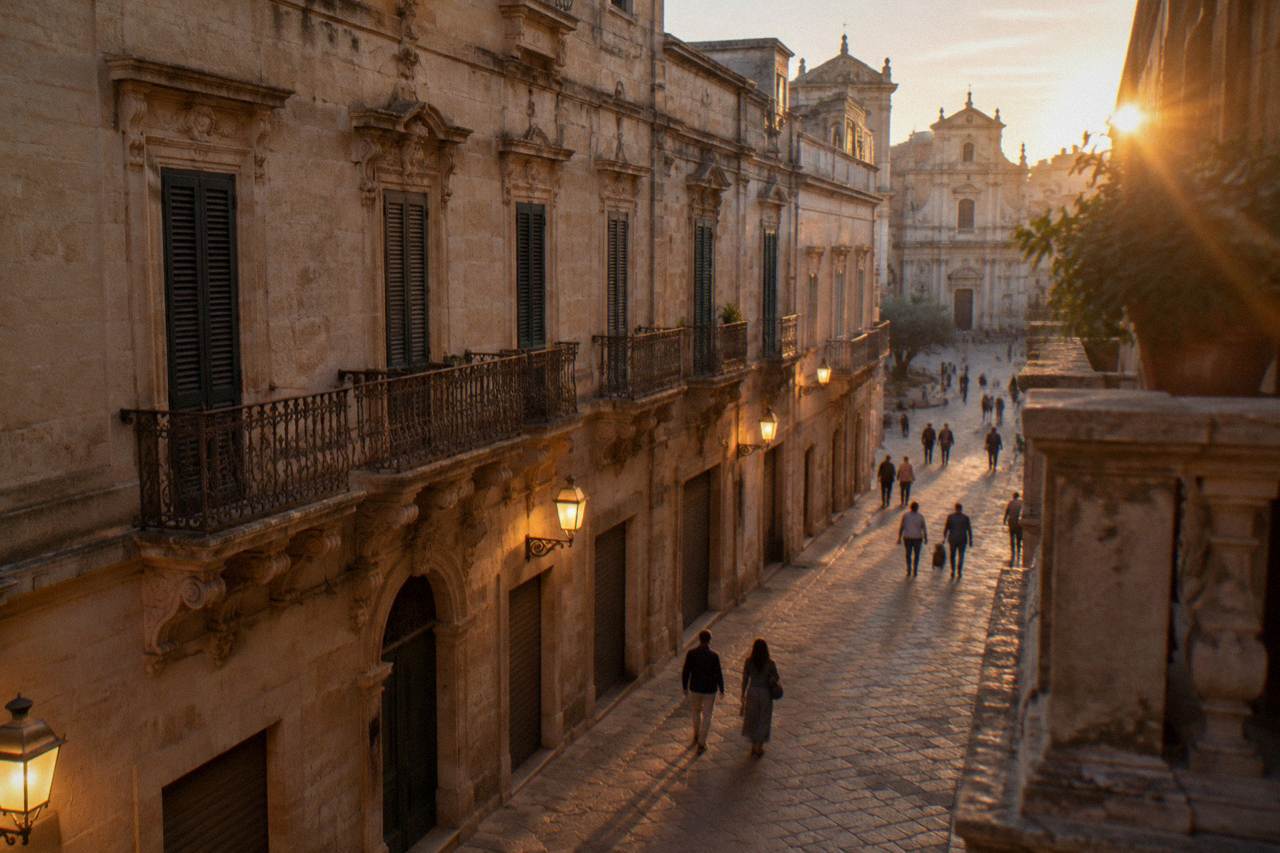
After dark Lecce's centre is a walking city of lit limestone squares and narrow lanes, with the main public spaces free to roam: Piazza Sant'Oronzo, the Villa Comunale and Porta Napoli cost nothing, and the Roman Amphitheatre is visible from above in the piazza at any hour. The ticketed interiors close earlier, with the LeccEcclesiae church circuit running 9:00 to 18:00 in winter and 9:00 to 21:00 in summer, so evening church visits are a summer-only option.
The free layer of the city is the evening layer. The facades of the Basilica di Santa Croce and the Duomo are visible from the street without a ticket, and the barocco leccese carving that makes Lecce famous reads differently under artificial light than at noon. The interior circuit is another matter: the combined LeccEcclesiae ticket covers the Duomo and crypt, Santa Croce, San Matteo, Santa Chiara and the Antico Seminario with the MuDAS museum, at 11 euro standard or 21 euro with the bell tower, valid 15 days, with under-12s free. None of that is an evening activity in the October-to-March window, when winter hours apply and visits pause during services.
Museums keep their own clocks. Museo Faggiano, the layered archaeological house, is open every day 9:30 to 20:00, so it is one of the few interiors that can follow a late afternoon walk. The Castello Carlo V runs guided tours Tuesday to Sunday, with the courtyard free and the interior tour at 10 euro full; its winter tour times cluster in the late morning and evening slots, and its exhibition "La materia dei sogni" ran from 17 July 2026 to 10 January 2027 at 8 euro. Check current times before planning a night around any of them.
For the evening itself, the honest description is architectural and social rather than commercial. The passeggiata fills Piazza Sant'Oronzo, the caffè in ghiaccio, espresso over ice with almond milk, is a Lecce drink credited to Antonio Quarta of Quarta Caffè in the 1940s to 1950s, and the squares stay animated until late in the warmer months. Anyone who wants the evening city explained rather than just walked can book a guided option, and the picks below are the verified ones for after-dark and around-town sightseeing.
The canoe tour among those picks has a night option, which is the clearest sign of how benign the region's evenings are treated by the people who work in them: a cave paddle after sunset is a bookable product, not an extreme one. The bike highlights tour covers the city's core sights with a guide, useful for anyone who wants the layout of the old town explained before exploring it alone at night.
Getting Back To Lecce Late: Trains, Buses And The ZTL
The real night-time risk in Salento is not street crime, which no source here rates, but logistics: the FSE regional trains and the seasonal Salento in Bus network thin out late, the Lecce ZTL camera zone runs overnight on weekdays, and a driver who blunders into it faces fines of 83 to 332 euro. Anyone staying outside Lecce should plan the return leg before the first drink, and confirm live timetables with the rail operators.
The verified transport facts are these. Salento in Bus, the summer shuttle network run by Cotrap and partners, operated 13 June to 13 September 2026, with peak service 1 July to 31 August, on lines including the 101 from Lecce via Torre dell'Orso to Otranto, the 104 via Porto Cesareo to Gallipoli, and the 107 and 108 toward Santa Maria di Leuca. Fares ran 1.10 to 5 euro by distance, with a 1 euro surcharge bought on board and under-10s free. Outside that window the coastal towns depend on FSE trains and ordinary local buses, and late-night frequencies are not published in any source here: confirm them on the operator's own timetable before committing to a late dinner in Otranto.
| Route | Mode | Typical Time | Fare (from) |
|---|---|---|---|
| Lecce to Otranto | FSE train, change at Maglie | about 1h33 to 2h+ | about 4 euro |
| Lecce to Gallipoli | FSE train, direct | about 1h18 to 1h43 | about 5 euro |
| Lecce to Galatina | FSE train, direct | about 38 to 55 min | about 3 euro |
| Lecce to Brindisi | Trenitalia, direct | about 18 to 24 min | about 3.40 euro |
The drive times are verified too: about 44 minutes by road from Piazza Sant'Oronzo to Otranto, about 41 to Gallipoli, about 29 to Galatina. A car solves the late-return problem but creates the ZTL one. The Lecce limited traffic zone is camera-policed, with reported active windows on weekdays of roughly 13:00 to 16:30 and 20:00 to 10:00, and 24 hours on Sundays and holidays; the hours are reported rather than guaranteed, and the standard advice is to ask the accommodation to register the plate. Fines run 83 to 332 euro, with a 30 percent discount if paid within five days. The guides to getting around Lecce and the Salento in Bus guide carry the fuller detail.
For anyone travelling without a car, the practical habit is to treat the last confirmed departure as a hard boundary. The Lecce train station guide covers the station itself, and the Salento itinerary page helps sequence the coastal towns so the return leg stays reasonable. A guided day tour removes the return-leg planning entirely, which is one reason the four-town Salento tour is this page's related product: it reaches Otranto, Leuca, Gallipoli and Galatina with a driver.
Night Safety On The Salento Coast: Otranto, Gallipoli And The Beach Towns
The coastal towns follow the same pattern as Lecce: no source here rates them for night safety, and none is given a verdict. Otranto's old town is small and walkable, Gallipoli's stands on a limestone island joined by a bridge, and both are evening destinations in season, with festival nights in August the busiest of the year. The verified specifics are architectural and logistical, not statistical.
Otranto's cathedral, whose floor mosaic dates from 1163 to 1165 by the priest Pantaleone, is free for independent visitors, though since 1 March 2026 groups and visitors with a licensed guide pay 2 euro. Its Castello Aragonese runs seasonal tickets of about 6 euro in low season to about 12 euro in high season, with longer summer opening during events. None of that is night-time data, but it frames the town: small, historic, and oriented toward evening strolling on the seafront in summer.
Gallipoli's old town is the more distinctive after dark, sitting on its limestone island connected to the mainland by a historic bridge, with the new town and the sea around it. The Castello di Gallipoli's ticket price was not found in any source here, so none is printed. What the sources do give is the summer reality: the town is a beach and evening destination, and the day-trip guide to Gallipoli region pages and the Salento guide carry the wider picture.
The August festival calendar concentrates people outdoors at night across the whole peninsula. The Notte della Taranta Concertone in Melpignano was held on Saturday 22 August 2026, its 29th edition, and the 2027 date had not been announced when this page's data was gathered. The Festa di San Rocco at Torrepaduli ran 14 to 17 August 2026, with the pizzica-scherma night dances on 15 and 16 August. These are late-ending, outdoor, family-heavy events, and they are also the nights when transport and parking need the most forethought.
For swimmers, the sea itself is a seasonal question. Sea temperature around Puglia runs about 22.5 C in June, peaks at 25 to 27 C in August, and falls to 20 to 22 C in October, so night swimming is a warm-month habit at the lidos and free beaches. One rule changed recently and matters: at the Grotta della Poesia near Roca Vecchia, bathing and diving have been banned since summer 2026, non-residents of Melendugno paid a 5 euro ticket in the 2026 season, and access is from the paths only. The Salento beaches guide covers the rest of the coast.
Practical Habits For Walking Around Lecce After Dark
The habits that matter are unglamorous: carry the 112 emergency number, keep valuables out of back pockets in festival crowds, prefer the lit main streets to unlit lanes at closing time, book the return transport before the evening starts, and ask the accommodation about ZTL plate registration on arrival. None of this is Salento-specific, and no source here rates the region as anything other than a place where these habits are the whole of the advice.
The emergency number is 112, the single European number, valid everywhere in Italy. Tourist tax exists and is collected by the accommodation, with the top reported Lecce rate at 5 euro per person per night for five-star stays in high season from 1 April 2026, with lower categories lower and short-let rates reported at 2.50 and 1.50 euro; confirm the exact amount at booking, since it varies by structure and season.
Church dress rules apply day and night: shoulders and knees covered, and tourist visits pause during services, with the calendar on the church circuit's own site. The evening openings that do exist in summer, when the LeccEcclesiae sites run to 21:00, are the window for anyone who wants the interiors after dinner rather than before it.
Luggage is a small evening problem with a verified answer: app-based storage networks operate near the Lecce station at about 2.50 to 3.50 euro per day, which matters for anyone with a late train and a dead afternoon. The answers on how many days Salento needs and whether Lecce is worth visiting frame the rest of the trip planning, and the Lecce at night guide goes deeper on the evening city than this page does.
The one thing this Lecce Travel Guide site will not do is hand a nervous traveller a verdict. What it can do is hand them the verified facts: a warm, busy, walkable evening city; a seasonal transport network that needs checking before dark; a camera zone that needs plate registration; and an emergency number that works. Plan the return leg, keep the phone charged, and the evening takes care of itself.
Common Questions About Night Safety In Salento
Is It Safe To Walk Around Salento At Night?
No source available to this site issues a safety verdict for Salento, and no crime figure is printed here. The verified picture is practical: evening is the region's main social hour, the squares stay busy, the emergency number is 112, and the real planning risks are seasonal transport gaps and the Lecce ZTL rather than anything a statistic would capture.
Is Lecce safe at night for solo travellers?
No source here rates Lecce for solo safety, so no verdict appears. The practical facts favour evening walking: the historic centre is compact and pedestrian-oriented, the passeggiata keeps the main squares populated late, and the free public spaces, Piazza Sant'Oronzo, the Villa Comunale and Porta Napoli, are open at all hours. Standard precautions about unlit lanes and valuables apply as anywhere in southern Italy.
What is the emergency number in Lecce?
112, the single European emergency number, which works everywhere in Italy including Puglia. It is the number to call for police, medical or fire emergencies, and it is the one detail every evening walker should have in the phone before dark.
Are Lecce's churches open in the evening?
Only in the summer window. The LeccEcclesiae circuit runs 9:00 to 21:00 from April to September and 9:00 to 18:00 from October to March, with last entry 15 minutes before close and visits paused during services. Dress rules apply at all hours: shoulders and knees covered.
Do buses and trains run late back to Lecce?
The summer Salento in Bus network ran 13 June to 13 September 2026 with evening and night services in peak season; outside those dates, FSE trains and local buses serve Otranto, Gallipoli and Galatina, but late-night frequencies are not published in any source here. Confirm the last departure with the operator before the evening starts.
Does the Lecce ZTL operate at night?
The reported camera windows are roughly 13:00 to 16:30 and 20:00 to 10:00 on weekdays, and 24 hours on Sundays and holidays, with fines of 83 to 332 euro. The hours are reported rather than guaranteed, so ask the accommodation about plate registration on arrival.