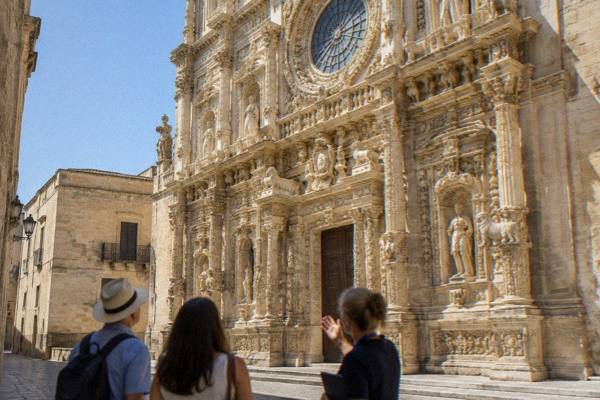
Lecce Stone: Why The City Glows Gold
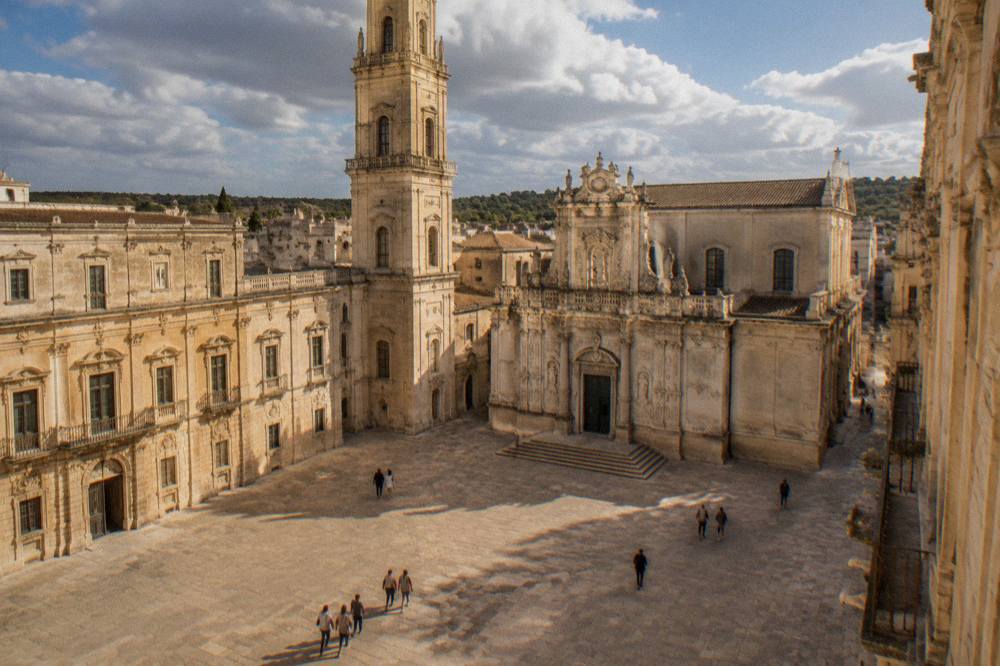
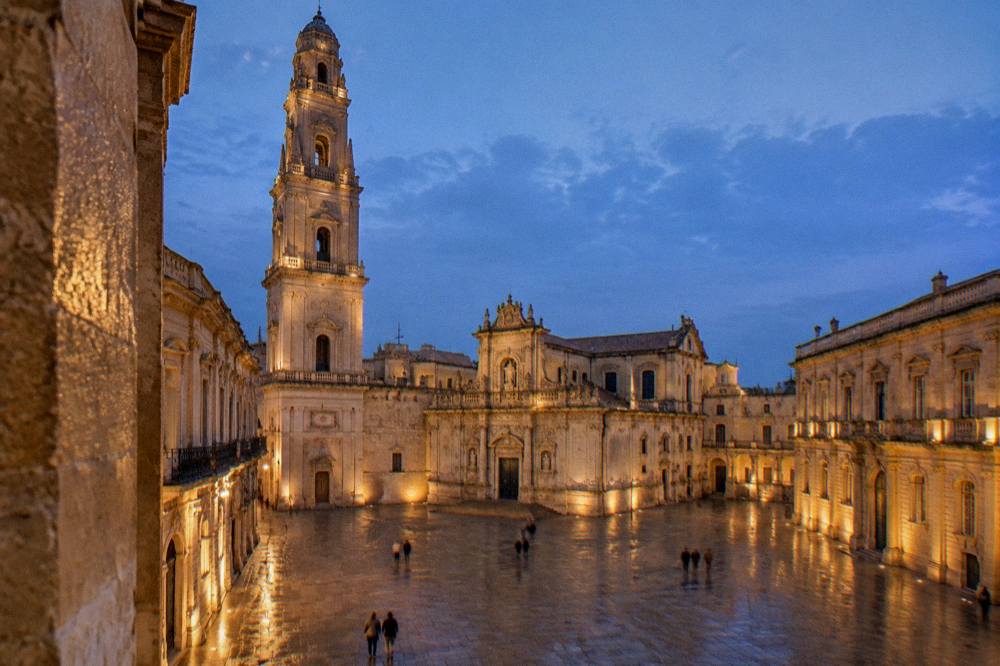
Lecce, in Puglia, southern Italy, is built from a single honey-coloured limestone called pietra leccese, and that stone is the reason the whole old town glows gold at sunset.
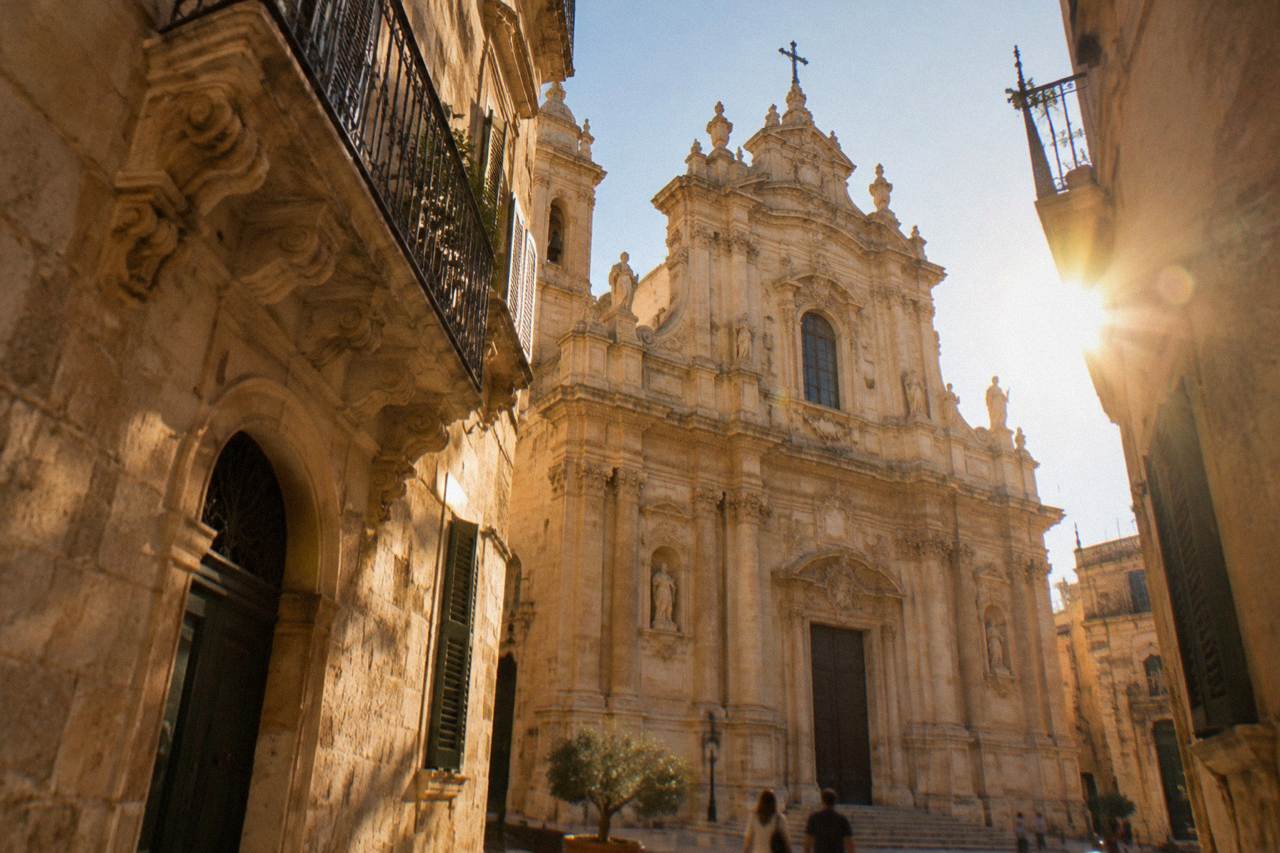
Short answer
Pietra leccese is a soft Miocene limestone quarried around Lecce, easy to carve when fresh and hardening with exposure, which is why the city's baroque facades carry such dense ornament and glow gold in low light.
Lecce, the baroque capital of Salento in Puglia, southern Italy, is one of very few European cities whose entire historic core is built from a single material: a warm, honey-coloured limestone the Italians call pietra leccese. The stone is soft when it comes out of the ground, which is precisely why the city's facades carry such extravagant carving, and it hardens and pales with exposure, which is why the old town seems to glow gold when the evening light hits it. This page explains what the stone is, where it came from, how to recognise it on the street, and where in Lecce and the surrounding Salento countryside to see it best, from the Basilica di Santa Croce to the disused quarries that dot the province. It sits alongside the site's broader guides to Lecce Baroque and the historic centre, but it is written to stand alone.
What Is Pietra Leccese, The Stone Lecce Is Built From?
Pietra leccese is a Miocene-era limestone, a calcarenite formed in shallow seas millions of years ago, that occurs naturally in and around Lecce and across the Salento plain. It is unusually soft and workable when first quarried, which lets masons carve deep figurative ornament into it, and it then hardens on exposure to air, giving Lecce's buildings their pale gold, weather-resistant surfaces. The comune's own geological and planning documents treat it as the city's traditional building material.
The geology matters more here than in nearly any other Italian city. Pietra leccese is a calcarenite, a sand-grade limestone of Miocene age, laid down when the Salento peninsula lay under a shallow sea. Fossils are visible in cut blocks if you look closely at a rough ashlar wall: shell fragments and marine debris compressed into a fine, even, golden matrix. The beds lie close to the surface across the province, which is why quarrying was cheap, local and constant for centuries, and why even humble courtyards and garden walls in Lecce share their material with the grandest church facades.
The physical behaviour of the stone explains the architecture. Fresh from the quarry it cuts almost like chalk, so a skilled carver can produce foliage, putti, heraldry and figural scenes at a speed and density that would be ruinous in marble or granite. Once exposed, the surface carbonates and hardens, taking on the pale honey tone that photographs so well in low, raking light. The trade-off is that the stone remains sedimentary and porous: it weathers, it blackens where rainwater runs, and it needs maintenance, which is why restorers in Lecce spend so much of their working life on limestone conservation. The comune of Lecce's planning norms name pietra leccese as the traditional material of the historic building stock, and its geological reports, prepared for works on the San Cataldo seafront, describe the calcarenite beds that underlie the city.
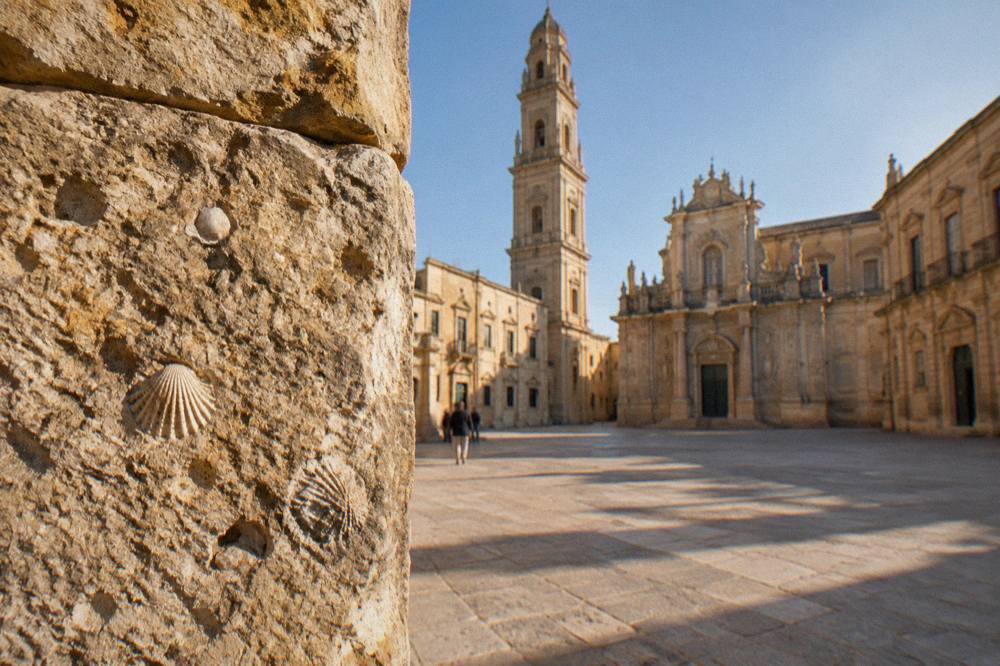
Why Does Lecce Look Gold At Sunset?
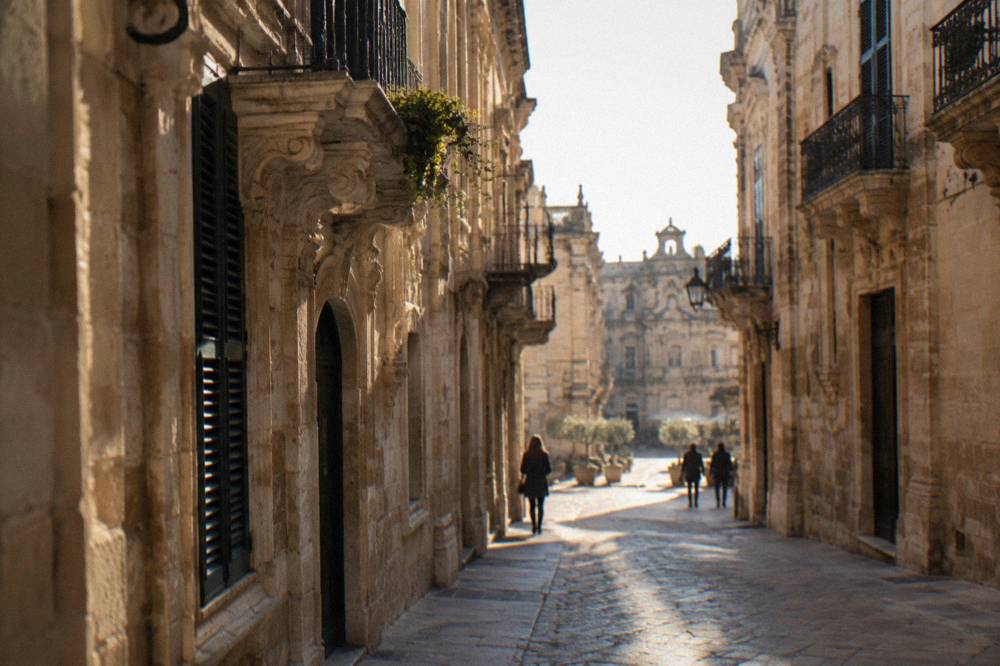
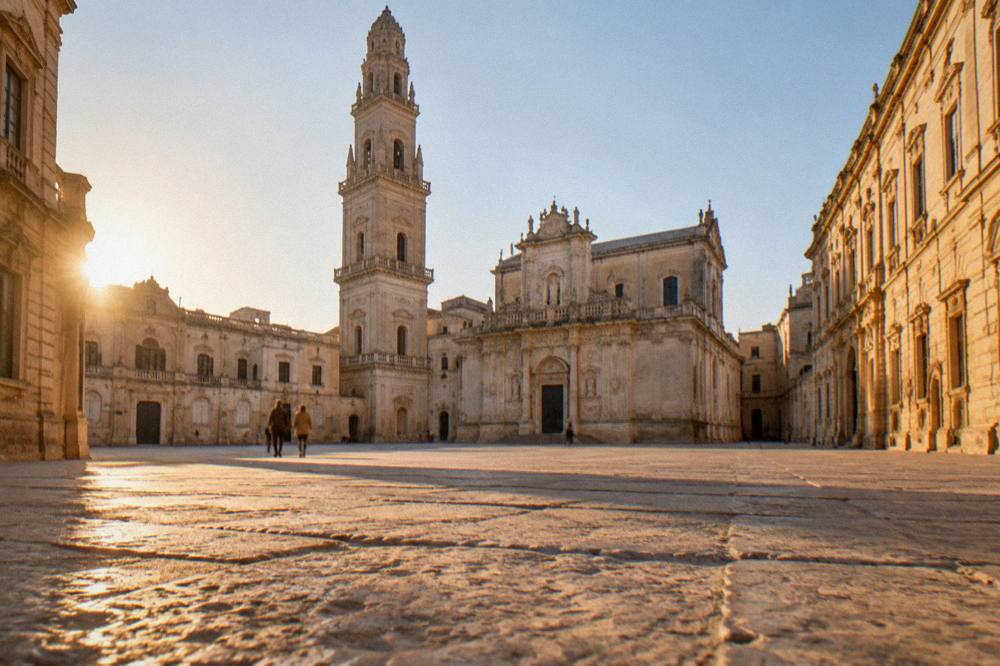
Lecce looks gold at sunset because pietra leccese reflects warm light strongly: its pale calcarenite surface is light-toned rather than grey, and the low evening sun rakes across facades, picking out the deep carving in shadow and highlight. The effect is strongest in the hour before sunset on east-west streets such as those around Piazza Sant'Oronzo, where entire walls of the same material catch the light together.
No paint, no render and no coating is involved. The colour is the stone itself, and because the historic core is built overwhelmingly from one material from one geological formation, the whole ensemble behaves as a single reflector. In flat midday light the city reads cream or ivory; in the low sun of late afternoon it reads gold; under storm light it can look almost amber. Photographers chasing the effect should simply walk the streets that run east to west and let the raking light do the work, then compare the same facades at midday.
There is a second, less obvious reason the glow is so uniform. Lecce's baroque builders did not face their buildings in stone over a brick core, as many northern Italian cities did: structure and ornament are the same material, so repairs and additions blend in rather than contrast. Where a modern intervention uses concrete or brick it stands out immediately, which is one of the reasons the comune regulates materials in the historic centre. For a fuller reading of the style the ornament serves, see the site's guide to Lecce Baroque; for the buildings that carry the most ornament, the Piazza del Duomo guide covers the cathedral group.
The best way to learn to read the stone, rather than just admire it, is with a guide who stops at facades and explains what the carvers were doing. The Baroque Architecture and Underground Rooms walking tour does exactly that, pairing the above-ground carving with the cellars and underground rooms cut into the same formation, and it can be booked through the operator's live listing:
If a guided walk appeals, these are the site's featured picks for Lecce itself:
Where Did Lecce's Stone Come From, And Where Are The Quarries?
The stone came from quarries in and around Lecce and across the Salento plain, where the calcarenite beds lie close to the surface, and many former quarries survive as cut landscape in the province today. The comune of Lecce's planning and geological documents record the local quarrying tradition, and sites such as the Parco delle Cave preserve disused workings as public parkland. No record exists of how much stone was extracted.
Quarrying around Lecce was small-scale, distributed and continuous. Because the beds are shallow, a landowner could open a pit, cut blocks for a building campaign, and either fill it or leave it to become a depression in the olive-country landscape. The results are visible across Salento: former cave di pietra leccese appear as sunken wooded hollows, garden amphitheatres and, in some cases, atmospheric pools. The Parco delle Cave on Lecce's outskirts is the best-known example of a quarry landscape turned public park, and it gives a direct sense of how the stone was extracted and how much material the city consumed.
Two practical notes follow from the geology. First, the underground rooms that visitors tour in Lecce, from the Faggiano museum's stratified basement to the cisterns and cellars under palazzi, exist partly because the soft stone could be dug out easily beneath the city. Second, the same softness means many quarries were worked by hand for local use only, so there is no grand industrial-quarry monument to visit: the experience is distributed across the countryside. For the museum that shows the underground side of the stone best, see the site's Museo Faggiano guide; for the wider region, the Salento overview covers the quarry-and-olive inland landscape.
| Aspect of pietra leccese | What it means on the ground |
|---|---|
| Rock type | Miocene calcarenite, a fine shell-bearing limestone |
| Colour when fresh | Pale, light cream-gold |
| Colour when weathered | Honey to gold, darkening where water runs |
| Workability | Soft and easily carved when quarried |
| Durability | Hardens on exposure; porous, needs maintenance |
| Where quarried | Shallow beds around Lecce and across Salento |
| Best place to see a quarry landscape | Parco delle Cave, on Lecce's outskirts |
Which Lecce Buildings Show The Stone Best?
The Basilica di Santa Croce's facade, the Duomo group in Piazza del Duomo, the courtyard of Palazzo dei Celestini, the Chiesa di San Matteo and the Chiesa di Santa Chiara are the key pietra leccese showpieces, all covered by the LeccEcclesiae combined church ticket (11 euro standard, valid 15 days). The Roman Amphitheatre in Piazza Sant'Oronzo shows the same formation used two millennia earlier.
The church circuit is the obvious itinerary, and the ticketing makes it easy: the official LeccEcclesiae ticket covers the Duomo and crypt, Santa Croce, San Matteo, Santa Chiara and the Antico Seminario with its sacred art museum, at 11 euro full price, 5 euro reduced for ages 12 to 17, with under-12s free. Hours follow the seasons: 9:00 to 21:00 from April to September, 9:00 to 18:00 from October to March, and tourist access is limited during services. The site's guide to the Lecce churches ticket breaks down the options, including the version with the bell tower ascent.
For contrast, the Roman monuments show the stone in its ancient, utilitarian register. The Roman Amphitheatre in Piazza Sant'Oronzo, partly uncovered below street level, is visible free from the square, and after its 1,500,000 euro restoration project reopened with a new accessible entrance it can be visited on a ticket of 5 euro full, 2 euro reduced, Tuesday to Sunday. Seeing amphitheatre and Basilica di Santa Croce on the same afternoon makes the point of this whole page: one formation, two thousand years apart, two completely different architectural ambitions. The Roman Amphitheatre and Basilica di Santa Croce guides go deeper on each.
A secular counterpoint is the courtyard of the Palazzo dei Celestini, which fronts the Basilica di Santa Croce and is today the seat of the prefecture; the courtyard is free to enter during office hours, and its regular ashlar walls show the stone used with almost no ornament, a useful calibration for the eye. The Piazza Sant'Oronzo guide ties several of these together into one walk.
| Site | How the stone is used | Ticket situation |
|---|---|---|
| Basilica di Santa Croce | Dense figurative facade carving | LeccEcclesiae ticket, 11 euro standard |
| Duomo and crypt, Piazza del Duomo | Facade, bell tower and crypt in one ensemble | LeccEcclesiae ticket |
| Chiesa di San Matteo | Richly carved facade, convex front | LeccEcclesiae ticket |
| Chiesa di Santa Chiara | Ornate interior and facade detail | LeccEcclesiae ticket |
| Palazzo dei Celestini courtyard | Plain ashlar, no ornament | Free, office hours |
| Roman Amphitheatre | Ancient seating cut into the formation | 5 euro full, 2 euro reduced, closed Mon |
| Museo Faggiano | Layers dug down through the strata | 5 euro, daily 9:30 to 20:00 |
How Do You Tell Pietra Leccese Apart From Other Limestone?
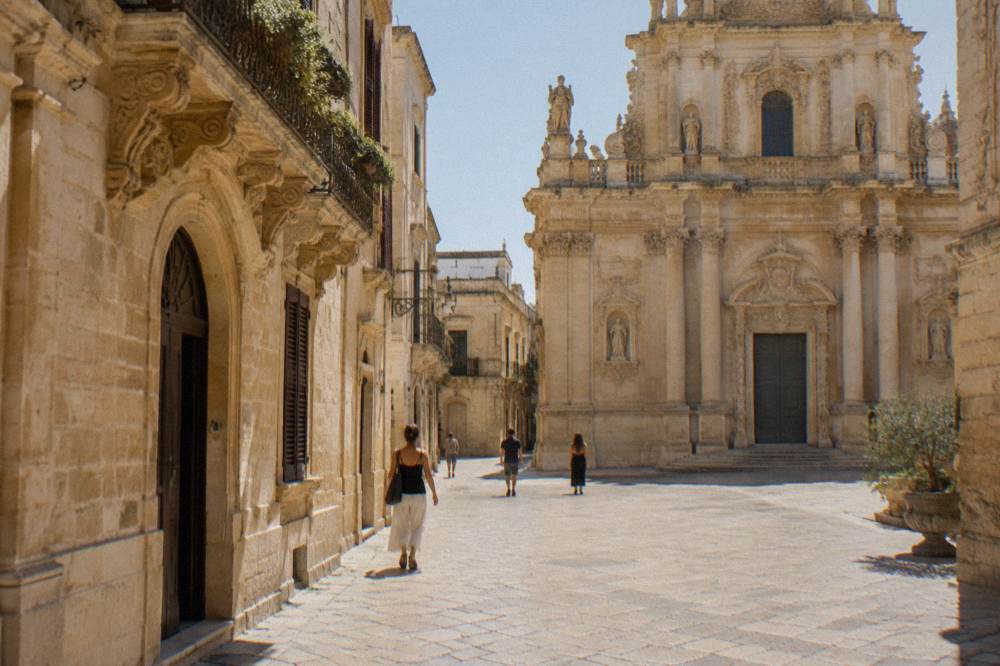
Look for three things: a warm pale-gold tone rather than grey or white, a fine even grain shot with tiny fossil shell fragments, and soft rounded weathering on carved edges rather than the crisp brittle fracture of harder limestones. Depth of carving is itself a clue, because no mason would attempt Lecce's deep foliage and figural work in a stone that fought back, so the sheer density of ornament signals a carvable material.
In practice, stand close to a wall and read it. A rough or rear elevation is the honest place to start, because it shows the raw block: even, pale, granular, with dark flecks that are fossils and iron oxides. Then find a carved detail at eye level, a wreath, a cherub's wing, a coat of arms, and notice how edges have rounded and surfaces have slightly sugared over the centuries. Marble keeps a polish; pietra leccese goes matte. Brick and travertine, the materials a visitor might otherwise confuse it with, are either obviously fired red or ringingly hard and pale-grey.
Weathering tells the rest of the story. Where rain has channelled down a facade the stone darkens to a deep honey brown, and where it stays sheltered it pales almost to ivory, so a single facade often carries a full tonal range. That gradient is one of the pleasures of walking the centro storico slowly rather than ticking monuments off. Two buildings to compare directly: the Chiesa di San Matteo's front, where the carving is so deep it traps shadow at noon, and the plain garden walls of the Villa Comunale, where the stone does no performing at all and simply glows.
Is The Stone Why Lecce Has So Much Carving Everywhere?
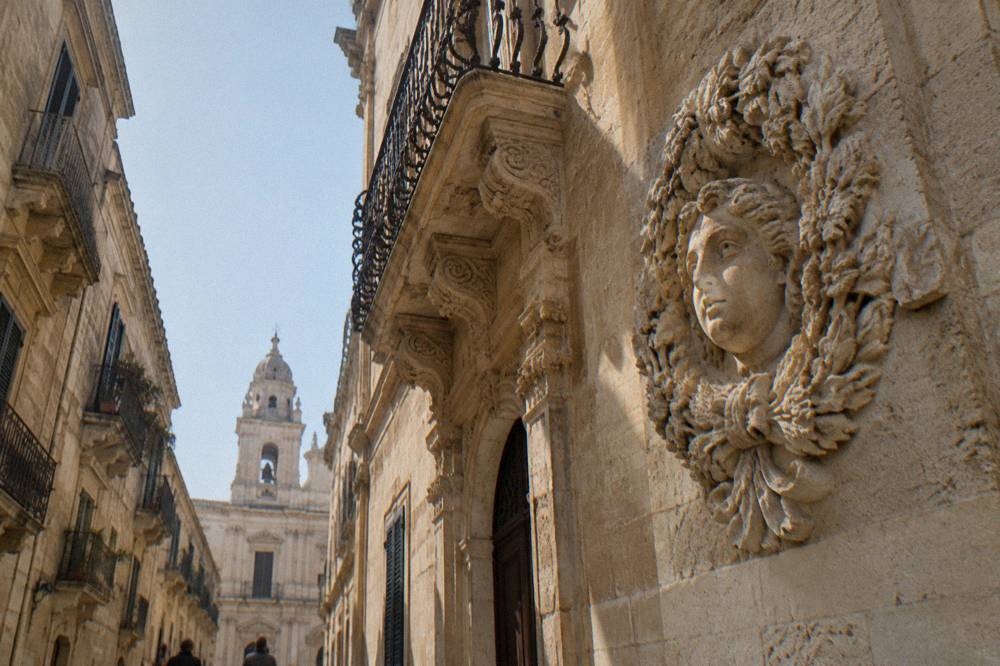
Yes: the softness of freshly quarried pietra leccese is the direct technical reason Lecce Baroque carries its extraordinary density of ornament, because carvers could work quickly and cheaply in it, treating the building stone itself as a sculptural medium rather than adding decoration in imported marble. The city's masons and cartapesta makers worked in parallel, and the results cover facades, altars, portals and even garden walls across the old town.
The economics are the underrated part. In cities where facade sculpture meant Carrara marble, ornament was an import and a luxury concentrated on a few monuments. In Lecce the ornamental medium was the structural material itself, already in the ground beneath the city, so carving scaled across whole streets and private palazzi, not just state and church showpieces. A doorway, a balcony bracket, a window surround: all of it could be foliage and faces at marginal cost. That is why wandering off the main squares in Lecce rewards the walker with minor masterpieces on unremarkable lanes. The rest of the planning pages sit on Lecce Travel Guide.
The craft also fed the city's other signature art, cartapesta, papier mache. The traditions were cousins: the same workshops and families supplied religious figures in either medium, and the papier mache sculptors imitated stone and gilded wood finishes. The site's guide to Lecce papier mache covers that story, and the Museo della Cartapesta inside the Castello Carlo V, included in the castle's guided tour, displays the results. The Castello Carlo V itself, by the way, is the one major old-town building that reads differently: a defensive structure in heavier, sterner masonry, a useful contrast to the lace-like church fronts nearby.
| Material or finish | How to recognise it in Lecce |
|---|---|
| Pietra leccese, fresh ashlar | Pale even cream-gold blocks, faint fossil flecks |
| Pietra leccese, carved ornament | Deep foliage and figures, rounded weathered edges |
| Pietra leccese, rain-darkened | Deep honey brown along water channels |
| Cartapesta (papier mache) | Lighter, hollow-sounding painted figures, usually interior |
| Brick interventions | Red, obvious against the limestone streetscape |
Can You Go Underground To See The Stone From Below?
Yes: the Museo Faggiano on Via Ascanio Grandi exposes layer after layer of excavated history beneath a townhouse, including Messapian, Roman and medieval levels cut into the living rock, and several guided walks in Lecce include cellar and underground rooms carved from the same formation. The museum is open every day 9:30 to 20:00 and costs 5 euro full, 3 euro for ages 8 to 16, free to age 8.
The underground side of pietra leccese is the city's best-kept structural secret. Because the stone is soft and shallow, Leccesi have been digging down into it for millennia: cisterns, granaries, escape passages, storage cellars and, in the Faggiano's case, a stratified archive of occupation levels all cut into the calcarenite. Standing in those rooms you see the stone in section, unweathered, its true pale colour revealed, and you understand why quarrying and building here were two halves of one activity: dig a cellar, get building blocks for free.
Beyond the museum, the walking-tour roster includes walks that pair the facades with the spaces beneath them. The Baroque Architecture and Underground Rooms walking tour is the featured one for this page, and there is also an underground walk with tastings for those who want the subterranean half of the story with something in the glass:
How Has The Stone Been Restored And Protected?
Lecce's stone heritage is actively conserved: the Roman Amphitheatre's 1,500,000 euro PNRR-funded restoration reopened the monument with a new accessible entrance and ramp, the Castello Carlo V's surrounding piazza works were completed and blessed in 2026, and no closures were reported for the Duomo, Santa Croce or the amphitheatre in October 2026. The comune regulates materials in the historic centre, where traditional pietra leccese is the norm for the building stock.
Restoration of a soft sedimentary stone is slow, unglamorous work: consolidating sugaring surfaces, desalinating blackened crusts, replacing decayed blocks with matching new stone from surviving quarries. The amphitheatre project, funded under the PNRR programme and documented by the regional museums directorate, is the most visible recent example, and its accessible entrance changed how the monument meets the piazza above it. Around the Castello Carlo V, the piazza works that closed part of the square were finished in 2026, and the castle itself continues to host exhibitions alongside its permanent Museo della Cartapesta.
The protective frame is partly regulatory. The comune's planning norms treat pietra leccese as the traditional material of the historic fabric, which in practice governs repairs in the old town. There is also the heritage-status question that visitors often raise: Lecce is not a UNESCO World Heritage Site. "Salento and the Barocco Leccese" sits on Italy's Tentative List, placed there in 2006, and regional bodies continue to push for recognition, but the inscription has not happened. Any guide that tells you otherwise is repeating a common error.
| Conservation item | Status as reported |
|---|---|
| Roman Amphitheatre restoration | 1,500,000 euro PNRR project, reopened with accessible entrance |
| Castello Carlo V piazza works | Completed in 2026 |
| Duomo, Santa Croce | Open, no closure reported in October 2026 |
| UNESCO status | Tentative List only, since 2006 |
| Historic-centre materials | Regulated by comune planning norms |
Where Else In Salento Can You See The Stone Used?
The same calcarenite builds towns across the Salento peninsula: Otranto's Aragonese castle and old town walls, Gallipoli's island centre, Galatina's Basilica di Santa Caterina d'Alessandria (free entry), Castro's clifftop old town above the Grotta Zinzulusa, and the masserie and dry-stone walls that grid the olive country between them. Lecce remains the densest single display, but the material is regional, not municipal.
Travel east to Otranto and the stone turns defensive: thick walls, towers and the Aragonese castle, whose seasonal tickets run about 6 euro in low season to 12 euro in high, per the comune of Otranto's listings. Gallipoli's historic centre sits on a limestone island linked to the mainland by a bridge, a geology-made fortress where the building stone and the bedrock are the same thing. Galatina, an easy FSE train hop from Lecce, holds the Basilica di Santa Caterina d'Alessandria, free to enter, whose interior frescoes are carried on the same pale walls. Castro, on the Adriatic coast, perches its old town directly above limestone cliffs, and the Grotta Zinzulusa below it is a sea cave in the identical formation, visitable year-round on guided visits at 7 euro full, 4 euro reduced.
Inland, the stone goes vernacular. Masserie, the fortified farmhouses of the Salento plain, are built of it; so are the endless dry-stone walls partitioning olive groves, and the pajare, the corbelled field huts of the far south. This is the stone in its work clothes, and it is the landscape that the site's Salento itinerary guide crosses. For the coastal stops in detail, see Otranto, Gallipoli and Castro.
| Place | What the stone is doing there | Access notes |
|---|---|---|
| Otranto | Castle walls and old town | Castle ticket varies by season |
| Gallipoli | Island historic centre on limestone bedrock | Reachable by FSE train from Lecce |
| Galatina | Basilica di Santa Caterina d'Alessandria | Free entry, split daily hours |
| Castro | Clifftop old town above Grotta Zinzulusa | Cave 7 euro full, 4 euro reduced |
| Masserie inland | Fortified farm buildings | Visit arrangements vary, confirm locally |
What Does Rain And Weather Do To The Stone Over Time?
Rain gradually darkens and erodes pietra leccese: the porous calcarenite blackens where water channels down facades, carved edges round off, and sheltered surfaces stay pale, so old facades record their own drainage history in tone. Lecce's climate normals (ERA5 reanalysis, 1991-2020) put November as the wettest month at 93.7 mm and July as the driest at 15.3 mm, so the weathering season is autumn and winter.
You can read the rainfall table directly off the walls. The months that matter for the stone are October through December, when monthly totals climb from 91.3 mm to the November peak of 93.7 mm; the summer barely wets it, with July at 15.3 mm. A facade that has stood two centuries carries, in its streaks and crusts, the accumulated pattern of a couple of hundred rainy seasons, and restorers effectively undo that record in the course of a cleaning campaign. That is also why freshly cleaned buildings in Lecce can look startlingly pale next to their neighbours, and why they re-tone within a few years.
| Season | ERA5 rain pattern, 1991-2020 | Effect you can see |
|---|---|---|
| Spring (Mar to May) | About 40 to 65 mm per month | Surfaces drying, pale tones |
| Summer (Jun to Aug) | About 15 to 18 mm per month | Maximum glow, dry stone |
| Autumn (Sep to Nov) | Peaks in November at 93.7 mm | Darkening streaks return |
| Winter (Dec to Feb) | About 59 to 76 mm per month | Deep honey browns on wet walls |
For planning around the light rather than the weathering, the site's guides to the best time to visit Lecce and Lecce weather carry the full monthly picture.
How Should You Plan A Day Around The Stone In Lecce?
Start at the Basilica di Santa Croce and the Palazzo dei Celestini courtyard in the morning, walk to Piazza del Duomo on the LeccEcclesiae ticket (11 euro, valid 15 days), see the Roman Amphitheatre from Piazza Sant'Oronzo at midday, then descend at the Museo Faggiano (5 euro, open to 20:00) and finish with the raking evening light on an east-west street. One full day covers the stone story at walking pace.
The sequence works because it runs soft to ancient to underground to golden hour. Morning belongs to the baroque showpieces, when the churches open at 9:00 and the facades are in flat, readable light. Midday is for the amphitheatre and the square, with the option of the 5 euro visit inside. Late afternoon is the Faggiano, which closes at 20:00 and needs no advance booking. Then, in the last hour of light, do nothing in particular: walk a lane that runs into the sun and watch the whole corpus of pietra leccese do the thing it does.
If the day leaves you wanting a guide's eye on the facades, or a meal in a home whose walls are the same stone, these are the site's picks:
And for the experience that pairs the carving above ground with the rooms below:
Can You Buy Lecce Stone, Or Things Made From It?
Small carved objects in pietra leccese, from paperweights to carved panels and architectural fragments, are sold by artisan shops and some masonry workshops in Lecce's historic centre, alongside the city's better-known cartapesta figures, though this site has no verified list of individual workshops or prices. Ask in the botteghe around the Santa Croce quarter and confirm provenance and price in the shop.
The honest advice is to buy with your eyes open. Genuine carved stone has weight, coolness to the touch and the fossil flecks described above; cast resin imitations are lighter and warm quickly in the hand. Beyond objects, the stone's presence in Lecce spills into souvenirs of every kind simply because the backdrop photographs so well, and the shopping and souvenirs guide covers that wider field. For the craft that grew up alongside the stone carvers, the papier mache workshops remain the living tradition, and a hands-on class is a way to take home something made rather than mined. The site's page on what to eat in Lecce completes the trinity of what this city exports: stone, paste and pasticciotto.
Common Questions About Lecce Stone
What is Lecce stone called?
It is called pietra leccese, literally "Lecce stone", a Miocene calcarenite, a fine shell-bearing limestone quarried around Lecce and across the Salento plain. The comune's own planning and geological documents name it as the city's traditional building material.
Why are Lecce's buildings gold?
Because they are built from a single pale, warm-toned limestone that reflects low sunlight strongly. In flat midday light the same facades read cream or ivory; the gold effect belongs to morning and, above all, to the hour before sunset.
Is pietra leccese soft or hard?
Both, in sequence. It is soft and easily carved when first quarried, which is why Lecce's baroque ornament is so dense, and it then hardens on exposure to air. It remains porous and needs ongoing conservation.
Where can you see a pietra leccese quarry?
Former quarries survive across Salento as cut landscapes; the Parco delle Cave on Lecce's outskirts preserves disused workings as public parkland. The underground rooms visited on tours in the city, including those at Museo Faggiano, show the formation in section.
Is Lecce a UNESCO World Heritage Site because of its stone architecture?
No. "Salento and the Barocco Leccese" has been on Italy's UNESCO Tentative List since 2006, but the city is not inscribed on the World Heritage List.
Which buildings show Lecce stone best?
The Basilica di Santa Croce facade, the Duomo group, the Chiesa di San Matteo, the Chiesa di Santa Chiara and the plain courtyard of the Palazzo dei Celestini, with the Roman Amphitheatre showing the same formation in its ancient register.
The stone is the story of Lecce in one material: dug from under the city, carved while it yielded, hardened into the golden skyline that Salento is known for. Walk it slowly, in the last light, and the geology does the talking.