Chiesa Di San Matteo: The Convex And Concave Facade
The Chiesa di San Matteo in Lecce is the city's most sculptural baroque facade, a wall of pietra leccese that swells outward and caves inward, covered on the LeccEcclesiae combined church ticket.
Short answer
The Chiesa di San Matteo in Lecce is open daily 9:00 to 21:00 in summer (April to September) and 9:00 to 18:00 in winter (October to March), and entry is through the LeccEcclesiae combined ticket at 11 euro standard, valid 15 days across five churches plus the Diocesan Museum.
The Chiesa di San Matteo in Lecce, the baroque capital of Salento in Puglia, southern Italy, is the church travellers come to when they have already seen the Duomo and Santa Croce and want the style pushed one step further. Its facade is a single wall of honey-coloured pietra leccese limestone that does something almost no other church front in the city does: it bends. The lower storey swells outward toward the street in a convex curve, and the upper storey curves back away from it, concave, framed by volutes that leap between the two. Inside, the plan is elliptical, another rarity in a city of rectangular naves.
The church sits a short walk west of Piazza Sant'Oronzo, in the old centre where the streets narrow and the limestone walls close in. It is one of the five churches covered by the LeccEcclesiae combined ticket, alongside the Duomo with its crypt, the Basilica di Santa Croce, the Chiesa di Santa Chiara and the Antico Seminario with the Museo d'Arte Sacra. That single decision, one ticket covering five buildings valid for 15 days, shapes how the whole page is organised below.
What Makes The Facade Of Chiesa Di San Matteo In Lecce Unusual?
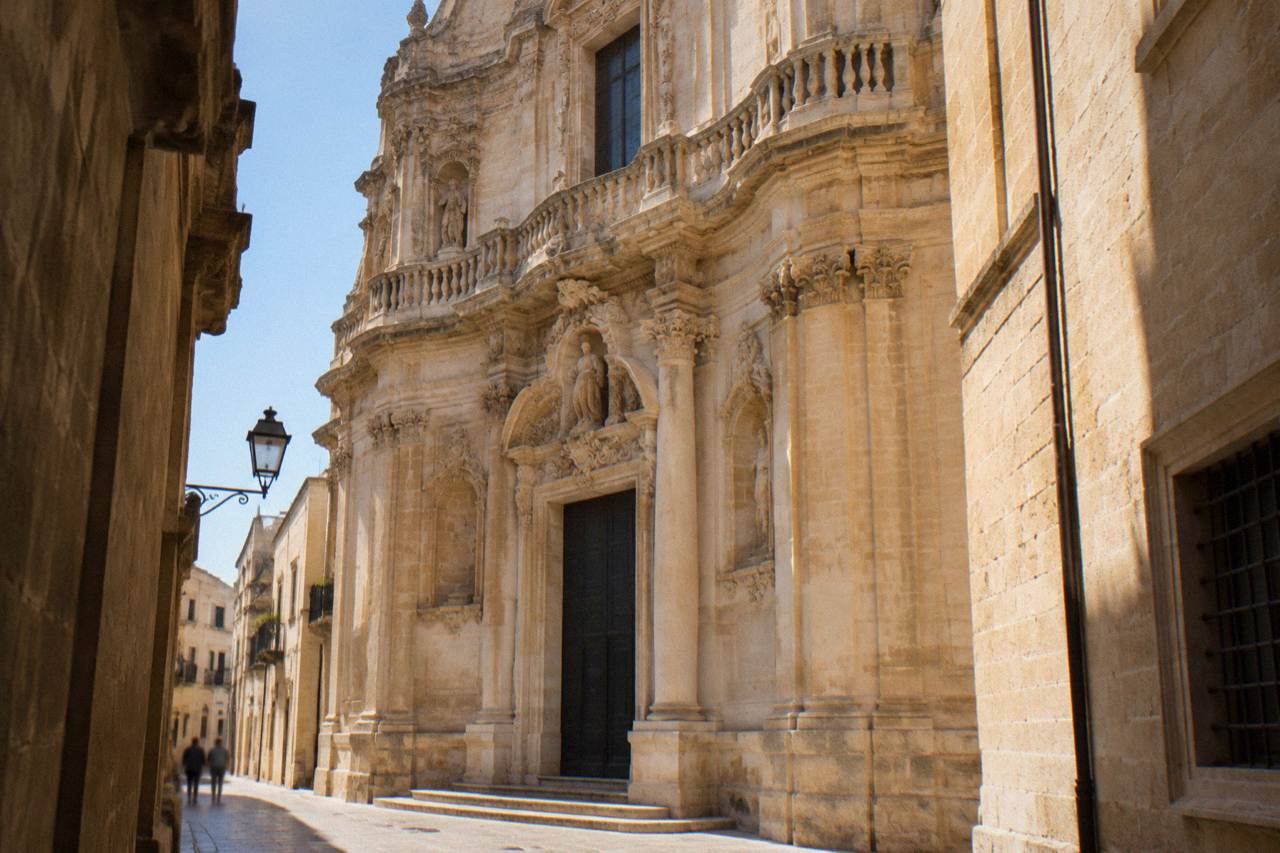
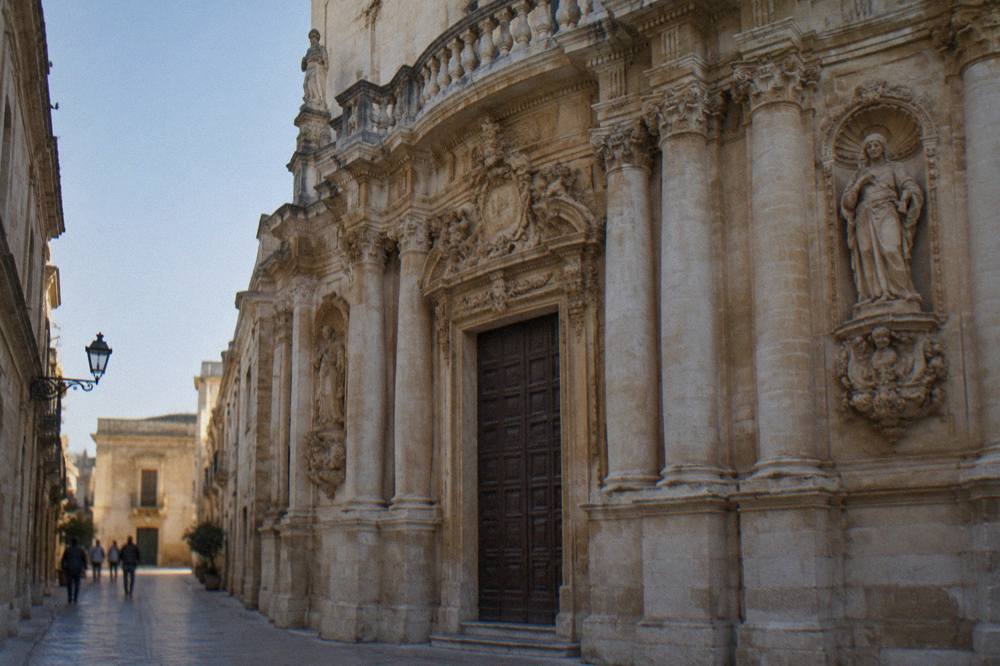
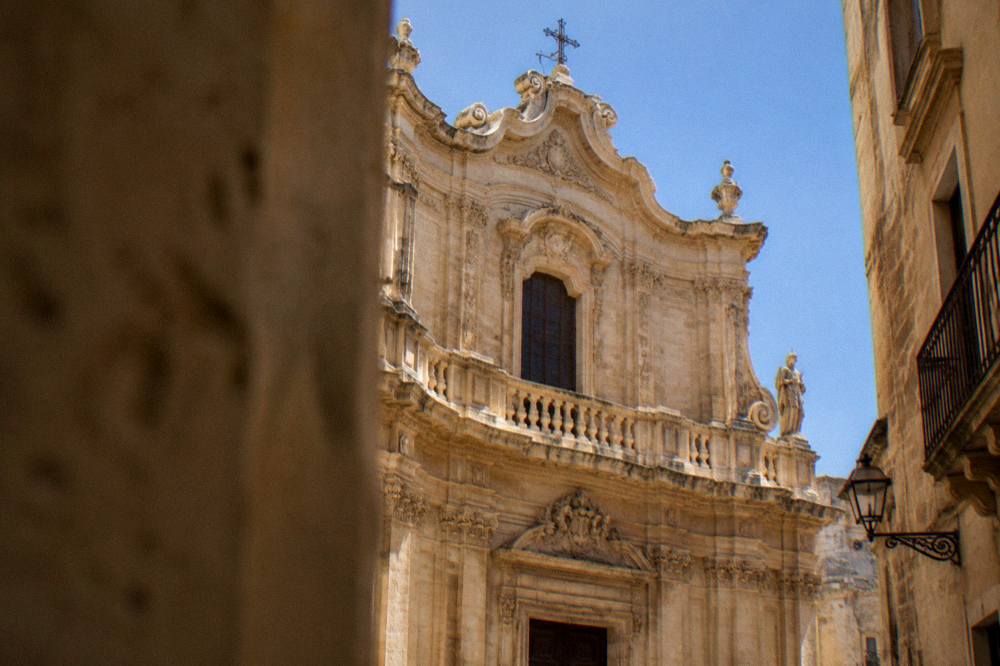
The Chiesa di San Matteo facade is the clearest example in Lecce of a baroque front built on opposing curves: the lower order bows outward toward the viewer in a convex sweep, the upper order recedes in a concave curve, and the two are stitched together by large scrolling volutes. The effect is a facade that appears to move as you walk past it. Most other major church fronts in the city are organised on flat or gently modelled planes.
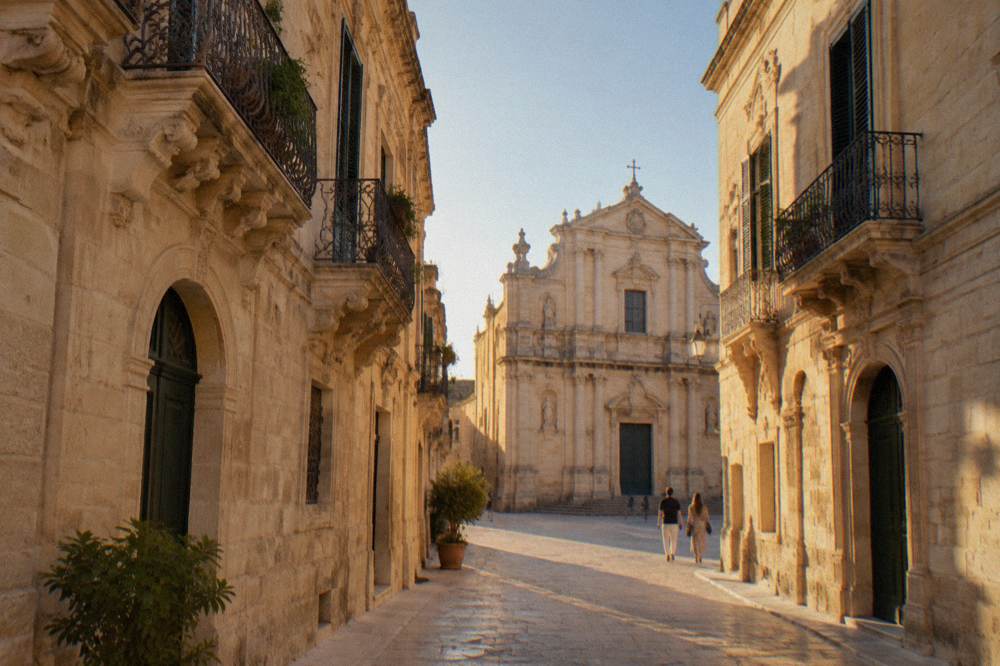
The contrast is easiest to see if you arrive from the direction of Piazza Sant'Oronzo. The streets funnel you toward the church at a slight angle, and that angle is where the curves do their work. A flat facade reads the same from every position; a concave-convex facade changes continuously. Stand to the left of the portal and the lower storey seems to swell toward you; cross to the right and the upper storey appears to open like a shallow shell. No photograph settles it, because the geometry is the architecture here, not the ornament.
The ornament is still considerable. Columns are stacked and doubled, herms stand in place of plain pilasters, the portal is framed by broken pediments that overlap, and putti and leafwork crowd every horizontal band. All of it is carved from pietra leccese, the Miocene limestone quarried around Lecce that is soft and workable when first cut, then hardens on exposure to air. That softness is what allowed carvers to treat stone the way woodworkers treat wood, and the facade of San Matteo is one of the places in the city where the carving is at its most unrestrained.
What the curves also do is manage a narrow street. The church does not front a grand piazza like the Basilica di Santa Croce; it rises directly from the building line. The convex lower storey gives the portal physical and visual prominence without a square in front of it, and the concave upper storey pulls the eye upward and inward, creating depth on a plot that has none to spare.
How Much Does The Chiesa Di San Matteo Cost, And What Does The Ticket Include?
San Matteo is not ticketed on its own: it is covered by the LeccEcclesiae combined ticket, which costs 11 euro standard, 5 euro reduced for ages 12 to 17 and 24 euro for a family of two adults plus 12-to-17-year-old minors, and is valid for 15 days. The same ticket also covers the Duomo with its crypt, Santa Croce, Santa Chiara and the Antico Seminario with the Museo d'Arte Sacra. Children under 12 enter free.
That structure means the practical question is never "is San Matteo worth 11 euro" but "is the five-church circuit worth 11 euro", and for the baroque centre of Lecce the answer is usually yes, because the circuit includes the two landmark churches of the city. A fuller version of the ticket, at 21 euro full price, adds the Duomo bell tower ascent, with reduced and family rates published alongside. Tickets are sold at Piazza Duomo 5 and at the Basilica di Santa Croce, so a visitor can buy once and then walk the circuit over several days, since the 15-day validity removes any pressure to rush.
| Ticket | Full | Reduced (12-17) | Family (2 adults + minors 12-17) | Covers |
|---|---|---|---|---|
| LeccEcclesiae standard | 11 EUR | 5 EUR | 24 EUR | Duomo + crypt, Santa Croce, San Matteo, Santa Chiara, Antico Seminario + MuDAS |
| LeccEcclesiae with bell tower "Up!" | 21 EUR | 13 EUR | 48 EUR | All of the above plus the Duomo bell tower ascent |
| Children under 12 | Free | Free | Free | All LeccEcclesiae sites |
There is also a broader Artwork city pass at 29 euro for 7 days that bundles the LeccEcclesiae sites and the bell tower with additional attractions, sold through its own listing; whether that pays off depends on how many of the extras a visitor actually plans to see.
A guided walk is another way in, and it removes the ticket question entirely: a guided tour with entry to the Duomo and the Basilica di Santa Croce included covers the headline churches with the guide's fee carrying the entries, and it can be paired with the combined ticket on another day for the remaining sites such as San Matteo. You can Check availability on the operator's live listing.
When Is The Chiesa Di San Matteo Open, And When Should You Go?
The LeccEcclesiae churches, San Matteo included, are open daily from 9:00 to 21:00 in summer (April to September) and from 9:00 to 18:00 in winter (October to March), with last entry 15 minutes before closing. Tourist visits pause during religious services, so a Sunday morning visit can collide with Mass. Under-12s enter free and diocese residents enter free with ID.
The summer evening hours are the quiet advantage of the system. Between April and September the churches stay open until 21:00, which means a visit at 19:30 or 20:00 is possible after a day of sightseeing, and the low evening light on pietra leccese flatters the carving in a way the midday glare does not. In the winter window the schedule tightens, and October visitors should plan church time before about 17:45 to be safe with the last-entry rule.
Dress matters: shoulders and knees must be covered, the standard rule enforced across the diocese's visiting churches, and it applies in August heat as much as in January. The rule is easy to satisfy with a light scarf or a longer layer carried in a bag.
| Period | Hours | Notes |
|---|---|---|
| April to September | Daily 9:00 to 21:00 | Last entry 20:45; evening light suits photography |
| October to March | Daily 9:00 to 18:00 | Last entry 17:45; winter schedule |
| During services | Tourist access limited | Check chieselecce.it listings; Sundays most affected |
What Will You See Inside The Chiesa Di San Matteo?
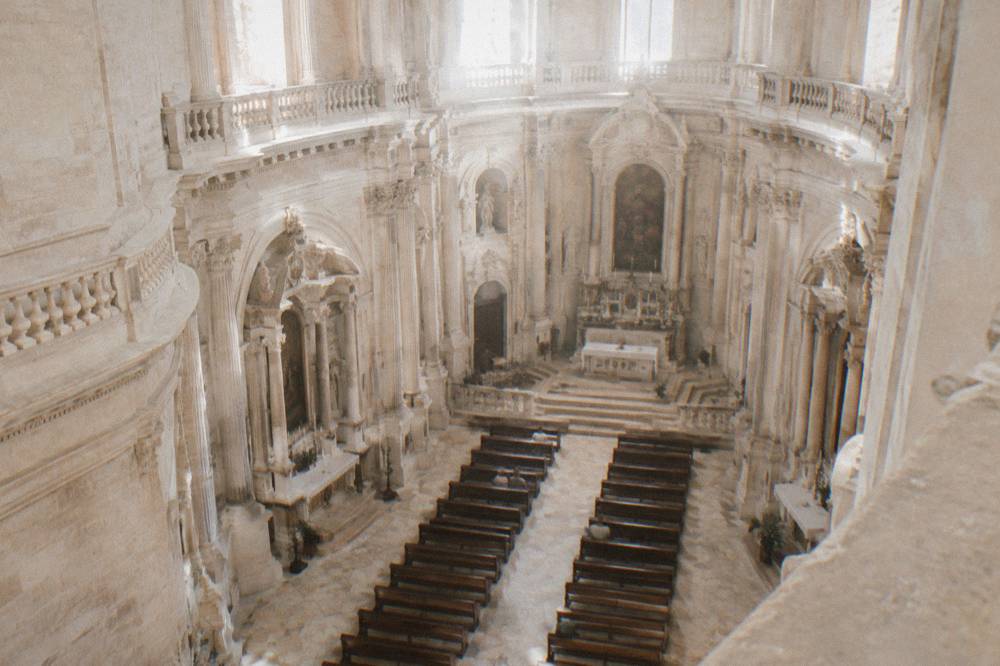
The interior of San Matteo is centred on an elliptical plan, a shaped space rather than the long rectangular nave used by the Duomo or Santa Croce, with side altars, carved stonework in pietra leccese and a decorated ceiling and presbytery area. The LeccEcclesiae listing includes the church among its ticketed sites, and the visitor experience is compact: one shaped room, richly finished, viewed in well under an hour.
The elliptical plan is the interior's signature and it matches the facade's logic. Where the outside plays convex against concave, the inside resolves into a continuous curved wall of altars, so that the eye travels around the room rather than down it. The carving is of the same school as everything else in the city: fruit garlands, cherubs, scrollwork and columns treated as sculpture rather than structure. Visitors who arrive straight from the Duomo will notice how much more of a single gesture this space is.
Photography is generally possible, but trips and services can change the room's usability, and flash is discouraged in the way it is across the diocese. Confirm any specific rule at the door. The church is small enough that a visit slots naturally between other stops, and it is close to Santa Chiara and the Museo Faggiano, both of which are short walks away and covered by, respectively, the same ticket and a separate 5 euro museum ticket.
Where Is The Chiesa Di San Matteo, And How Do You Reach It?
The Chiesa di San Matteo stands in the historic centre of Lecce, a few minutes on foot west of Piazza Sant'Oronzo and within the old city's walkable core; the entire centro storico is compact enough that the church needs no transport of its own. Lecce has no commercial airport, and the nearest gateway is Brindisi, about 47.6 km and roughly 43 minutes away by road.
Arriving visitors land at Brindisi and reach Lecce by airport bus, about 40 minutes at 6.50 euro one way per the operator's page, or by train via Brindisi station. From the Lecce train station the centre is a flat walk of roughly fifteen to twenty minutes, or a short city bus ride. Once inside the old walls, everything on the LeccEcclesiae circuit is on foot.
Drivers should note that the historic centre is a camera-policed ZTL, and the published hours vary by day type; ask your accommodation to register your plate if a car is part of the plan. Park outside the restricted zone, in a structure such as Park Liberty near the centre, and walk in.
| From | To San Matteo area | Practical note |
|---|---|---|
| Piazza Sant'Oronzo | A few minutes on foot | Level streets through the centro storico |
| Lecce station | Roughly 15 to 20 minutes on foot | Flat route; SGM city bus also serves the centre |
| Brindisi airport | About 43 minutes by road | Airport bus about 40 min, 6.50 EUR one way per the operator |
| Duomo / Piazza Duomo ticket point | Under 10 minutes on foot | Same combined ticket covers both |
How Does San Matteo Compare With Lecce's Other Baroque Churches?
Against the Duomo and Santa Croce, San Matteo is the more sculptural and experimental facade but the smaller and less monumental building; against Santa Chiara it is the more externally dramatic of the two; and unlike Sant'Irene or the Basilica del Rosario, whose hours and prices are not published on verified listings, San Matteo has confirmed access through the LeccEcclesiae ticket at 11 euro. It is best treated as the connoisseur's stop after the two landmarks.
The Duomo, in its closed courtyard off Piazza del Duomo, plays a different game: a restrained facade inside a theatrical square, with a bell tower that can be added to the ticket. Santa Croce is the city's maximalist statement, a facade of stacked ornament facing the Palazzo dei Celestini. San Matteo, by contrast, achieves its drama with geometry rather than sheer quantity of decoration, and that is exactly why repeat visitors to Lecce rank it highly. Sant'Irene and the Basilica del Rosario sit outside the combined-ticket system, so plan those separately and confirm access locally.
For a fuller walk through the style, the site's Lecce Baroque guide places all of these buildings in one itinerary, and the centro storico guide covers the streets between them. The craft tradition behind the carving, papier mache and stone, has its own story at lecce papier mache.
Can You Visit San Matteo On A Guided Tour Of Lecce?
Yes: guided walking tours of Lecce's historic centre run daily and pass through the baroque district where San Matteo stands, and one listed walk includes free entry to the Duomo and the Basilica di Santa Croce as part of the guided visit. San Matteo itself is reached either on that route or afterwards with the LeccEcclesiae ticket, which stays valid for 15 days, so a guided morning and a self-guided afternoon combine without waste.
Guided walks add what the stones cannot say for themselves: the vocabulary of the barocco leccese, the quarries and carvers, the reason a facade bends. The listing for the Duomo-included guided tour describes a walk focused on the two headline churches, and it suits a first day in the city. Tip-based walks also run locally; confirm arrangements directly with the guide.
For a different angle on the same craft tradition, a papier mache workshop teaches the technique that ran parallel to stone carving in the city's workshops for centuries, and it pairs well with a church-heavy morning. And for the evening, a home-cooked Salento meal in a local family house is the counterpart to a day of facades.
What Is There To See Near The Chiesa Di San Matteo?
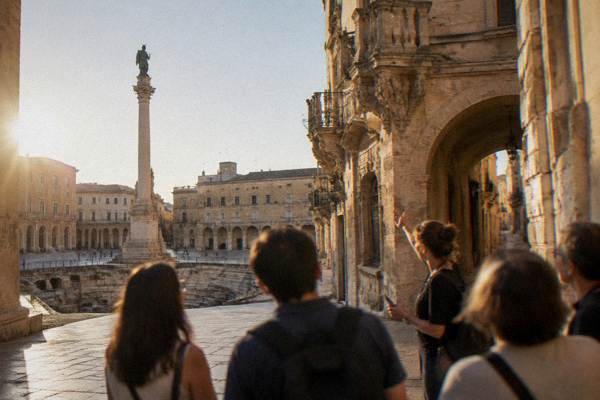
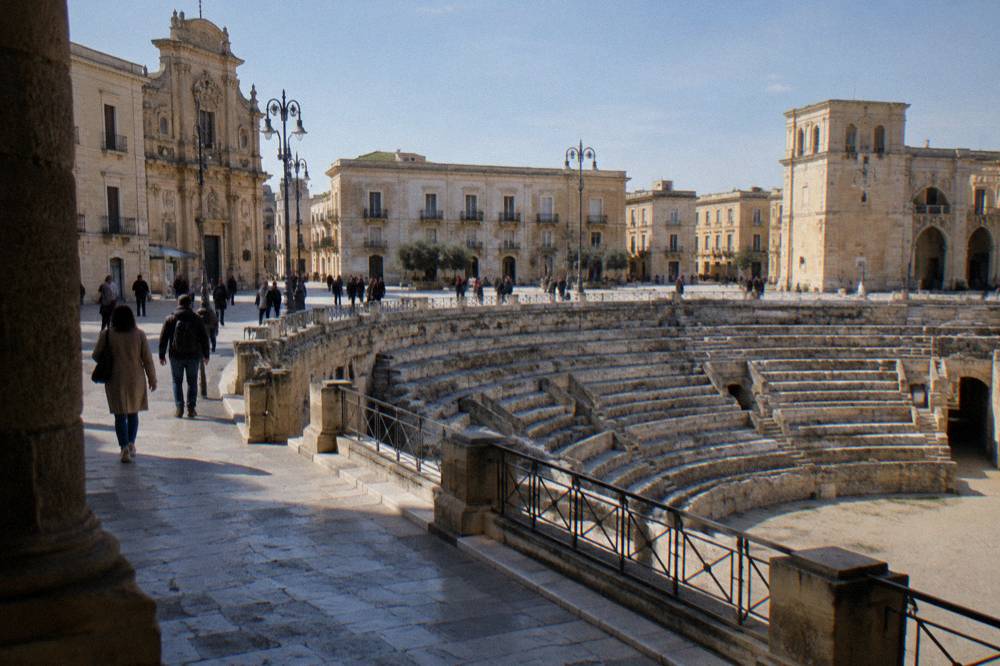
Within a short walk of San Matteo the visitor reaches Piazza Sant'Oronzo with the Roman Amphitheatre, the church of Santa Chiara, the Museo Faggiano archaeological house, the Museo Ebraico in the former Jewish quarter, and the shopping streets around Piazza Mazzini; everything is flat and walkable, and the whole loop can be covered in a morning.
The closest of these is the Chiesa di Santa Chiara, on the same LeccEcclesiae ticket, noted for its interior and its small cloister atmosphere. The Museo Faggiano is a different register entirely: a private house whose renovation uncovered layers of Messapian, Roman and medieval remains beneath the floors, open daily 9:30 to 20:00 at 5 euro with family reductions. The Jewish museum tells the story of Lecce's Jewish quarter, and the Teatro Romano, tucked into the streets a little further on, is the smaller Roman theatre sibling of the amphitheatre.
| Nearby site | Covered by | Verified ticket |
|---|---|---|
| Chiesa di Santa Chiara | LeccEcclesiae | Yes, combined 11 EUR |
| Museo Faggiano | Own ticket | 5 EUR, family reductions |
| Museo Ebraico | Own ticket | 5 EUR, guided visits |
| Roman Amphitheatre | Own ticket | 5 EUR full, 2 EUR reduced |
| Piazza Sant'Oronzo | Public space | Free |
What Is The Best Time Of Day And Year To Photograph The Facade?
The facade of San Matteo is best photographed in the low light of early morning or late afternoon, when the raking sun emphasises the convex and concave curves that flatten out under midday glare; in summer the churches stay open until 21:00, so an evening visit combines workable interior hours with golden exterior light. October brings the highest monthly rainfall of the year after November, per the ERA5 reanalysis, 1991-2020, so autumn photographers should keep a flexible window.
The curve is the whole subject, and curves read only in directional light. Around midday the sun sits high and the facade goes flat, the volutes losing their shadows. In the last two or three hours of daylight the western-facing stone glows, and even on an overcast day the modelling survives better than the colour contrast. A tripod is unnecessary; the street is narrow and steady handheld shots work fine, though a wide lens helps because the building is close.
Season-wise, spring and autumn give the most comfortable walking weather between churches, with ERA5 mean highs of about 23 C in May and 22 C in October. July and August mean highs reach about 31 C, which pushes sensible church-going toward the evening hours that the summer schedule conveniently allows.
What Else Should You Know Before Visiting The Chiesa Di San Matteo In Lecce?
Bring the LeccEcclesiae ticket, dress with shoulders and knees covered, plan around the 15-day validity rather than a single day, and remember that visits pause during services; there is no separate San Matteo ticket, under-12s are free, and the combined 11 euro standard price is bought at Piazza Duomo 5 or Santa Croce. The church is a stop on a walking circuit, not a destination requiring transport.
A practical sequence works like this: buy the combined ticket at the Duomo or Santa Croce, do those two on the first morning with a guide or alone, then use the remaining 15 days for Santa Chiara, the Antico Seminario with its Museo d'Arte Sacra, and San Matteo on a quieter day with a camera. The Lecce Travel Guide site's pages on Piazza Sant'Oronzo and the Castello Carlo V cover the other anchor sights for the same days, the castle being a guided-tour-only interior at 10 euro full with its courtyard free.
Lecce is a compact, low-crime city where petty theft is the main practical concern, and the walk back to accommodations after an evening church visit is unremarkable. The tourist tax exists, is collected by the accommodation at a top reported rate of 5 euro per night in the high season for the top category, and should be confirmed at booking.
For travellers building the rest of the Salento trip around the city, the boat and coast options are reachable without a car in summer through the Salento in Bus network, and the day-trip towns of Otranto and Gallipoli are direct train or bus rides from the station. But the reason San Matteo earns its page is local: it is the facade that shows what pietra leccese does when a carver stops stacking decoration and starts bending the wall itself.
Common Questions About The Chiesa Di San Matteo In Lecce
Is the Chiesa di San Matteo in Lecce free to visit?
No. It is covered by the LeccEcclesiae combined ticket at 11 euro standard, 5 euro for ages 12 to 17 and 24 euro for a family, with under-12s free. There is no separate single-church ticket listed.
What are the opening hours of the Chiesa di San Matteo in Lecce?
Daily 9:00 to 21:00 from April to September and 9:00 to 18:00 from October to March, with last entry 15 minutes before closing. Tourist visits pause during religious services.
What is special about the facade of San Matteo?
The facade combines a convex, outward-bowing lower storey with a concave upper storey, joined by large volutes. This opposing-curve composition is unusual among Lecce's major church facades, which are generally organised on flatter planes.
How long does a visit to the Chiesa di San Matteo take?
The church is compact and an elliptical single space, so a visit is typically well under an hour. It is usually combined with the other LeccEcclesiae sites on the same 15-day ticket.
Is there a dress code at the Chiesa di San Matteo?
Yes. Shoulders and knees must be covered, the standard rule across the diocese's visiting churches, enforced year-round.
Where do you buy the LeccEcclesiae ticket?
At Piazza Duomo 5 or at the Basilica di Santa Croce. The ticket is valid 15 days across the Duomo with crypt, Santa Croce, San Matteo, Santa Chiara and the Antico Seminario with the Museo d'Arte Sacra.