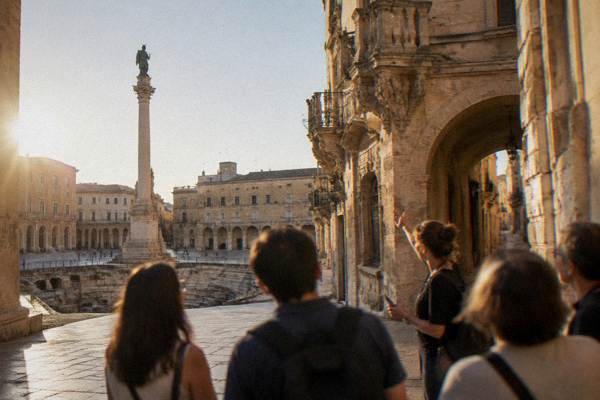
Basilica Del Rosario
The Basilica del Rosario is one of the quieter baroque churches of Lecce, the limestone capital of Salento in Puglia, and a short walk from Piazza Sant'Oronzo and the Duomo.
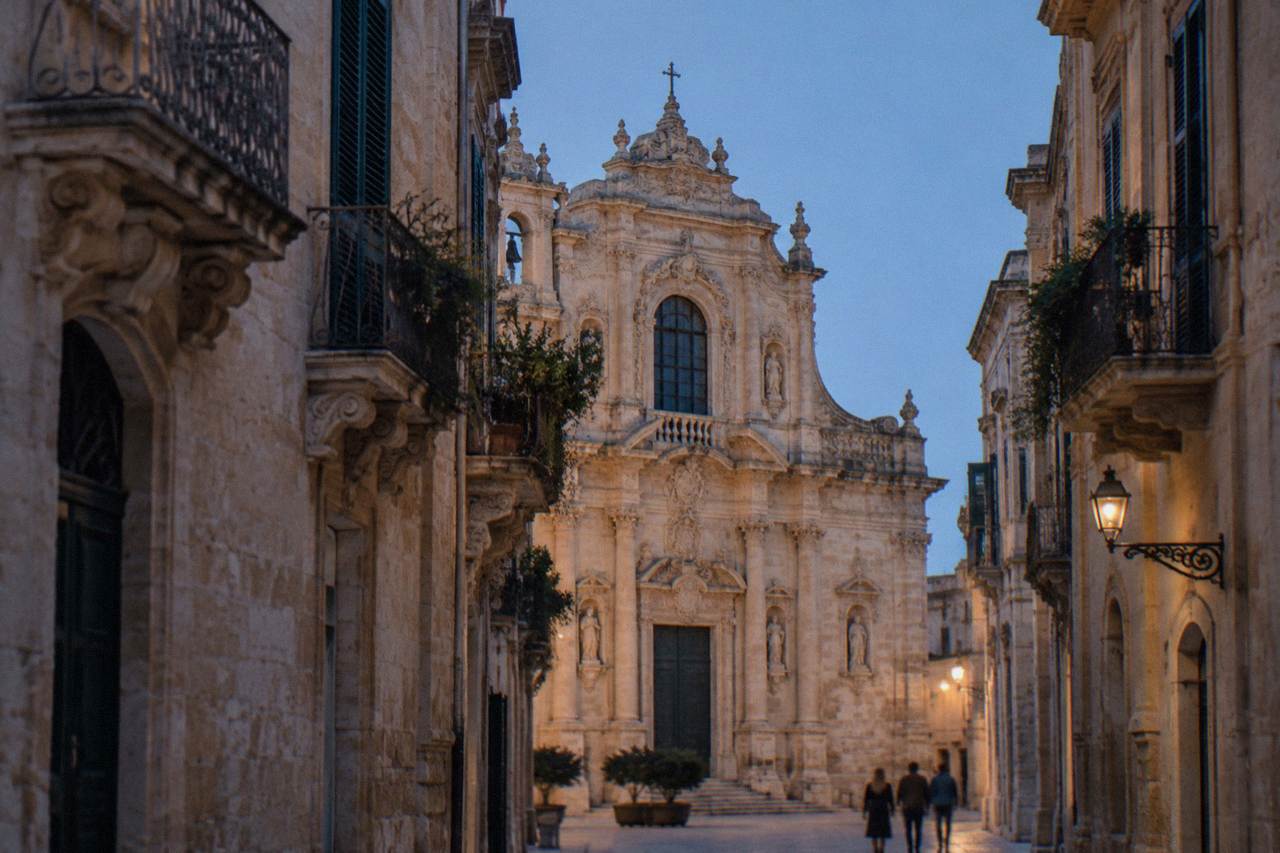
Short answer
The Basilica del Rosario is a baroque church in Lecce's centro storico, built in pietra leccese. It is not part of the LeccEcclesiae combined church ticket, which covers the Duomo, Santa Croce, San Matteo, Santa Chiara and the Antico Seminario. Hours and any entry arrangement should be confirmed on the spot.
The Basilica del Rosario stands in the old town of Lecce, the baroque capital of Salento in Puglia, southern Italy, a few kilometres inland from the Adriatic coast. It is one of the city's less trumpeted churches, which in a place built almost entirely of carved honey-coloured limestone is saying something. Its facade is the local pietra leccese, the soft Miocene limestone that hardens on exposure and made the city's dense baroque decoration possible. The basilica's name refers to the Rosary, the devotion associated with the Dominican order, and the church is often described as the final commission of the architect whose name dominates the story of Lecce Baroque; that attribution belongs to local tradition rather than documented fact, and no settled construction date for the basilica exists. What a visitor gets is a church of the old town's scale and light: a carved limestone front, an interior of columns and altars, and a location that puts it within a short walk of Piazza Sant'Oronzo, the Duomo and the Basilica di Santa Croce. This page from the Lecce Travel Guide sets out what is known, what is not, and how to fit the basilica into a day in the city.
What Is The Basilica Del Rosario In Lecce?
The Basilica del Rosario is a baroque church in the centro storico of Lecce, in Puglia, southern Italy, carved from the city's own pietra leccese limestone and no architect or construction date is stated here, because no official source consulted confirms one. It is a working church rather than a ticketed monument, and no verified opening hours or entry price exist for it.
The basilica belongs to the family of churches that make Lecce what it is. The city has no official, settled count of churches, and figures quoted around the internet vary widely, so this page prints none. What is certain is that the old town is dense with them, and that the Rosario sits among the second rank of sights behind the headline names: the Duomo in Piazza del Duomo, the Basilica di Santa Croce and the church of Sant'Irene. The Rosary dedication points to the Dominican tradition, the order that promoted the rosary devotion across Catholic Europe, and churches of this name across Italy are commonly Dominican foundations. For the building itself, the attribution to a single great name is carried in the approved page title as "last work", and it should be read exactly as tradition, not as a documented commission with dates.
The honest position on practical details is this: no verified hours, and no verified price, exist for the Basilica del Rosario in this site's research. Sant'Irene nearby is in the same position. When a church is unverified on logistics, the right move is to confirm on the spot: churches in Lecce are generally open during daytime hours, pause tourist visits during services, and expect shoulders and knees covered. That is a city-wide pattern reported by the Diocese's own visitor information for the ticketed churches, and it is a sensible default for this one too.
Where Is The Basilica Del Rosario And How Does It Fit Into A Lecce Walk?
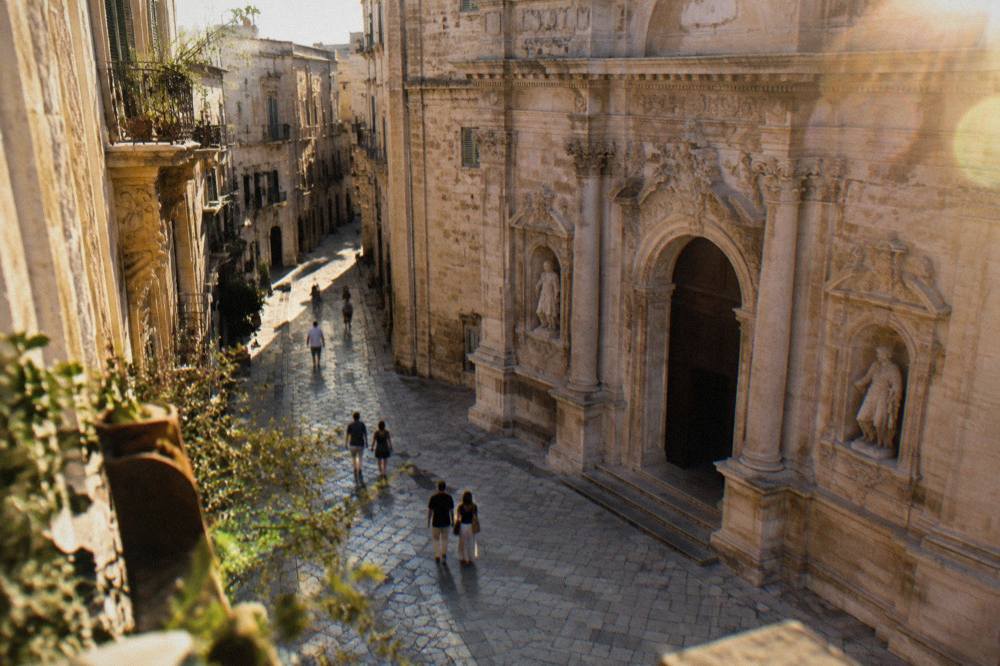
The Basilica del Rosario stands inside the centro storico of Lecce, within level walking distance of Piazza Sant'Oronzo, the Duomo complex and the Basilica di Santa Croce, so it slots naturally into any walking route through the old town. Lecce is compact and flat, and the whole baroque core is covered on foot.
Lecce's old town is small enough that geography matters less than order. A sensible baroque walk, described in more detail on the site's Lecce walking tour page, threads the major facades together. The centro storico is a grid of narrow limestone streets enclosed by the old walls, with the two great squares, Piazza Sant'Oronzo and Piazza del Duomo, as anchors. The Basilica del Rosario sits in the streets between them, close to the church of Sant'Irene, which faces the Piazza Sant'Oronzo area, so the pair are usually seen back to back on the same stretch of walking.
The pedestrian scale of the city is one of its practical strengths. There is no tram or metro to plan around; the historic centre is closed to unauthorised traffic much of the day by a camera-policed ZTL, and the streets themselves are the attraction. Visitors arriving at the station walk into the old core in a matter of minutes. For anyone structuring a first day, the site's Lecce in one day itinerary puts the church quarter at the centre of the route, and the Rosario is a natural add-on when the bigger basilicas are done.
| Landmark | Role in a walking route | Notes |
|---|---|---|
| Piazza Sant'Oronzo | Main civic square, usual starting point | Roman Amphitheatre visible free from the square |
| Basilica del Rosario | Quiet church between the major squares | No verified hours; confirm on the spot |
| Chiesa di Sant'Irene | Nearest of the other baroque churches | Also no verified hours or price |
| Piazza del Duomo | Cathedral square, the architectural climax | LeccEcclesiae ticket sites here |
| Basilica di Santa Croce | The signature facade of Lecce Baroque | Included in the LeccEcclesiae ticket |
A guided introduction is one way to see the quarter with context, and the operator's live listing covers the essentials with entry to the Duomo and Santa Croce arranged: Check availability.
What Do You See At The Basilica Del Rosario In Lecce?
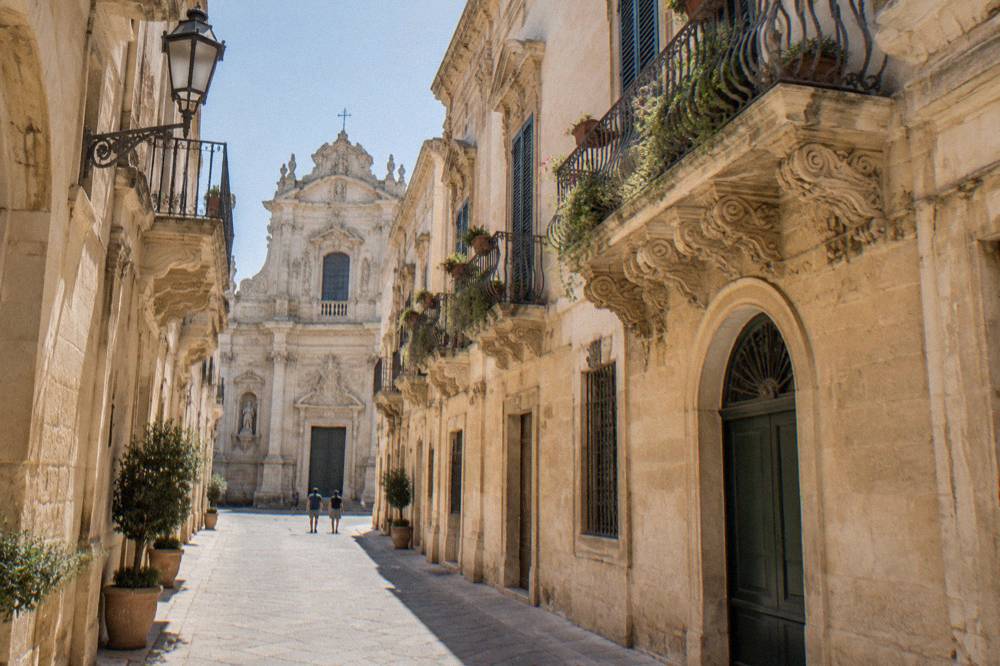
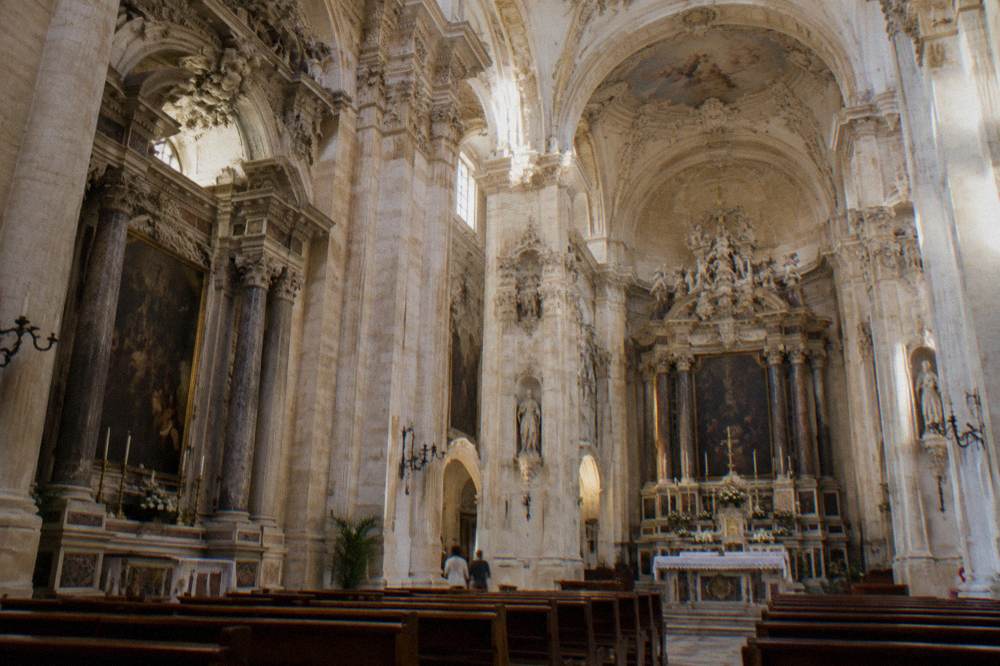
Visitors see a baroque church of the Lecce type: a pietra leccese facade with columns, niches and carved ornament around the portal, and an interior of side altars, stonework and painted decoration arranged on a single nave plan. As a working church it rewards a slow, quiet look rather than a ticketed monument visit, and photography etiquette follows church norms.
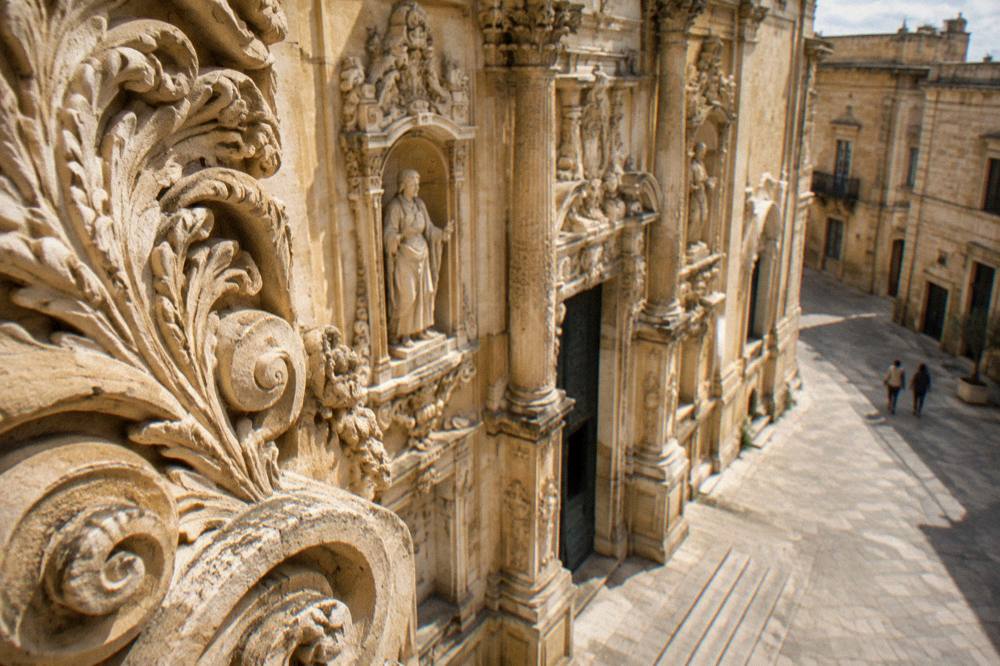
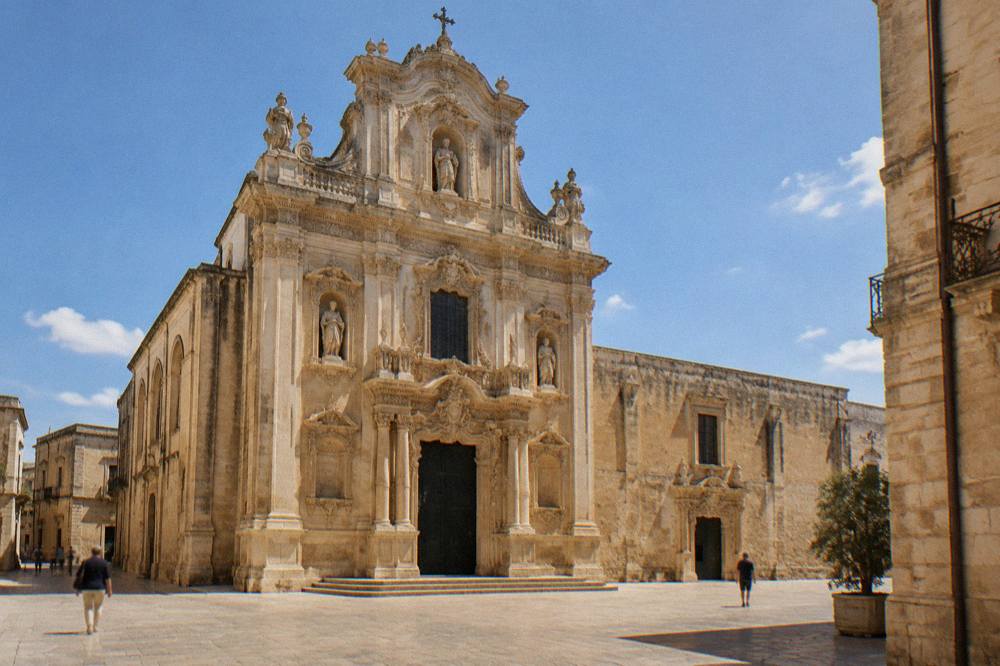
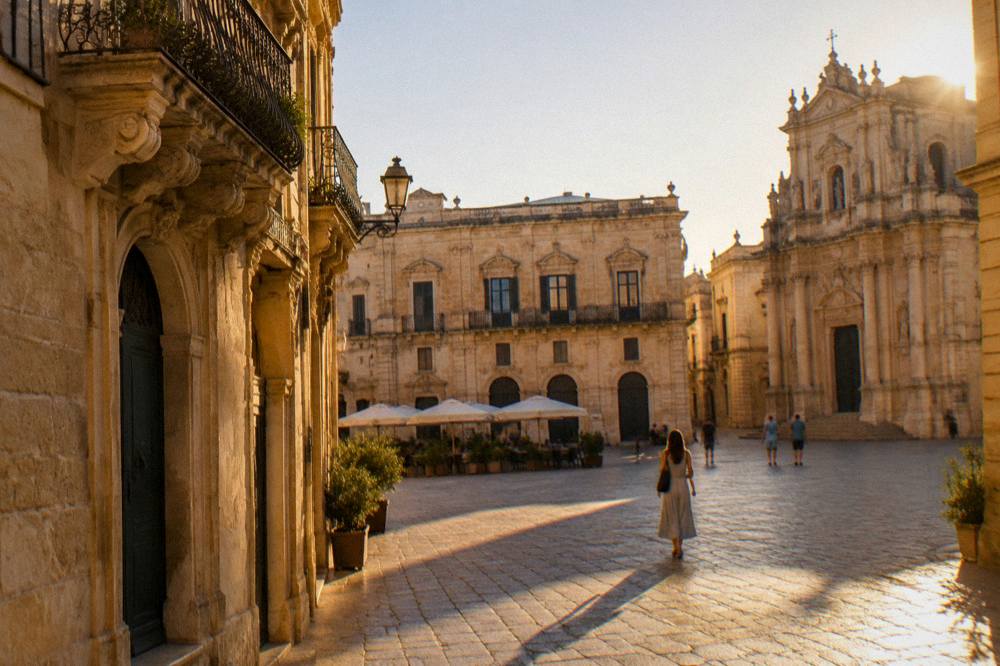
Describe the facade by what is in front of you, not by documents. The Rosario presents the vocabulary of Lecce Baroque: a two-stage front in pale golden stone, pilasters and columns stacked for theatrical depth, a central portal framed by carved surrounds, niches for statues, and a crowning element that lifts the eye upward. This is the signature of the local style, made possible because pietra leccese is soft and easy to carve when first quarried and then hardens in the open air, a property that let masons cut deep foliage, putti and scrollwork at a scale other cities could not match in harder stone. The same stone built everything from Santa Croce to the palaces of the centre, and the site's page on Lecce stone explains where it came from.
Inside, baroque churches of this city typically run to a single nave with paired side altars, a decorated apse and, in the richer cases, inlaid marble floors. The altars carry paintings and statuary, and the Rosary dedication means imagery connected to the Madonna and the mysteries of the rosary is the theme to look for. Lecce's churches double as galleries of local craft: much of the statuary in the city is cartapesta, the papier-mache technique that Lecce artisans developed for religious figures, and the craft is documented across the old town's workshops. The site's page on Lecce papier-mache covers the tradition.
Two practical cautions repeat across every church in Lecce and apply here. Dress with shoulders and knees covered, and expect visits to pause during religious services. The Diocese's visitor information for the ticketed churches states both plainly, and the Sunday Mass schedule takes precedence over sightseeing in any working church.
Is The Basilica Del Rosario Included In The LeccEcclesiae Ticket?
No. The LeccEcclesiae combined ticket covers the Duomo with its crypt, the Basilica di Santa Croce, the Chiesa di San Matteo, the Chiesa di Santa Chiara and the Antico Seminario with the MuDAS art museum, and the Basilica del Rosario is not on that list. The standard ticket costs 11 euro, with ages 12 to 17 paying 5 euro, and stays valid for 15 days.
The combined ticket is the single most useful piece of church logistics in Lecce, and the details below come from the Diocese's own information. Hours are daily 9:00 to 21:00 in the April to September summer season and 9:00 to 18:00 from October to March, with last entry 15 minutes before closing. Children under 12 enter free, and access is limited during services.
| Ticket | Full | Reduced (12-17) | Family (2 adults + minors 12-17) | Validity |
|---|---|---|---|---|
| LeccEcclesiae standard | 11 EUR | 5 EUR | 24 EUR | 15 days |
| LeccEcclesiae with bell tower "Up!" | 21 EUR | 13 EUR | 48 EUR | 15 days |
| Artwork city pass (7 days, adds extras) | 29 EUR | See current price | See current price | 7 days |
Because the Rosario stands outside this scheme, the practical reading is that it costs nothing to plan for and nothing to pre-book. A visitor confirms locally whether the doors are open at the hour of arrival. The contrast with the ticketed five is worth knowing in the other direction too: the combined ticket's 15-day validity means it can be spread across a whole week's stay, so the big churches do not all need to crowd into one day, and the free or confirm-locally churches like the Rosario, Sant'Irene and the public squares can fill the gaps between.
How Does The Basilica Del Rosario Compare With Lecce's Other Baroque Churches?
The Rosario is a quieter counterpart to the headline churches: smaller in reputation than the Basilica di Santa Croce, less monumental than the Duomo, and unverified on hours where those two are ticketed and scheduled. Its value is atmosphere and convenience, sitting between the two great squares, while Santa Croce and the Duomo carry the city's most elaborate facades and interiors.
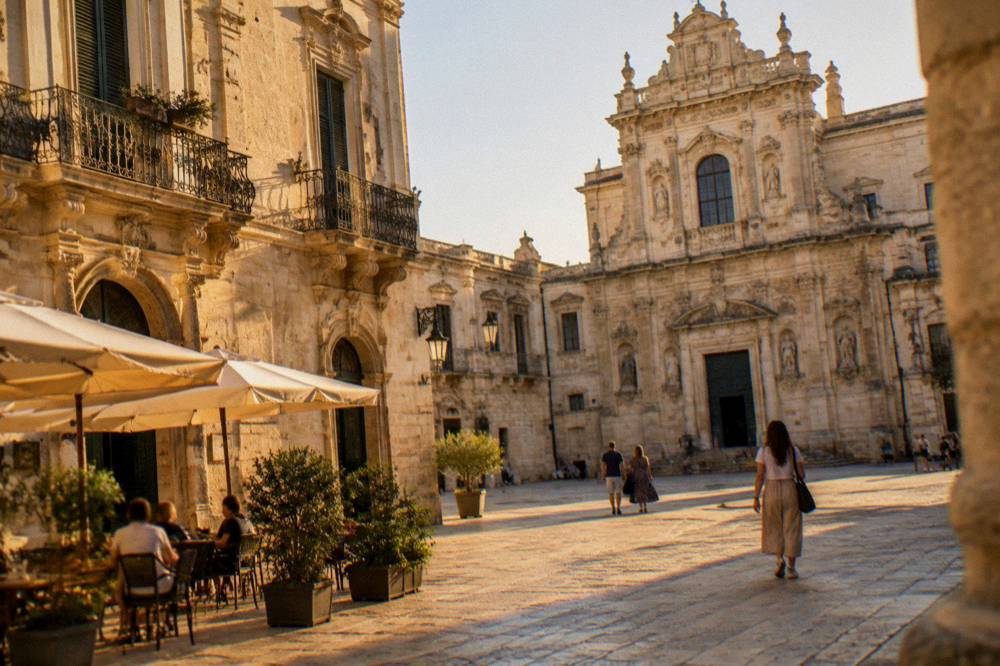
Every church city has a hierarchy, and Lecce's is unusually legible. The Basilica di Santa Croce has the most celebrated facade in the city, a screen of ornament that gives Lecce its reputation; the site's page on Santa Croce describes it in detail. The Duomo compound, with its piazza, campanile and crypt, is the largest single set of ecclesiastical architecture in the centre. Around them sit the second rank: San Matteo with its convex facade, Santa Chiara with its papier-mache ceiling, Sant'Irene, and the Rosario. These are churches you see because they are on the way, which in a walking city is the highest compliment available.
| Church | Position in the old town | Ticket status | Standout feature |
|---|---|---|---|
| Basilica di Santa Croce | Off the main street near the centre | LeccEcclesiae, 11 EUR standard | The city's signature baroque facade |
| Duomo and crypt | Piazza del Duomo | LeccEcclesiae | Cathedral square, campanile, crypt |
| Chiesa di San Matteo | Centro storico | LeccEcclesiae | Curved, undulating facade |
| Chiesa di Santa Chiara | Centro storico | LeccEcclesiae | Cartapesta ceiling work |
| Basilica del Rosario | Between the main squares | Not on the ticket; confirm locally | Quiet Dominican-tradition interior |
| Chiesa di Sant'Irene | Near Piazza Sant'Oronzo | Not on the ticket; confirm locally | Facade on the walking route north |
The comparison is also a scheduling one. The ticketed five have published hours and a formal entry; the rest run on church time. A workable pattern is to buy LeccEcclesiae for the start of a stay, then spend remaining days drifting through the free tier of the old town: the Rosario, Porta Napoli, the public rooms of the Villa Comunale, and the free views over the Roman Amphitheatre from Piazza Sant'Oronzo. The site's page on free things to do in Lecce collects more of that tier.
For visitors who want the stories behind the stone, a themed walk adds what the facades themselves do not say, and a baroque-and-underground option is one of the strongest in the city.
When Is The Best Time To Visit The Basilica Del Rosario In Lecce?
The best time to see the Basilica del Rosario, and Lecce generally, is spring or early autumn: the ERA5 reanalysis for Lecce, 1991-2020, shows mean daily highs of 23.4 C in May and 21.8 C in October against 31.3 C in August, with rainfall lowest in July at 15.3 mm and highest in November at 93.7 mm. Church interiors also stay cooler than the street in summer.
The numbers behind that answer come from modelled climate normals for the grid cell near Lecce and are worth reading as ranges rather than forecasts. Summer is hot and dry, with July and August both averaging daily highs above 31 C and very little rain; winter is mild on paper, with a January mean low of 6.7 C, but damp. October, the month this guide's data reflects, carries a mean high of 21.8 C and 91.3 mm of rain, so late autumn visitors should plan around showers rather than heat.
| Month | Mean high C | Mean low C | Rain mm |
|---|---|---|---|
| April | 18.6 | 10.7 | 54.6 |
| May | 23.4 | 14.7 | 39.9 |
| June | 28.2 | 19.1 | 18.0 |
| July | 31.0 | 21.7 | 15.3 |
| August | 31.3 | 22.2 | 18.1 |
| September | 26.4 | 19.0 | 58.9 |
| October | 21.8 | 15.4 | 91.3 |
Values are ERA5 reanalysis, 1991-2020, for the grid cell near Lecce at about 48 m elevation. The site's fuller Lecce weather and best time to visit Lecce pages develop the seasonal argument. For a church like the Rosario specifically, light is part of the visit: baroque interiors in Lecce are at their best with low morning or late-afternoon sun through the windows, and the limestone streets outside photograph best in the same hours, when the stone glows rather than glares. Midday in July and August is the hour to be inside any church in this city, for temperature as much as anything.
What Is Near The Basilica Del Rosario In Lecce?
Within a few minutes' walk of the Basilica del Rosario lie Piazza Sant'Oronzo with the Roman Amphitheatre, the whole Piazza del Duomo complex, the Museo Faggiano's underground layers, the Castello Carlo V and the Teatro Romano, so the basilica sits at the centre of everything a first visit to Lecce covers. Nothing in the old town needs transport.
The density is the point. The Museo Faggiano is a townhouse turned accidental archaeology museum, open daily 9:30 to 20:00 for 5 euro. The Castello Carlo V is a guided-tour-only visit, 10 euro full, courtyard free. The Teatro Romano and its small museum run weekday mornings. The Roman Amphitheatre in Piazza Sant'Oronzo reopened after a 1,500,000 euro PNRR restoration with a new accessible entrance, per the museum authority's own page. All of these are strung along the same walkable core as the Rosario, and the MUST museum and Museo Castromediano extend the museum day for anyone with more time.
| Nearby sight | Type | Entry | Verified detail |
|---|---|---|---|
| Roman Amphitheatre | Archaeology, Piazza Sant'Oronzo | 5 EUR full, 2 EUR reduced | Tue-Sun, closed Mon; visible free from the square |
| Museo Faggiano | Underground archaeology | 5 EUR, ages 8-16 3 EUR | Daily 9:30 to 20:00 |
| Castello Carlo V | Castle, guided tours only | 10 EUR full, courtyard free | Tue-Sun, closed Mon |
| Basilica di Santa Croce | Church | LeccEcclesiae 11 EUR | Daily 9:00 to 18:00 winter, to 21:00 summer |
| Basilica del Rosario | Church | Confirm locally | No verified hours |
Beyond the city, the Rosario's central position makes it a natural first stop on days that end elsewhere. Otranto is about 46.7 km and 44 minutes' drive away, Gallipoli about 41.0 km and 41 minutes, and Galatina, the town whose Pasticceria Ascalone claims the invention of the pasticciotto in 1745, a claim the shop itself makes and historians dispute, is about 25.7 km and 29 minutes. Train options and the seasonal Salento in Bus summer network are covered on the site's Salento itinerary pages.
For travellers who prefer the city after dark, an evening walk built around Lecce's ancient and underground layers is another way to see the quarter, and the listing below covers a night option outside the daytime church circuit.
A food-and-underground combination is the third pattern worth knowing: several walks pair the old town's subterranean rooms with tastings, which suits a slow afternoon that begins with the churches.
Whether the Basilica del Rosario becomes a destination in itself or a brief pause between squares, it belongs to the layer of Lecce that rewards the unhurried: the churches without queues, the streets between the monuments, and the stone that gives the whole city its colour. Confirm the doors are open when you pass, cover shoulders and knees, and give the facade the minute it deserves.
Common Questions About The Basilica Del Rosario In Lecce
Is the Basilica del Rosario in Lecce free to enter?
No verified price or opening arrangement exists for the Basilica del Rosario. It is a working church rather than a ticketed monument, and it is not part of the LeccEcclesiae combined ticket. Confirm locally on arrival.
Is the Basilica del Rosario included in the LeccEcclesiae ticket?
No. The LeccEcclesiae ticket covers the Duomo with crypt, the Basilica di Santa Croce, San Matteo, Santa Chiara and the Antico Seminario with MuDAS. The Rosario is not on the list.
Who built the Basilica del Rosario in Lecce?
No architect attribution or construction date for the building is stated on this page, because none could be confirmed from an official source (Comune di Lecce, the Soprintendenza, Treccani). Treat any attribution you read elsewhere as unverified.
What are the opening hours of the Basilica del Rosario?
No verified hours exist for this church. As a general rule in Lecce, churches open during daytime hours, pause tourist visits during services, and require shoulders and knees covered. Check on the spot.
How far is the Basilica del Rosario from Piazza Sant'Oronzo?
The basilica stands inside the centro storico, a short level walk from Piazza Sant'Oronzo and the Duomo. Lecce's old town is compact and fully pedestrian in scale, so no transport is needed between them.