Pizzica And Tarantismo: The Music Behind The Festival
The pizzica is the fast, circling dance music of Salento, the peninsula around Lecce, and tarantismo is the old healing rite it grew out of. This guide explains the legend, the music and where to hear both today.
Short answer
The pizzica is a traditional tamburello-driven dance music from Salento, the region around Lecce in Puglia, born out of tarantismo, an old folk healing rite said to cure the bite of the tarantula. Today it peaks each August at the Notte della Taranta in Melpignano, about 30 minutes from Lecce.
Lecce, the baroque capital of Salento in Puglia, southern Italy, is the natural base for one of the most distinctive musical traditions in the Mediterranean: the pizzica. It is fast, hypnotic music built around the tamburello, the frame drum of the Salento peninsula, and behind it sits tarantismo, a healing rite that was practised in the villages around Lecce within living memory. The two are inseparable. You cannot understand the August festivals that light up the province, above all the Notte della Taranta at Melpignano, without knowing where the rhythm came from.
This page lays out the legend, the music and the practical side: what tarantismo actually was, what the instruments and steps are, when and where the festivals happen, and how to build a Lecce trip around them. Along the way it connects the tradition to the wider culture of the peninsula, from the paper and craft heritage of Lecce to the food and wine of Salento. If you are still shaping the trip itself, the main guide to things to do in Lecce covers the city's sights, and where to stay in Lecce sorts out the base.
What Is The Pizzica, And Where Does It Come From In Salento?
The pizzica is a couple-based folk dance music from Salento, the peninsula around Lecce in Puglia, driven by the tamburello frame drum and played at a rapid tempo in circles at village festivals. The name comes from the verb pizzicare, to sting or pinch, a direct reference to the spider at the centre of the tarantismo legend. It belongs to a wider southern Italian family of tarantella-type dances.
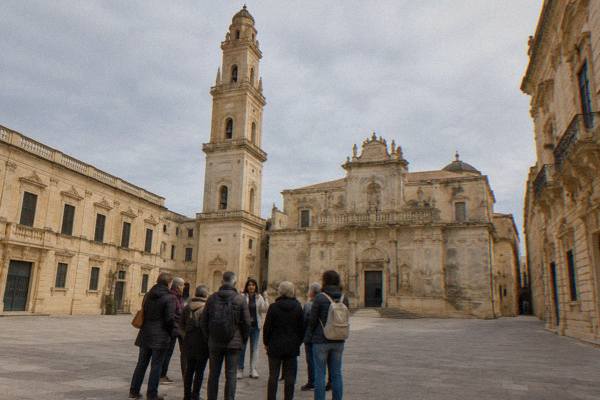
The tradition is rural, not urban. It grew up in the flat agricultural country of the Salento plain, in the towns and villages that stretch south and east of Lecce towards Otranto, Gallipoli and Santa Maria di Leuca, and it was music for feast days, harvests and patron saints rather than for concert halls. The Salento region guide covers that geography in detail: Lecce sits a few kilometres inland at the neck of the peninsula, with the Adriatic to the east and the Ionian to the west, and almost every village in the surrounding province has its own summer feast where a pizzica band still plays.
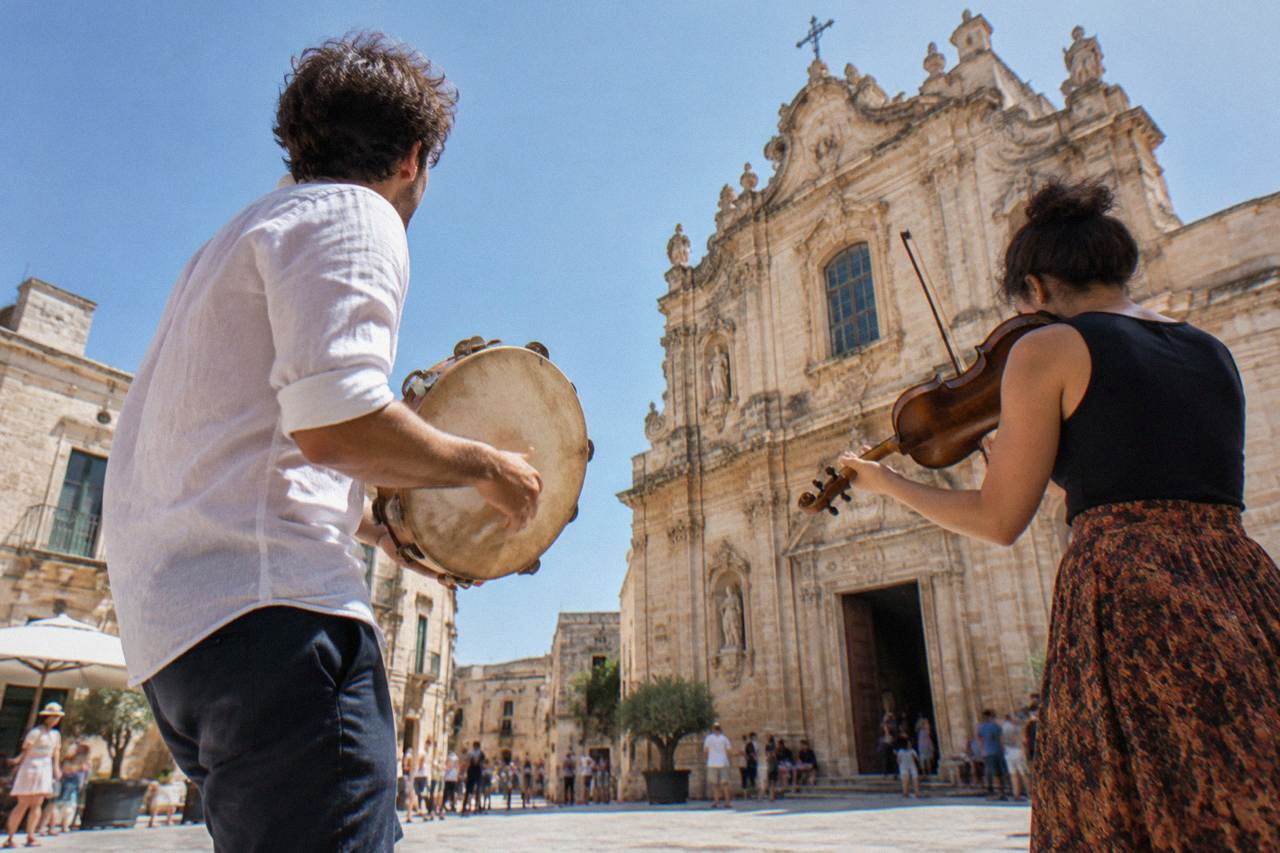
What distinguishes the pizzica from the generic tarantella that tourists meet elsewhere in southern Italy is the role of the drum. In the Salento version the tamburello is not a decoration, it is the lead instrument, and its rolling, galloping attack defines everything else the band plays around it. Violin, accordion, guitar and sometimes organetto and launeddas carry the melody, but the rhythm section commands the dance floor.
The music was nearly lost in the decades after the Second World War, when emigration and changing tastes emptied the village feasts. Its later revival, driven by researchers, folk musicians and then by the founding of the Notte della Taranta festival, turned a dying peasant tradition into the public sound of the whole peninsula. That revival is why a visitor basing themselves in Lecce today will hear the pizzica not only in small villages but in the city's own August celebrations.
What Was Tarantismo, The Tarantula Legend Behind The Pizzica?
Tarantismo was a folk healing rite of Salento, the region around Lecce, in which a person said to have been bitten by a tarantula was treated with continuous music and dancing until the poison was worked out. Tradition held that the victim, the tarantata or tarantato, could only be cured by the right rhythm. It was treated as a real condition in rural Salento within living memory.
By tradition, the bite was believed to strike mainly women working in the tobacco and tomato fields, and the symptoms were described as mood swings, fainting, aching limbs and a compulsion to dance. The cure, as the legend tells it, was not medicine but music: musicians came to the sufferer's house, found the rhythm that stirred her, and played for hours, sometimes for days, while she danced herself back to health. Each spider was said to respond to its own tune, so the band cycled through melodies until one took hold.
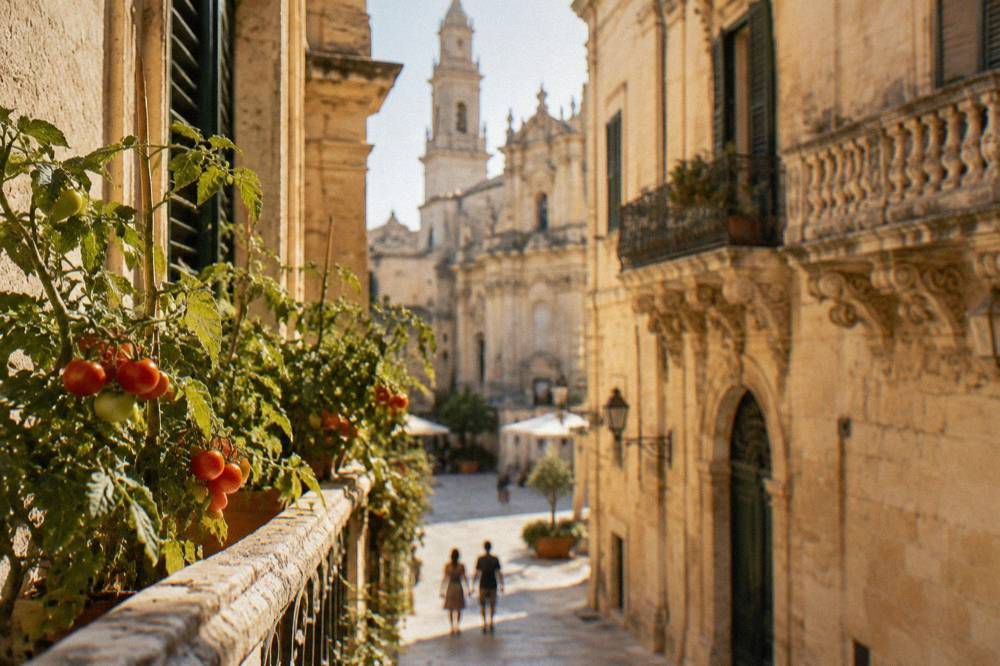
The rite clustered around 29 June, the feast of Saints Peter and Paul, when sufferers traditionally gathered at the chapel of San Paolo in Galatina, a short train ride from Lecce, to complete their cure. Anthropologists who studied the phenomenon during the rite's long decline described it as a culture-bound condition: a socially permitted outlet for distress in a strictly controlled rural society, expressed through music and dance rather than through language. The tradition's own explanation, the spider's bite, and the scholarly reading, a coded form of suffering, coexist, and this page presents both as reported, not as competing medical claims.
The rite faded as Salento modernised, and the medical framing of tarantismo belongs to the researchers who documented it. What survived was the music. When you watch a pizzica circle at a feast near Lecce today, you are watching the soundtrack of that old cure played for joy rather than for healing, and the connection is not forgotten: festival programmes around the peninsula still describe the dance in the language of the sting.
| Element Of The Legend | What Tradition Says | Notes |
|---|---|---|
| The spider | A tarantula whose bite causes languor, mood swings and a compulsion to dance | Folk belief, presented as tradition |
| The victim | Called tarantata or tarantato, mainly women field workers by tradition | The rite was reported across rural Salento |
| The cure | Continuous music and dancing to the correct rhythm, until the "poison" is expelled | Musicians were called to the house |
| The season | Traditionally peaked in summer, especially around 29 June | Field work and the feast calendar coincided |
| The shrine | Chapel of San Paolo at Galatina, near Lecce | Sufferers completed cures there by tradition |
| The survival | The music outlived the rite and became today's pizzica | Kept alive by researchers and folk musicians |
A night walk is one of the better ways to feel how Salento layers its past, and the evening guided walk known as Ancient City Night Tour near Lecce taps directly into that after-dark atmosphere the festivals trade on.
Where Can You Hear Pizzica In And Around Lecce Today?
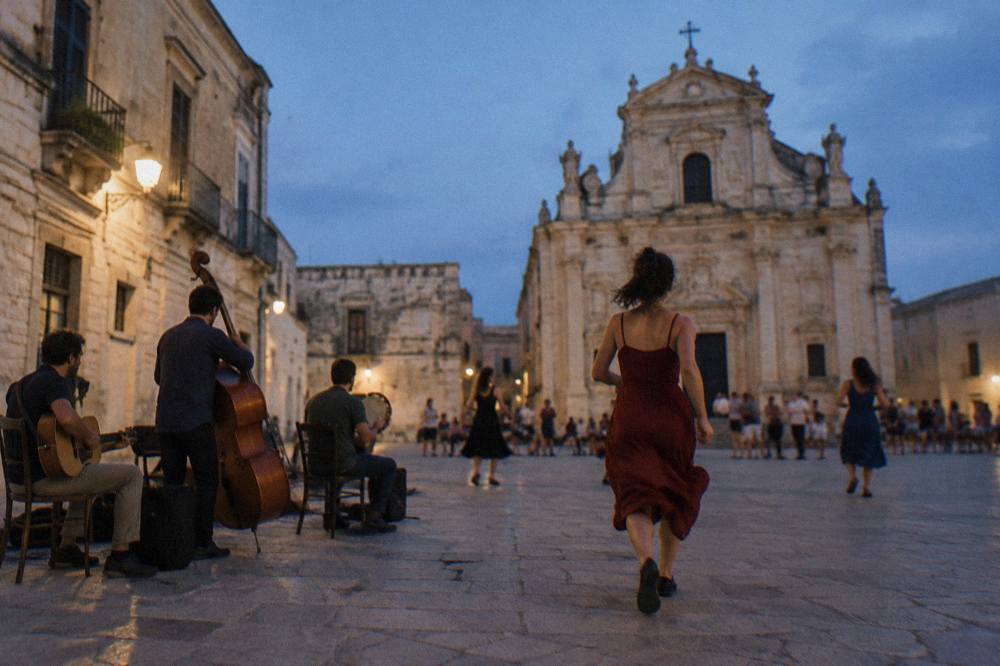
The pizzica is heard across Lecce and its province from June to September, above all at summer patronal feasts, at the Notte della Taranta at Melpignano in late August, and at the Festa di San Rocco at Torrepaduli on 14 to 17 August, which by tradition features the night-time ronda and the pizzica-scherma dance duel. City squares in Lecce itself host concerts during the patronal feast in late August.
The feast of Lecce's patron saints Oronzo, Giusto and Fortunato fell on 23 to 26 August in 2026, the latest edition, with processions, illuminations and concerts filling the historic centre, and the celebration returns in late August each year. Torrepaduli, a fraction of Ruffano inland to the south-west of Lecce, holds its San Rocco feast from 14 to 17 August, and its overnight dance circle, the ronda, is one of the places where the pizzica-scherma, a mock sword-fight danced with pointed fingers instead of blades, is still performed in something close to its original setting.
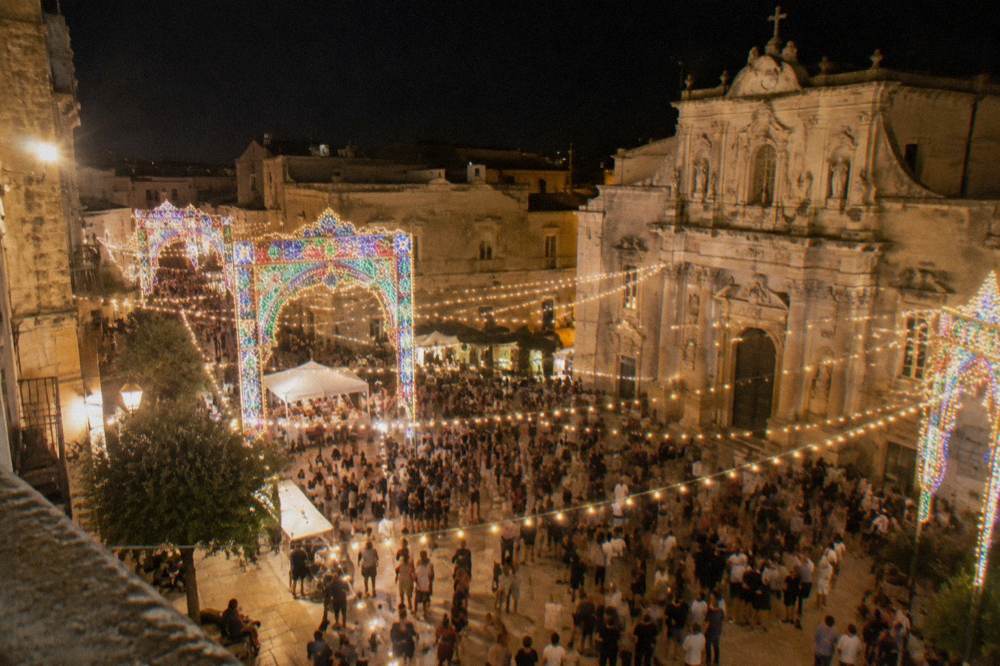
Beyond the big dates, small towns across the province run summer sagre and patronal feasts where local pizzica groups play in the square, and the music also surfaces in Lecce's bars and cultural venues year-round in smaller forms. The practical rule for a visitor: build the trip around late August if the big festival matters, otherwise any summer weekend in the province will surface a feast somewhere within a short drive or train ride of Lecce. The best time to visit Lecce and Lecce weather pages give the climate context, and the ERA5 reanalysis for 1991 to 2020 puts the mean August high at 31.3 C with only 18.1 mm of rain, which is why the dancing happens after dark.
| Event | Where | When | Character |
|---|---|---|---|
| Notte della Taranta Concertone | Melpignano, inland Salento | 22 August 2026, the 29th edition; late August each year | Large open-air concert, touring finale |
| Festa di San Rocco | Torrepaduli (Ruffano) | 14 to 17 August 2026 | Night ronda and pizzica-scherma duel |
| Festa dei Santi Patroni | Lecce historic centre | 23 to 26 August 2026 | Processions, illuminations, concerts |
| Village patronal feasts | Across the province of Lecce | Weekly through summer | Small squares, local bands |
| Summer sagre | Towns across Salento | June to September | Food stalls plus music and dance |
Lecce works as a base for all of this because the province is compact: Melpignano is an inland drive from the city, Torrepaduli sits south-west towards the Ionian side, and the coastal feasts at Otranto and Gallipoli are each under an hour away by road, with FSE trains also serving both coasts from Lecce station. Details of those rail lines are covered in getting around Lecce, and the summer-only Salento in Bus network, which ran 13 June to 13 September in 2026, connected the city with the main beach towns on lines such as 101, 104 and 107/108.
What Happens At The Notte Della Taranta Near Lecce?
The Notte della Taranta is Italy's large festival of Salento popular music, held each August at Melpignano, a town in the inland province of Lecce, ending with the Concertone, a single open-air night of pizzica orchestra music. The 29th edition took place on 22 August 2026 with Ermal Meta as musical director, and the 2027 date had not been announced.
The festival's format is unusual. Through late July and August touring concerts move between towns of the Grecìa Salentina, the inland strip of Salento where a Greek dialect survived into modern times, and the season closes with the Concertone at Melpignano, where a full orchestra of traditional instruments, dozens of tamburelli and strings and voices, performs on an open stage to a crowd that fills the town. Rehearsals in the preceding days are themselves open to the public, and the festival's own programme frames the event as a celebration of the pizzica and the tarantismo heritage described above. Everything else covered here is indexed on Lecce Travel Guide.
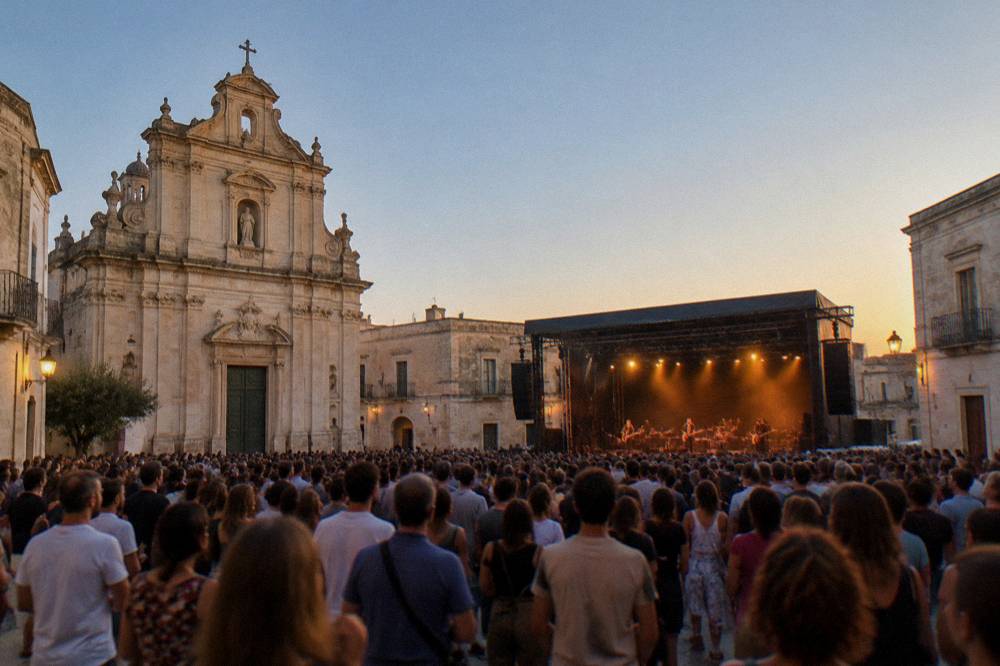
The event has a dedicated following, and the practical advice is simple: it is free to stand in the open areas, it is extremely popular, it happens in August heat, and Melpignano is a small town whose roads saturate on the night. Shuttle and coach services run from surrounding towns including Lecce on the night, organised around each edition, and the festival publishes its own transport guidance each year, so check the operator's live listing before committing to a plan. Sleeping in Lecce and travelling out for the night is a common pattern, and the rail line from Lecce towards Gallipoli passes near the festival area, with connections used by festivalgoers.
The date moves within the latter part of August. The 2026 edition was Saturday 22 August; earlier editions have fallen on nearby Saturdays. Treat any specific 2027 date you see elsewhere with caution, because the festival had not announced it, and plan instead around "late August, a Saturday, confirmed in the festival's own channels".
What Instruments And Steps Make Up The Pizzica In Lecce?
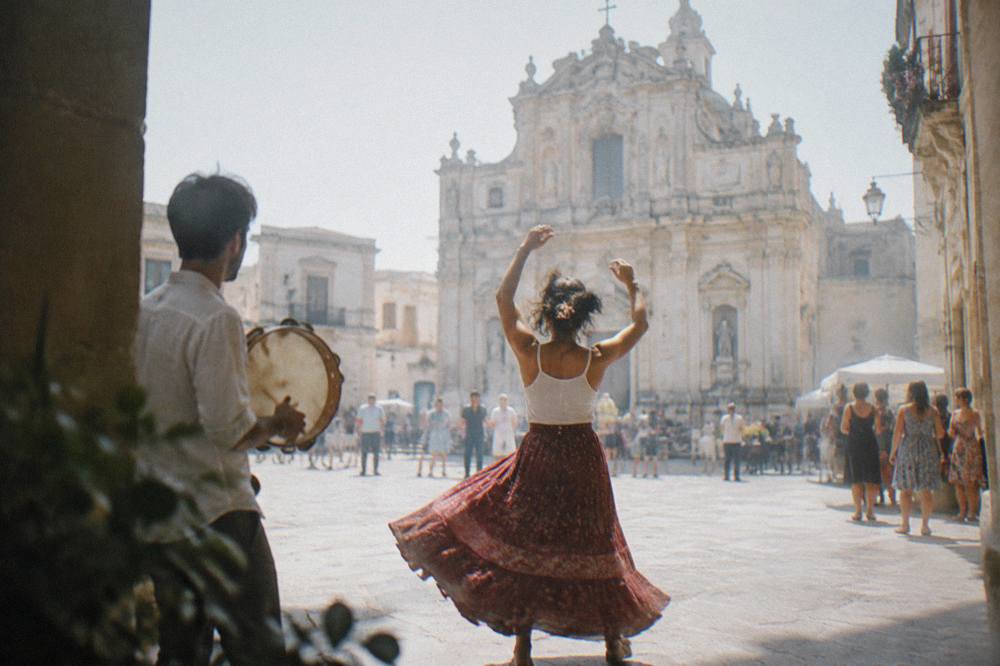
The core of a pizzica band is the tamburello, the Salento frame drum played with both hands for a fast, rolling beat, joined by violin, accordion or organetto, guitar and sometimes voice. The dance is done in couples who face each other, circle and cross without touching, and the energy is competitive rather than romantic, with the tamburello player and the dancers pushing each other faster.
The tamburello deserves the spotlight. It is a single-headed frame drum with paired cymbals set into the rim, so every strike carries its own metallic shimmer, and the Salento technique, with fingers of both hands working the skin in continuous six-eight patterns, is physically demanding enough that drummers traditionally rotate through a long night. Around that beat the violin carries the melody lines associated by tradition with particular rites, and the organetto, the small diatonic accordion, adds the propulsive chord work heard at modern festivals.
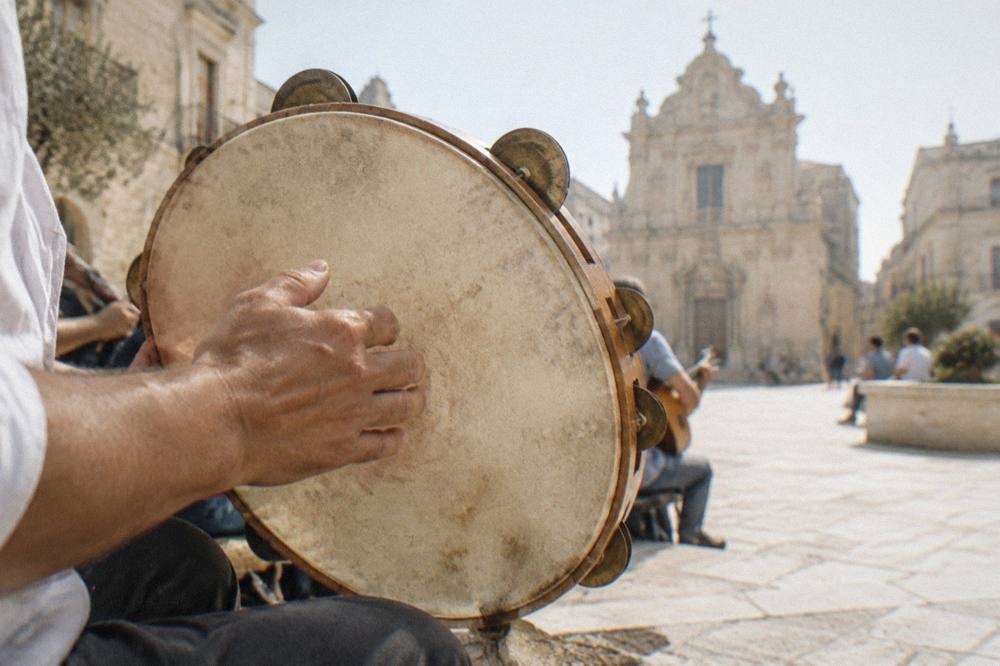
The dance itself has several recognised forms, and the differences matter to anyone watching closely at a feast near Lecce. The couple dance, the pizzica dei corteggiatori or courtship pizzica, is the version seen at festivals: two dancers, traditionally a man and a woman, facing and circling. The pizzica-scherma of Torrepaduli is the duel form, danced between two men using jabbing finger gestures in place of knives. And the historic solo form, the tarantata's dance of the old rite, survives mainly in staged reconstructions and in the solo moments festival performers still insert into sets.
| Form | Dancers | Where It Is Seen | Character |
|---|---|---|---|
| Pizzica dei corteggiatori | A facing couple | Feasts and festivals across Salento | Circling, competitive, no fixed choreography |
| Pizzica-scherma | Two men | Torrepaduli ronda, mid August | Mock duel with finger "blades" |
| Solo tarantata dance | One dancer | Reconstructions and solo breaks | Echo of the old healing rite |
| Orchestra pizzica | Full band plus crowd | Notte della Taranta Concertone | Mass participation, dancing in front of the stage |
Nobody checks credentials at the edge of a pizzica circle. The custom at village feasts is that anyone may enter the circle for a turn and leave again, and beginners are tolerated warmly, provided they respect the couple structure and the drum's tempo rather than fighting it. Lessons and workshops in the dance and the tamburello run in Lecce and across the province, particularly in summer; check locally for current offerings, as schedules change each season.
How Does The Pizzica Fit Into A Wider Lecce Trip?
The pizzica fits into a Lecce trip as the cultural thread connecting the city's baroque core, its craft traditions and its food culture, all within a province you can cross in under an hour. The city's August patronal feast brings the music into the historic centre, while papier-mache workshops, Salento wine and the iced coffee of Lecce's cafés carry the same regional identity, and the beaches of both coasts sit a short ride away.
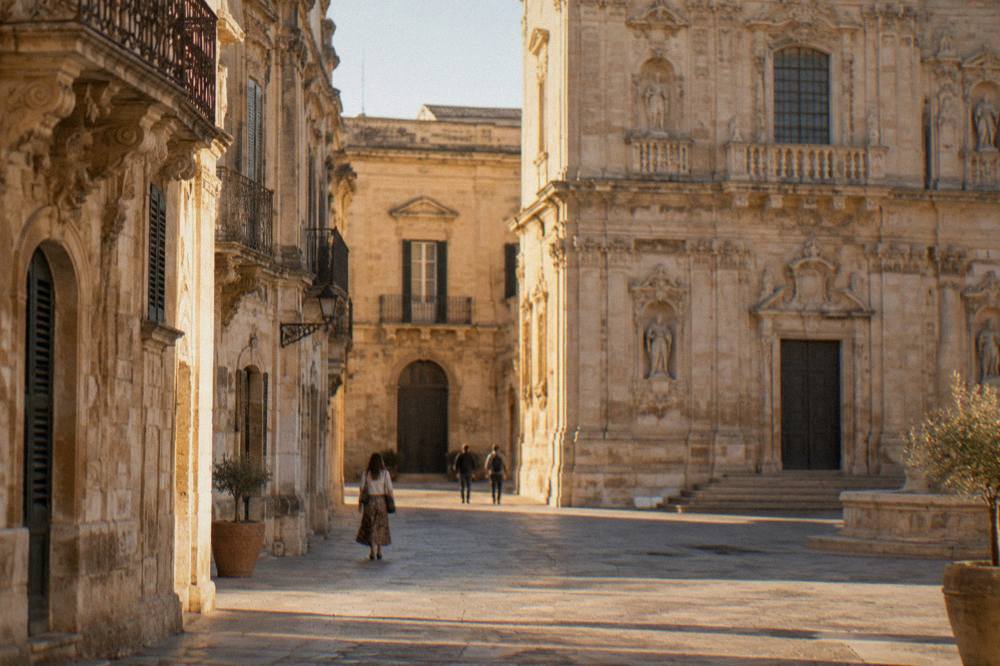
Start in the city. Lecce's baroque architecture, covered in the Lecce Baroque guide, was carved in pietra leccese, the soft local limestone that hardens on exposure, and the same hands that carved saints and cherubs also shaped the cartapesta, the papier-mache craft of the Lecce papier-mache tradition, whose figures star in the processions that accompany the summer feasts. The Fiera dei Pupi, the papier-mache Christmas fair, ran in the 2025 pattern from early December to 24 December in Lecce, and the 2026 dates were not yet published.
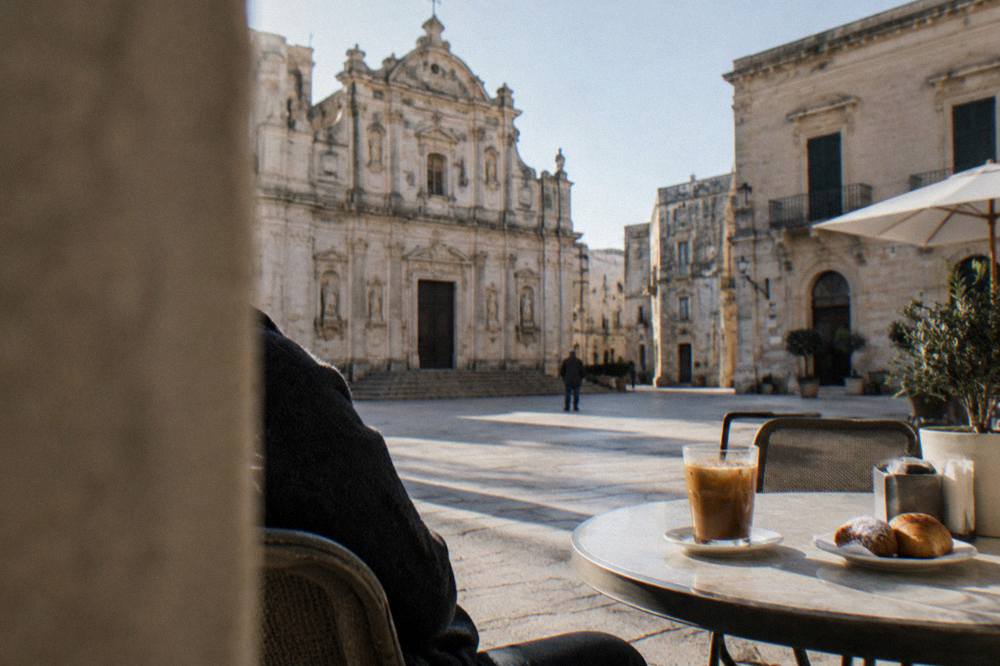
Then eat. A feast night runs on food, and Salento's table, covered in what to eat in Lecce, runs from the pasticciotto, whose 1745 invention date is one Galatina pastry shop's own contested claim, to the rustico and the caffe in ghiaccio con latte di mandorla, the iced coffee with almond milk credited to Antonio Quarta of Lecce's Quarta Caffè, introduced there in the years after the war. Wine matters too: the Salice Salentino DOC, established in 1976 and built on the Negroamaro grape, is the classic pour of the province, and tasting the region's wines alongside its music is a natural pairing. For venues, the best restaurants in Lecce page lists the places worth booking.
Finally, escape. The beaches near Lecce begin about 13 km away at San Cataldo on the Adriatic, the Salento beaches guide spreads across both coasts to Pescoluse and the Ionian, and the sea itself sits at around 25 to 27 C at the August peak, per seatemperature.org figures for Puglia. A festival trip can pair a morning at a lido with an afternoon in Otranto or Gallipoli and a night of pizzica, all without leaving the province.
| Trip Thread | In Lecce | In The Province | Connects To The Pizzica |
|---|---|---|---|
| Baroque and stone | Historic centre churches and squares | Towns across Salento | Feasts process through these spaces |
| Papier-mache | Workshops and the Fiera dei Pupi | Cartapesta processions | Feast statues and Nativity figures |
| Food and wine | Cafés, pasticcerie, restaurants | Sagre and wineries | Feast nights are built on eating |
| Sea | San Cataldo, about 13 km away | Both coasts, Adriatic and Ionian | Beach days before festival nights |
When Is The Best Time To Visit Lecce For Pizzica?
Mid-June to mid-September is the festival season around Lecce, with the pizzica peaking in late August, when Torrepaduli's San Rocco feast ran 14 to 17 August 2026, the Lecce patronal feast fell on 23 to 26 August, and the Notte della Taranta Concertone at Melpignano was held on 22 August 2026. The trade-off is August heat, with an ERA5 reanalysis mean high of 31.3 C for 1991 to 2020.
August is the month when everything converges, but it is also the month when the coast is at its fullest and the inland towns are at their emptiest in the afternoons, which is precisely why the dancing starts after dark. The 2026 Salento in Bus network ran from 13 June to 13 September with its peak service from 1 July to 31 August, and 2027 dates were not published, so transport planning for a future summer should wait for the operator's announcement.
For travellers who would rather avoid the peak, early summer and September still surface the tradition: feasts continue into the first half of September, the sea stays around 20 to 22 C in October per seatemperature.org, and Lecce itself, described in the Salento overview, rewards a quieter visit with its churches and museums open on winter hours from October. What you lose outside August is the concentration of big festival nights; what you gain is space, cooler evenings and easier tables at the restaurants of Lecce's dining scene.
| Period | What Runs | Conditions |
|---|---|---|
| Mid-June to mid-July | Early feasts, Salento in Bus start, sea around 22.5 C | Warm, mean high 28.2 C in June |
| Late July | Touring Notte della Taranta concerts begin | Hot, mean high 31.0 C in July |
| 14 to 17 August | San Rocco ronda at Torrepaduli | Peak heat, peak atmosphere |
| Late August | Lecce patronal feast plus Concertone at Melpignano | Mean high 31.3 C, dancing after dark |
| September | Feasts taper, sea still swimmable | Mean high 26.4 C, calmer |
Common Questions About Pizzica And Tarantismo In Lecce
What is the pizzica in Lecce, Italy?
The pizzica is the traditional fast dance music of Salento, the peninsula around Lecce, led by the tamburello frame drum and danced in facing couples at village feasts. Its name comes from pizzicare, to sting, linking it to the tarantula legend of the old healing rite.
Is the tarantula legend of tarantismo real?
It is folklore, presented here as tradition. Rural Salento treated the spider's bite and its cure through music as fact within living memory, while anthropologists who studied the rite described it as a culture-bound condition expressed through dance. The music is real and thriving; the bite was never medically established.
Where is the Notte della Taranta held near Lecce?
The Concertone is held in Melpignano, an inland town of the Grecìa Salentina in the province of Lecce. The 29th edition took place on 22 August 2026, and the 2027 date had not been announced.
Can you dance the pizzica as a visitor in Lecce?
Yes. At village feasts anyone may enter the circle for a turn, and beginners are welcome if they follow the drum's tempo. Workshops in the dance and the tamburello run in Lecce and across the province, mainly in summer; confirm current schedules locally.
What is pizzica-scherma?
It is the duel form of the dance, performed by two men using jabbing finger gestures in place of blades, and it is central to the night ronda at the Festa di San Rocco at Torrepaduli, which ran 14 to 17 August in 2026.
When can you hear pizzica in Lecce itself?
In late August, when the feast of the patron saints Oronzo, Giusto and Fortunato fills the historic centre, which fell on 23 to 26 August in 2026, and in smaller concerts and venue nights through the year.
The pizzica is the sound of the whole peninsula Lecce anchors, a rhythm that began as a claimed cure in the fields of Salento and now closes every August in front of a huge crowd at Melpignano. Hear it once, in a small square or at the Concertone, and the tamburello's gallop will attach itself to every memory of the trip.