Lecce Baroque Walk: A Self-Guided Route Through 12 Facades
A self-guided walking route through Lecce, the baroque capital of Salento in Puglia, covering twelve facades and the main squares in one connected loop.
Short answer
The Lecce baroque walk is a self-guided loop of about 3 km through the centro storico: Porta Napoli, Piazza Sant'Oronzo and the Roman Amphitheatre, Piazza del Duomo with its five sights on the LeccEcclesiae ticket, Santa Croce, and the side churches of San Matteo and Santa Chiara. Allow half a day, and buy the 11 euro combined church ticket at Piazza Duomo 5 or Santa Croce.
Lecce, in Puglia at the heel of Italy, is the baroque capital of Salento: a compact old town built from pietra leccese, a honey-coloured limestone soft enough to carve into flowers, animals and swirling frames while it sits in the quarry, and hard enough to hold those shapes once exposed to air. That single property of the stone explains why this small inland city, a few kilometres from the Adriatic beaches at San Cataldo, carries one of the densest concentrations of decorated facades in southern Italy. The route below strings twelve of them into one walkable loop, all inside the centro storico, with tickets, hours and detours reported from the official sources, and it needs no car and no booking beyond one church ticket. The stone, the style and the street plan do the rest.
What Is The Lecce Baroque Walk Route?
The Lecce baroque walk is a self-guided loop of roughly 3 km through the pedestrian-scaled old town of Lecce, linking twelve carved facades in this order: Porta Napoli, the Villa Comunale, the amphitheatre in Piazza Sant'Oronzo, the Duomo complex, Basilica di Santa Croce, Palazzo dei Celestini, Chiesa di San Matteo, Chiesa di Santa Chiara, the ex-Convento dei Teatini facade, Palazzo Vernazza, the Castello Carlo V courtyard and Porta Rudiae. The route is flat, and the whole of it sits within the ZTL camera zone, which means the streets themselves are largely traffic-free during restricted hours.
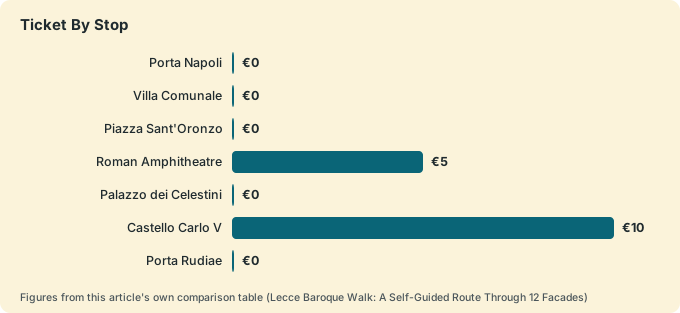
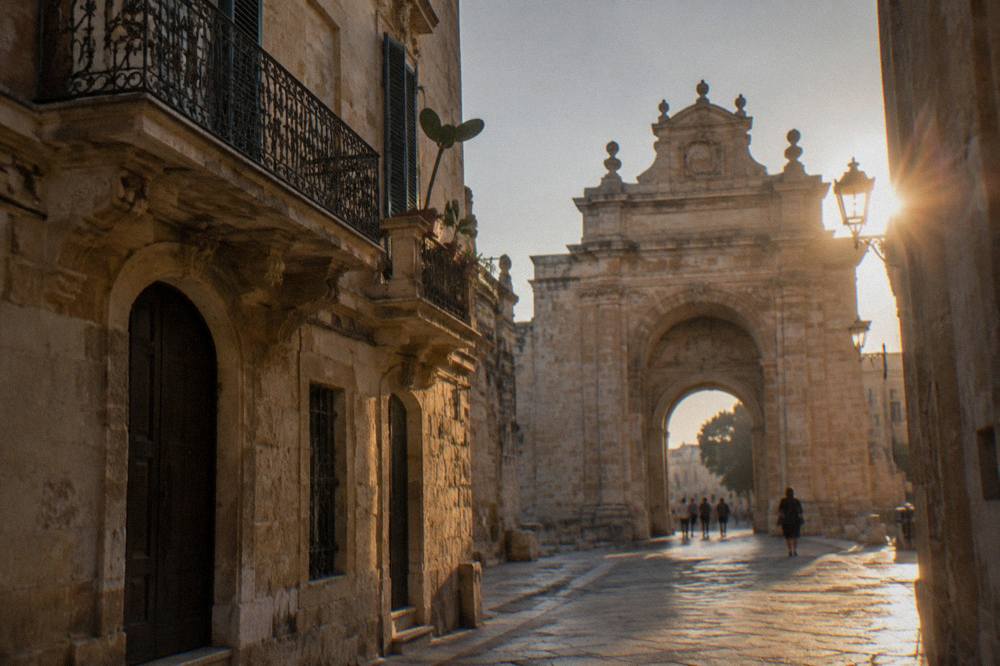
Start at Porta Napoli, the triumphal arch on the western edge, and finish at Porta Rudiae on the north-east side, which puts you within a few minutes' walk of the station end of the centre. Walking it in that direction means the two biggest set pieces, Piazza Sant'Oronzo and Piazza del Duomo, arrive early while legs are fresh, and the quieter side churches fill the back half. The full list of stops, with what each one costs and what the ticket covers, is in the table below.
| Stop | What You See | Ticket |
|---|---|---|
| Porta Napoli | Triumphal arch, exterior only | Free |
| Villa Comunale | Public gardens, free access | Free |
| Piazza Sant'Oronzo | Square, amphitheatre seen from above, Sant'Oronzo column | Free |
| Roman Amphitheatre | Roman-era seating below street level | 5 EUR full, 2 EUR reduced |
| Piazza del Duomo | Duomo, crypt, bell tower, seminary cloister | LeccEcclesiae ticket |
| Basilica di Santa Croce | The city's most carved facade | LeccEcclesiae ticket |
| Palazzo dei Celestini | Prefecture seat, courtyard only | Free |
| Chiesa di San Matteo | Curved baroque facade | LeccEcclesiae ticket |
| Chiesa di Santa Chiara | Facade and interior | LeccEcclesiae ticket |
| Castello Carlo V | Courtyard free, interior by guided tour | 10 EUR tour |
| Porta Rudiae | Gate, exterior | Free |
The walk works in either direction, and it overlaps heavily with the stops on the longer Lecce in one day plan, so anyone building a first visit around it loses nothing. If your time in the city is short, this route plus an evening passeggiata covers the essentials of what Lecce Travel Guide describes across its attraction pages.
Where Should The Walk Start: Porta Napoli To Piazza Sant'Oronzo?
The walk starts at Porta Napoli, the free-standing ceremonial arch on the western edge of the old town, because it is the one major facade with no queue, no ticket and no opening hours, and from there the route runs east through the Villa Comunale gardens to Piazza Sant'Oronzo, where the sunken Roman Amphitheatre sits directly in the square, visible free from above or enterable for 5 EUR full and 2 EUR reduced, Tuesday to Sunday in winter, closed Monday. The amphitheatre is a Roman structure, part-buried below the modern street level, and it received a 1,500,000 euro PNRR restoration before reopening with a new accessible entrance and ramp.
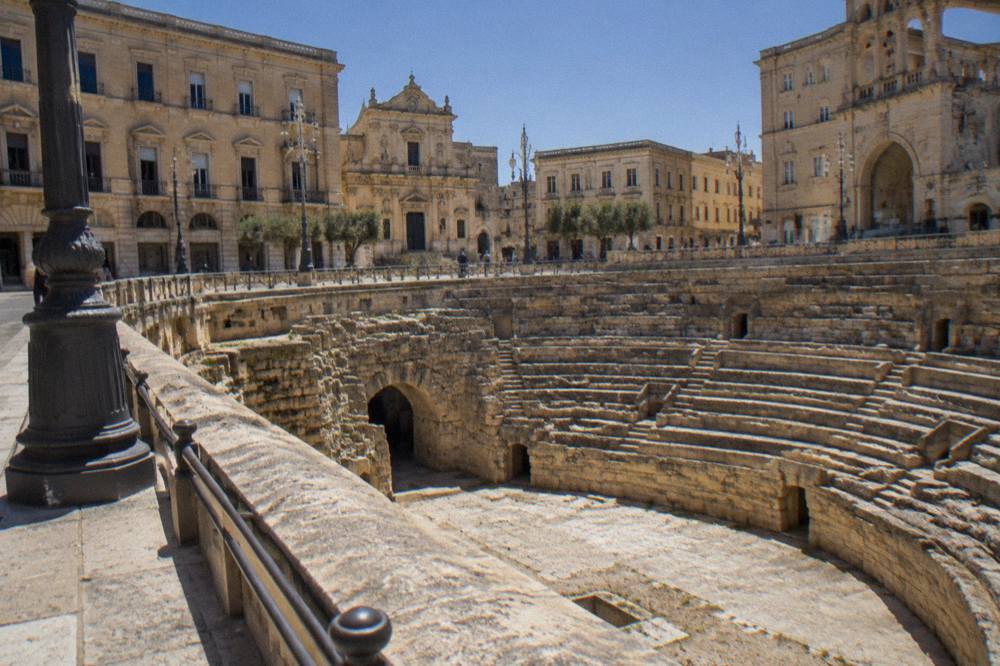
Piazza Sant'Oronzo is the widest open room on the route and the natural midpoint of the walk's first half. The square holds the amphitheatre, a column carrying the city's patron saint, and the terrace of the historic Caffe Alvino, whose roots go back to about 1880 per local reporting, making it a plausible coffee stop before the church circuit begins. The square's buildings mix periods rather than pure baroque, which is itself part of the story: Lecce's decorated style sits on a Roman and medieval street plan, and the amphitheatre makes that layering literal.
Between Porta Napoli and the piazza, the Villa Comunale offers the walk's only green interval, a public garden with no ticket and unrestricted access. It is a useful marker for pace: if you have reached the gardens within fifteen minutes of leaving Porta Napoli, the whole route fits comfortably in half a day with stops.
For anyone who prefers a guide over a printed route, a guided walking tour of Lecce covers the same core, and tip-based walks also run locally, though no verified platform listing for them exists for Lecce, so confirm arrangements directly with the guide. A free walking tour on that basis is a service local guides offer, not a bookable product this site can price.
What Is In Piazza Del Duomo On The Lecce Baroque Walk?
Piazza del Duomo is a walled, closed square holding five sights on one combined LeccEcclesiae ticket: the Duomo or cathedral with its crypt, the towering bell tower, the Antico Seminario with the MuDAS art museum, and, on the same circuit elsewhere in the centre, the Chiesa di San Matteo and the Chiesa di Santa Chiara, with the standard ticket at 11 EUR full, 5 EUR reduced for ages 12 to 17 and 24 EUR for a family, valid 15 days, under 12s free. The full ticket adding the bell tower, called Up!, is 21 EUR full, 13 EUR reduced and 48 EUR family. Chieselecce.it, the Diocese's own ticket site, lists hours of 9:00 to 21:00 in the April to September season and 9:00 to 18:00 from October to March, with last entry 15 minutes before closing.
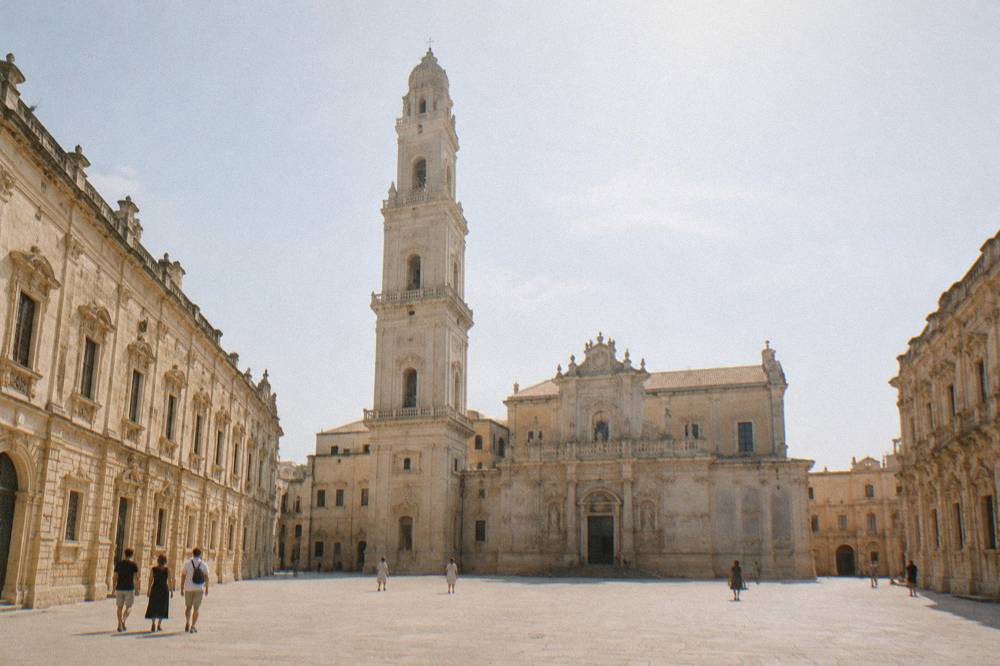
The square's design rewards arriving from the side street rather than the main road, because Piazza del Duomo was built as a closed composition: you enter through a gap and the facade of the seminary, not the cathedral, greets you first. The Duomo's own facade sits at an angle across the square, the bell tower rises beside it, and the whole ensemble is limestone carving on the scale the city is famous for. Tickets are sold at Piazza Duomo 5 or at the Basilica di Santa Croce, and the 15-day validity means the ticket does not have to be consumed in one morning.
Two practical notes from the Diocese's own information page: tourist access is limited during religious services, and a dress code covering shoulders and knees is enforced. Sunday visitors should check the service calendar before planning the church circuit, since the architecture stays put but the visiting windows move.
A guided option that ends in this part of town is the street food walk this site features: it pairs the historic centre's streets with tastings, and the operator's live listing carries the current price and times. Check availability alongside the itinerary page for the street food tour of Lecce.
How Do The Basilica Di Santa Croce And Palazzo Dei Celestini Fit The Route?
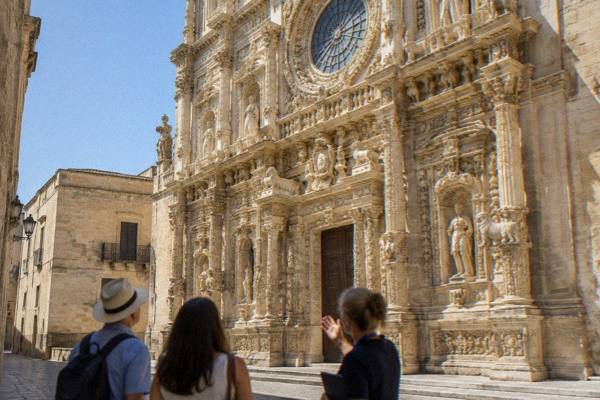
Basilica di Santa Croce is Lecce's most heavily carved facade and the single building the phrase Lecce Baroque is built around, a wall of pietra leccese worked into animals, garlands, putti and caryatids, and it stands directly opposite Palazzo dei Celestini, whose courtyard is free to enter while the interior functions as the Prefecture, a government seat with no public interior visit, so the pair makes one stop on the walk with one exterior requiring the LeccEcclesiae ticket and one courtyard costing nothing. The basilica is included in the standard combined ticket, and its access runs through that circuit's hours.
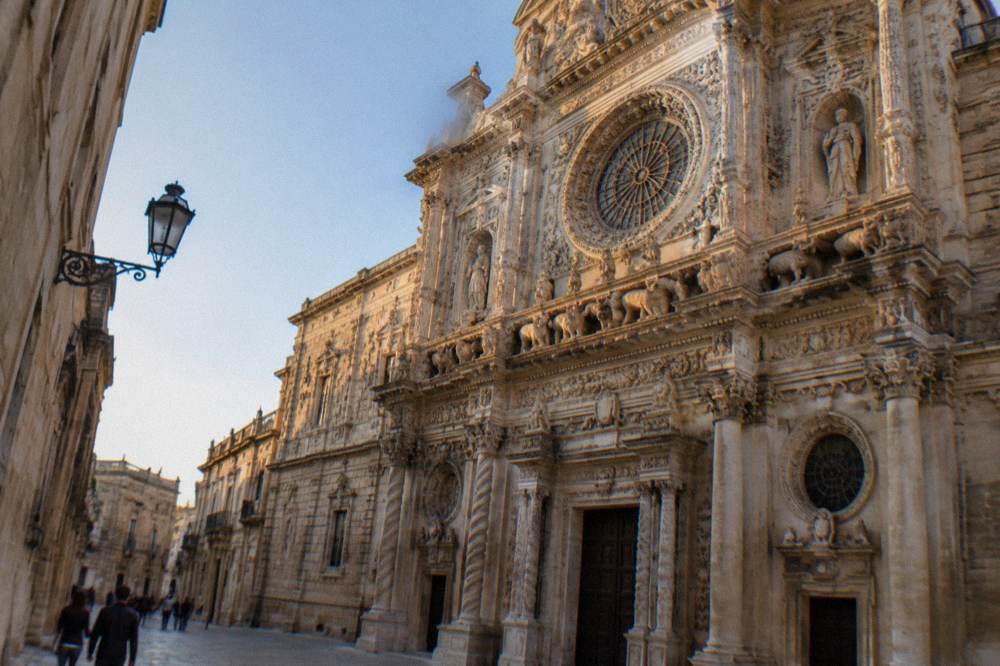
Describing the facade by what a visitor actually sees: the lower level is framed pilasters and doorways, the upper level a window centrepiece ringed with sculpture, and the whole surface carries small carved figures supporting ledges, ram heads, rosettes and layered mouldings. The building stone, pietra leccese, is a Miocene limestone quarried locally, soft when cut and hardening on exposure, which is why the carving is so fine and so dense here compared with harder-stone cities. Construction dates and architect attributions for this and other Lecce churches are disputed in the sources, so this page prints none of them.
Palazzo dei Celestini next door keeps a plainer order, and its courtyard is the free interior moment of the walk's second half. From this pair, the route drops south to the Castello Carlo V, whose courtyard is free but whose interior and Museo della Cartapesta are visitable only on the guided tour at 10 EUR full and 6 EUR reduced, running Tuesday to Sunday with the castle closed Mondays. The Castello Carlo V makes a natural terminus before the final gate.
What Are The Side Stops: San Matteo, Santa Chiara And The Synagogue Quarter?
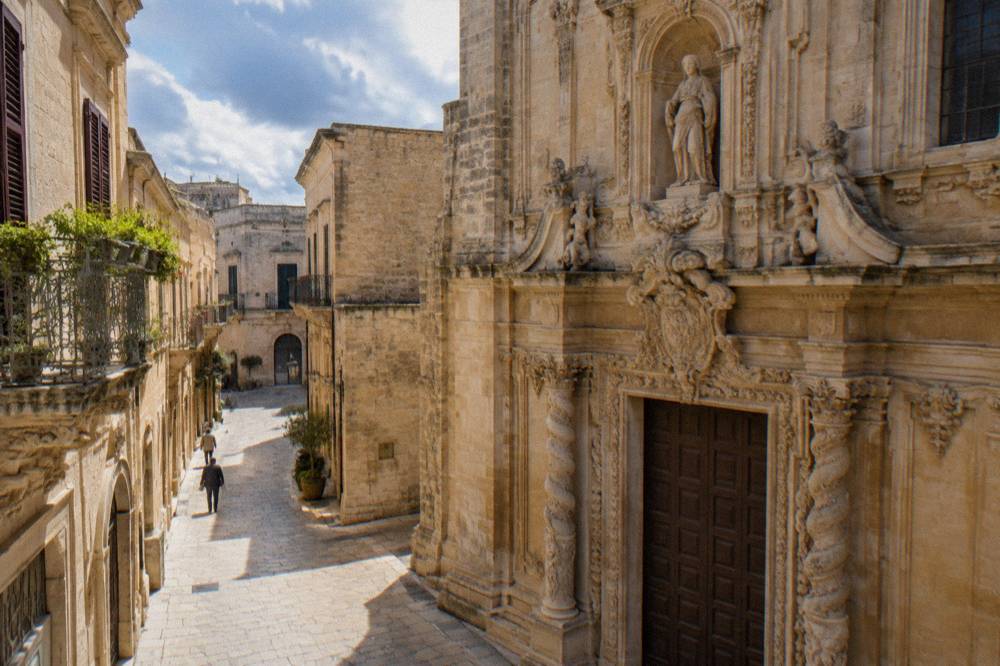
The walk's quieter half takes in Chiesa di San Matteo, whose facade curves outward in concave bays unlike anything else on the route, and Chiesa di Santa Chiara, both included on the LeccEcclesiae combined ticket, then crosses into the old Giudecca quarter where the Museo Ebraico documents the city's medieval Jewish community with guided-visit-only access at 5 EUR full and 4 EUR reduced, and where the ancient synagogue basement can be seen on a dedicated guided walking tour rather than independently. These stops sit within a few blocks of each other south and west of Santa Croce.
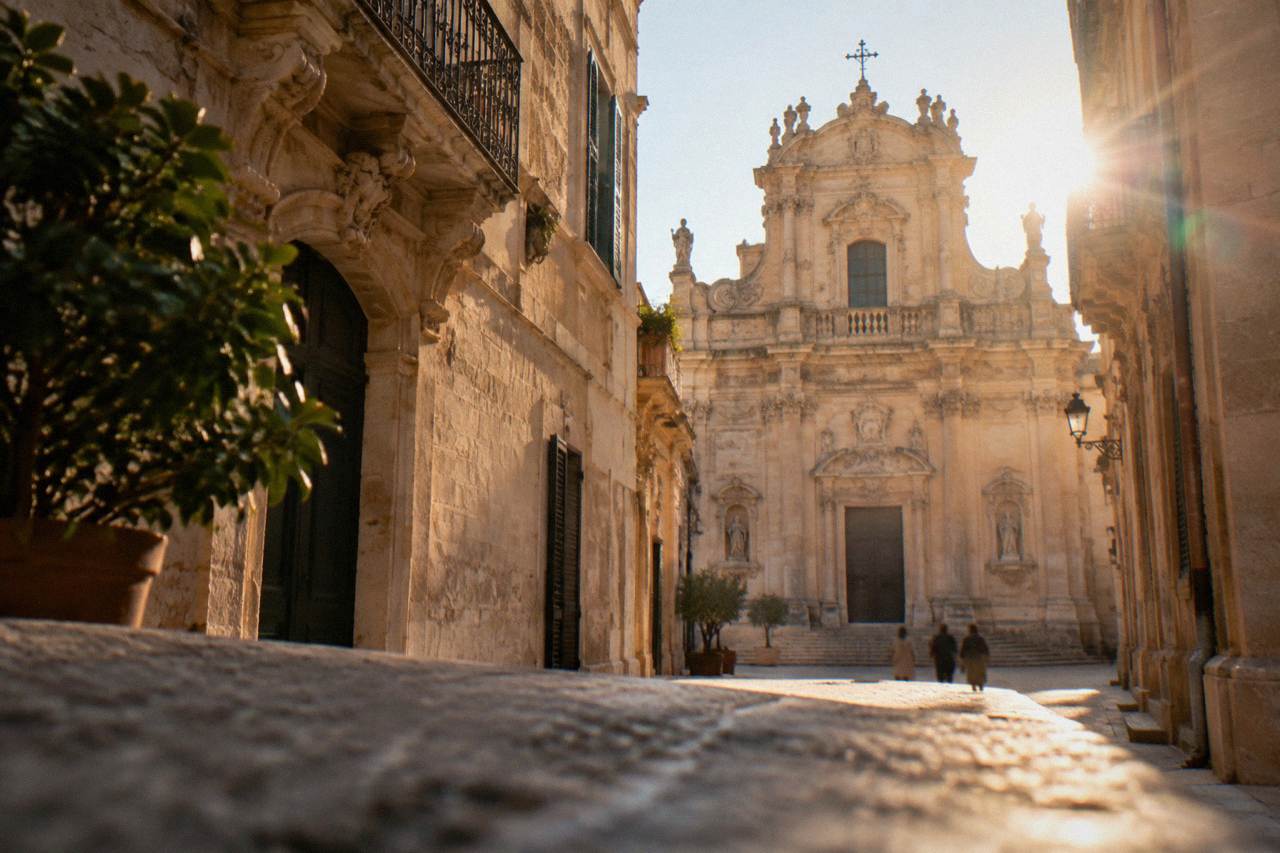
San Matteo is the facade photographers stop longest at, because its convex-concave wall movement is the clearest single demonstration of what barocco leccese does with soft stone. Santa Chiara's interior, by contrast, is the ticket's quietest room, an altarpiece wall in gilt and limestone that rewards the ten minutes the bigger churches don't allow. Neither church charges separately: the combined ticket covers both, and the 15-day window means a second pass later in the trip costs nothing extra.
The Jewish quarter stop needs a decision in advance, since the museum runs on guided visits only and the synagogue basement likewise. For walkers who skip it, the route back north passes the ex-Convento dei Teatini, whose cloister hosts the papier-mache Christmas fair each December, and Palazzo Vernazza, a palazzo open daily 15:30 to 21:00 with a phygital experience at 10 EUR ordinary and 8 EUR reduced, per the comune's listing. The city's papier mache and Lecce baroque guides cover those crafts in depth.
How Long Does The Lecce Baroque Walk Take, And What Does It Cost?
The walk takes about half a day at museum pace, roughly three hours of pure walking and four to six hours with interior visits, and the full cost runs from nothing, if you view only facades and free courtyards, to about 27 EUR per adult for the LeccEcclesiae standard ticket at 11 EUR, the amphitheatre at 5 EUR and the Castello guided tour at 10 EUR, with the 29 EUR seven-day Artwork City Pass covering the church circuit, bell tower and extras as an alternative. The 21 EUR full LeccEcclesiae ticket adds the bell tower ascent, which runs at roughly 20-minute intervals per the Diocese's listing.
| Item | Price | Notes |
|---|---|---|
| Facades, squares, gates, courtyards | Free | Porta Napoli, Piazza Sant'Oronzo, Celestini courtyard |
| LeccEcclesiae standard | 11 EUR | 5 churches, 15 days, under 12 free |
| LeccEcclesiae with bell tower | 21 EUR | Adds the Up! tower ascent |
| Roman Amphitheatre | 5 EUR | 2 EUR reduced, closed Mon |
| Castello Carlo V guided tour | 10 EUR | Includes Museo della Cartapesta |
| Artwork City Pass | 29 EUR | 7 days, churches plus extras |
| Museo Ebraico | 5 EUR | Guided visit only |
Solo travellers and pairs should note the ticketing structure rather than the totals: because the church ticket lasts 15 days, splitting the walk over two mornings costs no more than cramming it into one, and because the amphitheatre and castle are separate operators, neither is triggered by buying the church circuit. The pass only pays off on a stay long enough to use its extras.
When Is The Best Time Of Day To Walk The Lecce Baroque Route?
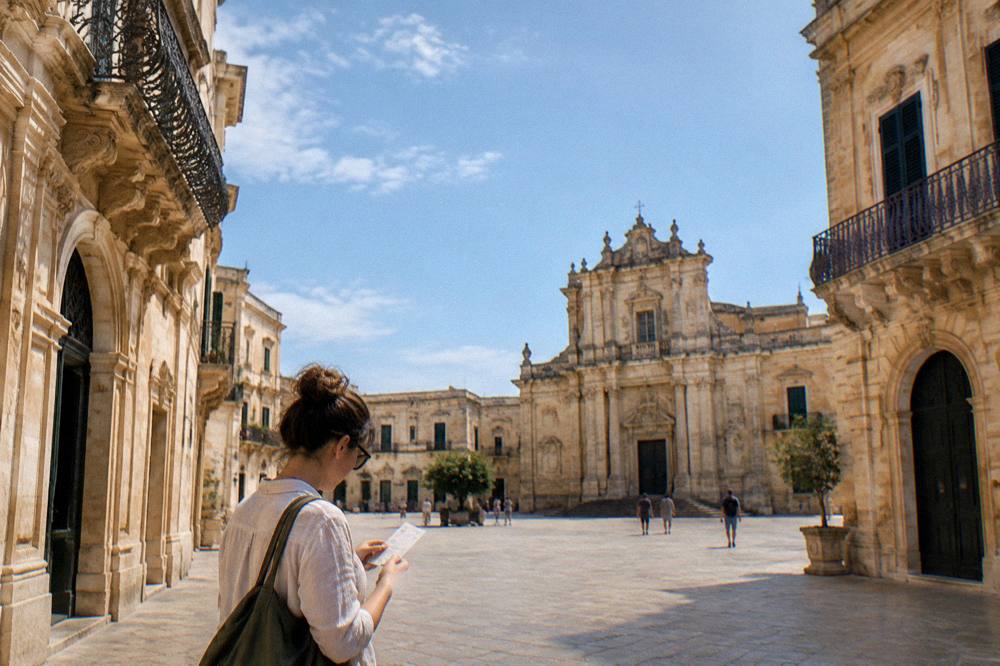
The best time of day is late afternoon into early evening, because the ERA5 reanalysis for Lecce, 1991-2020, puts the mean daily high at 31.3 C in August and 31.0 C in July, and the low-angle evening sun brings out the relief of the carving on the west-facing facades, while the churches keep long hours to match: the LeccEcclesiae circuit stays open to 21:00 daily in the April to September season, so a 16:00 start still allows three interior visits before close. In the October to March season, closing moves to 18:00 and a morning start is safer.
| Period | Mean high C | Mean low C | Rain mm | Church hours |
|---|---|---|---|---|
| Jan | 12.4 | 6.7 | 63.1 | 9:00 to 18:00 |
| Mar | 15.4 | 8.3 | 64.9 | 9:00 to 18:00 |
| Jun | 28.2 | 19.1 | 18.0 | 9:00 to 21:00 |
| Aug | 31.3 | 22.2 | 18.1 | 9:00 to 21:00 |
| Oct | 21.8 | 15.4 | 91.3 | 9:00 to 18:00 |
| Nov | 17.3 | 11.7 | 93.7 | 9:00 to 18:00 |
November carries the highest monthly rainfall in the normals at 93.7 mm and July the lowest at 15.3 mm, so the shoulder months trade warmth against rain risk. The best time to visit Lecce and Lecce weather pages carry the full monthly table. One date-driven note for evening walkers: the feast of the patron saints, Sant'Oronzo, Giusto and Fortunato, ran 23 to 26 August 2026 with processions and illuminations, and during those days the squares change character completely, which cuts both ways for photography.
Midday has a second drawback beyond heat: a reported local riposo pattern closes some shops between about 13:00 and 16:00, and churches pause tourist access during services. A morning church circuit, a long lunch, and a facade-only evening pass is the pattern the hours themselves suggest.
Self-Guided Or Guided: Which Lecce Baroque Walking Tour Suits You?
A self-guided walk suits anyone who wants to set their own pace, spend as long as a facade demands and pay only the monument tickets, while a guided baroque tour suits first-time visitors who want the iconography decoded, since the carved figures, saints and symbols read as a language rather than decoration, and guided options on this site range from a budget historic-centre intro walk to private baroque-and-underground tours, with the street food and tasting walks adding the city's kitchens to the same streets. The choice is about interpretation, not access: nothing on the route requires a guide except the Castello interior and the synagogue basement.
| Option | What It Adds | Best For |
|---|---|---|
| Self-guided loop (this page) | Full control, facade-only cost possible | Repeat visitors, photographers |
| Budget centre intro walk | A guide's overview, low entry price | First-time visitors |
| Private baroque and underground tour | Depth, subterranean rooms | Architecture enthusiasts |
| Street food walk with tastings | Food stops folded into the route | Food-first travellers |
| Synagogue quarter walk | Access to the Jewish quarter sites | History-focused walkers |
The free-walk question comes up often, and the honest answer is that tip-based walks do run locally but no verified platform listing for Lecce exists in this site's research, so any arrangement should be confirmed directly with the guide and no tip figure can responsibly be printed. The paid walks above all carry their live prices on the operator's listing.
Where Does The Walk End, And How Do You Get Back?
The walk ends at Porta Rudiae on the north-eastern edge of the centre, a second historic gate whose exterior is free and always viewable, and the station area with its luggage storage at roughly 2.50 to 3.50 EUR per day lies a short walk further north-east, with SGM city buses running on a 60-minute ticket of about 1.20 EUR bought in advance or 1.50 EUR on board, and the Park Liberty car park offering 466 spaces near the centre for arriving drivers. The getting around Lecce and ZTL and parking pages carry the detail.
Drivers staying inside the restricted zone should ask their accommodation to register their plate, since the ZTL is camera-policed with reported fines of 83 to 332 EUR, and the enforcement hours are reported rather than guaranteed. Anyone extending the trip beyond the city can move straight from this walk into the Salento itinerary or the wider Puglia itinerary, since Lecce is the region's natural transport hub, with FSE trains to Gallipoli, Otranto via Maglie and Galatina, and Trenitalia services north.
For an evening, the walk's squares are the stage for the Lecce at night scene, and the city's safety reputation is strong enough that wandering back from dinner raises no special caution: petty theft is the main concern flagged in crime-index sources, well below major Italian cities.
Common Questions About The Lecce Baroque Walk
How long does a Lecce baroque walking tour take?
Allow three hours of walking for the full loop and half a day with interior visits. The LeccEcclesiae ticket's 15-day validity means the church circuit can also be split across several days at no extra cost.
Do I need a ticket for the churches on the walk?
Yes. The main church interiors, including the Duomo, Santa Croce, San Matteo and Santa Chiara, are on the combined LeccEcclesiae ticket at 11 EUR standard or 21 EUR with the bell tower, per the Diocese's ticket site. Facades, squares, gates and the Celestini courtyard cost nothing.
Can you do the Lecce baroque walk for free?
Yes, as a facade-only route. Porta Napoli, Piazza Sant'Oronzo, the amphitheatre seen from above, the Villa Comunale, the Celestini courtyard and Porta Rudiae are all free, and the exteriors of every church on the route are viewable from the street at any hour.
Is the Lecce baroque walk suitable for wheelchair users and strollers?
The route is flat and largely pedestrianised, and the Roman Amphitheatre reopened with a new accessible entrance and ramp after its PNRR restoration. Individual church thresholds vary; confirm specific access needs with each site before visiting.
What is the best month for a Lecce baroque walking tour?
May and October balance mild temperatures, mean highs of 23.4 C and 21.8 C respectively in the ERA5 1991-2020 normals, against moderate rainfall. July and August bring the heat, mean highs above 31 C, but also the season's 21:00 church closing hours, which suit evening walks.
Does the walk cover the Castello Carlo V?
The route passes it and its courtyard is free, but the interior and the Museo della Cartapesta inside are visitable only on the guided tour at 10 EUR full, 6 EUR reduced, Tuesday to Sunday with the castle closed Mondays.
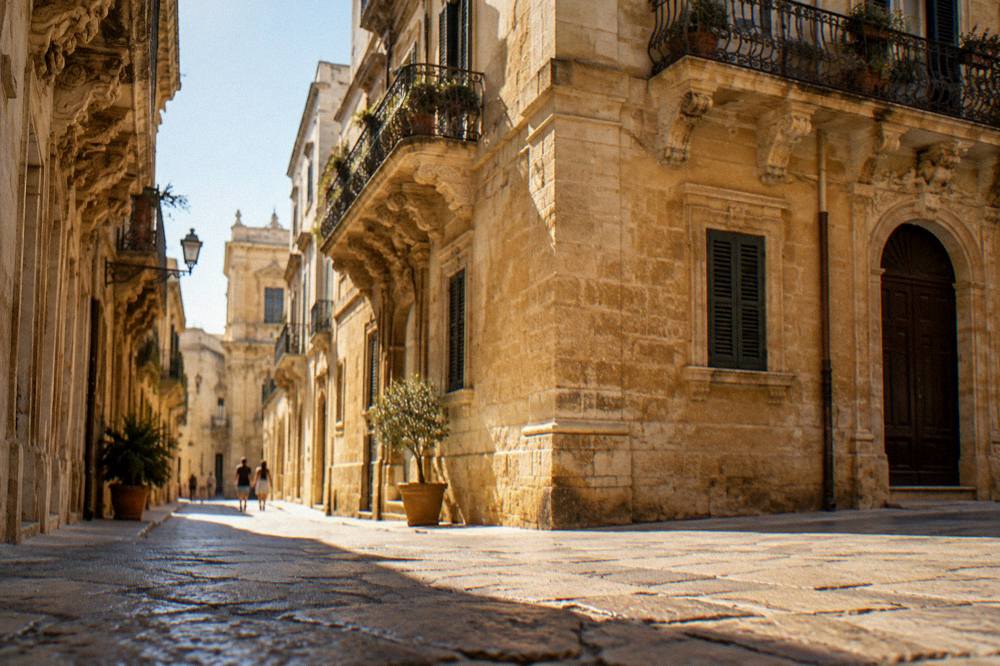
The twelve facades hold still all day, which is the quiet advantage of a stone-built route: the walk can be started at any hour the churches are open, reversed, halved or repeated, and the carving will be exactly where this page left it.