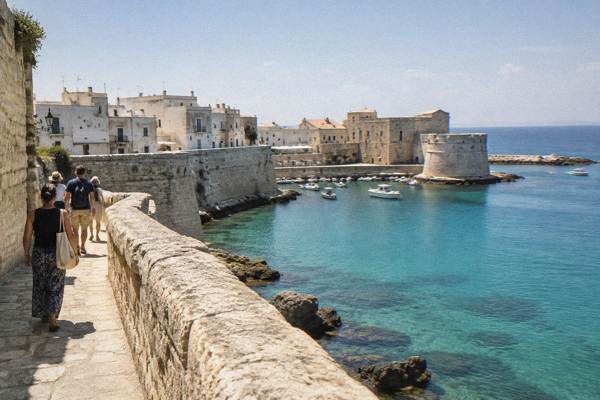
Torre Dell Orso: The Two Sisters Beach
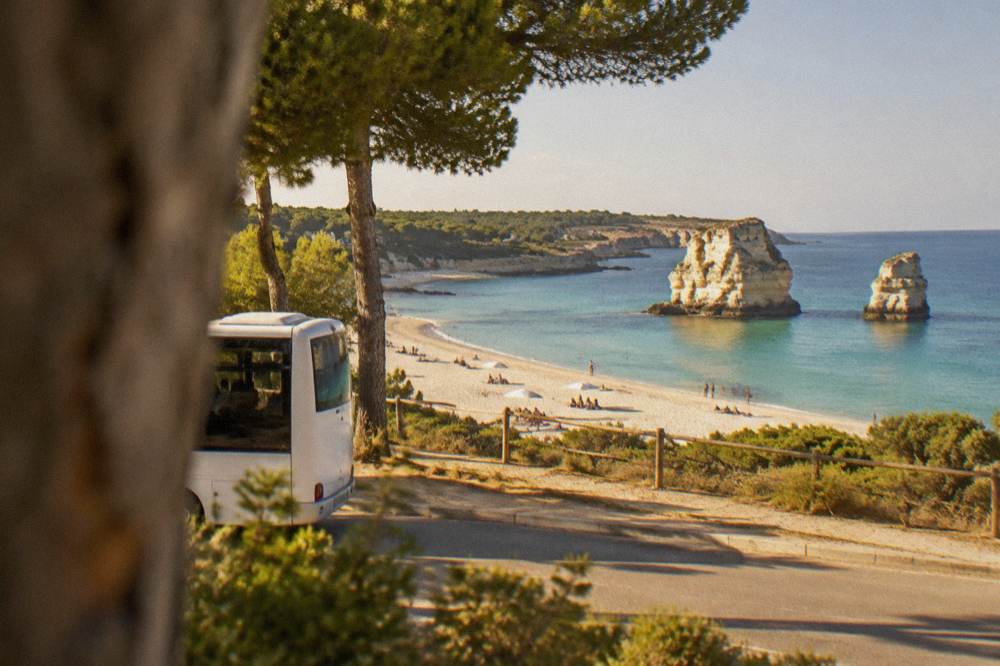
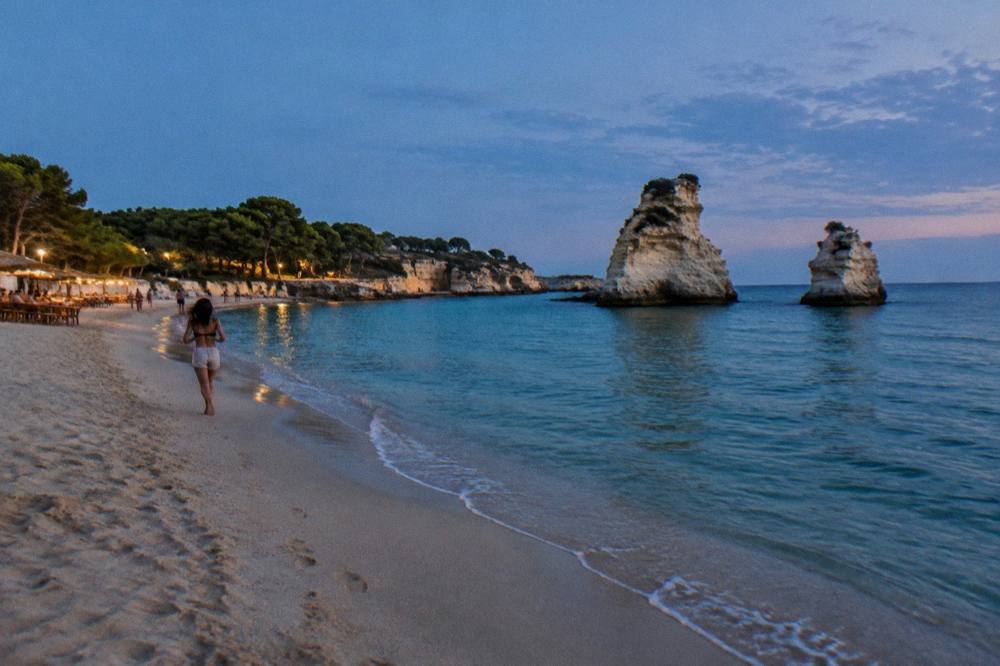
Torre dell Orso, about 28 km east of Lecce in Puglia, is the Adriatic beach day trip from the baroque capital of Salento: a pine-fringed bay watched over by the Due Sorelle sea stacks, reachable in summer by the Salento in Bus line 101.
Short answer
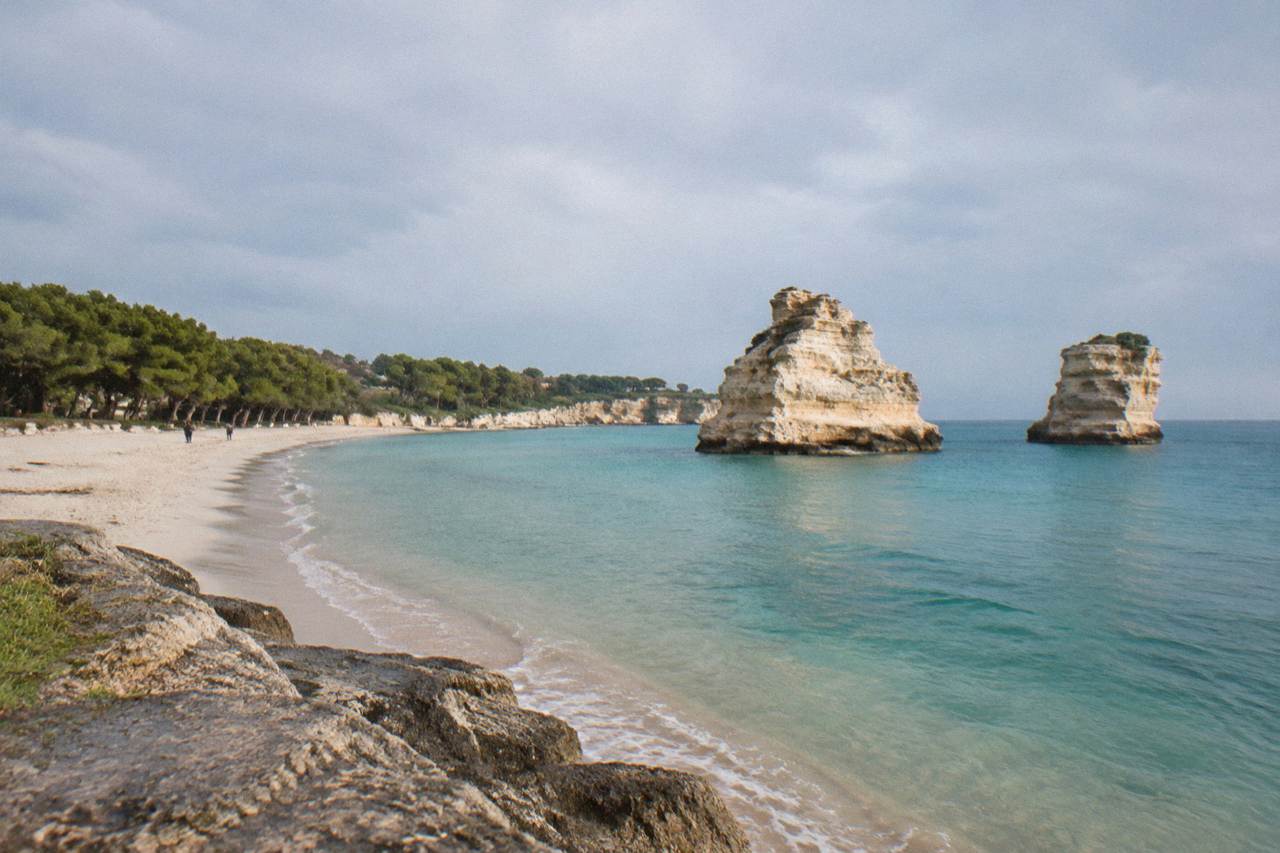
Torre dell Orso is a seaside village in Melendugno, about 28 km (about 32 minutes by car) east of Lecce. Its beach sits between pine forest and low cliffs, with the Two Sisters rock stacks just offshore. In summer the Salento in Bus line 101 runs there from Lecce in about 60 minutes.
Torre dell Orso is the Adriatic beach answer to a Lecce city break: a broad crescent of pale sand about 28 km east of Lecce, in the municipality of Melendugno on the Salento coast of Puglia, southern Italy, framed by a pine forest and watched over by two pale limestone stacks known as the Due Sorelle, the Two Sisters. Lecce itself is a baroque inland city, so this page on Lecce Travel Guide treats Torre dell Orso as what it is for a leccese-based traveller: the closest thing the Adriatic side offers to a classic all-purpose beach day within half an hour's drive of the old town.
Where Is Torre Dell Orso And How Far Is It From Lecce?
Torre dell Orso lies on the Adriatic coast of Salento, in the municipality of Melendugno, about 27.9 km from Piazza Sant'Oronzo in Lecce, roughly 32 minutes of free-flow driving east along the provincial coast road. It is one of the marine di Melendugno, along with San Foca and Roca Vecchia, and sits between the lakes of Alimini country to the south and the low Adriatic cliffs that continue north. The village is small and essentially one long beach basin.
The drive time is computed from a free-flow routing engine, so in the July and August peak it stretches, particularly on the final approach into the village where the road narrows and parking fills. The coast here is the cliff-and-rock side of the peninsula: the Adriatic, the Ionian being the sandy and shallower side, a general geographic fact rather than a ranking. For context, Otranto is 46.7 km and about 44 minutes from Piazza Sant'Oronzo, and San Cataldo, the nearest beach to Lecce of all, is only 12.9 km away, covered on the San Cataldo marine of Lecce page.
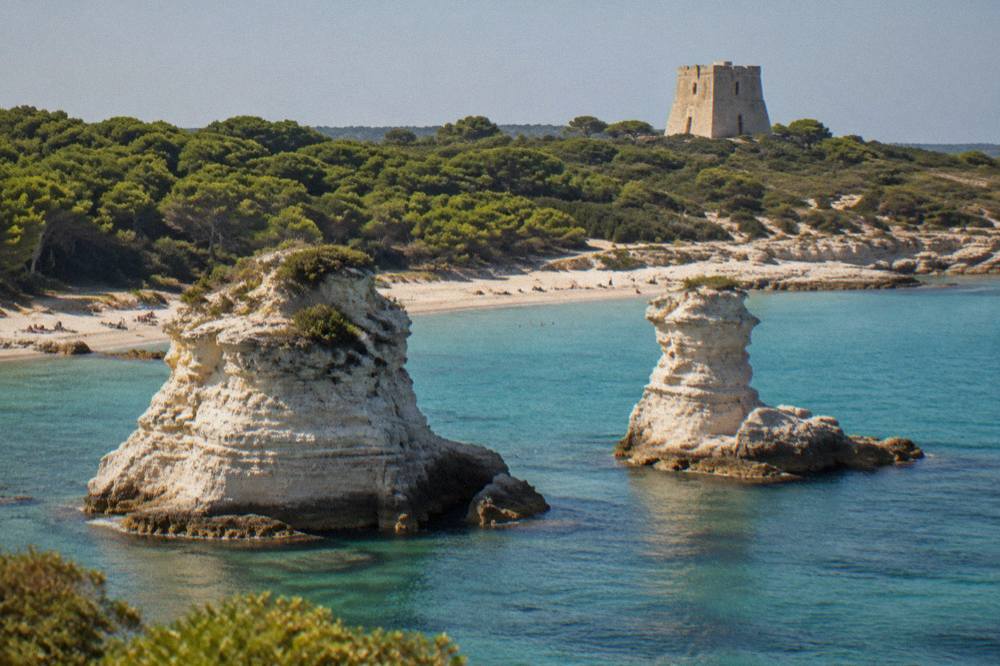
Torre dell Orso is named for its watchtower, a coastal defence tower whose profile still stands above the bay, part of the chain of towers built against raids along this shore. The tower gives the village its name and its landmark; the beach gives it its visitors. Around it the place is pine woods, low cliffs, lidos and a compact strip of bars, gelaterie and holiday apartments that hum from June to September and quieten sharply in October.
| Destination from Piazza Sant'Oronzo, Lecce | Distance | Free-flow drive time |
|---|---|---|
| San Cataldo | 12.9 km | about 14 min |
| Torre dell Orso | 27.9 km | about 32 min |
| Otranto | 46.7 km | about 44 min |
| Castro | 47.4 km | about 48 min |
| Gallipoli | 41.0 km | about 41 min |
| Porto Cesareo | 28.0 km | about 34 min |
| Brindisi | 39.8 km | about 35 min |
What Makes The Two Sisters Beach At Torre Dell Orso Special?
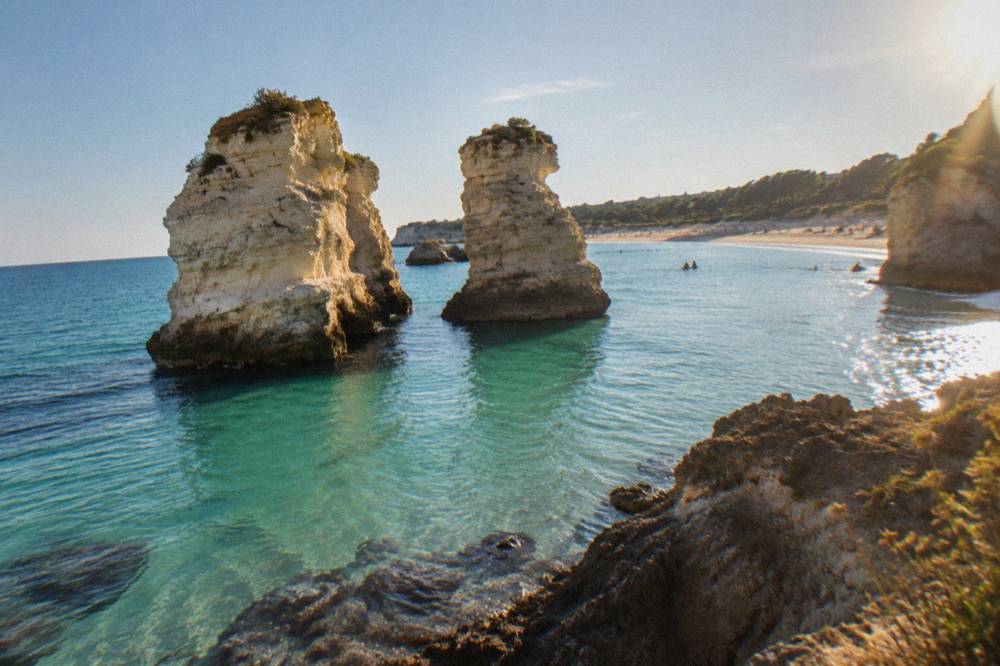
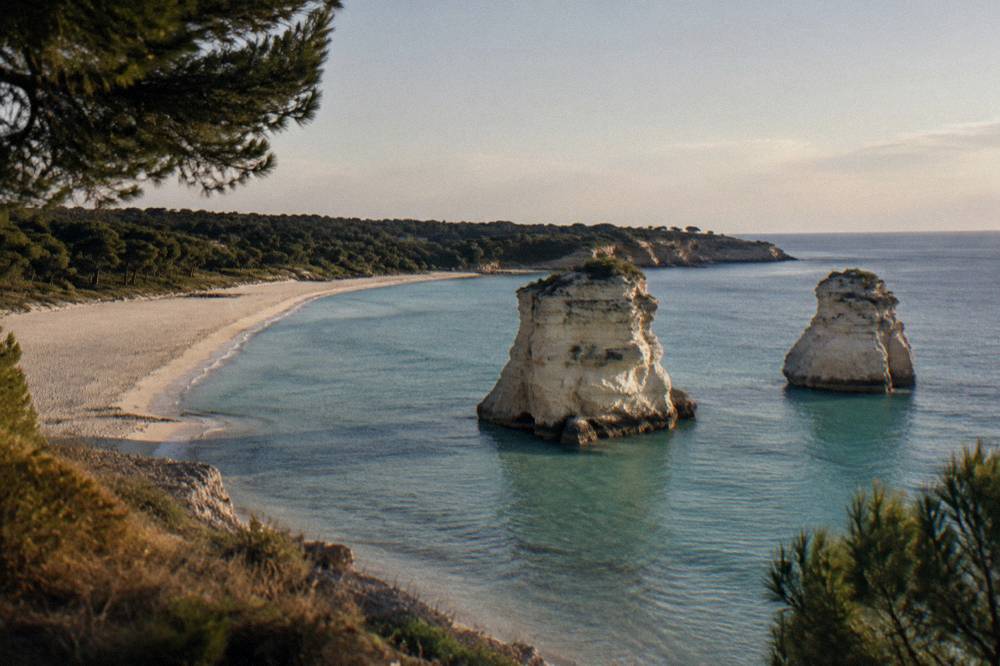
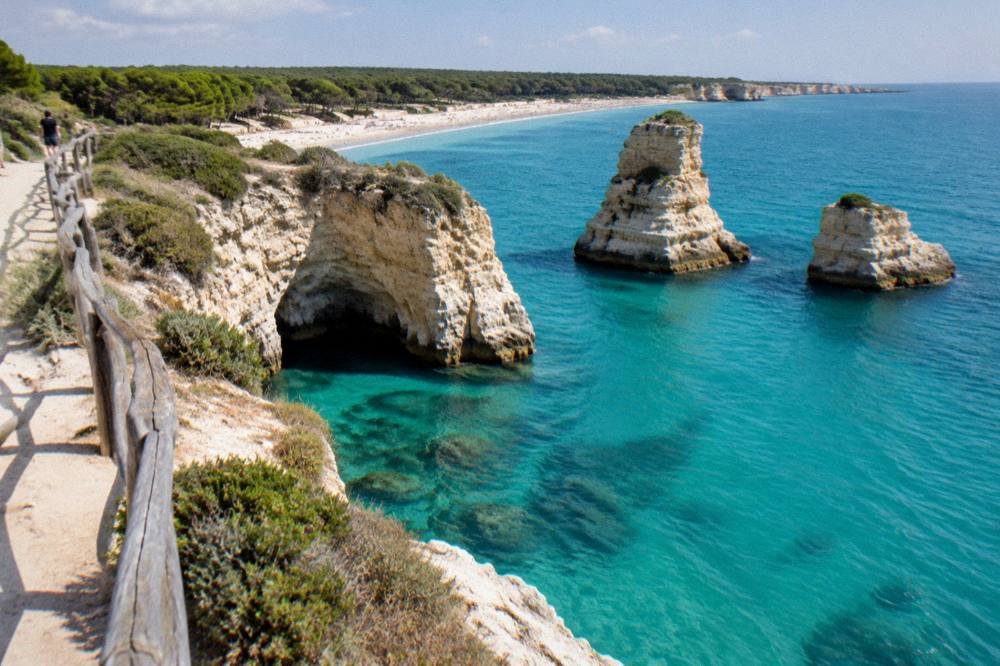
The Due Sorelle, the Two Sisters, are two slender limestone sea stacks standing just off the beach at Torre dell Orso, eroded free of the cliff line and reachable, when the sea allows, by swimming or wading from the sand. Together with the pine forest behind the bay and the clear, shallow water over pale sand, they are the single most photographed sight on this stretch of the Adriatic coast between San Foca and Otranto.
The stacks are the remains of a former arch or cliff section, and local tradition gives them their name from the story of two sisters who drowned there, though that is legend and not history. What is certain is the geology: this coast is soft Miocene limestone, kin to the pietra leccese that built Lecce's baroque facades, and the sea carves it fast, producing stacks, coves and caves. Grotta della Poesia at Roca Vecchia, a few kilometres north, is the same story at a grander scale, and that page covers Grotta della Poesia in full.
The beach itself divides into a free public stretch and rows of lidos. In the 2026 season, per the Udicon and Adoc consumer surveys reported by Corriere Salentino, an umbrella with two sunbeds per day at the Torre dell Orso and San Foca lidos ran about 25 to 35 euro in June and 50 to 60 euro in August. Those are survey figures for that year, not operator promises: prices change each season, so check the price board at each lido before settling in. The free stretches remain large, and the pine forest gives shade that no paid umbrella improves on.
| Item | Reported 2026 figure | Notes |
|---|---|---|
| Umbrella + 2 sunbeds, Torre dell Orso / San Foca, June | 25 to 35 euro per day | Udicon survey via Corriere Salentino |
| Umbrella + 2 sunbeds, Torre dell Orso / San Foca, August | 50 to 60 euro per day | Same survey; peak month |
| Umbrella + 2 sunbeds, San Cataldo, June | 15 to 25 euro per day | Closer to Lecce, cheaper |
| Umbrella + 2 sunbeds, San Cataldo, August | 33 to 35 euro per day | Same survey |
| Free beach | no charge | Public stretches and pine forest shade |
The second thing to understand about the bay is its orientation. It faces north-east, into the Adriatic, and on days when the wind blows from that quarter the water chops up and the stacks photograph grey rather than teal. On the settled days of high summer it is the postcard. Sea temperature, per seatemperature.org averages for the region, runs about 22.5 C in June, 25 to 27 C at the August peak, and 20 to 22 C in October, which is why the bathing season here effectively tracks the Salento in Bus timetable.
How Do You Get To Torre Dell Orso From Lecce Without A Car?
In summer, the Salento in Bus line 101 runs from Lecce to Torre dell Orso in about 60 minutes, with the same line continuing to Otranto. The 2026 season ran 13 June to 13 September, with fares from about 1.10 to 5 euro depending on distance and a 1 euro surcharge if bought on board. Outside that window, options thin out and the journey usually means a change at Otranto or a seasonal local service, so check times before committing.
Salento in Bus is the Province of Lecce's summer shuttle network, operated by Cotrap with partner companies, and it exists precisely because this coast has no rail. The 2026 network ran about ten main lines: line 101 covered Lecce, Torre dell'Orso and Otranto; line 104 ran Lecce, Porto Cesareo and Gallipoli; lines 107 and 108 reached Santa Maria di Leuca. Tickets came via the Cotrap platform or app, children under 10 travelled free, and the 2027 dates had not been announced. The full logistics sit on the Salento in Bus guide.
By car, the route is straightforward: out of Lecce eastward, through the countryside toward Melendugno, and down to the coast. Parking is the pinch point. In July and August the lido car parks fill by late morning, and the fallback is the roadside strips along the pine forest approach. The general Salento advice on driving, the ZTL cameras in Lecce's centre, and the plate-registration question to put to your accommodation, is collected on the site's driving pages; the one rule that matters here is simply to arrive before mid-morning or after 17:00, when the Adriatic lidos empty and the light goes long.
Cyclists should note the terrain honestly: 28 km each way on summer roads is a committed ride, and the e-bike tours that leave Lecce head the other way, toward the flatter olive-country interior and Gallipoli or Galatina, rather than to this coast.
| Way to get there | Time | Reported fare | Season |
|---|---|---|---|
| Salento in Bus line 101 from Lecce | about 60 min | 1.10 to 5 euro, +1 euro on board | 13 June to 13 Sept 2026; 2027 not announced |
| Car from Piazza Sant'Oronzo | about 32 min free-flow | parking varies | year-round |
| Bus toward Otranto (FSE network) then local connection | varies | 2 to 6 euro reported | check live timetables off-season |
What Does A Day At Torre Dell Orso Cost?
A day at Torre dell Orso can cost almost nothing or a fair amount: the beach and pine forest shade are free, a lido umbrella with two sunbeds was reported at 25 to 35 euro in June and 50 to 60 euro in August 2026, the bus each way runs a few euro in season, and food ranges from a bakery stop to a full fish lunch. Budget the lido as the single biggest line.
The lido figures deserve their attribution spelled out: they come from the Udicon and Adoc consumer-association surveys of the 2026 season, reported by Corriere Salentino, and both bodies noted prices rising year on year, with the Ionian lidos dearer than the Adriatic ones on average. Treat them as planning ranges and check the board on the sand. The free beach is genuinely free, and the pine forest behind it is public land that does the umbrella's job for nothing.
Eating falls into two tiers. The village's bars and friggitorie sell the Salento street canon: rustico leccese, puccia, pasticciotto, and caffè in ghiaccio con latte di mandorla, whose prices are not published on official sources, so check at the counter. Sit-down restaurants along the front serve the Adriatic catch. The site's rules on venues are strict because the underlying data is: no verified meal prices exist for named restaurants here, so none are printed, and the best restaurants in Lecce page frames the general price structure of eating in this province instead, with the specific venue detail kept to the city where sourcing exists.
One cost that does have a printed figure is the tourist tax, which is charged by accommodation across the comune, not by the beach. Within Lecce the top reported rate reached 5 euro per person per night for five-star high-season stays from 1 April 2026; rates around Melendugno are set locally, so confirm at booking.
When Is The Best Time Of Year To Visit Torre Dell Orso?
The most reliable beach weather at Torre dell Orso runs from mid-June to mid-September, when the Salento in Bus network operates and the sea averages 22.5 C in June rising to 25 to 27 C at the August peak. July and August bring mean daily highs of about 31 C and the lowest rainfall of the year, about 15 to 18 mm per month, but also the crowds and peak lido prices.
The climate context comes from the ERA5 reanalysis, 1991-2020, for the grid cell near Lecce, a modelled record rather than a weather station. It shows the shape of a classic Mediterranean year: a dry core from June through August, and the wettest months in October and November, at 91.3 and 93.7 mm respectively. November, not a summer month, carries the highest monthly rainfall of the year. For the sea rather than the air, the seatemperature.org regional averages give about 14 C in February and 20 to 22 C as late as October, which is why October beach days here are real, if quieter, and why the Lecce in summer guide and its off-season counterparts matter for timing.
The shoulder choice is a genuine one. June offers the same water clarity with a lighter lido bill and thinner crowds; September keeps warm sea with the village already calming down; October strips the place back to locals and walkers. What the shoulder months take away is the bus: outside the Salento in Bus window you need a car or a taxi, and no verified taxi fare exists in this site's sources, so confirm the price before setting off.
| Month | Mean high C (ERA5 1991-2020) | Rain mm | Sea C (regional average) |
|---|---|---|---|
| June | 28.2 | 18.0 | about 22.5 |
| July | 31.0 | 15.3 | about 25 |
| August | 31.3 | 18.1 | 25 to 27 |
| September | 26.4 | 58.9 | about 24 to 25 |
| October | 21.8 | 91.3 | 20 to 22 |
| November | 17.3 | 93.7 | about 17 to 18 |
Can You Combine Torre Dell Orso With Grotta Della Poesia And Roca Vecchia?
Yes, and the pairing is the natural full day: Roca Vecchia and the Grotta della Poesia lie a few kilometres north of Torre dell Orso along the same coast road, close enough to visit both between morning and late afternoon. But the rules at the grotta changed in 2026: bathing and diving are banned, and non-residents of Melendugno paid a 5 euro entry ticket in the 2026 season, with access limited through the ArcheoRoca project.
The 2026 season details, reported by idealista.it, ran like this: the 5 euro ticket applied from about 18 or 19 July to the end of September, residents of Melendugno entered free, and the swimming and diving ban was enforced, with viewing from the paths only. An "Experience" ticket with guide and virtual reality cost 10 euro, and summer hours ran 9:00 to 20:00 in June and July and 9:00 to 19:00 in August and September. The 2027 rules and any daily visitor cap had not been announced, so confirm before planning a visit around a swim that is no longer permitted.
Roca Vecchia itself is an archaeological site as much as a beauty spot: a Bronze Age settlement over the cliffs, with the grotta as its flooded centrepiece. Combined with the Two Sisters stacks at Torre dell Orso and the tower at San Foca, this short stretch is the densest run of photogenic coastline on the Adriatic side of Salento. It also explains why the most beautiful beach town in Puglia question is genuinely contested rather than settled: the answers differ depending on whether you rank sand, cliffs or old towns.
Is It Worth Seeing Torre Dell Orso From The Water?
Seeing this coast by boat changes what it is: the stacks, caves and coves between San Foca and Torre Sant'Andrea read as a cliff gallery from the sea, and a snorkel cruise from San Foca covers that stretch with swimming stops. From the sand you see one bay; from the water you get the whole limestone wall, including towers and arches invisible from the beach.
The site's featured product for this page is the San Foca snorkel cruise toward Torre Sant'Andrea, which departs from the harbour a few minutes north of Torre dell Orso and drifts down this same rock front. Its price, rating and details render on its own listing rather than being typed here. Boat tours from Santa Maria di Leuca on the far south coast, a different proposition at 83.2 km and about 78 minutes' drive from Lecce, are covered on the Santa Maria di Leuca page. What the San Foca version offers is proximity: it is the coast you are already lying on.
For a land-based alternative, the e-bike and van tours that leave Lecce take in the Salento interior and the southern towns rather than this bay. The eight-hour Otranto, Leuca, Gallipoli and Galatina van tour covers the whole peninsula loop in one long day; the Galatina e-bike tour with olive mill and wine tasting runs the flat inland country south of Lecce. Both are contrast rather than competition: same province, different coastline.
Where Next From Torre Dell Orso: Otranto, San Foca Or Back To Lecce?
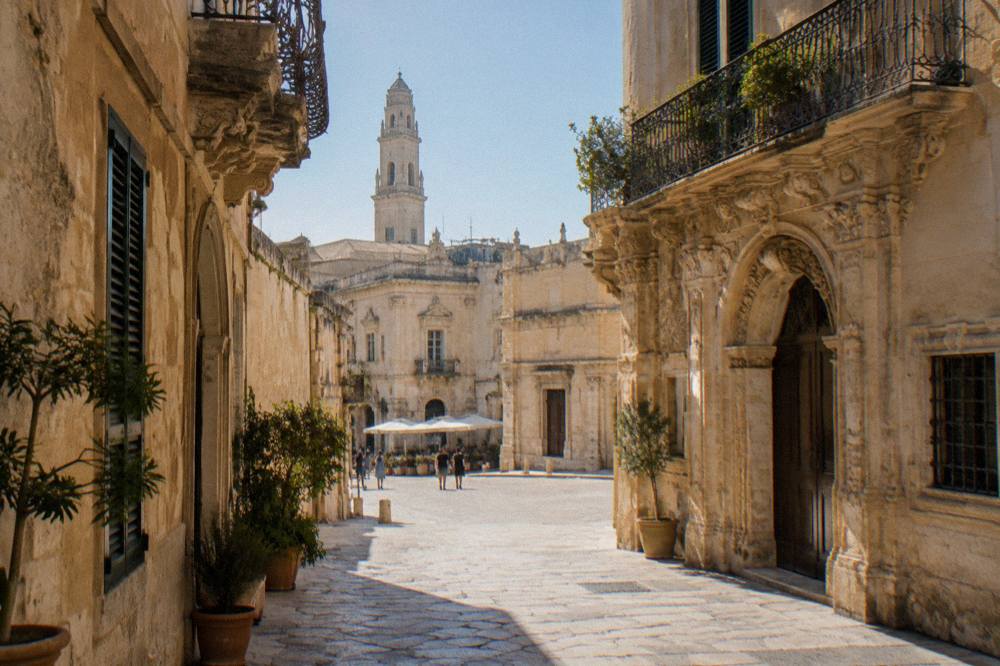
South along the coast, Otranto is about 19 km from Torre dell Orso and the same bus line 101 in season; north, San Foca is the immediate harbour neighbour; and inland, Lecce waits with the Duomo, Santa Croce and the Castello for the evening. A two-base plan of beach mornings and city evenings is the shape that works, and the site's two-day itinerary builds exactly that.
Otranto deserves at least half a day on its own: the cathedral's floor mosaic, dated 1163 to 1165 by the priest Pantaleone, the aragonese castle, and the old town inside its walls. The Diocese of Otranto's notice states that since 1 March 2026 independent visitors enter the cathedral free while groups and guided visitors pay 2 euro, with a 5 euro combined ticket covering the Museo Diocesano and San Pietro. The details, including the Castello Aragonese's seasonal tickets of roughly 6 to 12 euro, are on the Otranto day-trip page.
The other directions serve different moods. San Foca is the working harbour end of this coast, with its own tower and the boat departures. Porto Cesareo, 28.0 km from Lecce on the Ionian, is the sandy, shallow answer if the Adriatic wind is up, covered on the Porto Cesareo page. And the Le marine di Lecce overview collects the whole chain of coastal frazioni, from San Cataldo through Frigole to the Melendugno marine, for readers choosing between them. If the day runs long, the evening return to Lecce lands you in a baroque city at aperitivo hour, which is the argument for basing in Lecce at all, and the Lecce in two days itinerary sequences it.
Common Questions About Torre Dell Orso
How far is Torre dell Orso from Lecce?
About 27.9 km from Piazza Sant'Oronzo, roughly 32 minutes of free-flow driving east to the Adriatic coast at Melendugno.
Is there a bus from Lecce to Torre dell Orso?
Yes, in summer: Salento in Bus line 101 ran Lecce to Torre dell'Orso and on to Otranto in about 60 minutes, from 13 June to 13 September 2026, with fares from about 1.10 to 5 euro. The 2027 dates had not been announced.
What are the Two Sisters at Torre dell Orso?
The Due Sorelle are two limestone sea stacks standing just off the beach, eroded from the cliff line, and the village's best-known sight.
How much is a sunbed at Torre dell Orso?
Reported 2026 survey figures put an umbrella with two sunbeds at 25 to 35 euro per day in June and 50 to 60 euro in August. Prices change each season, so check the lido board.
Can you swim at Grotta della Poesia near Torre dell Orso?
No. Since summer 2026 bathing and diving are banned at the grotta, and non-residents of Melendugno paid a 5 euro entry ticket to view it from the paths. The 2027 rules had not been announced.
When is the sea warmest at Torre dell Orso?
Regional averages put the sea at 25 to 27 C at the August peak, about 22.5 C in June and 20 to 22 C in October.