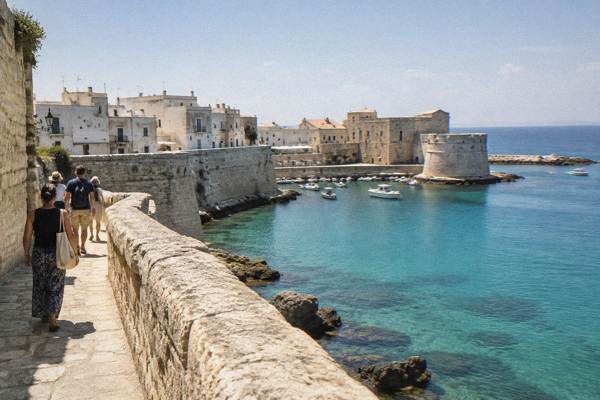
Brindisi From Lecce: Harbour And The Roman Column
Brindisi is the city most Lecce visitors pass through without stopping: the airport gateway, a train ride of well under half an hour, and a working harbour town with a Roman column on its waterfront.
Short answer
Brindisi sits about 35 minutes by car or roughly 20 minutes by direct train from Lecce, on the Adriatic coast of Puglia. It is usually treated as a transit point, but its harbour front, old lanes and seafood make an easy half-day trip, especially on a cloudy beach day.
Brindisi is the city nearly every visitor to Lecce touches and almost nobody explores. It is the airport gateway to the whole of Salento, the place where the train north begins, and a working Adriatic harbour town in its own right, all under 40 kilometres from Lecce's baroque centre. Lecce, for orientation, is the baroque capital of Salento in Puglia, southern Italy: a honey-coloured inland city built of pietra leccese limestone, with the nearest beach at San Cataldo about 13 kilometres away. Brindisi is the opposite of that, a port on the coast due north, and the contrast is exactly why it works as a day trip. This page, from the Lecce Travel Guide editorial desk, sets out what the sources actually support: the train and drive figures, the airport logic, what a walk around the harbour involves, and how Brindisi stacks up against the coast towns most day-trippers chase instead.
Where Is Brindisi In Relation To Lecce?
Brindisi lies directly north of Lecce on the Adriatic coast of Puglia, about 39.8 kilometres by road from Piazza Sant'Oronzo, roughly a 35-minute drive in free-flowing traffic according to OpenStreetMap routing. It is the provincial capital immediately north of Lecce's own province and the site of the region's main commercial airport, BDS. In a straight line the gap is about 39 kilometres.
Those figures come from computed routing rather than a timetable, so treat them as free-flow estimates: traffic around both cities at rush hour can stretch the drive. The geography is simple. Lecce sits inland near the base of the Salento peninsula; Brindisi occupies a natural inlet on the Adriatic a little further up the heel, where a deep natural harbour has shaped the city's whole economy for as long as records exist. The road between them, broadly following the SS16 corridor, is flat, fast and unremarkable, running through olive country that produces much of the region's oil.
The relationship between the two cities is worth understanding before you plan anything. Brindisi is where you arrive; Lecce is where you stay. That is the pattern the transport network is built around, and it is why so many visitors only ever see the inside of Brindisi's airport terminal and the motorway south. Flipping the direction, travelling from Lecce up to Brindisi for a day, is easy precisely because the same infrastructure runs both ways, and off-peak trains are frequent. If your trip planning starts earlier, the site's guide to getting from Brindisi airport into Lecce covers that specific journey in detail.
How Do You Get From Lecce To Brindisi Without A Car?
A direct Trenitalia train runs from Lecce to Brindisi in about 18 to 24 minutes, with fares from around 3.40 euro on regional services and departures roughly every 30 minutes, per aggregator listings of the current timetable. Driving takes about 35 minutes over 39.8 kilometres. No single transport detail here is verified against a live schedule, so check Trenitalia for your own date.
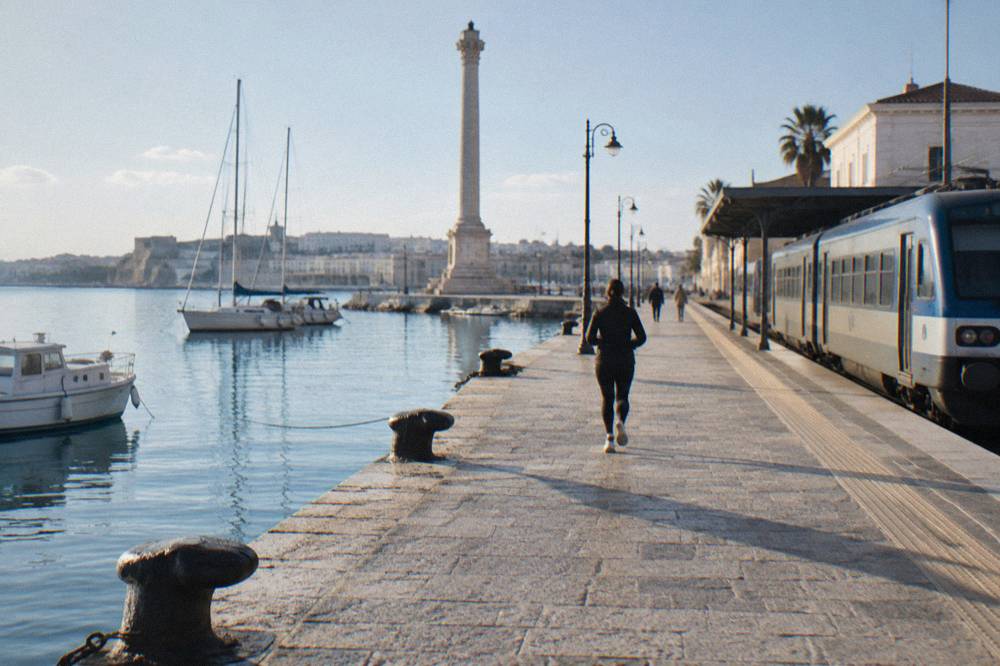
The train is the obvious choice for a car-free day trip. Lecce's station is a short walk outside the historic centre, and Brindisi Centrale sits close to the waterfront, so the whole exchange involves very little onward travel. Regional fares in the low single digits make it one of the cheapest returns on this site's day-trip pages. Frequency is the real asset: with departures through the day, you are not locked into a rigid out-and-back plan and can decide on the day whether to come back for dinner in Lecce or stay for the harbour at dusk.
| Option | Time | Cost | Notes |
|---|---|---|---|
| Direct train, Lecce to Brindisi | about 18 to 24 min | from about 3.40 euro | roughly every 30 minutes; regional and faster services both run |
| Car, Piazza Sant'Oronzo to Brindisi | about 35 min | fuel and any parking | 39.8 km, computed free-flow routing |
| Airport bus, Brindisi Airport to Lecce | about 40 min | 6.50 euro one way, 13 euro return | Terravision, per the operator's own page |
The bus row in that table is the reverse of the day trip but included because it is the one Brindisi transport figure this site holds as operator-verified. Taxi and private-transfer fares between Lecce and Brindisi were not verified, so none appear here; confirm any private booking directly with the operator.
One planning note that matters: the airport is not in Brindisi's centre, it is several kilometres north of it. A day trip by train delivers you to the city and its harbour, not to the terminal. If you are combining the two, flying out late in the day and travelling up by train with luggage, bear in mind that the airport connection is a separate leg and the site's airport transfer guide covers it. Before or after any Brindisi leg, the guided walks below are the strongest uses of a half day in Lecce itself.
Is Brindisi Worth A Day Trip From Lecce?
Brindisi is worth a half-day trip if you want a working port city rather than a postcard one: a harbour front you can walk end to end, seafood kitchens, a historic centre on a human scale, and a Roman column on the waterfront that marked, in antiquity, the terminus of the Via Appia from Rome. It will not replace Lecce's baroque or the beaches; it complements them.
That last clause is the honest framing. Brindisi's stock in trade is authenticity of the unglamorous kind. The city serves as the region's ferry and cruise stop, a naval base and an administrative capital, and its centre has the relaxed, lived-in feel that implies. What this site cannot do is supply verified opening hours, ticket prices or sight inventories for Brindisi's individual monuments, because those were not found in the preferred official sources, so plan to confirm locally on arrival.
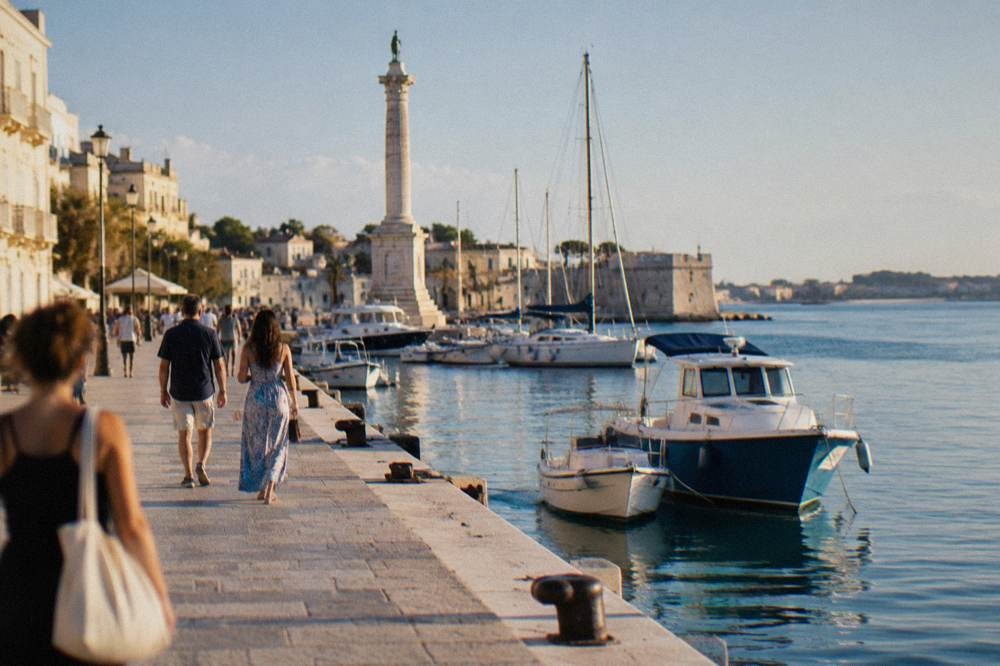
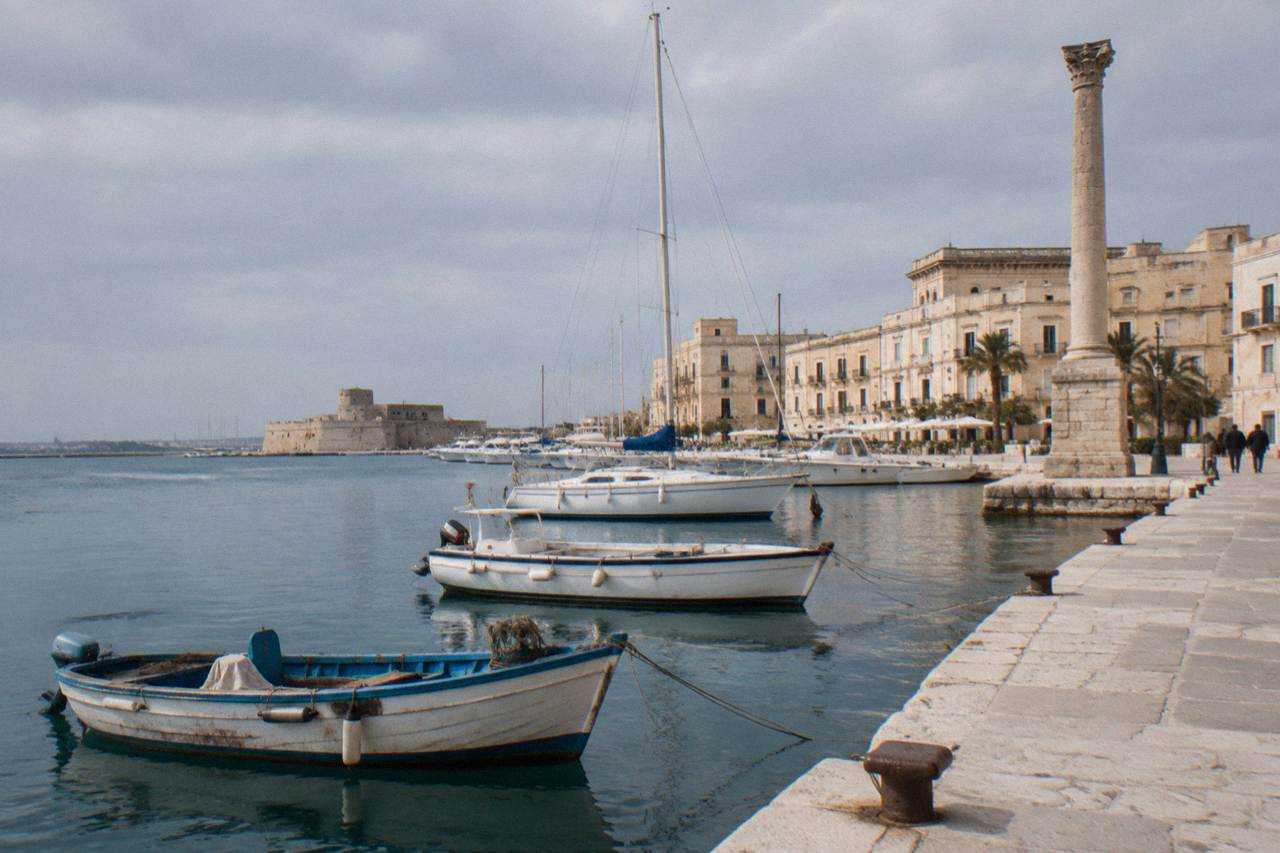
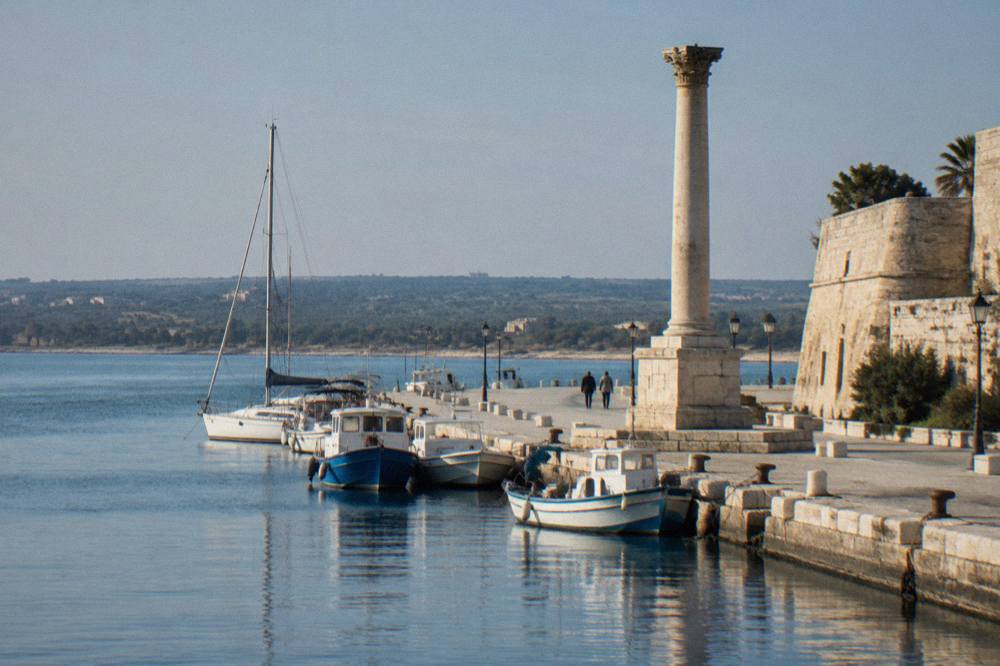
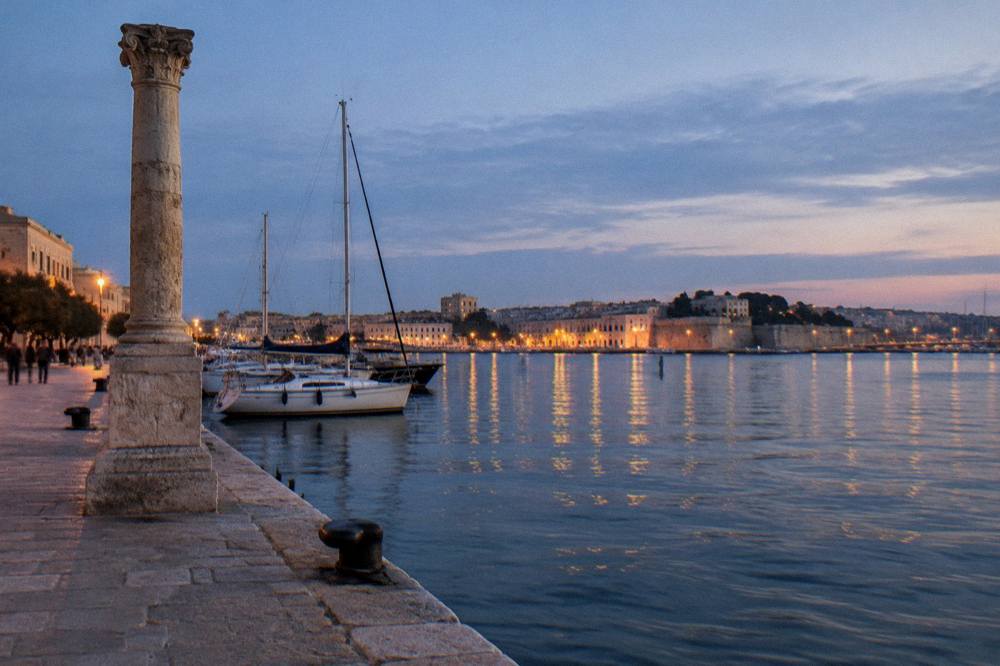
The harbour is the reason the city exists and the reason to go. The natural inlet runs deep into the land, and the waterfront promenade around it is the spine of any visit. The Roman column of the page title stands at the water's edge: ancient sources and tradition place the end of the Via Appia, the great road from Rome, at Brindisi, and the column is the landmark that commemorates it. Beyond that, the old town climbs back from the water in narrow lanes, and the city's role as a departure point for Greece and the East, first for Roman legions and later for Crusader armies, is the historical thread running through it. This page prints no dates or attributions beyond that general outline.
What Can You See In Brindisi On Foot In A Few Hours?
Brindisi's walkable core runs from the train station area down to the harbour promenade and back through the old lanes: the waterfront with its Roman column, the streets behind it, churches and palazzi you pass rather than queue for, and a sweep of the outer harbour where ferries and naval craft sit at anchor. Everything listed sits within easy walking distance of Brindisi Centrale.
The column deserves its own sentence, since it headlines this page. Two columns traditionally stood at the harbour marking the Via Appia's end; one fell centuries ago and its remains were taken, and the survivor is the one photographed today. Say "traditionally" advisedly: the ancient itineraries are consistent on Brindisi as the road's terminus, and this site prints no construction dates.
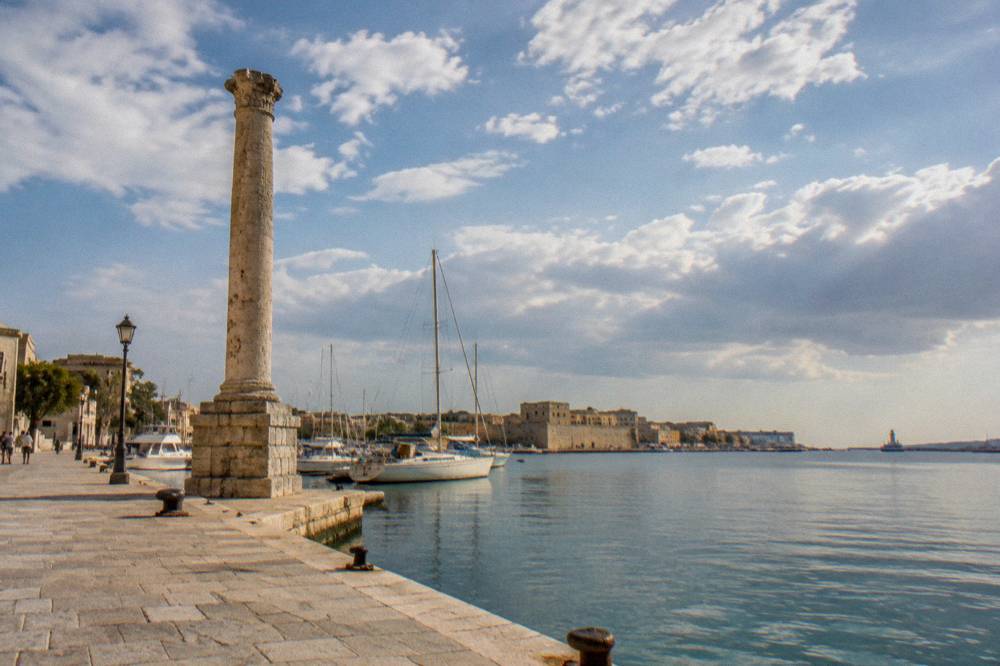
From the column, the sensible loop keeps to the water as long as possible, follows the promenade around the inner harbour, then cuts inland into the historic streets for an hour of wandering before returning to the sea for an aperitivo. Compared with Lecce's sight pattern, Piazza Sant'Oronzo and the Roman Amphitheatre visible from it, Brindisi is less about single monuments and more about the ensemble of port and streets. If deep-layered urban archaeology is what draws you, Lecce's own Roman Theatre hidden in the old city is the stronger single site, and a guided walk with a synagogue basement visit covers that underground layer properly.
Should you crave more structured sightseeing than Brindisi's loose wander, the answer is usually to spend the morning in Lecce with a guide and the afternoon by the sea rather than the reverse.
Should You Fly Into Brindisi Airport Or Bari Airport For A Lecce Trip?
Brindisi Airport (BDS) is the correct gateway for Lecce: the Terravision bus to Lecce costs 6.50 euro one way or 13 euro return and takes about 40 minutes, per the operator's own page. Bari Airport has no direct link to Lecce; reaching Lecce from it means an airport connection into Bari Centrale and then a train of about 1 hour 19 minutes to 1 hour 24 minutes on the fastest services, from roughly 9 to 24 euro depending on train type.
The arithmetic is not close. Bari serves a purpose if your itinerary includes Bari itself, Polignano a Mare or points north, and the site's Bari day-trip and transfer pages cover those cases. For a trip centred on Lecce and Salento, Brindisi saves hours each way.
| Gateway | Link to Lecce | Time | Verified cost |
|---|---|---|---|
| Brindisi Airport (BDS) | direct Terravision bus | about 40 min | 6.50 euro single, 13 euro return |
| Bari Airport (BRI) | bus or train to Bari Centrale, then Trenitalia to Lecce | about 2 hours total and more | train leg from about 9 to 24 euro; airport leg varies |
There is a neat symmetry available to Brindisi-arriving visitors: because the airport bus and the Lecce train network both pass through the same corridor, a late-afternoon flight home can be paired with a morning in Brindisi itself, luggage stored at Lecce station where app-based storage networks operate for a few euro a day, then a direct train up, the harbour for lunch, and the short hop to the terminal. Confirm the airport bus times for your date with the operator before committing to a tight version of that plan.
How Does Brindisi Compare With Other Day Trips From Lecce?
Brindisi is the shortest day trip from Lecce on this site's list: about 35 minutes by car and under half an hour by train, closer than Otranto (about 44 minutes by car), Gallipoli (41) or Ostuni (66), though Ostuni's train of 39 to 51 minutes is competitive without a car. Brindisi suits a short, low-effort excursion; the coast towns suit a fuller day.
Here is how the verified drive times from Piazza Sant'Oronzo line up, all computed over free-flow routing:
| Destination | Distance | Drive time | Car-free option |
|---|---|---|---|
| Brindisi | 39.8 km | about 35 min | direct train, about 18 to 24 min |
| San Cataldo (nearest beach) | 12.9 km | about 14 min | SGM bus line 32, about 20 min |
| Otranto | 46.7 km | about 44 min | FSE train with change at Maglie, about 1 h 33 min or more |
| Gallipoli | 41.0 km | about 41 min | direct FSE train, about 1 h 18 to 1 h 43 |
| Ostuni | 78.3 km | about 66 min | direct train, about 39 to 51 min |
| Galatina | 25.7 km | about 29 min | direct FSE train, about 38 to 55 min |
The pattern is clear. For beaches and swimming coves, Otranto, Gallipoli and Porto Cesareo are the classics, and the site's Salento beaches coverage goes deeper. For a white-town hilltop, Ostuni repays the longer ride. Brindisi's niche is different: it is the one excursion that works as a couple of evening hours, a rainy-morning filler, or a bolt-on to a departure day, precisely because it is so close and so untouristed. That low effort cuts both ways. Nobody should sell Brindisi as a rival to Lecce itself; for the full things to do in Lecce picture, the baroque city wins on monuments, and a guided introduction such as the options below makes better use of a first day.
Where Do You Eat On A Brindisi Day Trip?
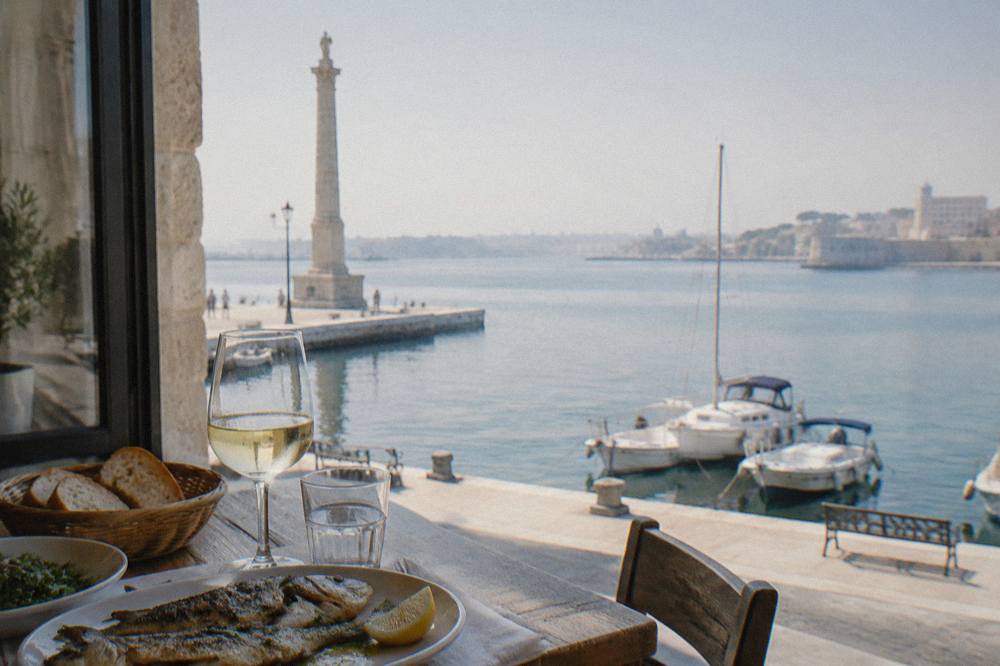
Brindisi is a seafood city by geography and habit: the kitchens around the harbour serve the catch of the adjacent Adriatic, and the town's eating culture is tied to the port's rhythms rather than to tourism. This site verified no individual restaurant, price or address in Brindisi, so the honest advice is to eat near the water and treat any specific name you read elsewhere as something to confirm locally.
That constraint is stated plainly because food advice is where destination content decays fastest into invention. What can be said from general position: the harbour promenade and the lanes immediately behind it hold the density of places to eat, a port city's raw-fish traditions sit close to the surface, and Puglia's wider repertoire, the vegetables, pulses and breads catalogued on the site's what to eat in Lecce overview, travels with you. A rustico or a pasticciotto bought in Lecce before the train remains the cheapest insurance against a disappointing lunch.
For travellers who want the region's food explained rather than merely eaten, Lecce remains the better classroom. A guided street food walk connects dishes to the city's history while you taste, and a cooking class goes further; the walk below is the one this site features alongside its Brindisi coverage.
What Does A Sensible Brindisi Day Trip Timetable Look Like?
A workable shape is a mid-morning train from Lecce, arriving in Brindisi under half an hour later, a slow loop of the harbour and column before lunch, seafood near the water, an hour in the old lanes after, and a late-afternoon train back in time for aperitivo in Lecce. Every time in the sample table below is a planning suggestion, not a schedule; only the journey duration and fare bands are sourced.
The point of the table is proportion, not precision:
| Time | Activity |
|---|---|
| 09:30 | Train from Lecce station |
| 10:00 | Arrive Brindisi Centrale; walk toward the harbour |
| 10:15 to 12:00 | Harbour promenade, the Roman column, the outer harbour views |
| 12:00 to 13:30 | Seafood lunch near the water |
| 13:30 to 15:00 | Old-town lanes at the siesta pace; churches as encountered |
| 15:30 | Train back to Lecce |
| 16:00 | Aperitivo in the baroque city |
Two cautions attach. First, southern riposo: smaller shops and some churches close in the early afternoon, so the timetable deliberately puts structured sightseeing in the morning and idle wandering after lunch. Second, if your real reason for being in Brindisi is a flight, invert the day and let the harbour be the finale rather than the main course.
A final note on season. Brindisi's experience barely changes between June and January in the way a beach town's does: the harbour, the column and the lanes are the same visit in a coat as in a t-shirt. The ERA5 reanalysis for nearby Lecce, 1991-2020, puts the mean daily high at about 31 degrees in July and August and about 12 degrees in January, with November the wettest month at about 93.7 millimetres, and Brindisi's coastal position moderates those figures only slightly. That makes the city a genuine shoulder-season and winter option, when the swimming coves further south lose their point and Lecce's own cold-season rhythm, covered in the site's seasonal guides, takes over. However you slot it in, Brindisi asks little, gives a real port city back, and costs less than the price of a pasticciotto-heavy morning to reach.
Common Questions About Brindisi As A Day Trip From Lecce
How far is Brindisi from Lecce?
Brindisi is about 39.8 kilometres by road from Piazza Sant'Oronzo in Lecce, roughly a 35-minute drive in free-flow conditions, or about 39 kilometres in a straight line. The direct train covers the distance in about 18 to 24 minutes.
Is there a direct train from Lecce to Brindisi?
Yes. Direct Trenitalia regional and faster services run between Lecce and Brindisi in about 18 to 24 minutes, from around 3.40 euro, with departures roughly every 30 minutes per current aggregator listings. Check Trenitalia for your travel date.
What is Brindisi famous for?
Brindisi is famous as an ancient harbour city: the traditional terminus of the Via Appia from Rome, marked today by a Roman column on the waterfront, and a modern ferry and cruise port for Greece and the Adriatic. It also holds the region's main commercial airport, BDS.
Is Brindisi worth visiting or just the airport?
Brindisi is worth a half day for its harbour promenade, the Roman column, its old lanes and its seafood kitchens, especially given the short train ride from Lecce. It is not a substitute for Lecce's baroque centre or the Salento beaches, but it works well as a rainy-day, evening or departure-day excursion.
Can you do Brindisi and Lecce in one day?
Yes, in the airport direction: a morning guided walk in Lecce, luggage stored at the station for a few euro via app-based networks, then a direct train of under half an hour to Brindisi for the harbour and lunch before the short hop to the airport. Confirm the airport bus time with the operator if the flight is tight.