Rustico Leccese: The Puff Pastry Snack
The rustico leccese is Lecce's savoury answer to the pasticciotto: a round of puff pastry filled with béchamel, tomato and cheese, served warm from the city's bakeries and bars.
Short answer
A rustico leccese is a savoury Salento snack of puff pastry filled with béchamel, mozzarella or fior di latte, tomato and pepper, baked golden and eaten warm in Lecce.
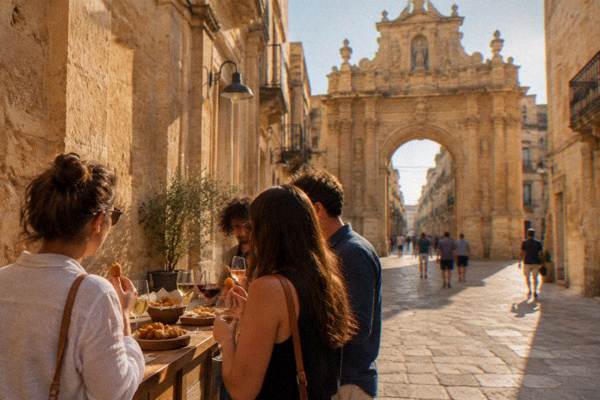
Lecce, the baroque capital of Salento in Puglia, southern Italy, runs on a small round of savoury puff pastry called the rustico leccese. It sits in bakery windows and bar counters across the old town, golden and slightly blistered, and it is the city's standard answer to mid-morning and late-afternoon hunger in a way that few visitors expect from a place usually described in terms of limestone facades and church spires. This page sets out what the snack is, what the sources say goes inside it, how it relates to the sweeter pasticciotto that shares its display case, and how to fold one into a day of eating in a city built a few kilometres inland from the Adriatic, at the heel of Italy.
What Is A Rustico Leccese?
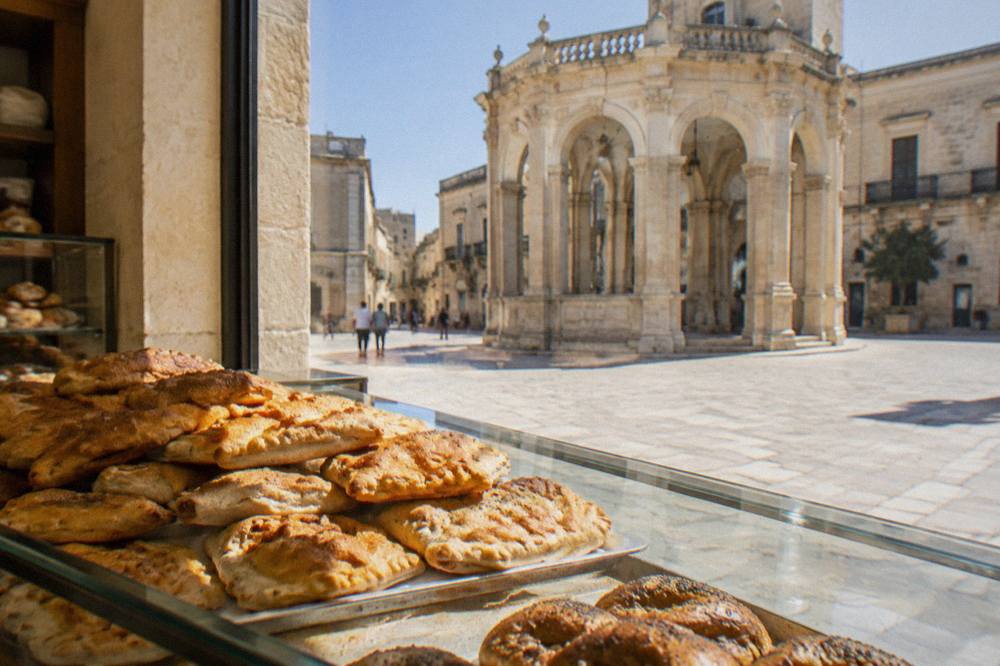
A rustico leccese is a savoury Salento snack made from puff pastry, baked into a round parcel and filled with béchamel sauce, mozzarella or fior di latte, tomato pulp and black pepper, sometimes with nutmeg in the béchamel. It is eaten warm rather than hot, usually standing at a bar counter in Lecce, and it belongs to the same family of everyday baked snacks as the pasticciotto, which is its sweet counterpart.
The name itself is the first thing to understand. "Rustico" simply means rustic or savoury in Italian, and in Lecce it functions as shorthand: order "un rustico" at a bar in the old town and the counter staff will reach for the puff pastry round, not for a menu. The snack is a product of the city's café culture rather than its restaurant culture, which is why it turns up in pasticcerie and bars rather than on sit-down menus.
Its documented shape and filling come from the food sources this site reports rather than from legend. The shell is sfoglia, puff pastry, and the filling combines besciamella, béchamel, with mozzarella or fior di latte, tomato sauce or pulp, and pepper, with nutmeg appearing in some versions. The result is soft and faintly liquid inside, crisp and layered outside, and it is that contrast that separates a good one from a stale one.
The origins are genuinely uncertain, which is worth saying plainly. Food historians writing about the rustico place its likely emergence in the late 18th or 19th century, and some accounts suggest an aristocratic kitchen or a bar invention influenced by the French vol-au-vent. Nobody has produced a founding date or a founding baker, and the honest position is that the snack grew out of the pastry traditions of Salento at some point after puff pastry itself became common. Any page that gives you a precise birth year for the rustico is guessing.
What Goes Inside A Rustico Leccese, And How Is It Made?
The classic filling is béchamel sauce, mozzarella or fior di latte, tomato sauce or tomato pulp, and black pepper, with nutmeg sometimes added to the béchamel, all sealed inside two discs of puff pastry and baked until the top is golden. The shell is the same sfoglia used for savoury pastry across Italy, and the cheese is deliberately mild so the tomato and pepper carry the flavour.
The construction matters more than it sounds. A round of puff pastry is topped with the filling, sealed under a second round, crimped at the edge, and baked. The steam from the mozzarella and béchamel lifts the layers of pastry apart, which is what produces the flaky dome. Because the filling is wet, a rustico does not keep well: the pastry softens within hours, and this is a snack meant to be eaten the day it is baked, ideally within an hour or two of it leaving the oven.
There are variations, and the sources describe them without attaching names to them. Some bakers use a double-crust approach closer to a small pie; some add harder cheese for sharpness; a few make a rectangular version for takeaway counters. None of these is a different dish. They are all the same béchamel-and-tomato idea in a slightly different wrapper, and arguing about which shape is authentic is a Lecce parlour game rather than a matter of record.
For visitors with dietary constraints, the honest summary is this: the traditional rustico contains wheat and dairy, and the béchamel is made with butter and milk or cream. A vegan or gluten-free version is not part of the tradition as documented, and any bar offering one is improvising. Ask at the counter rather than assuming.
| Component | Traditional form | Notes from the food sources |
|---|---|---|
| Pastry shell | Puff pastry, sfoglia, two rounds crimped | Post-17th-century technique; the dish cannot predate puff pastry |
| White sauce | Besciamella, béchamel | Sometimes with nutmeg |
| Cheese | Mozzarella or fior di latte | Mild, melts into the sauce |
| Tomato | Sauce or pulp | Balances the richness |
| Seasoning | Black pepper, sometimes nutmeg | No other spice is traditional |
The reason this snack thrives in Lecce specifically, rather than being spread evenly across Puglia, is partly the city's café density and partly the pattern of the local day. The old town supports a large number of bars and pasticcerie serving a university population of roughly 20,774 enrolled students at the Università del Salento, plus the resident population of about 94,387, and a cheap warm savoury pastry fits both a student budget and a mid-morning pause. For a wider map of the city's food, read what to eat in Lecce, and for the sweet half of the display case, the pasticciotto guide covers that pastry in full.
Where Do You Eat A Rustico In Lecce?
You eat a rustico at a bar or pasticceria counter in Lecce's centro storico, ordered by the single word "rustico" and usually eaten standing or walking within sight of where it was baked, paired in the afternoon with the city's iced coffee. The snack is a counter food all day, from mid-morning through the evening passeggiata, and no venue on this page is recommended over another because the sources support no ranking.
The geography is simple. The display cases cluster in and around the old town: Piazza Sant'Oronzo, the streets off Piazza del Duomo, the Giudecca quarter and the area around Porta Napoli. You do not need a address list, because the pastry is near-universal: any pasticceria with a savoury shelf will have it, and any bar serving morning coffee will either bake it or buy it in. What varies is freshness, and the practical test is turnover, a busy counter at mid-morning is baking or receiving rustici continuously.
Two named institutions appear in the verified sources and are worth knowing about, without any claim that either is the definitive one. Caffè Alvino on Piazza Sant'Oronzo traces its roots to about 1880 and is described in local reporting as a historic bar and pasticceria. Pasticceria Natale has been family-run since 1978 and is known for traditional Salento pastries. Beyond these, this site prints no bakery names, no addresses, no hours and no meal prices, because none of that is verified for other venues, and the practical advice is simply to walk in and look at the case.
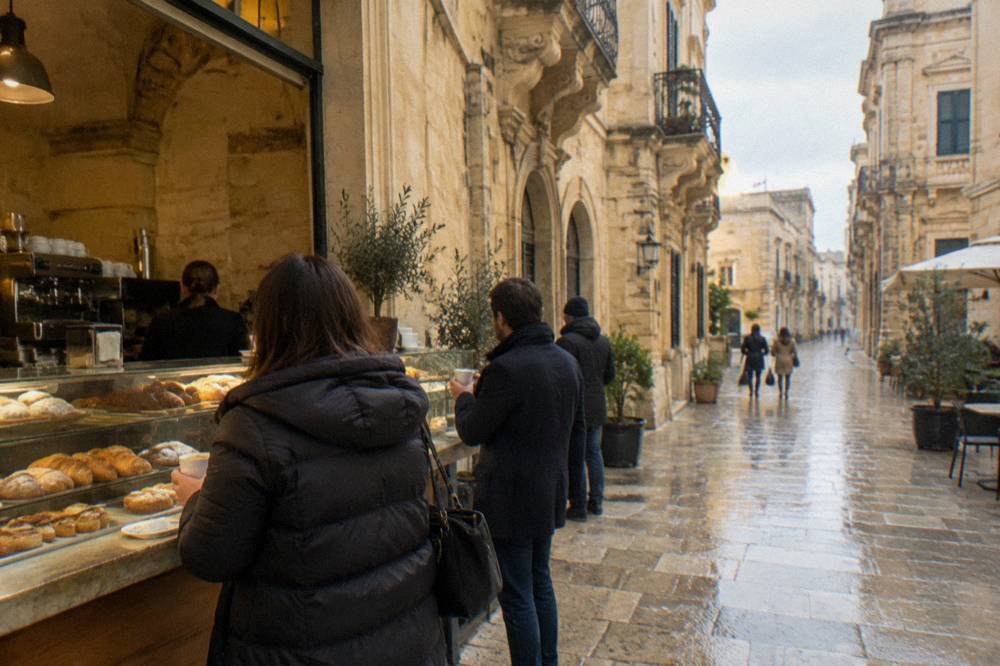
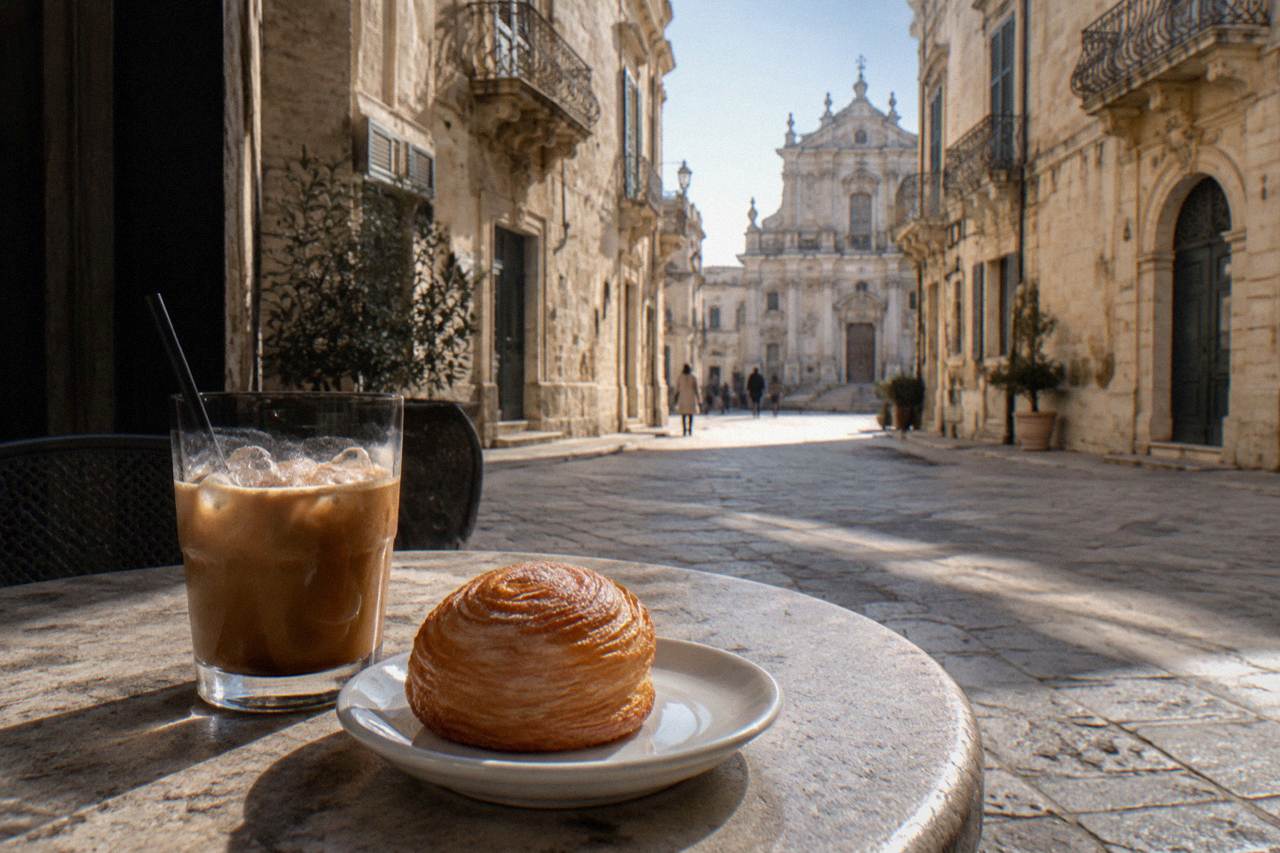
The pairing that defines the Lecce experience is caffe in ghiaccio con latte di mandorla, espresso poured over ice cubes with almond milk syrup, a drink credited to Antonio Quarta of Quarta Caffè in the 1940s or 1950s and now on Italy's PAT list of traditional products. The cold sweet coffee against the warm savoury pastry is the city's own contrast, and it costs a fraction of a restaurant meal. The specific figure this site can print is a single reported example, a "Santo Pasticciotto" listed at 2.20 euro, which gives a sense of the counter-pastry price band without describing the rustico itself; prices change, so check the board.
| Named institution | Sourced fact | Source type |
|---|---|---|
| Caffè Alvino, Piazza Sant'Oronzo | Roots to about 1880, historic bar and pasticceria | Reported in local press |
| Pasticceria Natale | Family-run since 1978, traditional Salento pastries | Reported |
| Bar Avio | Opened about 1978 as a Quarta Caffè bar | Reported |
| Quarta Caffè | Credited with caffe in ghiaccio con latte di mandorla, 1940s or 1950s | Reported |
A guided tasting is one way to short-circuit the guesswork, and the old town's food walk below builds savoury snacks and local wines into a single circuit, with the operator's live listing carrying the current details. The Lecce Travel Guide food pages cover the restaurant side of the city separately, including the best restaurants in Lecce for evenings when a counter snack will not do.
Rustico Or Pasticciotto: How Do The Two Pastries Compare?
The rustico is the savoury sibling and the pasticciotto is the sweet one: where the rustico holds béchamel, mozzarella and tomato in puff pastry, the pasticciotto holds custard, and sometimes amarena cherry, in shortcrust pastry, and the two are eaten at different moments, the rustico as a mid-morning or pre-dinner savoury bite, the pasticciotto as dessert or breakfast. Both are counter foods in Lecce and both are cheap relative to a restaurant plate.
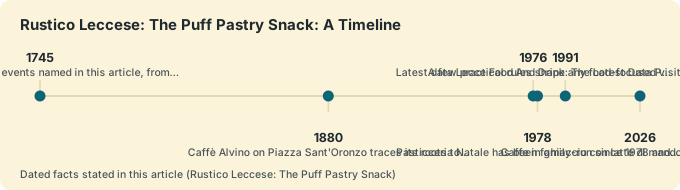
The comparison is worth making carefully because visiting guides sometimes collapse the two into a single "Lecce pastry" idea. They share a display case and a price bracket, and nothing else. The dough differs, the filling differs, and the eating occasion differs. The pasticciotto also carries an origin story that the rustico lacks: Pasticceria Ascalone in Galatina, a town about 26 km from Lecce, claims the 1745 invention date during a patron saint feast, using leftover shortcrust and custard in small copper moulds. Historians dispute the date and the shop, not Lecce, is where the claim sits, so it is always reported here as the shop's claim rather than fact.
| Feature | Rustico leccese | Pasticciotto |
|---|---|---|
| Course | Savoury snack | Sweet pastry, breakfast or dessert |
| Pastry | Puff pastry, sfoglia | Shortcrust pasta frolla |
| Filling | Béchamel, mozzarella or fior di latte, tomato, pepper | Custard, sometimes with amarena cherry |
| Best eaten | Warm, day of baking | Same morning for the classic version |
| Origin story | Uncertain, 18th or 19th century, no named inventor | Galatina shop's own 1745 claim, disputed |
| Classic drink pairing | Caffè in ghiaccio con latte di mandorla, or beer | Espresso |
A practical note on timing: the pasticciotto is a morning item at its best, while the rustico holds up through the afternoon, since a savoury filling reheats more gracefully than custard. If you are planning a single pastry crawl, do the sweet one early and the savoury one later, and let the two bookend the sightseeing day rather than compete with it.
How Does A Rustico Fit Into A Day Of Eating In Lecce?
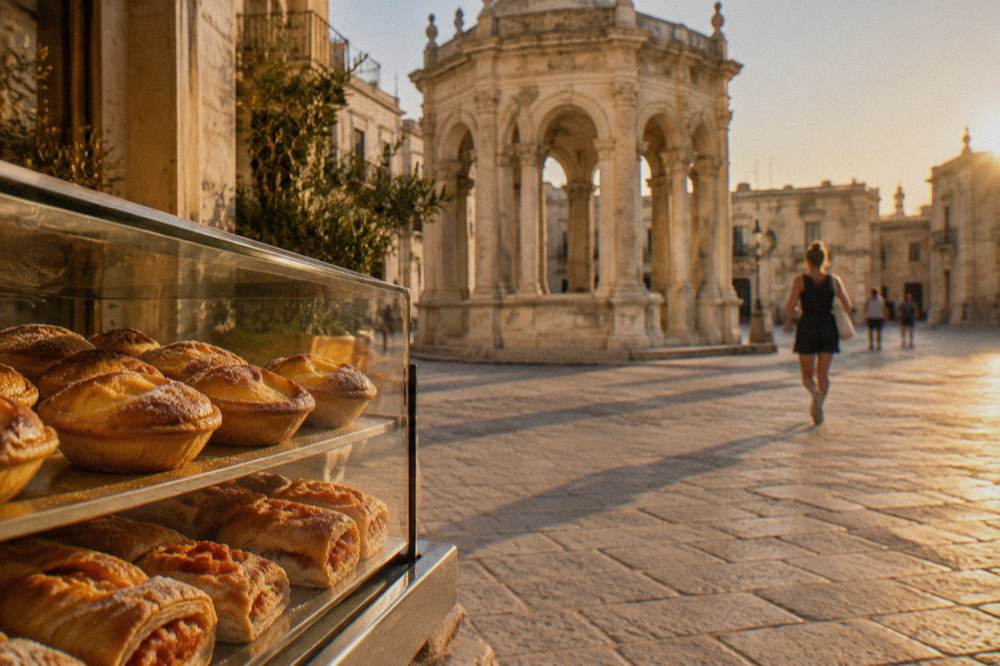
A rustico slots into the mid-morning pause or the early-evening aperitivo window, the two moments when Lecce's bars are busiest with locals rather than sightseers, and it works as the savoury anchor of a grazing day that might move from pasticciotto at breakfast, through rustico and iced coffee at eleven, to a proper restaurant dinner after eight. It is not a meal, and treating it as lunch is the one mistake worth avoiding.
The rhythm of the local day explains the snack's place. Breakfast in Salento is sweet, coffee plus pastry, taken standing. Lunch is a real meal but later than northern European habits, and the gap between a 8:00 coffee and a 13:00 lunch is where the rustico lives. The other slot is early evening, when the passeggiata fills the streets between Piazza Sant'Oronzo and the Duomo and a savoury bite holds off hunger until dinner at 20:30 or later. Shops in the historic centre commonly close for a mid-afternoon pause in the roughly 13:00 to 16:00 or 17:00 window, and the bars that stay open are where the afternoon rustico crowd sits.
For a visitor structuring a day, the pattern writes itself. Morning: church architecture, the LeccEcclesiae circuit covers the Duomo, crypt, Santa Croce and more on a combined ticket of 11 euro standard, 21 euro including the bell tower, valid 15 days. Mid-morning: rustico and caffe in ghiaccio. Afternoon: a museum such as Museo Faggiano at 5 euro or the Castello Carlo V by guided tour at 10 euro full. Evening: aperitivo and dinner. The Lecce churches ticket guide breaks down the combined ticket, and the free things to do in Lecce page covers the squares and streets that cost nothing between meals.
What Salento Wines And Drinks Go With A Rustico?
Salice Salentino DOC, a Negroamaro-based red established in 1976 across the provinces of Lecce and Brindisi, is the local red most often poured alongside Salento food, with Negroamaro as the key grape of the peninsula and Primitivo di Manduria as the other regional benchmark, and for a non-wine pairing the city's own iced coffee with almond milk is the standard counter companion to a warm rustico.
The wine logic is straightforward. A savoury, mildly acidic, cheese-rich pastry wants a red with enough body and enough acidity to cut through the béchamel, and Negroamaro, the "black-bitter" grape that anchors Salento's reds, is built for exactly that job. Salice Salentino DOC was established in 1976 and requires a Negroamaro-dominant blend, with permitted percentages having shifted over the years toward a higher minimum. Primitivo di Manduria DOC, centred on Manduria in Taranto province at the northern edge of Salento, gives a riper, softer alternative.
| Wine or drink | What it is | Why it works with a rustico |
|---|---|---|
| Salice Salentino DOC | Negroamaro-based red, established 1976, Lecce and Brindisi provinces | Body and acidity cut the béchamel |
| Negroamaro | Key Salento grape, base of many DOCs | Bitter-dark fruit against mild cheese |
| Primitivo di Manduria DOC | Salento red from Taranto province | Riper, softer counterpoint |
| Caffè in ghiaccio con latte di mandorla | Espresso over ice with almond milk, PAT-listed | Cold and sweet against warm and savoury |
| Local beer | Standard Italian lagers at the counter | A common aperitivo pairing in the bars |
The coffee deserves its own sentence of history, because it is as identified with Lecce as the rustico itself. Caffè in ghiaccio con latte di mandorla is credited to Antonio Quarta of Quarta Caffè in the 1940s or 1950s, espresso poured over ice cubes with almond milk syrup, traditionally unstirred so the layers mix only as you drink. Local reporting notes the drink entered Italy's PAT list of traditional agri-food products around 2026. The almond milk is the Salento touch, the region grows almonds, and the drink turns the southern habit of iced coffee into something site-specific.
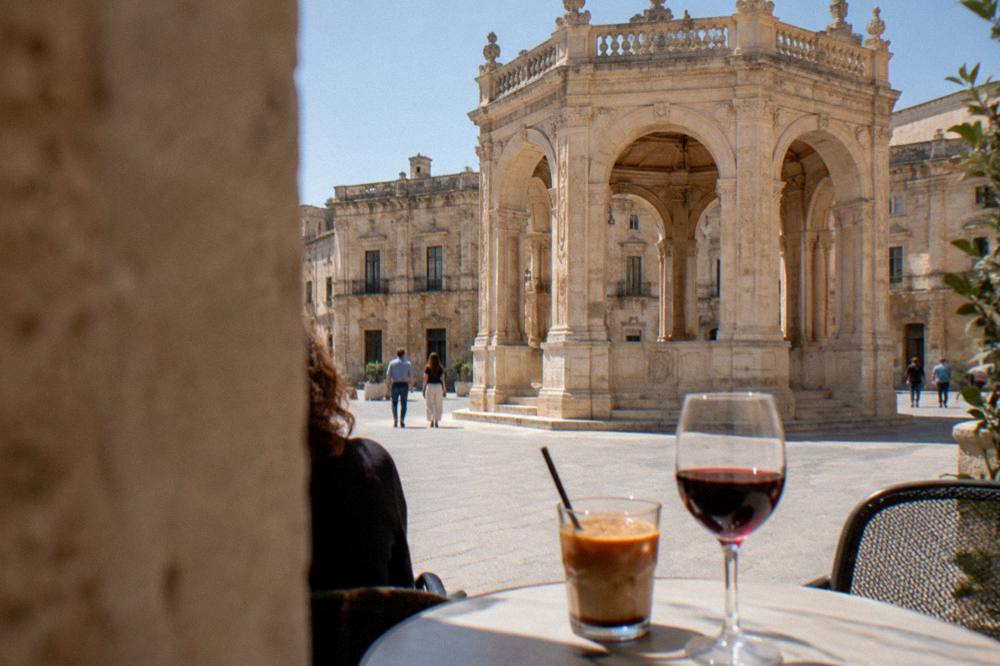
Wine and food tasting experiences that walk through these pairings are among the site's featured products, and the selection below pairs the old town tasting with a pasta class and a guided walk through the Jewish quarter, three ways of encountering the same food culture at different depths.
Can You Learn To Make Salento Pastries And Pasta In Lecce?
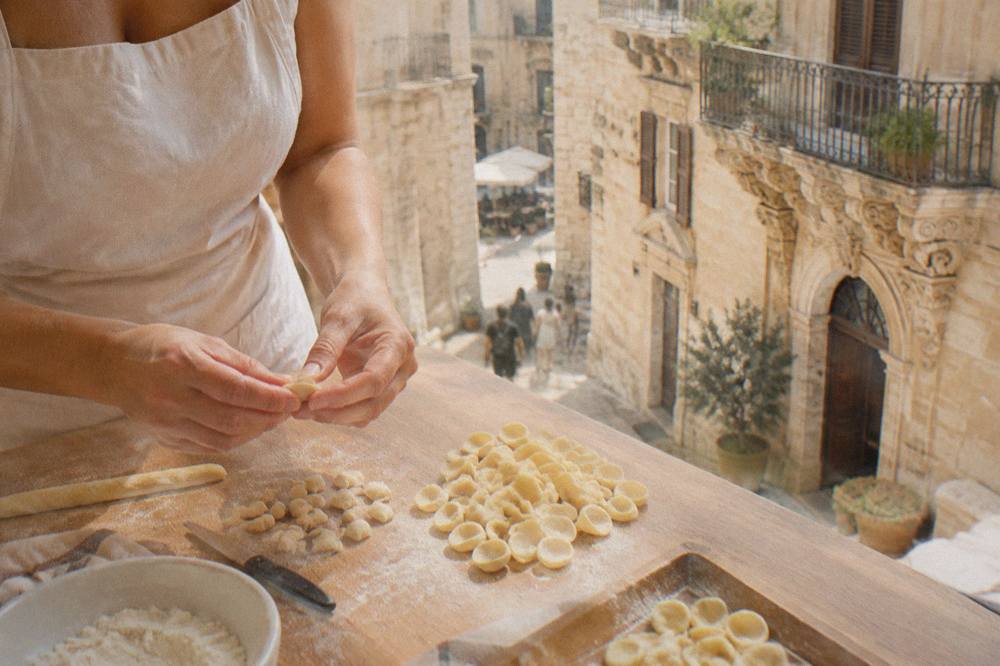
Yes, Lecce has a working craft-and-cooking scene: cooking classes in the city and in family homes outside it teach orecchiette and other Salento pasta shapes, a 1400s-era courtyard hosts a pasta-making class with wine, and the city's papier mâché workshops run alongside them as the other hands-on tradition, though no verified source documents a class specifically for the rustico, so the honest answer for this one pastry is the bakery counter, not the classroom.
The distinction matters. Pasta classes are documented, verifiable products sold through this site's listings, and the pasta-making class in a 1400s-era courtyard is the one most closely tied to the old town's material history, the class happens inside a courtyard of the age the buildings around it claim. Salento pasta traditions, orecchiette above all, are taught with wine included, and a private class in a family home near Lecce takes the format further. None of these is a rustico class. The rustico depends on laminated pastry, which is a bakery technique, and bakeries do not generally teach it to visitors.
What a class does give you is context. Making orecchiette by hand, the thumb-dragged shape that Puglia is known for, explains the logic of Salento food: few ingredients, patient technique, everything eaten fresh. The rustico obeys the same logic in a bakery register. A street food walk that builds tastings into a guided circuit of the old town is the closest verified product to a rustico-centred experience, since savoury pastries typically feature alongside the other counter foods.
What Else Should You Know About Eating Your Way Round Lecce?
A few practical rules shape any food-focused visit to Lecce: the city has no commercial airport, so the gateway is Brindisi with a bus connection of about 40 minutes, the historic centre is compact and walkable, counter food is eaten standing and paid per item, the tourist tax exists and is collected by your accommodation at a top reported rate of 5 euro per night in high season, and the best months for grazing outdoors are late spring through early autumn, per the ERA5 reanalysis 1991-2020 climate normals.
The climate numbers back that up. The ERA5 reanalysis for Lecce, 1991-2020, gives a mean daily high of 23.4 C in May rising to 31.0 C in July and 31.3 C in August, with rainfall at its lowest in July at 15.3 mm and highest in November at 93.7 mm. April at 18.6 C and October at 21.8 C are the shoulder months where a walking-and-eating day is comfortable without the August heat. The best time to visit Lecce question is covered in full elsewhere, as is Lecce weather month by month.
Practicalities for the eating day itself: carry small cash or a contactless card, since some counters are cash-preferred; expect service to be fast and standing-room; and remember that bars selling coffee in the morning switch character by late afternoon into aperitivo mode. The tourist tax is a real line on your accommodation bill, its top reported rate is 5 euro per person per night for five-star high season stays from the April 2026 tariff update, and you should confirm the exact category rate at booking. For getting to the city at all, the how to get to Lecce and Brindisi airport to Lecce pages hold the transport detail, and the Salento guide extends the food trail down the peninsula to Otranto, Gallipoli and Leuca.
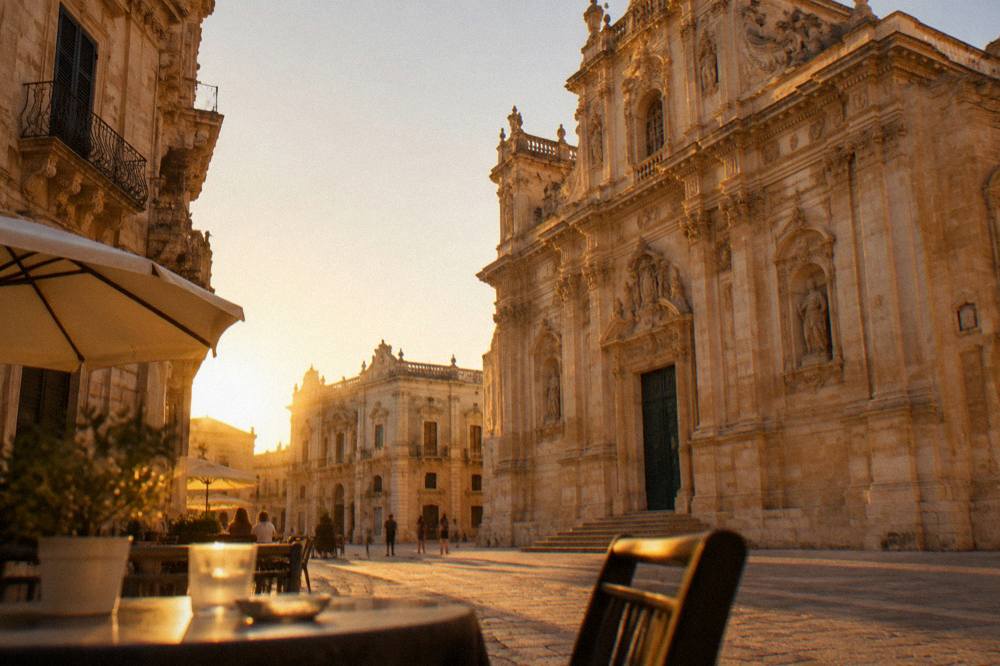
One last framing thought. The rustico is not a monument, and that is precisely its value in a city that can feel like an open-air museum. You will spend your mornings in Lecce looking up at pietra leccese facades, and the stone is genuinely extraordinary, soft Miocene limestone that carves like wood and hardens on exposure, worked into the florid detail of the Lecce Baroque. But the rustico is the part of the city you hold in your hand and eat, the same tradition of local material, wheat, milk, tomato and almond, turned to the same principle of abundance in a small format. Buy one warm, order the iced coffee, and stand at the counter like a local. That is the whole ritual, and it costs less than a museum ticket.
Common Questions About Rustico Leccese
What is a rustico leccese?
A savoury baked snack from Lecce in Puglia: a round of puff pastry filled with béchamel, mozzarella or fior di latte, tomato sauce or pulp and black pepper, sometimes with nutmeg, eaten warm from a bar or bakery counter.
Is a rustico leccese sweet or savoury?
Savoury. Its sweet counterpart in the same display case is the pasticciotto, a shortcrust pastry filled with custard. Ordering "un rustico" in Lecce gets you the savoury one.
When was the rustico leccese invented?
Nobody knows, and no source gives a verified date. Food historians place it likely in the late 18th or 19th century, possibly as an aristocratic or bar invention influenced by the French vol-au-vent, because the dish cannot predate common puff pastry.
What do you drink with a rustico in Lecce?
The classic counter pairing is caffè in ghiaccio con latte di mandorla, iced espresso with almond milk, credited to Antonio Quarta of Quarta Caffè in the 1940s or 1950s. In the evening, a Negroamaro-based Salento red such as Salice Salentino DOC is the local match.
How much does a rustico cost in Lecce?
This site prints no price for a rustico because none is verified. Counter pastries in Lecce are inexpensive; a reported example of a "Santo Pasticciotto" at a named pasticceria was listed at 2.20 euro, which indicates the general bracket. Check the price board at the counter.
Is the rustico the same as a pasticciotto?
No. The rustico is savoury, made with puff pastry and a béchamel-tomato-cheese filling; the pasticciotto is sweet, made with shortcrust and custard. Both are Lecce counter foods, but they are different pastries eaten at different moments of the day.