Where Is Lecce In Italy?
Where Lecce sits in Italy: Puglia and the Salento peninsula, how far it is from the sea, the Brindisi airport link and how the city fits into a Puglia itinerary.
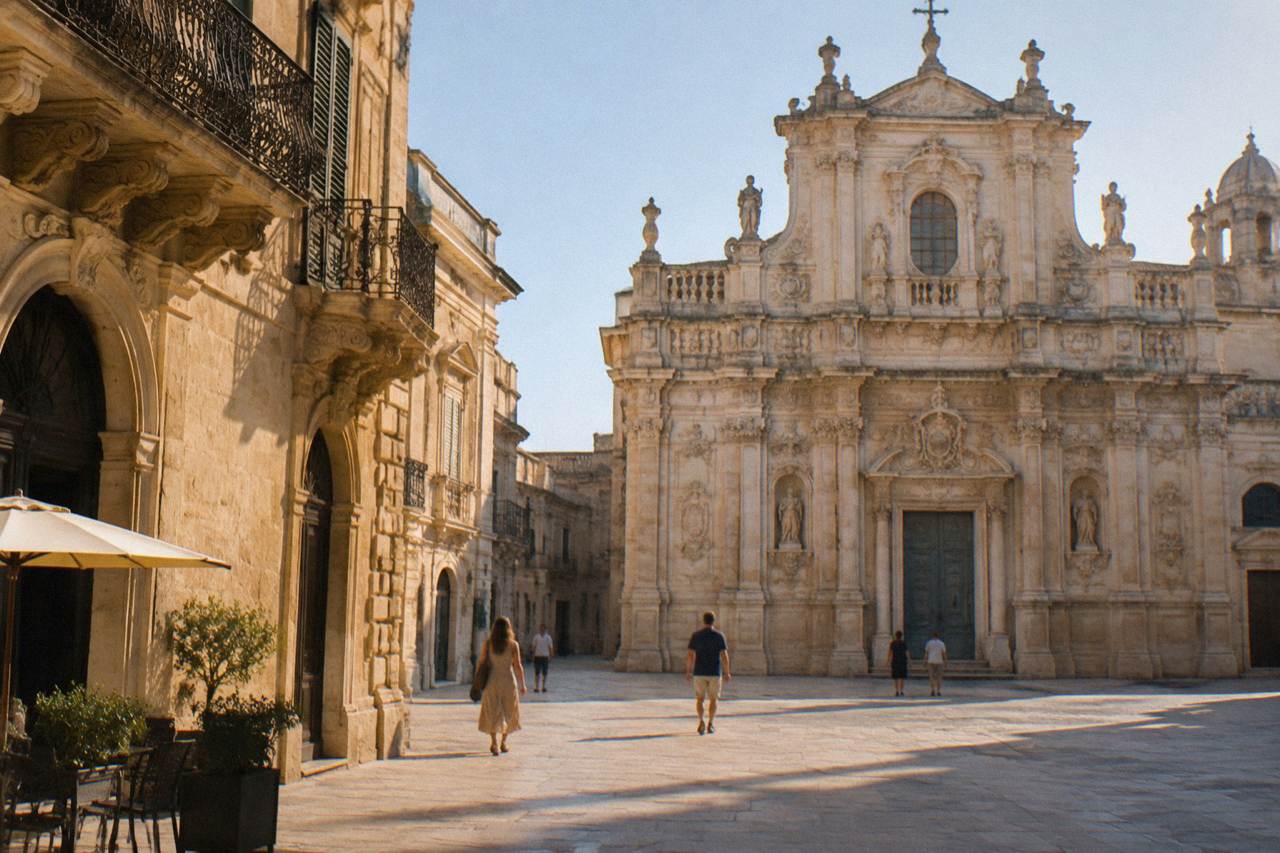
Lecce is a city in Puglia, the region that forms the heel of the Italian boot in southern Italy, and it is the capital of the Province of Lecce. It stands inland near the middle of the Salento peninsula, the flat limestone plain that runs between two seas: the Adriatic to the east and the Ionian to the west. The city counted 94,387 residents on 1 January 2026, with 761,927 across the province, and the Università del Salento adds roughly 20,774 enrolled students to the population. The old town is built from pietra leccese, a honey-coloured Miocene limestone that is soft when quarried and hardens with exposure, which is what gave the local baroque its dense, carved look.
Where Is Lecce In Italy?
Lecce is a city in Puglia, the region Italians also call Apulia, which forms the heel of the boot in southern Italy. It is the capital of the Province of Lecce and stands on the Salento peninsula, the low limestone tongue of land between the Adriatic Sea to the east and the Ionian Sea to the west. The city itself sits a few kilometres inland, about 12.9 km from the nearest beach at San Cataldo.
Puglia stretches along the Adriatic from the Gargano promontory down the whole eastern flank of the heel, and Lecce sits near the southern end of it, closer to the peninsula's waist than to its tip. Look at any map of Italy and the Salento is the flat, roughly triangular end of the boot: Brindisi and Taranto sit along its northern edge, Otranto marks its eastern point on the Adriatic, and Santa Maria di Leuca is the very tip where the two seas meet. Lecce is the largest city in that triangle and its administrative centre.
The city is not on the water, which surprises a good number of first-time visitors to the region. It is a baroque town of palaces and churches built a short drive from two coastlines, and that position is exactly why it works as a base. The Adriatic beaches of Torre dell'Orso and Otranto sit one side of it, the Ionian beaches of Porto Cesareo and Gallipoli the other, and the drive times are short in both directions.
Distances below are free-flow drive times from Piazza Sant'Oronzo, the central square, computed by routing engine from the actual road network:
| Destination | Sea | Distance | Drive time |
|---|---|---|---|
| San Cataldo | Adriatic, nearest beach | 12.9 km | about 14 min |
| Porto Cesareo | Ionian | 28.0 km | about 34 min |
| Torre dell'Orso | Adriatic | 27.9 km | about 32 min |
| Gallipoli | Ionian | 41.0 km | about 41 min |
| Otranto | Adriatic | 46.7 km | about 44 min |
| Brindisi | north of the city | 39.8 km | about 35 min |
| Santa Maria di Leuca | heel's tip | 83.2 km | about 78 min |
What Is Salento, And Why Is Lecce Called Its Capital?
Salento is the southern stretch of Puglia: the peninsula that runs down from the Brindisi and Taranto area to Santa Maria di Leuca at the heel's tip, with the Adriatic down its east side and the Ionian down its west. Lecce is its largest city and its historic capital, often called the Florence of the South for the Lecce Baroque architecture carved from local pietra leccese. The city counted 94,387 residents on 1 January 2026, and the province 761,927.
Salento is a cultural unit as much as a geographic one. It has its own dialect traditions, its own music in the pizzica and the Notte della Taranta festival at Melpignano, and its own food vocabulary, from pasticciotto to caffè in ghiaccio con latte di mandorla. Lecce sits at the centre of all of it, roughly equidistant from both coasts, which is why the whole peninsula is usually visited from a base here.
The baroque label is not decoration. Lecce's historic centre is built almost entirely from pietra leccese, the soft local limestone, and the stonework is dense with cherubs, wreaths, beasts and foliage carved in a way that harder marbles would resist. The nickname "Florence of the South" is often applied to the city, and the credit for coining it is contested between two historical figures, so this page simply reports the phrase without settling who first used it.
One status point worth being precise about: Lecce is not inscribed on the UNESCO World Heritage List. "Salento and the Barocco Leccese" has sat on Italy's Tentative List since 2006, which is a different thing, and any guide that calls the city UNESCO-listed is wrong. For more on what the city holds, read what Lecce is famous for, and for the practical version, the main things to do in Lecce page covers the sights street by street.
Is Lecce On The Coast, Or Inland?
Lecce is inland. The nearest beach, San Cataldo on the Adriatic, lies about 12.9 km east of the centre, around 14 minutes by road from Piazza Sant'Oronzo. From the city, the Adriatic coast is the near side and the Ionian sits across the peninsula: Porto Cesareo on the Ionian is about 34 minutes' drive, Otranto on the Adriatic about 44, and Santa Maria di Leuca at the heel's tip about 78.
The sea is close, but it is not the point of the city. Lecce is a town of interiors: churches, cloisters, cellar museums and courtyards, with the coast a bus or car ride away. San Cataldo is the local escape, a low sandy shore backed by pine forest, reached on the SGM line 32 bus from the City Terminal in about 20 minutes. In summer a wider network opens up, covered further down this page.
The water itself is warm through the season. Reported sea temperatures for the Puglia coast run about 22.5 C in June, 25 to 27 C at the August peak, 20 to 22 C in October and about 14 C in February, so the bathing window is long. For the full picture of the nearest shores, how close Lecce is to the sea breaks down both coastlines, and the beaches page on this site lists the specific strands.
How Do You Reach Lecce, Given It Has No Airport?
Lecce has no commercial airport. The gateway is Brindisi Airport (BDS), about 47.6 km and roughly 43 minutes by road from Piazza Sant'Oronzo, linked by an airport bus that the operator lists at 6.50 euro one way for a ride of about 40 minutes. Rail is the other way in: direct Trenitalia trains cover Lecce to Brindisi in about 18 to 24 minutes, and Lecce to Bari Centrale in about 1 hour 19 at fastest.
The airport bus runs several times a day and is the standard transfer; fares and timetables should be confirmed at booking, since schedules shift with the seasons. By rail, Lecce is the end of the line for Trenitalia's main Adriatic services, which means the city is better connected than its position suggests: direct trains run north along the coast and there are direct services to Rome taking about 5 hours 58 to 6 hours 16 at fastest.
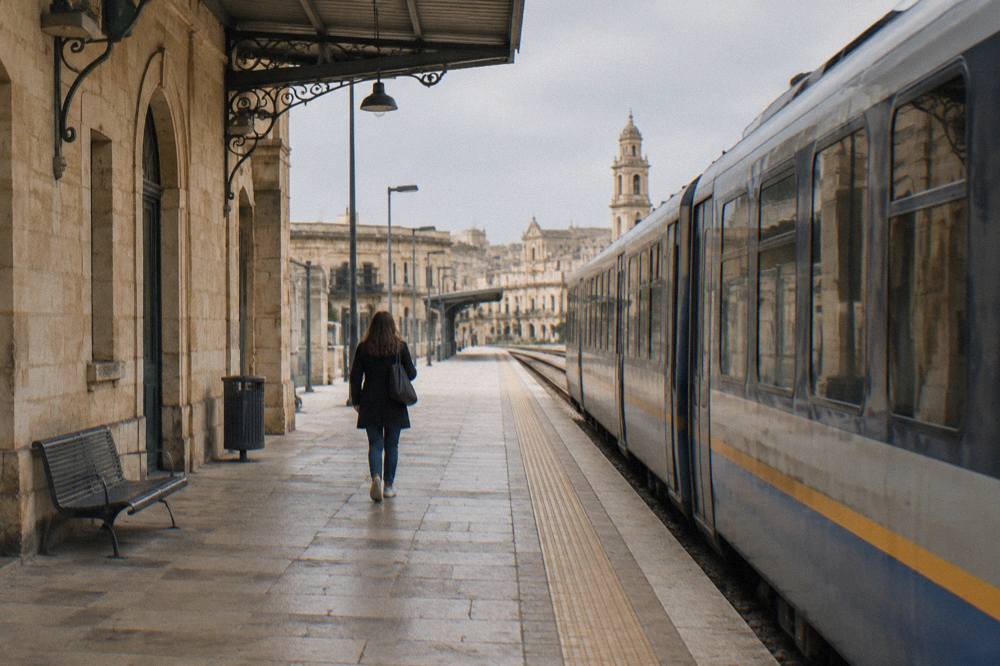
Within Salento, the FSE network takes over from Lecce: direct trains to Gallipoli in about 1 hour 18 to 1 hour 43, direct trains to Galatina in about 38 to 55 minutes, and Otranto reached with a change at Maglie in about 1 hour 33 to over 2 hours. The main journeys, with the figures the sources give:
| Journey | Mode | Typical time | Fare |
|---|---|---|---|
| Brindisi Airport to Lecce | airport bus | about 40 min | 6.50 euro one way |
| Lecce to Brindisi | Trenitalia | about 18 to 24 min | from about 3.40 euro |
| Lecce to Bari Centrale | Trenitalia | fastest about 1 h 19 to 1 h 24 | about 9 to 13 euro regional, 18 to 24 euro fast |
| Lecce to Rome | Trenitalia, direct | about 5 h 58 to 6 h 16 | from about 32 euro |
| Lecce to Gallipoli | FSE | about 1 h 18 to 1 h 43 | from about 5 euro |
| Lecce to Otranto | FSE, change at Maglie | about 1 h 33 to over 2 h | from about 4 to 5 euro |
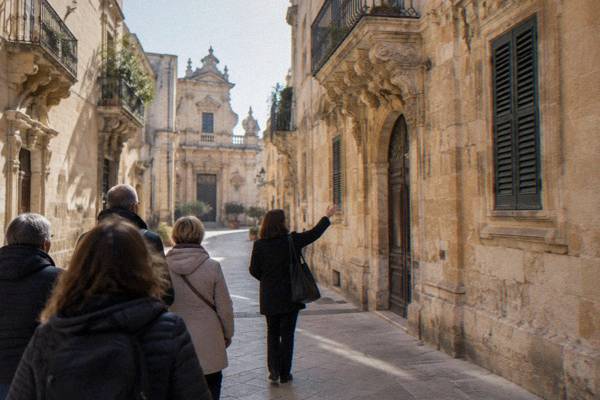
Once in the city, the historic centre is compact and flat, and the station sits a short walk from the walls. A guided walk is the usual first move, and the one that descends into the basement of the ancient synagogue gives the old town a layer below street level. Check availability.
What Is The Climate Like In Lecce Through The Year?
Lecce has a Mediterranean climate: hot, dry summers and mild, damp winters. The ERA5 reanalysis for 1991-2020 puts the highest mean daily high at 31.3 C in August and the lowest mean daily low at 6.7 C in January. November carries the largest monthly rainfall total at 93.7 mm, July the smallest at 15.3 mm, and the year as a whole totals 652.3 mm.
These are modelled normals for a grid cell near Lecce, not readings from a weather station, and they describe the average shape of the year rather than any individual week. Summer is the dry season, with mean highs above 28 C from June through August and very little rain in July. Autumn is the wet turn: October, November and December together carry the heaviest three-month share of the annual total.
| Month | Mean high C | Mean low C | Rain mm |
|---|---|---|---|
| Jan | 12.4 | 6.7 | 63.1 |
| Feb | 13.0 | 6.8 | 59.0 |
| Mar | 15.4 | 8.3 | 64.9 |
| Apr | 18.6 | 10.7 | 54.6 |
| May | 23.4 | 14.7 | 39.9 |
| Jun | 28.2 | 19.1 | 18.0 |
| Jul | 31.0 | 21.7 | 15.3 |
| Aug | 31.3 | 22.2 | 18.1 |
| Sep | 26.4 | 19.0 | 58.9 |
| Oct | 21.8 | 15.4 | 91.3 |
| Nov | 17.3 | 11.7 | 93.7 |
| Dec | 13.5 | 8.2 | 75.5 |
What that means for a visit: May, June, September and October are the shoulder months, warm enough for the coast without the full heat of August. July and August are the peak, both for temperature and for the festival calendar, including the Notte della Taranta Concertone at Melpignano, held on 22 August 2026 in its 29th edition. Winter is mild by northern European standards but wet, and the city's baroque interiors, museums and café culture carry the season.
How Does Lecce Fit Into A Wider Puglia Itinerary?
Lecce works as a base for the whole Salento peninsula and for much of Puglia beyond it. Direct trains reach Ostuni in about 39 to 51 minutes and Polignano a Mare in about 1 hour 9 to 1 hour 21, while the FSE network runs to Gallipoli in about 1 hour 18 to 1 hour 43 and to Otranto with a change at Maglie. Matera, in Basilicata, is a bus ride of about 3.5 to 4 hours.
The classic pattern is a stay of several nights in Lecce with the old town on foot and the peninsula radiating out by train, bus or hire car. Alberobello, the trulli town, is a longer haul: about 91 minutes by road, or a train journey with a change of about 2.5 to 3 hours in total. Bari, the regional capital, is about 118 minutes by car or a direct train ride north along the Adriatic, and the comparison between the two cities, Bari compared with Lecce, comes down to what kind of trip you want.
For travellers without a car, the summer bus network and the year-round FSE trains cover most of the peninsula, and the detail is in day trips from Lecce without a car. How long to give the whole region depends on the pace: how many days Lecce needs is the short answer for the city, and whether the city justifies the journey at all is answered in whether Lecce is worth visiting. This Lecce Travel Guide covers the city and its peninsula in depth, from the churches ticket to the beaches on both coasts.
Common Questions About Lecce's Location In Italy
Where Is Lecce In Italy?
Lecce is in Puglia (Apulia), the heel of southern Italy, and is the capital of the Province of Lecce. It stands inland near the middle of the Salento peninsula, between the Adriatic Sea to the east and the Ionian Sea to the west.
Is Lecce Near The Sea?
Not on it. Lecce sits inland, and the nearest beach, San Cataldo on the Adriatic, is about 12.9 km from the centre, around 14 minutes by road. Both the Adriatic and the Ionian coasts are within a short drive.
Which Airport Do You Fly Into For Lecce?
Brindisi Airport (BDS), about 47.6 km and roughly 43 minutes by road from the centre. An airport bus links the two, listed by the operator at 6.50 euro one way for a ride of about 40 minutes. Lecce itself has no commercial airport.
Is Lecce In Northern Or Southern Italy?
Southern. Lecce is in Puglia, on the Salento peninsula at the extreme southeast of the Italian mainland, the heel of the boot. It is one of the southernmost cities on the mainland, farther southeast than Naples or Bari.
What Exactly Is Salento?
The peninsula that forms the lower half of Puglia: roughly from the Brindisi and Taranto line down to Santa Maria di Leuca at the tip, with the Adriatic on its east coast and the Ionian on its west. Lecce is its capital and largest city.
How Far Is Lecce From Bari?
About 152.6 km by road, roughly 118 minutes of driving from Piazza Sant'Oronzo. By train the fastest direct services take about 1 hour 19 to 1 hour 24, with regional fares around 9 to 13 euro and fast trains higher.