What Is The Prettiest Town In Puglia?
Lecce, the baroque capital of Salento, makes the strongest sourced case for the prettiest town in Puglia. Here is how it compares with Otranto, Gallipoli, Ostuni and the rest.
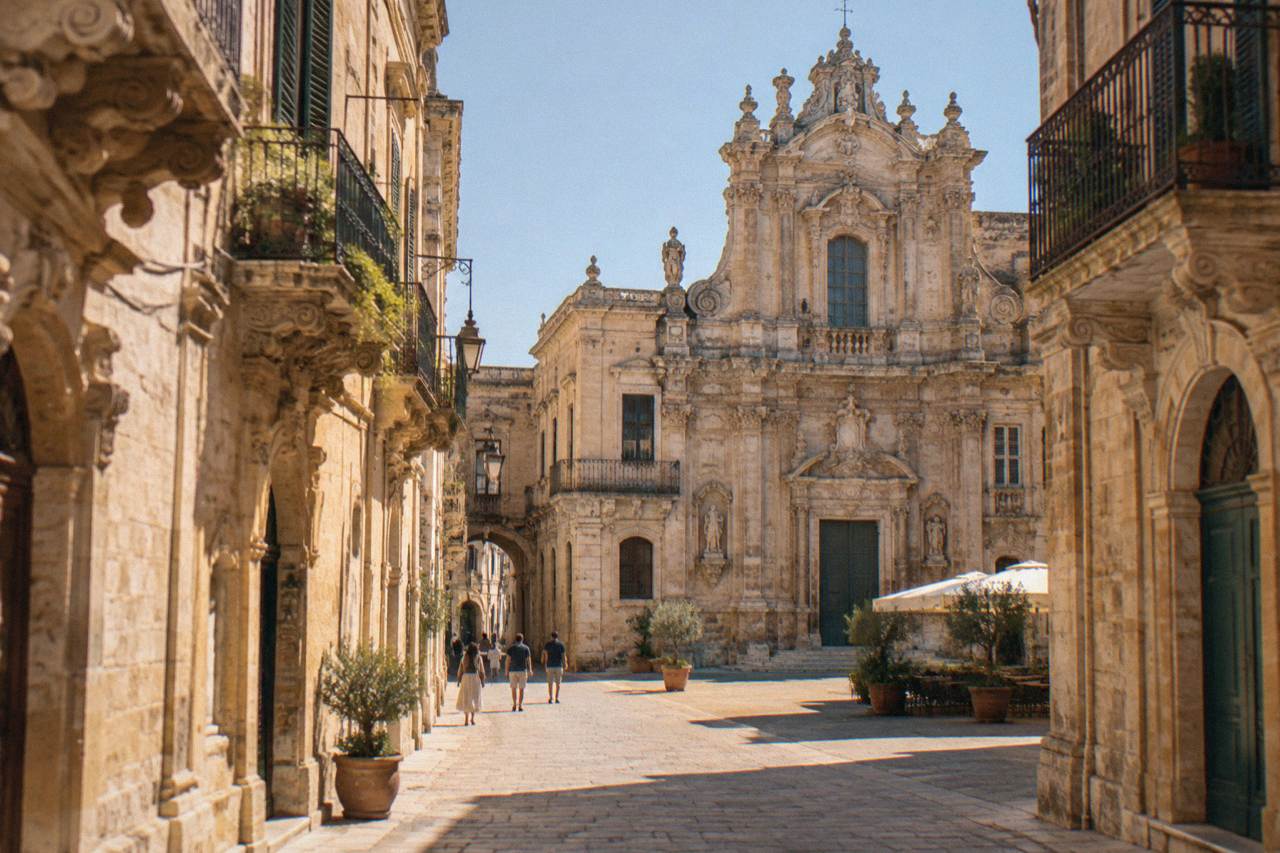
Ask which town deserves the title of prettiest in Puglia and the honest answer has to start with Lecce, the baroque capital of Salento in the heel of Italy, a city of about 94,387 residents built from honey-coloured pietra leccese limestone. It is often called the Florence of the South, a nickname whose origin is contested and best left unattributed, and its old centre is dense with carved facades, church domes and public squares that few towns in the region can match for sheer decoration. It is not a beach town: San Cataldo, the nearest stretch of sand, is 12.9 km away, with the Adriatic to the east and the Ionian to the west across the peninsula.
This page argues the case from what the sources support rather than from taste. It compares distances, train times and the specific sights this guide has verified for Lecce and a handful of Salento neighbours, and it points to the companion pages on Lecce Travel Guide for the deeper dives.
What Is The Prettiest Town In Puglia?
On the evidence this guide can source, Lecce has the strongest claim to being the prettiest town in Puglia: a compact historic centre carved from pietra leccese, the Basilica di Santa Croce and the Duomo within a fifteen-minute walk of each other, a Roman amphitheatre sitting in the main square, and an inland position that makes it the natural base for the coast on both sides. The title is subjective, but Lecce is the only candidate whose beauty is architectural rather than just scenic.
That last distinction matters. Coastal towns such as Otranto and Gallipoli trade heavily on their settings, the sea and the skyline, while Lecce's appeal survives a rainy November afternoon because it is built into the stone itself. Pietra leccese is a Miocene limestone, soft when quarried and hardening with exposure, and the craftsmen of the Lecce Baroque exploited that softness to carve flowers, animals and putti into facades at a scale other Puglian towns never attempted. "Salento and the Barocco Leccese" sits on Italy's UNESCO Tentative List (2006), which is a candid way of saying the heritage is recognised as candidate material without being inscribed.
No ranking of Puglian towns by beauty exists in any source this guide would cite, and inventing one would be dishonest. What can be compared honestly is what each place offers and how far apart they sit, which is what the rest of this page does.
Why Lecce Makes The Strongest Case In Puglia
Lecce's case rests on three sourced facts: it has the highest concentration of carved baroque architecture in the region, its five principal churches are sold on one 11 EUR ticket valid for 15 days, and its sights sit inside a walkable centre that the amphitheatre, the Castello and two Roman-era theatres thread through. No other Puglian town on this guide's list combines that density with that ease of access.
The LeccEcclesiae ticket, sold at Piazza Duomo 5 and at the Basilica di Santa Croce, bundles the Duomo with its crypt, Santa Croce, San Matteo, Santa Chiara and the Antico Seminario with its sacred art museum. The Castello Carlo V is visited by guided tour only, 10 EUR full, with only the courtyard free, and it houses the Museo della Cartapesta, devoted to the papier-mache craft that gave Lecce its other nickname as a city of artisans. The Museo Faggiano charges 5 EUR for an archaeological stratigraphy dug out beneath a private palazzo, and the Anfiteatro Romano is visible free from Piazza Sant'Oronzo even before you pay the 5 EUR to descend inside.
The practical layer supports the aesthetic one. Lecce is walkable, flat and safe by the standards of the sources this guide cites, and it is the rail hub of Salento, with FSE trains to Gallipoli, Otranto via Maglie and Galatina. The city's student population, about 20,774 at the Universita del Salento, keeps the centre lively outside the August peak. For a fuller treatment of the city's own sights, the guide to things to do in Lecce covers the ground in detail.
If the question is beauty per square metre of old centre, Lecce wins on the sourced record. If the question is beauty per kilometre of coastline, the answer changes, which is why the comparison below exists.
Which Other Puglia Towns Contend, And How Far Are They From Lecce?
Otranto, Gallipoli, Galatina and Castro are the strongest Salento contenders, each within about 48 km and 48 minutes of Lecce by road, while Ostuni, Alberobello and Polignano a Mare in northern Puglia sit 78.3, 114.1 and 116.3 km away respectively and are better treated as day trips. This guide has verified sights and logistics for Lecce and those Salento neighbours; for the northern towns only the travel times are sourced, and their attractions are not covered here.
The comparison table below uses drive times computed from Piazza Sant'Oronzo in free-flow conditions, plus train times where a direct or one-change rail link exists.
| Town | Distance from Lecce | Drive time | Train option |
|---|---|---|---|
| Galatina | 25.7 km | about 29 min | FSE direct, about 38 to 55 min, from about 3 EUR |
| Gallipoli | 41.0 km | about 41 min | FSE direct, about 1h18 to 1h43, from about 5 EUR |
| Otranto | 46.7 km | about 44 min | FSE via Maglie, about 1h33 to 2h |
| Castro | 47.4 km | about 48 min | no direct rail |
| Ostuni | 78.3 km | about 66 min | Trenitalia direct, about 39 to 51 min, from about 7 EUR |
| Alberobello | 114.1 km | about 91 min | train plus FSE change, about 2h30 to 3h plus |
| Polignano a Mare | 116.3 km | about 88 min | Trenitalia direct, about 1h09 to 1h21 |
What the sources say about the contenders is narrower than the folklore. Otranto's cathedral holds a mosaic floor dated 1163 to 1165 by the priest Pantaleone, and the Diocese of Otranto's notice says independent visitors enter free while groups and guided visitors pay 2 EUR since 1 March 2026. Gallipoli's old town sits on a limestone island linked to the mainland by a bridge. Galatina's Basilica di Santa Caterina d'Alessandria is free to enter, and Galatina is also where Pasticceria Ascalone claims, against disputed historical opinion, to have invented the pasticciotto in 1745. Castro's Grotta Zinzulusa runs guided visits year-round at 7 EUR full. Those are real, checkable pleasures, and the head-to-head with Lecce is treated in which is better, Lecce or Otranto.
For a different axis of the same debate, the question of which is the most beautiful beach town in Puglia looks at the coastal candidates, and which is nicer, Bari or Lecce covers the region's capital.
What Does Lecce Look Like Beyond The Postcard Squares?
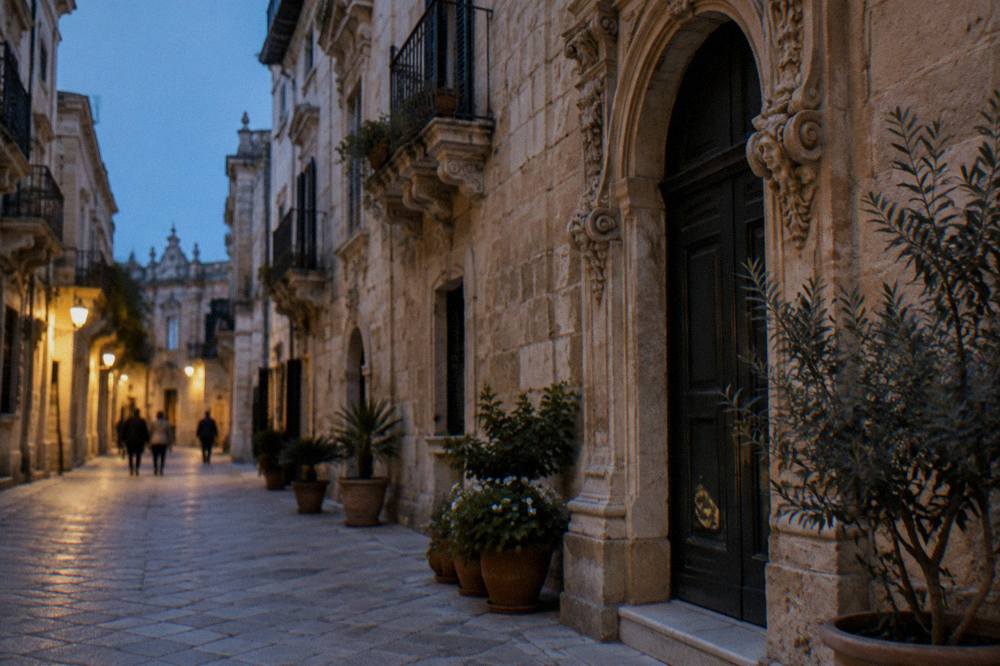
Beyond Piazza Sant'Oronzo and the Duomo, Lecce's look runs through the carved facade of the Basilica di Santa Croce, the courtyard of the Palazzo dei Celestini, the free public rooms of the Villa Comunale and the three lesser-known churches on the LeccEcclesiae ticket, all inside a centre whose building material gives the whole city a single honey tone at sunset. The uniformity of the stone is the city's visual signature.
Pietra leccese is the reason the town photographs the way it does. Because nearly every building in the historic centre is cut from the same Miocene limestone, the light does the decorating: warm at golden hour, bleached and severe at midday, grey-gold in rain. The stone's softness when freshly quarried is what allowed the baroque carvers their extravagance, and the craft tradition survives in the cartapesta workshops, where masters still build figures from paper and glue using moulds. Visitors who want to see the sights in a planned sequence can follow the Lecce baroque walk, and the question of how many days you need in Lecce has its own answer page.
A budget note that genuinely helps planners: the standard LeccEcclesiae ticket is 11 EUR full, 5 EUR reduced for ages 12 to 17, 24 EUR for a family of two adults plus minors in that band, and children under 12 go free. The full version with the bell tower costs 21 EUR. There is also a 29 EUR, seven-day Artwork city pass that adds the bell tower and extras such as Palazzo Vernazza, though its coverage is a listing claim rather than a municipal scheme. Sums stay modest because the city's best material, the squares, the gates and the amphitheatre's upper view, costs nothing.
Should You Stay In Lecce And Visit The Others, Or The Other Way Round?
On the sourced logistics, Lecce is the practical base: it is the region's rail hub, it sits within about 48 minutes by road of the four main Salento contenders, and its own sights fill the evenings after day trips empty out. Staying in Otranto or Gallipoli and visiting Lecce works only outside summer, because the seasonal Salento in Bus network that links the coast ran just 13 June to 13 September in 2026 and its 2027 dates are not published.
That asymmetry is the quiet argument for basing yourself in the prettiest town rather than commuting into it. From Lecce, FSE trains reach Galatina in under an hour and Gallipoli in under two, and a direct bus ran about 55 minutes to Otranto in 2026. From a coastal base in the off-season, the connections thin out once the summer network stops. The broader trade-offs, including the northern-Puglia alternatives, are laid out in which town in Puglia is the best base for a trip.
The one-loop option deserves its own mention. A van day tour from Lecce that strings together Otranto, Castro, Santa Maria di Leuca and Gallipoli in a single day covers, by road, roughly the arc that would otherwise take three separate FSE journeys, and it can be booked with free cancellation through the operator's live listing: Check availability.
The verdict, restated plainly: prettiest is a matter of taste, but the town with the most verified beauty per street, the best transport links and the cheapest bundled sightseeing is Lecce, and the prettiest day out from it is the loop down the Salento coast.
Common Questions About The Prettiest Town In Puglia
Is Lecce really considered the prettiest town in Puglia?
It is the strongest candidate on the evidence this guide sources: the densest carved baroque architecture in the region, a walkable centre, and the "Florence of the South" nickname, whose coinage is contested and which the city is only "often called". Beauty itself is subjective, and no official ranking exists.
What makes Lecce prettier than the coastal towns?
Lecce's beauty is built into the stone rather than the setting. Pietra leccese, soft when quarried and hardening with exposure, let baroque carvers decorate facades at a scale the seaside towns never matched, so the city rewards looking closely on any weather, not just from a viewpoint in sunshine.
Can you see the prettiest Salento towns as day trips from Lecce?
Yes. Galatina is about 29 minutes by road, Gallipoli about 41, Otranto about 44 and Castro about 48, and FSE trains serve Galatina, Gallipoli and Otranto via Maglie. Outside summer the seasonal Salento in Bus network, which ran 13 June to 13 September in 2026, stops running, so check schedules before relying on coastal buses.
Is Lecce a beach town?
No. Lecce sits inland; San Cataldo, the nearest beach, is 12.9 km away, reachable on SGM bus line 32 in about 20 minutes. The Adriatic is to the east and the Ionian to the west across the peninsula, both reachable as half-day trips.
How much does sightseeing in Lecce cost?
The LeccEcclesiae combined church ticket is 11 EUR standard and valid 15 days, the Castello Carlo V guided tour is 10 EUR full, the Roman Amphitheatre is 5 EUR and Museo Faggiano is 5 EUR, with children under 12 free at the churches. Prices come from the operators' own pages and can change, so confirm at booking.
Is Lecce UNESCO-listed?
No. "Salento and the Barocco Leccese" has been on Italy's UNESCO Tentative List since 2006 but is not inscribed on the World Heritage List. Any claim that Lecce is a World Heritage Site is wrong.