What Is The Nicest City In Southern Italy?
Lecce, the baroque capital of Salento in Puglia, makes the strongest sourced case for the nicest city in southern Italy. Here is what the facts support.
The honest answer, from a desk that covers this city every day, is Lecce: the baroque capital of Salento, in Puglia, at the heel of southern Italy, built from honey-coloured pietra leccese limestone and sitting a few kilometres inland between two seas. This guide covers Lecce and its peninsula, not all of the Mezzogiorno, so instead of inventing a ranking across cities nobody here has verified, it lays out what the sources say about the one city that can be documented: its architecture, its food, its climate, and the coast and towns within an hour of its centre.
Why Lecce Makes A Strong Case As The Nicest City In Southern Italy
Lecce's case rests on three documented pillars: a historic centre carved almost entirely from pietra leccese, a concentration of baroque churches and monuments walkable in a day, and a position about 13 km from the Adriatic at San Cataldo, with Otranto, Gallipoli and Galatina all reachable in well under an hour by car. The city has 94,387 residents, hosts about 20,774 university students, and sits on Italy's UNESCO Tentative List, which is a candidacy rather than an inscription.
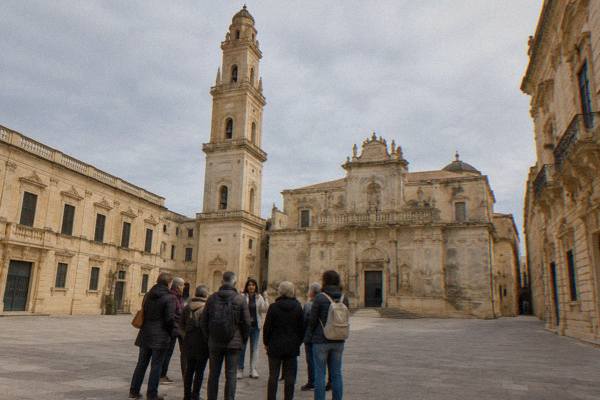
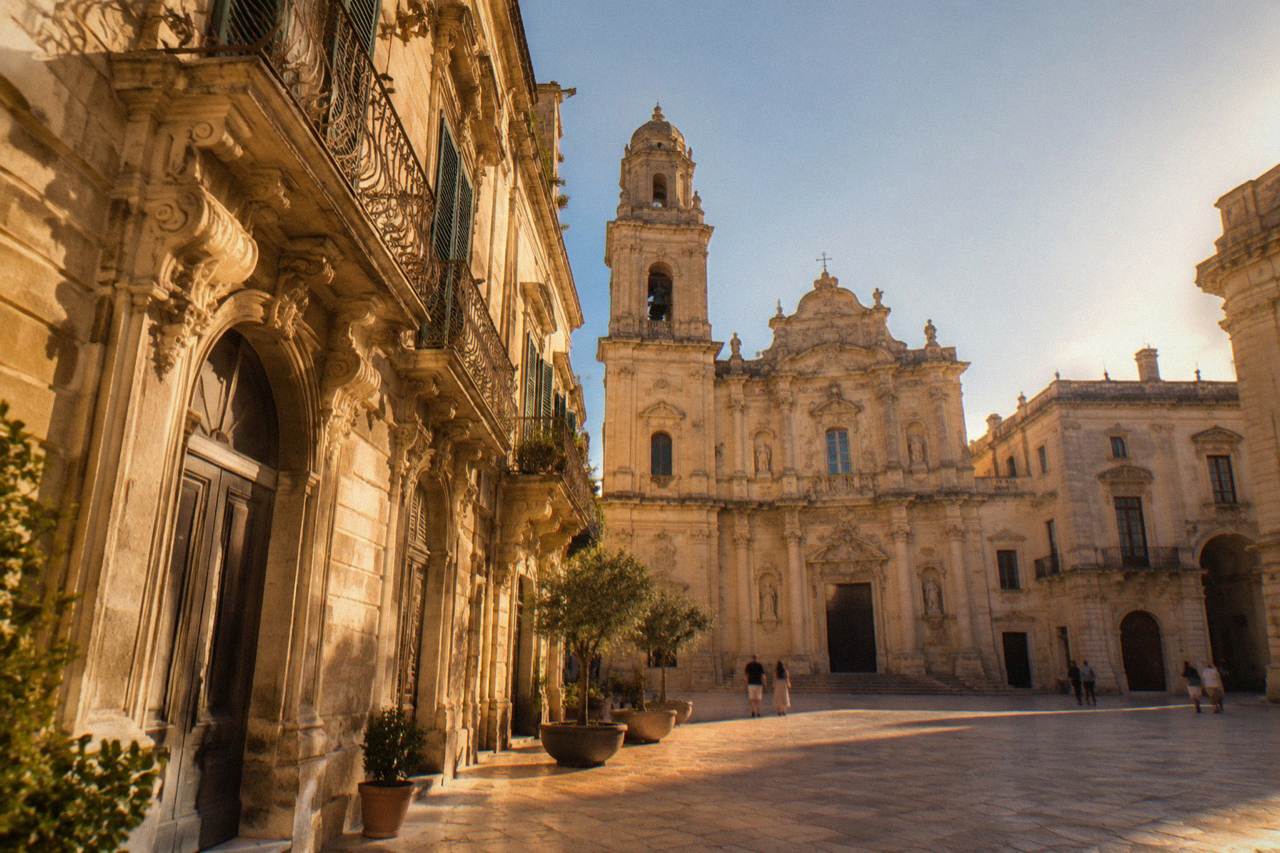
Start with the stone. Pietra leccese is a Miocene limestone, soft and workable when quarried, hardening on exposure, and it gave the city its whole character: facades, balconies, capitals and rose windows cut with a detail that harder stone would refuse. The result is often described using a contested nickname, "Florence of the South", whose origin is attributed to different writers and is best left unhoused here. What is not contested is the material: you can see it in every building on Piazza Sant'Oronzo and in the facades of the Basilica di Santa Croce.
Then there is density. The Duomo, the Roman amphitheatre, the Castello Carlo V, the Museo Faggiano and the papier-mache workshops of the historic centre sit within a few hundred metres of each other. The LeccEcclesiae combined ticket alone covers the Duomo with its crypt, Santa Croce, San Matteo, Santa Chiara and the Antico Seminario with its sacred art museum, and stays valid for 15 days.
Finally, position. San Cataldo, the nearest beach, is about 13 km east. Otranto is 46.7 km by road, Gallipoli 41.0 km, Galatina 25.7 km, and Santa Maria di Leuca 83.2 km. A city this compact, this close to two coasts and this rich in carved stone has a case no other documented candidate matches. For a fuller rundown of the city's attractions, see things to do in Lecce.
What Is The Nicest City In Southern Italy?
If the question is judged on what can actually be sourced, the answer this site gives is Lecce, in Puglia: a baroque city of about 94,387 people whose churches, squares and underground layers are carved from local limestone, whose July and August mean highs run about 31 C under the ERA5 reanalysis 1991-2020, and whose peninsula supplies beaches, cave coasts and walled towns within a short drive of the centre.
No published ranking crowns any southern city "nicest", so the case has to be built on evidence, and Lecce's is the one this desk can build.
That last clause matters. "Nicest" is a judgement word, and no study, survey or official designation ordains a winner for southern Italy. What exists instead is a set of facts, and Lecce's set is unusually strong: the Duomo square, the amphitheatre visible free from Piazza Sant'Oronzo, the Museo Faggiano's layered archaeology at 5 EUR, and a baroque fabric that earned the whole Salento a place on Italy's UNESCO Tentative List in 2006. It is a candidacy, not a title, and the city's boosters should say so plainly.
The practical side helps the case too. Lecce is a walkable city, small enough that the ZTL camera boundary more or less marks the old town, with a station on the Trenitalia network and FSE lines fanning out to Gallipoli, Otranto and Galatina. Readers weighing the region's other candidate can compare on sourced ground in which is nicer, Bari or Lecce.
If you want the shortest possible route into the city's highlights, the rickshaw tour below covers the centre with a guide and no walking-distance limit; it is the tour this article features, and availability is on the operator's live listing.
How Does Lecce Compare With Other Southern Italian Cities?
Only Lecce has verified facts here, so the comparison can only run on sourced ground: drive times, train times and Lecce's own documented offering. By car from Piazza Sant'Oronzo, Ostuni is 78.3 km, Alberobello 114.1 km, Polignano a Mare 116.3 km, Taranto 107.2 km, Bari 152.6 km and Matera 176.9 km, while Brindisi, the nearest airport gateway, is 39.8 km or about 35 minutes away. Nothing here rates Bari's or Sicily's attractions, because nothing about them was sourced.
The honest framing is geographic rather than competitive. Lecce sits at the end of the peninsula, which means the famous towns of northern Puglia, Alberobello, Ostuni, Polignano a Mare, are half-day or full-day trips rather than neighbours, while the Salento's own assets are close: Otranto in about 44 minutes of free-flow driving, Gallipoli in about 41, Castro in about 48. Matera lies in Basilicata, a different region, about 3.5 to 4 hours by bus.
| Destination | Distance from Lecce (km) | Drive time (free-flow) | Rail alternative |
|---|---|---|---|
| Otranto | 46.7 | about 44 min | FSE via Maglie, about 1h33 to 2h |
| Gallipoli | 41.0 | about 41 min | FSE direct, about 1h18 to 1h43 |
| Galatina | 25.7 | about 29 min | FSE direct, about 38 to 55 min |
| Santa Maria di Leuca | 83.2 | about 78 min | bus, about 2h to 2h15 |
| Ostuni | 78.3 | about 66 min | direct train, about 39 to 51 min |
| Brindisi (BDS airport) | 39.8 | about 35 min | train to Brindisi, about 18 to 24 min |
What the table cannot say is which city is "nicer", and neither can this site. What it can say is that a base in Lecce puts a baroque city, two seas and a string of documented towns inside one holiday, and the Salento itinerary pages set out how to sequence them. For a deeper look at what the city itself holds, what Lecce is famous for covers the baroque, the cartapesta and the food in detail.
What Does A First Visit To Lecce Actually Look Like?
A first visit clusters around five stops: Piazza Sant'Oronzo with the amphitheatre, the Duomo and its square, the Basilica di Santa Croce, the Castello Carlo V by guided tour at 10 EUR full, and the Museo Faggiano at 5 EUR, with the LeccEcclesiae ticket at 11 EUR standard covering the five main churches and staying valid 15 days. The whole loop fits inside the old town, on foot, with a caffe in ghiaccio con latte di mandorla somewhere in the middle.
The churches carry the visit. Chieselecce.it's ticket page lists the standard LeccEcclesiae ticket at 11 EUR full, 5 EUR reduced for ages 12 to 17 and 24 EUR for a family, with the bell-tower "Up!" variant at 21 EUR; children under 12 enter free. Winter hours run 9:00 to 18:00, summer 9:00 to 21:00, with visits paused during services and shoulders and knees covered. The Castello's own page states the interior is guided-tour only, 10 EUR full, with the courtyard free and the Museo della Cartapesta included in the tour.
The food is its own itinerary. Pasticciotto is the emblem, though its 1745 birth date belongs to a Galatina shop's own claim rather than to settled history, and the iced espresso with almond milk is credited to Antonio Quarta of Quarta Caffe in Lecce in the 1940s to 1950s. A street-food walk with a guide strings these together without the guesswork of finding the right counter, and the trio below includes one.
How Many Days Do You Need In Lecce?
Two full days cover the documented core: day one for Piazza Sant'Oronzo, the amphitheatre, the Duomo square and Santa Croce, day two for the Castello, Museo Faggiano and the workshops, with an evening for the baroque facades after dark. A third day pays off if you want Otranto or Gallipoli, each about 41 to 47 km away, and a fourth if Alberobello or Matera are on the list. Fewer than two days means choosing between churches and coast.
The arithmetic is simple. The LeccEcclesiae ticket lasts 15 days, so there is no need to rush the churches into one morning, but the city itself is small enough that two unhurried days absorb it. The beach question changes the budget: San Cataldo is about 13 km away and reachable on the SGM line 32 city bus in about 20 minutes, so a swim stop costs half a day, not a day. The detailed breakdown lives in how many days you need in Lecce.
When Is The Best Time To Visit Lecce?
The ERA5 reanalysis for Lecce, 1991-2020, shows mean highs of about 31 C in July and August with monthly rainfall of just 15.3 and 18.1 mm, against 21.8 C and 91.3 mm of rain in October and 12.4 C in January; November carries the year's highest monthly rainfall at 93.7 mm.
May, June and September balance warmth against thinner crowds, and the sea runs about 22.5 C in June, 25 to 27 C at the August peak and 20 to 22 C in October.
Summer is the season of the Notte della Taranta, whose 2026 Concertone ran in Melpignano on 22 August, and of the Festa dei Santi Patroni in Lecce from 23 to 26 August, both annual events whose 2027 dates had not been announced when this page was written. The Salento in Bus beach network ran 13 June to 13 September in 2026, a summer-only service. Autumn trades those for cooler stone and cheaper, quieter streets, with the Fiera dei Pupi papier-mache fair arriving in early December on its traditional pattern. The month-by-month detail is on the best time to visit Lecce.
| Month | Mean high C | Mean low C | Rain mm |
|---|---|---|---|
| May | 23.4 | 14.7 | 39.9 |
| June | 28.2 | 19.1 | 18.0 |
| July | 31.0 | 21.7 | 15.3 |
| August | 31.3 | 22.2 | 18.1 |
| September | 26.4 | 19.0 | 58.9 |
| October | 21.8 | 15.4 | 91.3 |
A tourist tax exists and is collected by your accommodation, topping out at a reported 5 EUR per person per night in the highest category in high season; confirm the exact rate at booking. If the coast rather than the city is the draw, is Lecce near the coast answers the geography question directly.
Whichever month you choose, the tours below cover the two halves of a Lecce stay: the city itself, and the peninsula around it.
Common Questions About The Nicest City In Southern Italy
These closing questions collect the strings readers actually search, answered with the same sourced figures used across the page, from the LeccEcclesiae ticket prices to the ERA5 reanalysis climate normals for Lecce 1991-2020. Each answer states what a primary or reanalysis source says, keeps contested claims flagged as claims, and points to the longer guide pages where the detail lives, so nothing below rests on invention.
What Is The Nicest City In Southern Italy?
On sourced evidence, this site's answer is Lecce: a baroque city of about 94,387 people in Puglia, carved from pietra leccese, about 13 km from the nearest beach and under an hour's drive from Otranto and Gallipoli. No official ranking exists, and any other answer would rest on taste rather than documentation.
Is Lecce Better Than Bari?
No honest verdict on Bari's attractions or character exists here. What is sourced is distance: Bari is 152.6 km from Lecce by road, about 118 minutes free-flow, with direct trains from about 1h19. The comparison is laid out in which is nicer, Bari or Lecce.
Is Lecce A UNESCO World Heritage Site?
No. "Salento and the Barocco Leccese" sits on Italy's Tentative List, added in 2006. That is a candidacy, not an inscription, and any guide claiming otherwise is wrong.
Does Lecce Have An Airport?
No. The nearest commercial airport is Brindisi (BDS), about 47.6 km and roughly 43 minutes by road from the centre, linked by airport buses costing 6.50 EUR one way for about 40 minutes, per the operator.
Is Lecce Walkable Without A Car?
The historic centre is compact and pedestrian in character, bounded by a camera-policed ZTL. FSE trains reach Gallipoli, Otranto via Maglie and Galatina, and the summer-only Salento in Bus network ran 13 June to 13 September in 2026. The full picture is in is Lecce a walkable city.
What Is Lecce Famous For?
Lecce Baroque in pietra leccese, the LeccEcclesiae churches, cartapesta papier-mache craft, and a food culture running from pasticciotto to caffe in ghiaccio con latte di mandorla. The long answer is on what Lecce is famous for.
The Lecce Travel Guide desk stands by the verdict above: no ranking crowns the south's nicest city, but the best-documented candidate, and the one this whole site can vouch for, is Lecce.