What Does "Lecce" Mean In English?
The name Lecce explained: what the word means in English, how it works in Italian, and the place behind the name in Puglia, southern Italy.
Lecce, the baroque capital of Salento in Puglia, southern Italy, has a name that English has simply borrowed whole. It is a proper noun: the name of a city of 94,387 residents (1 January 2026), not a word with a dictionary definition. English speakers pronounce and write it as they find it, and no translation exists because there is nothing to translate. What the name does carry is a bundle of derived Italian words, a demonym, a stone and an architectural style, and those are the parts worth unpacking. This page, from the editorial desk behind Lecce Travel Guide, reports what the sources say and stops where they stop.
What Does "Lecce" Mean In English?
In English, "Lecce" means nothing on its own, because it is a proper noun: the name of a city in Puglia, southern Italy, capital of the Province of Lecce on the Salento peninsula. English uses it only as that place name, with no translation, no plural in ordinary use and no separate dictionary sense. Any English meaning has to come from the place itself, not the word.
That is the honest answer, and it is worth stating plainly because the internet is fond of confident etymologies. Place-name origins for Lecce are debated among the usual candidates that circulate for Italian cities of ancient origin, and no official source settles the question. When a guide prints a tidy origin story for the name, it is repeating a tradition, not a documented derivation. The card-carrying facts about Lecce are geographical and administrative, not etymological: the city sits inland at the heel of Italy, the nearest beach, San Cataldo, is about 13 km away at San Cataldo, and the Adriatic and the Ionian seas flank the peninsula on either side.
For a fuller picture of what the city is actually known for, the companion page on what Lecce Italy is famous for covers the baroque architecture, the food and the craft traditions. The name itself is the smallest part of the story.
Is "Lecce" A Word In Italian, Or Just A Name?
In Italian, too, "Lecce" is only the city's name. Italian does not treat it as a common noun either, but the name generates a small family of real Italian words: "leccese" as the adjective and demonym, "pietra leccese" for the local limestone, and "barocco leccese" for the city's architectural style. These derivatives, not the name itself, are where meaning lives.
The adjective is the workhorse. "Leccese" means "of or from Lecce", and it applies to people, things and tastes: a leccese is a resident of the city, the residents collectively are leccesi, and a pasticciotto leccese is the custard-filled pastry of the local tradition. English travel writing borrows these forms freely, usually in italics on first use, which is why a reader who has never studied Italian still ends up knowing the word "leccese".
| English phrase | Italian form | What it refers to |
|---|---|---|
| of or from Lecce | leccese | The adjective, and one resident of the city |
| people from Lecce | leccesi | The demonym, used in both languages |
| Lecce stone | pietra leccese | The Miocene limestone the city is built from |
| Lecce Baroque | barocco leccese | The local architectural style of the 17th century onward |
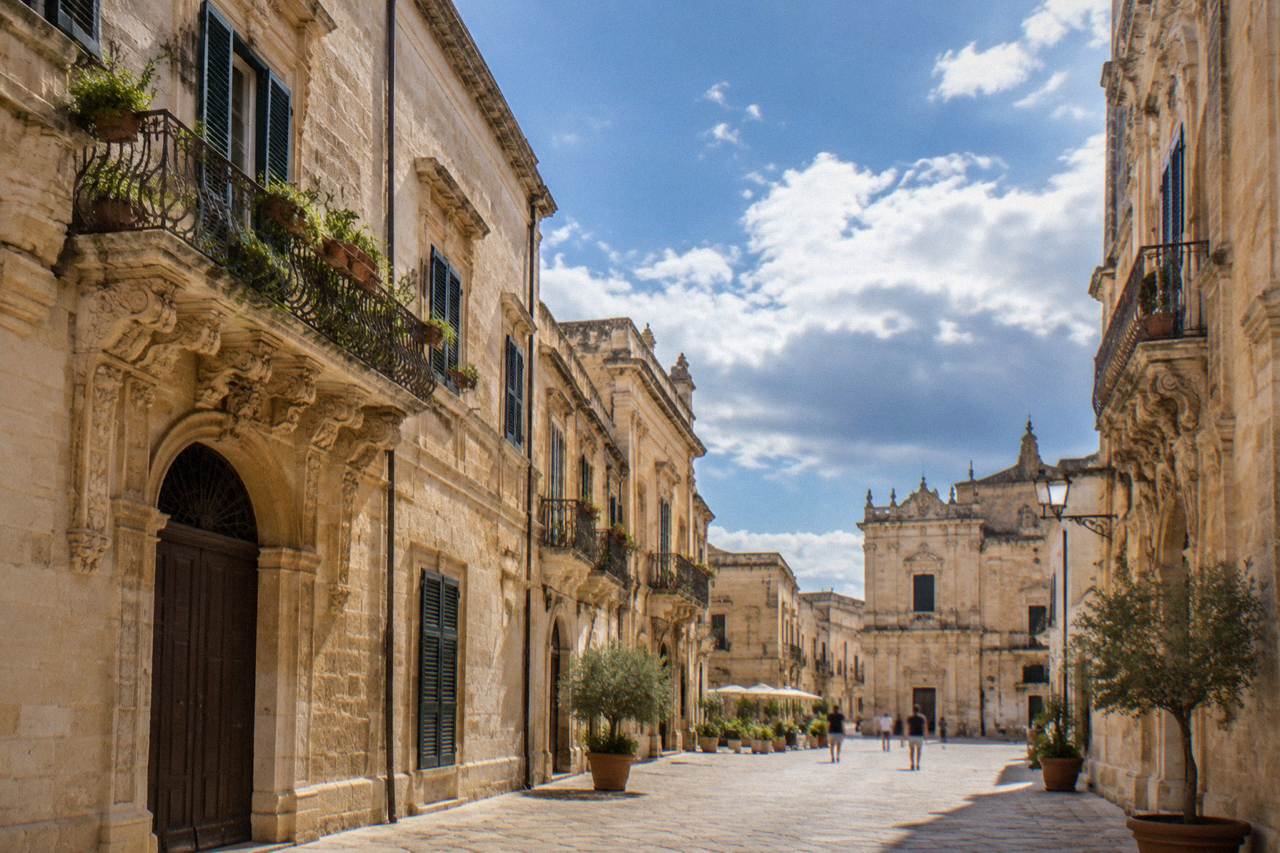
The stone deserves its own word because it explains the city's look. Pietra leccese is a honey-coloured limestone, soft when quarried and hardening with exposure, which is why the facades of the old town carry such deep carving. The style name, barocco leccese, is the term art historians use for the local variant of baroque architecture that this stone made possible. Neither phrase translates the city's name; both derive from it, which is the closest thing to a "meaning" the name has.
Names like this are why context matters in search, too. A reader asking after the word may equally be trying to place the city, in which case the guide to where Lecce is in Italy does that job with maps and travel times rather than linguistics.
Where Is The Place Behind The Name?
The place behind the name is a city in Puglia, in southern Italy, at the heel of the Italian boot: capital of the Province of Lecce, on the Salento peninsula, a few kilometres inland from the Adriatic. It had 94,387 residents on 1 January 2026, and its province 761,927. The Universita del Salento adds about 20,774 enrolled students to the city's population each academic year.
It is often called the Florence of the South, a nickname owed to its dense baroque centre, though who coined the phrase is contested and no single credit should be printed as fact. The city is not a beach town: San Cataldo, the nearest stretch of coast, lies about 13 km east, and the great beach towns of Salento, from Otranto to Gallipoli, ring the peninsula at a distance. Lecce is the inland capital those coastlines orbit.
| Fact about Lecce | Figure | As reported by |
|---|---|---|
| City population | 94,387 (1 January 2026) | citypopulation.de, from ISTAT data |
| Province population | 761,927 | citypopulation.de |
| University enrolment | about 20,774 | unisalento.it |
| Nearest beach | San Cataldo, about 13 km | comune.lecce.it |
Understanding the name as a pointer to this place, rather than as a word with a gloss, is also what makes planning easier. The question of how many days you need in Lecce is really a question about how much of this baroque centre and its surrounding peninsula a visitor wants to take in.
A short guided walk is one way to meet the place behind the name. The guided walk with Duomo entry covers the historic centre with entry to the Duomo and the Basilica di Santa Croce, and you can Check availability on the operator's live listing.
Why Do English Speakers Ask What Lecce Means?
English speakers ask because the word looks like it should mean something: it is short, Italian, and unfamiliar to anyone who has not travelled in Puglia. Search engines register the question steadily. The truthful reply is that "Lecce" functions in English exactly as "Rome" or "Venice" does, as a borrowed place name, and the confusion usually dissolves once the city behind the name is pictured.
There is a second, practical reason the question comes up. Booking sites, train timetables and airport transfer pages all use the bare name, sometimes alongside Brindisi or Bari, and a reader planning a trip wants to be sure which place they are dealing with. Lecce has no commercial airport of its own; Brindisi, about 47.6 km away by road, is the gateway, with a Terravision bus covering the distance in about 40 minutes for 6.50 euro one way, per the operator's own page. That kind of context is what the name actually delivers.
The spelling also trips people up. The double "cc" in Lecce is unusual in English, and questions about how the name sounds are common enough that this site keeps a separate page on how to pronounce Lecce. The spelling has stayed stable in English-language print for well over a century of travel writing, which is why the borrowed form and the Italian form are identical: no anglicised variant ever took hold.
Does The Name Appear In Other English Words?
No common English word derives from Lecce. The borrowings English has taken are all nouns used in travel and food writing, and all of them keep their Italian form: leccese for the adjective and the people, pietra leccese for the stone, barocco leccese rendered as Lecce Baroque for the style. English grammar adapts around them; the words themselves stay Italian.
Food writing is where the derivatives cluster most thickly. A pasticciotto leccese is the shortcrust custard pastry of the local tradition, and a caffe in ghiaccio con latte di mandorla, the iced espresso with almond milk credited to Antonio Quarta in the 1940s to 1950s, is often described in English simply as a leccese-style iced coffee. Writers reach for the adjective because the tastes are genuinely local, and there is no English equivalent word doing the work.
Art and architecture writing does the same with the style. "Lecce Baroque" appears in English-language art history as a fixed label for the local variant of baroque, and the honey-coloured stonework that defines it is described as pietra leccese even in English text. The city's craft tradition, cartapesta or papier-mache, adds one more: the papier-mache figures made in Lecce workshops are called cartapesta leccese in both languages.
What Should You Do With The Answer?
Treat "Lecce" as a label for a place, and spend your curiosity on the place. The city is a walkable baroque capital with a combined church ticket, a castle on guided tours, and a peninsula of coastal towns around it, and the practical questions, of timing, transport and days needed, matter far more to a trip than the name's origin, which no source settles anyway.
If the question behind your question was "is this place worth the name", the site's own assessment lives at is Lecce Italy worth visiting. If it was "where exactly is this", the geography page answers it. And if the trip is taking shape, the tours below are three ways to meet the city and its region, from a short centre walk with church entry to a full day on the Otranto coast.
Common Questions About The Name Lecce
What Does "Lecce" Mean In English?
Nothing on its own. Lecce is a proper noun, the name of a city in Puglia, southern Italy, and English uses it only as a place name with no translation or separate dictionary sense.
Is "Lecce" An Italian Word With A Definition?
No. Italian treats it purely as the city's name. The derived forms leccese (adjective and one resident), leccesi (residents), pietra leccese (the limestone) and barocco leccese (the architectural style) are the real Italian words built on it.
Why Is The Name Spelled With A Double C?
Because it is the Italian spelling, and English borrowed it unchanged. The double "cc" is unremarkable in Italian orthography, and no anglicised variant of the name has ever replaced it in English print.
Where Is Lecce?
In Puglia, southern Italy, at the heel of the boot: capital of the Province of Lecce, on the Salento peninsula, a few kilometres inland from the Adriatic coast. The nearest beach, San Cataldo, is about 13 km away.
Do People From Lecce Have A Name In English?
English borrows the Italian demonym. One person from Lecce is a leccese, and the residents collectively are leccesi, both usually italicised on first use in English text.
Does The Name Relate To Lecce Baroque Or Lecce Stone?
Those terms derive from the name rather than explain it. Pietra leccese is the honey-coloured Miocene limestone of the local buildings, and Lecce Baroque is the architectural style carved from it, both named after the city.