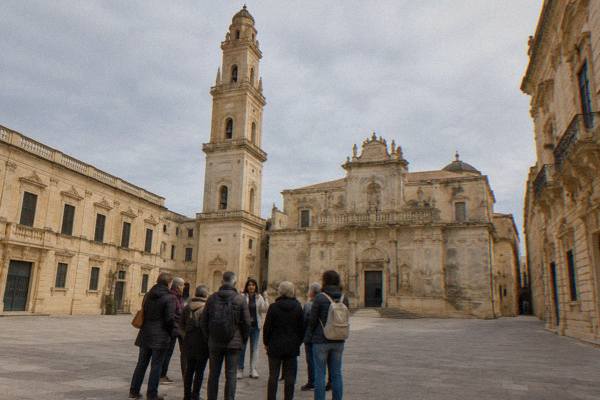
What Are Some Interesting Facts About Lecce?
Interesting facts about Lecce, the baroque capital of Salento in Puglia: its soft limestone, its Roman undergrounds, its food claims and its climate, all from primary sources.
Lecce, in Puglia at the heel of Italy, is a compact baroque city built almost entirely from one locally quarried stone, and it rewards curiosity more than almost any other town in the south. The city is the capital of the Province of Lecce, on the Salento peninsula, a few kilometres inland from the Adriatic. It has no commercial airport, no UNESCO inscription and no coastline of its own, and yet it carries one of the most famous nicknames in Italian travel. The facts below come from official city pages, diocesan ticket offices, museum sites and climate reanalysis data, and each one is attached to its source subject rather than to a plausible guess.
What Are Some Interesting Facts About Lecce?
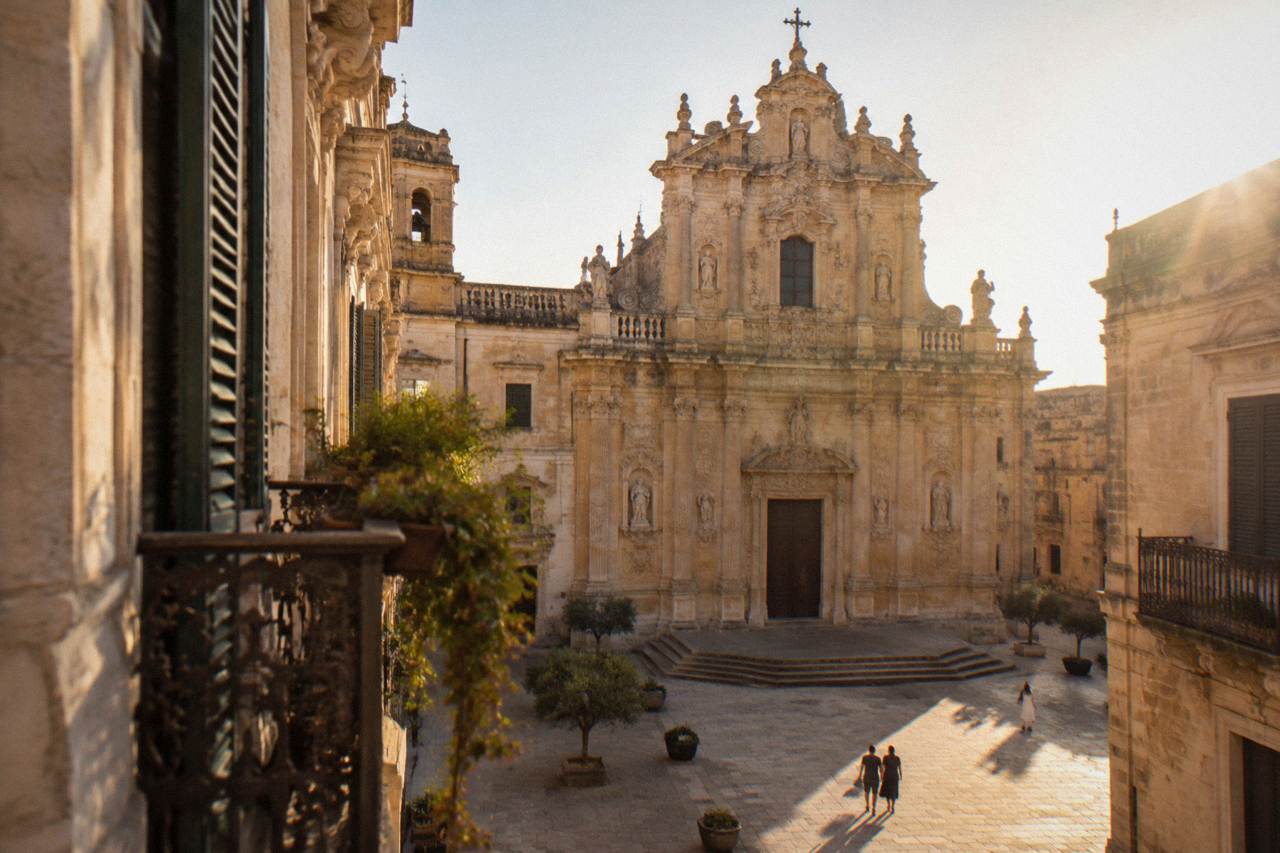
Lecce is a city of about 94,387 residents in Puglia, southern Italy, the capital of a province of 761,927 people, built from a soft Miocene limestone called pietra leccese and carved in the dense ornamental style known as Lecce Baroque. It has no commercial airport, it is not a UNESCO World Heritage Site, and its nearest beach is 12.9 km away at San Cataldo.
The headline numbers alone make Lecce unusual. The Università del Salento enrols about 20,774 students, which gives a city of 94,387 residents a large university population and a lively off-season street life. The building stone, pietra leccese, is a calcarenite that carvers can work almost like wood when it leaves the quarry, and that hardens with exposure to air, which is the physical reason the city's facades carry such deep, florid decoration.
The nickname and the heritage status are the two facts that get garbled elsewhere. Lecce is often called the Florence of the South, a label whose origin is contested between two historical figures, so this page reports the nickname without crediting either name. And while the city is often described as UNESCO-listed, the truth is narrower: the proposal "Salento and the Barocco Leccese" sits on Italy's Tentative List, submitted in 2006, and has never been inscribed on the World Heritage List. For more on the city's standing among southern destinations, see whether Lecce is worth visiting and how many days you need in Lecce.
| Fact | Detail |
|---|---|
| Region | Puglia (Apulia), southern Italy |
| Role | Capital of the Province of Lecce, Salento peninsula |
| City population | 94,387 residents, 1 January 2026 |
| Province population | 761,927 residents |
| University | Università del Salento, about 20,774 enrolled students |
| Building stone | Pietra leccese, a Miocene limestone, soft when quarried |
| Nearest beach | San Cataldo, 12.9 km east |
| Nearest commercial airport | Brindisi (BDS), about 47.6 km by road |
| UNESCO status | Tentative List (2006), not inscribed |
Why Is Lecce Called The Florence Of The South?
Lecce is often called the Florence of the South for the richness of its baroque architecture, a style executed in pietra leccese, a limestone soft enough to carve in fine detail when freshly quarried and hardening once exposed. The credit for the nickname is contested between two historical figures, so the city carries the label without a confirmed author, and the baroque style that earned it remains the city's defining feature.
The comparison rests on concentration. Within a walkable historic centre, Lecce packs a cathedral with a crypt, the Basilica di Santa Croce, a Roman amphitheatre, a castle and dozens of palazzi, all in the same honey-coloured stone. The LeccEcclesiae combined ticket run by the diocese covers the Duomo and its crypt, Santa Croce, San Matteo, Santa Chiara and the Antico Seminario with the Museo d'Arte Sacra, at 11 euro for the standard ticket and 21 euro with the bell tower lift, valid 15 days, with children under 12 free.
The stone also explains a craft that is uniquely Leccese: cartapesta, papier mâché. Because pietra leccese is easy to carve, it is also easy to mould in paper and glue, and the city's workshops have made religious figures and nativity scenes this way for generations. The tradition gets its own showcase each December at the Fiera dei Pupi, the papier mâché fair traditionally held in early December through to the 24th, at the ex-Convento dei Teatini. The Musei della Cartapesta inside Castello Carlo V covers the history, and the castle visit itself is by guided tour only, 10 euro full and 6 reduced, with the courtyard free.
If the fact-hunting on this page turns into a real trip plan, these three guided experiences cover the city, the wider region and its wine:
Is Lecce On The Sea, And How Far Is The Nearest Beach?
No, Lecce is not on the sea. The nearest beach is San Cataldo, 12.9 km east of the city on the Adriatic, reachable in about 20 minutes on the SGM line 32 bus from the City Terminal. The Salento peninsula gives Lecce a second coastline, the Ionian, across its width to the west, and the summer Salento in Bus network connects the city to both coasts.
San Cataldo is a low, sandy coast backed by pine forest, and the comune describes it as one of the five marine di Lecce. In the 2026 summer season the Salento in Bus network ran from 13 June to 13 September, with lines including the 101 to Torre dell'Orso and Otranto, the 104 to Porto Cesareo and Gallipoli, and the 107 and 108 towards Santa Maria di Leuca, at fares between 1.10 and 5 euro. The 2027 dates had not been announced, so confirm the season before planning a bus-based beach day, and see where Lecce sits in Italy for the geography.
The sea itself warms quickly. Sea temperature data for Puglia shows about 22.5 C in June, 25 to 27 C at the August peak, 20 to 22 C in October and about 14 C in February. Lido prices in the 2026 surveys ranged from 15 to 25 euro per day for an umbrella and two beds at San Cataldo in June, rising to 33 to 35 euro in August, with the Ionian coast generally dearer than the Adriatic; treat these as planning ranges and check the current price at each lido. One 2026 rule worth knowing before a swimming day: at Grotta della Poesia near Roca Vecchia, bathing and diving have been banned since summer 2026, and non-residents of Melendugno paid a 5 euro ticket to visit, so the famous sinkhole is now a view, not a swim.
What Lies Beneath The Streets Of Lecce?
Under the streets of Lecce sits a Roman amphitheatre in Piazza Sant'Oronzo, visible free from the square and open to visitors for 5 euro following a restoration funded with 1,500,000 euro of PNRR money that added a new accessible entrance. Below and around the centre lie a Roman theatre, the layered undergrounds of Museo Faggiano, the archaeological park of Rudiae and the medieval Jewish quarter.
The amphitheatre's winter season runs Tuesday to Sunday, 10:00 to 17:00, closed Mondays, with a 5 euro full ticket and 2 euro reduced. Museo Faggiano, a private house turned museum on Via Ascanio Grandi, is open every day from 9:30 to 20:00 and charges 5 euro, with children up to 8 free and ages 8 to 16 at 3 euro; its rooms cut down through centuries of construction, from Messapian and Roman layers to a convent period. Farther out, the Parco archeologico di Rudiae opens on weekends for guided visits, 5 euro full and 4 reduced, free under 7, with weekday access by reservation.
The Jewish quarter is the quietest of these undergrounds and, for many visitors, the most surprising. Lecce's Giudecca preserves the footprint of a medieval community whose synagogue now survives as an underground space beneath a later palazzo, and the Museo Ebraico on Via Umberto I visits it by guided tour only, about 5 euro full and 4 reduced. The Jewish Quarter Guided Walk covers this history with a licensed local guide, and you can Check availability for a date. A broader introduction to the city's layered story also runs as a small-group history walk:
What Food And Drink Started In Or Near Lecce?
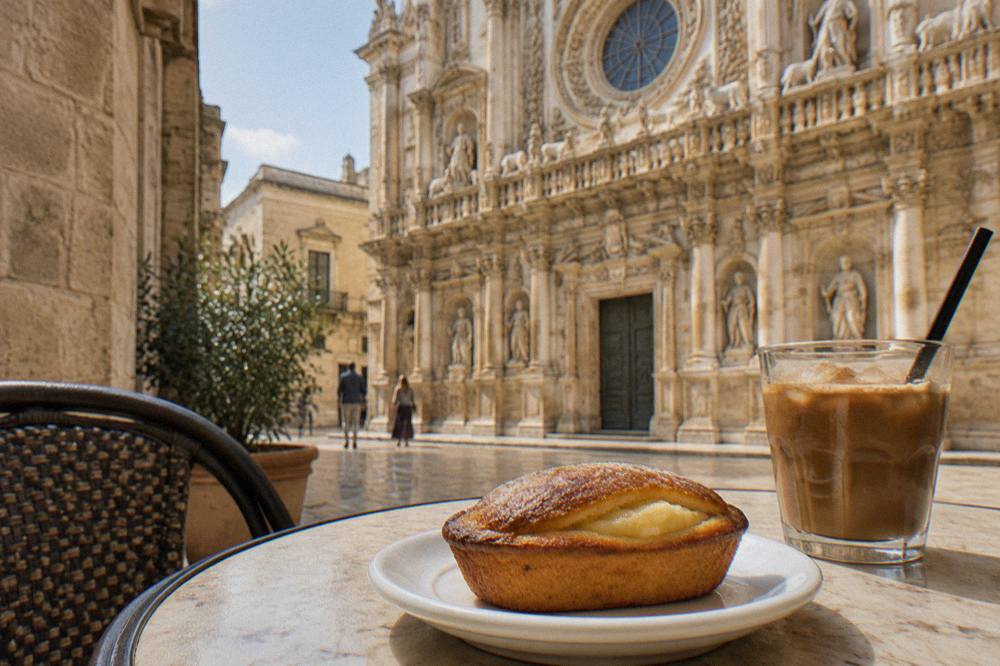
Two of Salento's signature items trace to Lecce itself. Caffè in ghiaccio con latte di mandorla, espresso poured over ice with almond milk, is credited to Antonio Quarta of Quarta Caffè in the 1940s to 1950s, while the pasticciotto's 1745 invention date is the claim of Pasticceria Ascalone in Galatina, not Lecce, and historians dispute it. The rustico leccese, the savoury puff pastry with besciamella and tomato, has origins that are likewise uncertain.
The disputed dates are part of the charm. The Ascalone shop says the pasticciotto was born in 1745 from leftover shortcrust and custard in small copper moulds, but the claim belongs to Galatina, a town about 25.7 km from Lecce by road, and no document settles it. The caffe in ghiaccio story is better anchored: the Quarta family's bar, opened around 1978 as a torrefazione, popularised the iced coffee that Antonio Quarta is credited with devising a few decades earlier, and the drink has since entered Italy's PAT list of traditional products.
| Item | What It Is | Where The Claim Sits |
|---|---|---|
| Caffè in ghiaccio con latte di mandorla | Espresso over ice cubes with almond milk syrup | Credited to Antonio Quarta, Quarta Caffè, 1940s to 1950s, in Lecce |
| Pasticciotto | Shortcrust custard tart | 1745 date claimed by Pasticceria Ascalone in Galatina, disputed |
| Rustico leccese | Puff pastry with besciamella, mozzarella and tomato | Origins uncertain, likely 18th to 19th century |
| Salice Salentino DOC | Negroamaro-based red wine | Established 1976, spanning Lecce and Brindisi provinces |
| Cartapesta | Papier mâché religious figures | A Lecce craft tied to the softness of pietra leccese |
The old cafes carry the rest. Caffè Alvino on Piazza Sant'Oronzo has roots to about 1880, by some accounts the first bar in the city, and Pasticceria Natale has been family-run since 1978. For the wider picture of the region's food culture, including the Negroamaro grape behind Salice Salentino, see what Lecce is famous for.
What Is The Climate Like In Lecce?
Lecce has a hot-summer Mediterranean climate. In the ERA5 reanalysis for 1991 to 2020, the mean daily high reaches 31.3 C in August against a mean daily low of 6.7 C in January, November is the wettest month at 93.7 mm of rain, and July the driest at 15.3 mm. Annual rainfall totals 652.3 mm across the year.
The pattern matters for planning. July and August are hot and nearly rainless, with mean highs of 31.0 and 31.3 C, while the autumn months carry the rain: October averages 91.3 mm and November 93.7 mm. Winters are mild and damp rather than cold, with January mean lows of 6.7 C. These are modelled normals from the ERA5 reanalysis for a grid cell near Lecce, not a weather station record, and they say nothing about sunshine hours.
| Month | Mean High (C) | Mean Low (C) | Rain (mm) |
|---|---|---|---|
| Jan | 12.4 | 6.7 | 63.1 |
| Feb | 13.0 | 6.8 | 59.0 |
| Mar | 15.4 | 8.3 | 64.9 |
| Apr | 18.6 | 10.7 | 54.6 |
| May | 23.4 | 14.7 | 39.9 |
| Jun | 28.2 | 19.1 | 18.0 |
| Jul | 31.0 | 21.7 | 15.3 |
| Aug | 31.3 | 22.2 | 18.1 |
| Sep | 26.4 | 19.0 | 58.9 |
| Oct | 21.8 | 15.4 | 91.3 |
| Nov | 17.3 | 11.7 | 93.7 |
| Dec | 13.5 | 8.2 | 75.5 |
The August calendar explains itself: the Festa dei Santi Patroni, honouring Oronzo, Giusto and Fortunato, ran 23 to 26 August in 2026, and the Notte della Taranta Concertone at Melpignano, about 20 km south, held its 29th edition on Saturday 22 August 2026. The 2027 dates had not been announced. If the fact-collecting has turned into a trip, these three picks cover the city walk, the inland towns and the wine:
Common Questions About Interesting Facts About Lecce
What are some interesting facts about Lecce?
Lecce is the baroque capital of Salento in Puglia, with about 94,387 residents, a university of about 20,774 students, buildings carved from soft pietra leccese limestone, a Roman amphitheatre under its main square, no commercial airport and no UNESCO inscription, only a Tentative List entry from 2006.
Is Lecce a UNESCO World Heritage Site?
No. "Salento and the Barocco Leccese" sits on Italy's Tentative List, submitted in 2006, but the city has never been inscribed on the World Heritage List. Any guide that calls Lecce UNESCO-listed is overstating the case.
Does Lecce have an airport?
No. The nearest commercial airport is Brindisi (BDS), about 47.6 km and 43 minutes by road from Piazza Sant'Oronzo. A shuttle bus connects the airport to Lecce in about 40 minutes at 6.50 euro one way, per the operator's page.
How far is Lecce from the beach?
The nearest beach, San Cataldo, is 12.9 km east of the city on the Adriatic, about 20 minutes by the SGM line 32 bus from the City Terminal. The Ionian coast lies across the peninsula to the west.
What is pietra leccese?
It is a Miocene limestone, a calcarenite quarried around Lecce, soft and easy to carve when fresh and hardening with exposure. That softness is the physical reason the city's baroque facades carry such deep decoration, and it also enabled the local papier mâché craft.
Who invented the pasticciotto?
The 1745 date is the claim of Pasticceria Ascalone, a shop in Galatina, not Lecce, and historians dispute it. The dessert is now made across Salento, and the claim is best reported as a claim rather than a fact.
The verified facts about Lecce keep circling back to one material: a soft limestone that made a whole architectural style possible, then a paper craft, then a city that punches far above its population. For the practical side of a visit, Lecce Travel Guide covers the churches ticket, the ZTL, the beaches and the day trips in separate pages, each built on the same primary sources as this one.