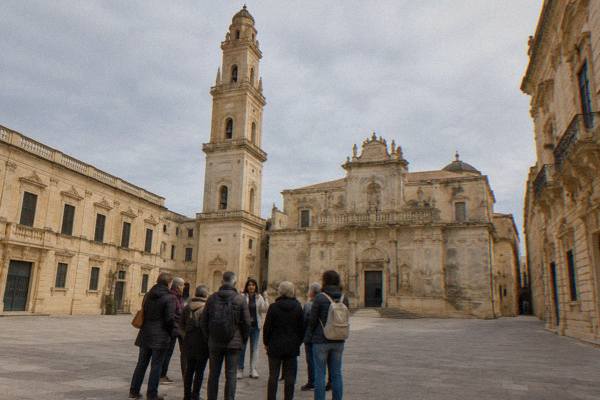
Is Lecce A Walkable City?
Is Lecce a walkable city? A sourced answer from the Lecce Travel Guide editorial desk: the historic centre on foot, car-free days out, beaches, night walking and what needs a bus or train.
Lecce, in Puglia, southern Italy, is the baroque capital of Salento: a city of about 94,387 people built in honey-coloured pietra leccese limestone, sitting a few kilometres inland at the heel of the Italian boot. San Cataldo, the nearest beach, is about 13 km away, so Lecce itself is not a beach town but a compact inland city whose sights cluster inside one old centre. For a broader first look at the city, the Lecce Travel Guide home page gathers the main planning pages in one place, and things to do in Lecce lists the sights themselves.
Is Lecce A Walkable City?
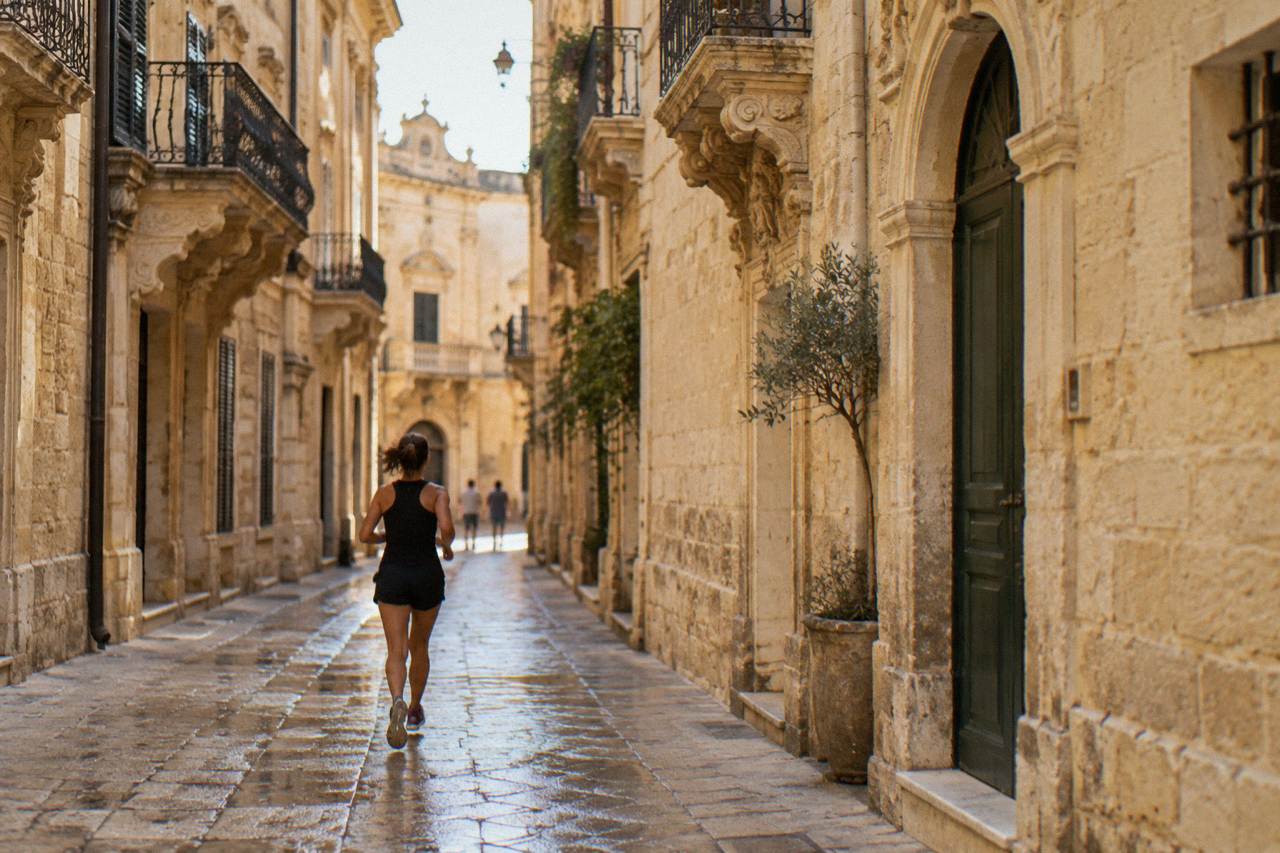
Yes, Lecce is a walkable city in the sense that matters to a visitor: its baroque centre is compact and flat, its principal squares and ticketed churches sit within a short stroll of one another, its historic core is closed to through traffic by a camera-policed ZTL, and the whole sightseeing layer of the city can be done on foot with no car at all. The Piazza Sant'Oronzo, the Piazza del Duomo, the Basilica di Santa Croce and the Castello Carlo V are all inside the same continuous fabric of lanes and squares. Walking is not just possible here, it is the default way the old town is meant to be seen, because the streets that hold the architecture are themselves the attraction.
The ZTL, the restricted traffic zone, is the structural fact behind that. The comune's ordinances place camera-enforced restrictions on the historic centre, active on weekdays roughly from 13:00 to 16:30 and again overnight into the morning, and around the clock on Sundays and holidays, with fines running from 83 to 332 euro. The reported hours are exactly that, reported, and the city's own notices should be checked, but the effect is stable: private cars are largely kept out of the centre, and the space belongs to people on foot. Any driver staying in the centre should ask their accommodation about plate registration, which is how authorised guests are exempted.
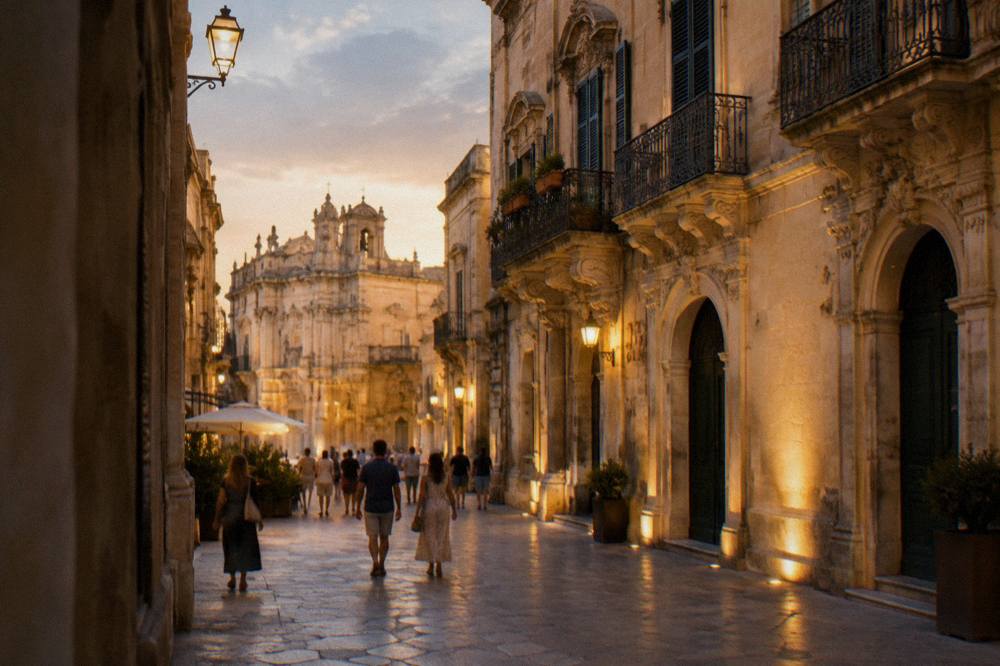
There is also a safety dimension, and the reporting on it is consistent: Lecce is generally described as a safe, low-crime city where petty theft is the main tourist concern and violent crime is rare. That matches the experience of an evening passeggiata through Piazza Sant'Oronzo or the streets around the Duomo, which stay lively after dark. The is it safe to walk around Salento at night page covers the wider region if night walking beyond the city is the question.
How Compact Is The Lecce Old Town On Foot?
The Lecce historic centre is small enough that the main sights form one continuous walking circuit: Piazza Sant'Oronzo with the Roman Amphitheatre, the Duomo and its bell tower, the Basilica di Santa Croce, Palazzo dei Celestini, Porta Napoli and the Villa Comunale all sit inside the old walls, and the LeccEcclesiae church circuit alone covers five ticketed sites within the same walkable area. No two of these require a vehicle, a bus or a taxi. The layout is a grid of lanes radiating between the great squares, flat underfoot, and closed to most traffic. Two full days is a comfortable allowance for the centre itself, which the how many days do you need in Lecce page works through in detail.
The sightseeing layer stacks up like this on foot:
| Sight in the historic centre | Access on foot | Ticket situation |
|---|---|---|
| Piazza Sant'Oronzo and the Roman Amphitheatre | Open public space, amphitheatre visible free from the piazza | Interior visit 5 EUR full, 2 EUR reduced |
| Duomo, crypt, Santa Croce, San Matteo, Santa Chiara, MuDAS | All on the LeccEcclesiae circuit inside the centre | Standard ticket 11 EUR, valid 15 days |
| Castello Carlo V | A short walk inside the centre, courtyard free | Interior by guided tour only, 10 EUR full |
| Museo Faggiano | Central, on the walking circuit | 5 EUR full, children's reductions |
| Porta Napoli, Villa Comunale, Palazzo dei Celestini courtyard | All walkable open space or free access | Free |
The LeccEcclesiae ticket deserves a note because it rewards walking rather than driving: the 11 EUR standard ticket covers the Duomo and crypt, Santa Croce, San Matteo, Santa Chiara and the Antico Seminario with its sacred art museum, stays valid for 15 days, and is sold at Piazza Duomo 5 or at the Basilica di Santa Croce, both points on the same foot itinerary. Children under 12 enter free, and the ticketed churches open daily from 9:00 to 21:00 in the April to September season and 9:00 to 18:00 from October to March. The comune's own pages describe the circuit as a walk between the principal baroque churches of the city, which is what it is.
Can You Visit Lecce Without A Car At All?
Yes, Lecce works as a car-free base: the city is a rail hub with Trenitalia services toward Bari, Brindisi and Rome, FSE regional lines to Gallipoli, Galatina and Otranto via Maglie, a summer Salento in Bus network to the beaches, an airport bus from Brindisi at 6.50 EUR each way, and local SGM buses including line 32 to San Cataldo beach, so both the city and its day trips can be done without driving. The station sits just outside the historic centre, a walkable edge of the old town, and luggage storage services operate near it at roughly 2.50 to 3.50 euro per day for arrival and departure days. The getting around Lecce guide carries the full detail.
The car-free connections from Lecce that the sources actually give times for:
| Destination from Lecce | Car-free option | Journey time | Fare reported |
|---|---|---|---|
| Gallipoli | Direct FSE train | About 1h18 to 1h43 | From about 5 EUR |
| Galatina | Direct FSE train | About 38 to 55 min | From about 3 EUR |
| Otranto | FSE train, change at Maglie | About 1h33 to 2h+ | From about 4 to 5 EUR |
| Ostuni | Direct Trenitalia train | About 39 to 51 min | From about 7 EUR |
| Polignano a Mare | Direct Trenitalia train | About 1h09 to 1h21 | On the operator's listing |
| San Cataldo beach | SGM bus line 32 | About 20 min | About 1 EUR |
| Brindisi Airport | Terravision airport bus | About 40 min | 6.50 EUR one way |
Salento in Bus, the seasonal shuttle network, ran from 13 June to 13 September in 2026, with line 101 to Torre dell'Orso and Otranto, line 104 to Porto Cesareo and Gallipoli, and lines 107 and 108 toward Santa Maria di Leuca, at fares from 1.10 to 5 euro. It is a summer-only service and the 2027 dates had not been announced, so anyone planning a shoulder-season car-free beach day should check what runs then. The day trips from Lecce without a car page expands on this, and for sightseeing inside the walls an introductory walk such as Discovering Lecce covers the centre's layout on foot, with live dates on Check availability.
Where Does Walking In Lecce Stop Working?
Walking in Lecce stops at the city edge: the beaches are not walkable from the centre, San Cataldo being about 13 km away, the Salento coast towns of Otranto, Gallipoli and Santa Maria di Leuca all need a train, bus or car, and the wider Puglia destinations such as Matera lie in another region entirely, so a car or the rail network takes over wherever the limestone lanes end. Inside the walls the answer never changes, but Lecce is an inland city by design, and the sea is a bus ride. SGM line 32 runs from the City Terminal to San Cataldo in about 20 minutes, with summer frequencies around every half hour reported by the comune.
Climate shapes the walking calendar too. The ERA5 reanalysis for Lecce, 1991 to 2020, puts the mean daily high at 31.0 C in July and 31.3 C in August, against 12.4 C in January, with November the wettest month at 93.7 mm of rain and July the driest at 15.3 mm. Summer walking is therefore an early-morning and evening activity, which suits the city anyway: churches on the LeccEcclesiae circuit keep evening hours in the summer season, closing at 21:00 from April to September, and the best time to visit Lecce guide works through the months in detail.
One planning wrinkle worth flagging: shops and some churches still keep a midday pause in the south of Italy, roughly from 13:00 to 16:00 or 17:00, varying by business, and church visits pause during services. A walking day in Lecce bends around those rhythms rather than fighting them.
Is Lecce Easy To Walk For A First-Time Visitor?
For a first-time visitor Lecce is among the easier Italian cities to walk: the centre is flat, the ZTL keeps traffic out, the main squares act as landmarks visible from the lanes between them, the pedestrian fabric runs continuously from Porta Napoli through Piazza Sant'Oronzo to the Duomo, and the city's reputation for low petty crime means evening walking is normal rather than something to plan around. Orientation is straightforward because the old town is bounded and small, and the amber stone gives every street the same readable character. The city is often called the Florence of the South for its baroque architecture, a nickname whose origin is contested and is best left unattributed.
A first day on foot can reasonably take in the amphitheatre seen from Piazza Sant'Oronzo, the LeccEcclesiae churches, the Castello courtyard and the Villa Comunale without transport of any kind, then finish with the caffè in ghiaccio con latte di mandorla, the iced espresso with almond milk credited to Antonio Quarta of Quarta Caffè in the 1940s to 1950s, at one of the historic cafés such as Caffè Alvino on Piazza Sant'Oronzo, whose roots go back to about 1880. The what is Lecce famous for page collects the signature themes, and is Lecce worth visiting tackles the bigger should-you-go question.
Common Questions About Walking In Lecce
Is Lecce A Walkable City?
Yes. Lecce's historic centre is compact, flat and largely closed to traffic by a camera-enforced ZTL, and all the principal sights, from Piazza Sant'Oronzo to the Duomo and the Basilica di Santa Croce, sit within one continuous walkable area. No car is needed inside the old town.
Can you explore Lecce without a car?
Yes. Lecce is a rail hub with Trenitalia and FSE lines to Gallipoli, Otranto via Maglie, Galatina, Ostuni and beyond, plus SGM city buses, a summer Salento in Bus beach network and an airport bus from Brindisi. The city itself is entirely walkable.
Is the Lecce historic centre pedestrianised?
The centre is a restricted traffic zone rather than fully pedestrianised. Cameras enforce the ZTL on weekdays roughly from 13:00 to 16:30 and overnight, and around the clock on Sundays and holidays, with fines from 83 to 332 euro. Residents and authorised guests, including registered hotel guests, are exempt, so drivers should ask their accommodation to register their plate.
Is it safe to walk around Lecce at night?
Lecce is generally reported as a safe, low-crime city where petty theft is the main concern and violent crime is rare. The central squares and lanes stay busy in the evening, and night walking is a normal part of city life rather than a risk to plan around.
Can you walk to the beach from Lecce?
No. Lecce is inland, and San Cataldo, the nearest beach, is about 13 km away, reachable on SGM bus line 32 in about 20 minutes. The wider Salento beaches need the summer Salento in Bus shuttles, FSE trains or a car.
How many days do you need to walk Lecce?
The historic centre itself fits comfortably into two walking days, covering the LeccEcclesiae churches, the Castello courtyard or guided tour, the amphitheatre and the museums. A third day allows day trips out into Salento by train or bus.