Are There Any Michelin Star Restaurants In Puglia?
Whether Puglia has Michelin-starred restaurants, what this guide can and cannot print about them, and the sourced food facts for Lecce, the baroque capital of Salento.
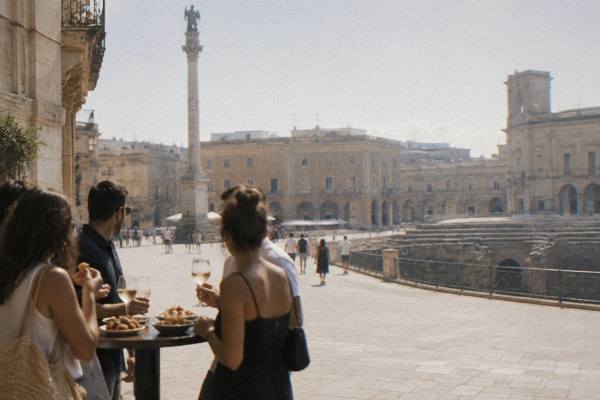
Lecce, in Puglia at the heel of Italy, is a food town before it is anything else. The baroque capital of Salento sits a few kilometres inland, built from the honey-coloured pietra leccese limestone that carves easily and hardens in the air, and its kitchen runs on cheap, generous, street-level things: iced espresso with almond milk, custard pastries eaten warm, hard bread softened with tomatoes, and Negroamaro wine from the plain around it. Visitors arriving from Bari or Brindisi often ask the same question about fine dining, and the question deserves a straight answer rather than a vague one.
Are There Any Michelin Star Restaurants In Puglia?
Yes, the Michelin Guide's Italy selection covers Puglia, so starred restaurants have existed in the region, but no star count, no starred name and no ranking appears on this page, because this guide's sources attach none to Lecce or to its province. For current stars, the Michelin Guide's own Italy selection is the list to consult, close to the date you book.
That answer is deliberately narrow, and the narrowness is the useful part. The Michelin Guide inspects and lists restaurants across Italy, Puglia included, and its stars are awarded and withdrawn restaurant by restaurant, year by year. A count printed anywhere other than the Guide's own current selection is a snapshot at best and a stale copy at worst. Anyone planning a dinner around a specific star should read the Guide's own entry for that restaurant, on that year's list, before booking, because a star can move between editions.
The second half of the honest answer is geographic. The Guide's Puglia coverage has never been concentrated in Lecce. The province's starred and recommended tables, where they exist, sit scattered across a region that runs from Bari down through the Murge and out along both coasts of Salento, and the inland baroque city is not the region's default fine-dining capital. Lecce's strengths are different: the pasticcerie, the historic cafes on the main squares, the wine bars pouring Salice Salentino, and the street food sold within a few hundred metres of Piazza Sant'Oronzo.
The practical conclusion is simple. Book the starred table if the Guide's current selection puts one within reach of your trip, and give it the same weight you would give any listing: read the entry, not just the star. Then build the rest of your eating around what Lecce itself does distinctively, which is the material this guide can actually stand behind.
What Food Facts About Lecce Actually Carry A Source?
Lecce's sourced food record runs to a handful of specific claims: Caffe Alvino on Piazza Sant'Oronzo traces its roots to about 1880, Pasticceria Natale has been family-run since 1978, the caffe in ghiaccio con latte di mandorla is credited to Antonio Quarta of Quarta Caffe in the post-war years, and Salice Salentino DOC was established in 1976. Everything beyond that list is general description, not recommendation.
Each of those claims keeps its attribution. The 1880 date for Caffe Alvino is the account given in local reporting on the bar's history, and the Catamo family has run it since 2007. Pasticceria Natale's 1978 founding by Fernando Natale is the shop's own account. The iced coffee with almond milk is credited to Antonio Quarta of Quarta Caffe, in the years after the war, and has since entered Italy's official list of traditional food products. Salice Salentino DOC, established in 1976, is Negroamaro-based and spans the provinces of Lecce and Brindisi.
The pasticciotto needs its own paragraph, because it is the region's most repeated food story and the story is not clean. The 1745 invention date belongs to Pasticceria Ascalone, and that shop is in Galatina, a smaller town about half an hour from Lecce, not in Lecce itself. The shop says the pastry was created from leftover shortcrust and custard during the patron saint's feast; historians dispute the date and the priority, so the claim stays a claim. One reported price exists in the sources: a "Santo Pasticciotto" at Pasticceria Natale was listed at 2.20 euro.
| Item | What The Source Says | Attribution |
|---|---|---|
| Caffe Alvino | Roots to about 1880, first bar in Lecce per some accounts; run by the Catamo family since 2007 | Local reporting on the bar's history |
| Pasticceria Natale | Family-run since 1978, founded by Fernando Natale | The shop's own account |
| Caffe in ghiaccio con latte di mandorla | Espresso over ice with almond milk, credited to Antonio Quarta of Quarta Caffe, post-war years | Local food reporting; now on Italy's traditional-products list |
| Pasticciotto | 1745 invention claimed by Pasticceria Ascalone, in Galatina; historians dispute it | The shop's claim, disputed |
| Santo Pasticciotto | Reported at 2.20 euro at Pasticceria Natale | Reported listing |
| Salice Salentino DOC | Established 1976, Negroamaro-based, provinces of Lecce and Brindisi | Regional production register |
No other restaurant, bar or bakery in Lecce carries a recommendation from this guide, and no meal price, address, opening hour or phone number appears for any venue beyond the names above. For a broader, regularly maintained view of where to eat in the city, the Lecce restaurant guide is the place to look, and for the question of whether the city rewards the trip at all, is Lecce worth visiting covers the case for and against.
How To Eat Salento Without A Reservation At All?
You do not need a starred reservation to eat well in Lecce. The city's sourced pleasures are street-level: an iced espresso with almond milk, a warm pasticciotto, rustic plates of frisa and puccia, and Negroamaro-based Salice Salentino DOC wine from the provinces of Lecce and Brindisi, all reachable on foot in the old centre.
The old town is compact and flat, which matters more here than in most Italian cities, because the food is spread across it rather than concentrated in one dining quarter. The squares around Piazza Sant'Oronzo and Piazza del Duomo hold the historic cafes. The pasticcerie open early and sell out by early afternoon in the hotter months. The wine bars pour the local DOCs by the glass. None of it requires a jacket, a booking or a budget built for a tasting menu. Other pages covering the same trip are gathered on Lecce Travel Guide.
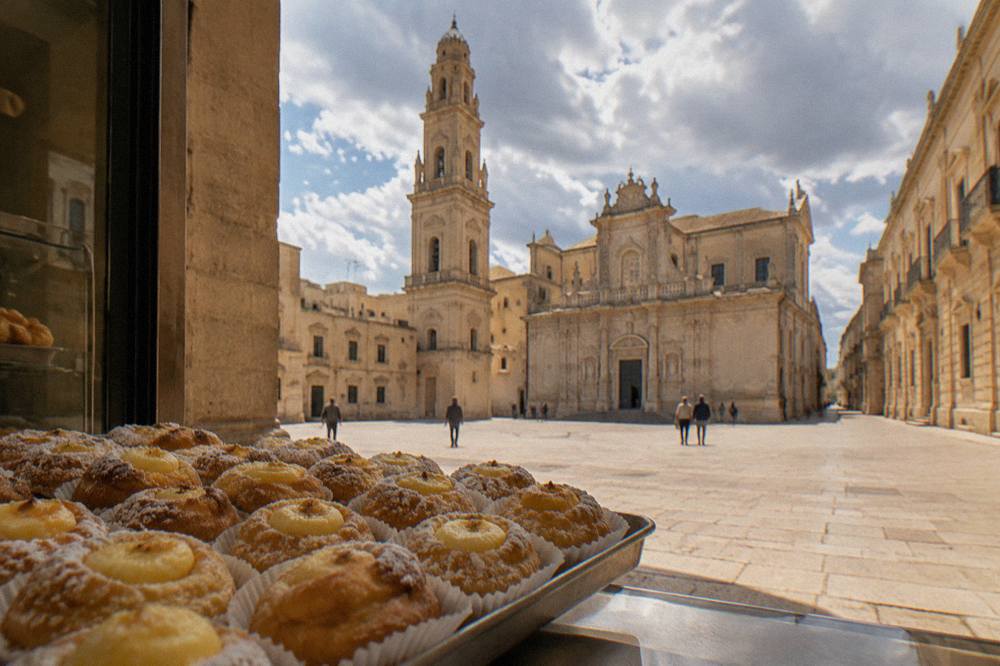
The dishes themselves are unglamorous by design. Frisa is a hard twice-baked rusk that gets soaked in water or tomatoes until it yields. Puccia is a small flatbread, often split and filled. The rustico leccese is a savoury puff-pastry disc filled with bechamel, tomato and cheese, a snack with an origin story nobody has settled. Ciceri e tria pairs chickpeas with a mix of fried and boiled pasta. These are workers' foods that happened to survive into a tourist economy, and they cost less than a coffee in a northern city.
| Dish Or Drink | What It Is | How To Approach It |
|---|---|---|
| Pasticciotto | Shortcrust pastry filled with custard, served warm where possible | Eat it fresh, early in the day, before the afternoon heat |
| Rustico leccese | Savoury puff pastry with bechamel, tomato and cheese | A morning or evening snack, sold by the piece |
| Frisa | Twice-baked rusk, soaked and dressed with tomatoes and oil | A summer lunch, made at home or served in simple places |
| Puccia | Small flatbread, split and filled | Bought by the piece, eaten standing or on a bench |
| Caffe in ghiaccio con latte di mandorla | Espresso poured over ice with almond milk | Ordered as the locals order it, without sugar |
A guided walk ties these threads together for visitors who would rather not assemble them alone. The site's featured food experience is a guided street food walk with wine, run by a local operator through the old centre; Check availability on the operator's live listing for current dates and prices. For the wider picture of the city's food reputation, what Lecce is famous for covers more than the table.
The three experiences above cover the same ground in three different ways: a walk that tastes as it goes, a class that teaches the pasta itself, and a history walk that goes underground into the ancient synagogue basement. Each is bookable without any starred anything, and each explains the city better than a tasting menu would.
Can A Cooking Class Or A Food Walk Replace A Starred Dinner?
A food walk or a pasta class gives you the same territory a starred kitchen guards: raw ingredients, local technique and someone who can explain both. Lecce's bookable food experiences cover street food walks with wine, orecchiette and pasta classes in old courtyards, and historic-centre walks that stop at the ancient synagogue basement. Prices, ratings and durations render on each operator's live listing.
That is not a claim that a class is equivalent to a starred meal. It is a claim about what a visitor actually takes home. A starred dinner delivers a chef's interpretation of a region; a class delivers the region's own methods, in your own hands, with the recipe to repeat at home. In a province whose kitchen is built on three or four techniques and a short list of ingredients, the second can outlast the first.
The classes run in settings that are themselves worth seeing: courtyards in the old centre, family homes in the countryside around Lecce, and workspaces where the pasta is rolled by hand and the wine poured from the local DOCs. The walks run through the same streets visitors would wander anyway, with the difference that someone names what is being eaten and where it came from. Both formats suit travellers who book late, since availability is usually broader and later than a starred table's.
Will the operator let you cancel if your plans shift? Cancellation terms vary by listing, so read the operator's own policy before you book rather than assuming. Check availability and the terms together, on the same page, before committing.
How Many Days Should You Give The Food Of Lecce?
Two full days is the working minimum for eating across Lecce: one for the old-centre classics, the pasticcerie and the wine bars around Piazza Sant'Oronzo and Piazza del Duomo, and one for a market, a cooking class or a food walk. Add a third for day trips to Galatina, Otranto or Gallipoli, where the food changes with the coast.
The rhythm of the first day matters. Pastries are a morning food in Salento, eaten warm within hours of baking, and the iced coffee is an afternoon one, ordered against the heat rather than after a meal. The squares fill after dark in summer, when the mean daily high sits around 31 degrees in July and August per the ERA5 reanalysis for 1991 to 2020, and dinner runs late. Trying to compress all of it into one day means eating three breakfasts.
The second day is better spent on depth: a class, a walk, or a slow lunch that turns into the afternoon. The third day, if it exists, belongs to the coast and the small towns, and the transport is genuinely easy. Galatina is about 29 minutes by road, or 38 to 55 minutes by the regional train from about 3 euro. Gallipoli is about 41 minutes by road, or 1 hour 18 to 1 hour 43 by train from about 5 euro. Otranto is about 44 minutes by road, or roughly 1 hour 33 by rail with a change at Maglie.
| Day Trip From Lecce | By Road | By Rail | What Changes At The Table |
|---|---|---|---|
| Galatina | About 29 minutes | Direct, 38 to 55 minutes, from about 3 euro | The town that claims the pasticciotto |
| Gallipoli | About 41 minutes | Direct, 1h18 to 1h43, from about 5 euro | Fishing-town raw seafood |
| Otranto | About 44 minutes | Change at Maglie, about 1h33 | Adriatic coast cooking, the mosaic city |
For the fuller question of trip length, how many days you need in Lecce lays out the trade-offs, and which is better, Lecce or Otranto treats the coast-versus-city choice directly. Neither answer is universal, but both are easier to make once the food is mapped.
Common Questions About Michelin Stars And Food In Puglia
Are there any Michelin star restaurants in Puglia?
Yes, the Michelin Guide's Italy selection covers Puglia, so starred restaurants have existed in the region. This guide prints no star count, no starred name and no ranking, because its sources attach none to Lecce or its province. Check the Michelin Guide's own current Italy selection, close to the date you book.
Does Lecce itself have a Michelin starred restaurant?
No starred table in Lecce appears in this guide's sources, and no count for the city is printed here. The Guide's Puglia coverage is spread across the region rather than concentrated in Lecce. Read the Guide's own current selection for the live answer.
What food is Lecce actually known for?
Pasticciotto, rustico leccese, frisa, puccia, ciceri e tria, and the caffe in ghiaccio con latte di mandorla, an iced espresso with almond milk credited to Antonio Quarta of Quarta Caffe. The local wine is Salice Salentino DOC, Negroamaro-based, established in 1976.
Where was the pasticciotto invented?
Pasticceria Ascalone, a shop in Galatina, about half an hour from Lecce, claims the 1745 invention during the patron saint's feast. Historians dispute the date, so treat it as the shop's claim rather than settled fact.
Is fine dining in Puglia expensive?
No price for a starred or fine-dining meal in Puglia appears in this guide's sources, so nothing is quoted here. What is sourced is cheap: a reported Santo Pasticciotto at 2.20 euro, and a street-food culture built on snacks sold by the piece.
What if I would rather cook than book a starred table?
Lecce sells pasta and orecchiette classes in old courtyards and family homes, plus street food walks with wine, all bookable through this site's tour listings. Check availability on each operator's live listing for dates, prices and terms.
The starred question has a short answer and the trip has a long one, and the two do not need to meet. Puglia appears in the Michelin Guide's Italy selection, so the stars exist; Lecce's own case rests on a century-old cafe on Piazza Sant'Oronzo, a disputed pastry from Galatina, an iced coffee credited to one post-war barman, and a Negroamaro DOC that has been bottled since 1976. Book the starred table if the Guide's current list puts one in reach, and give the rest of the week to the food that made the region worth a guide in the first place.