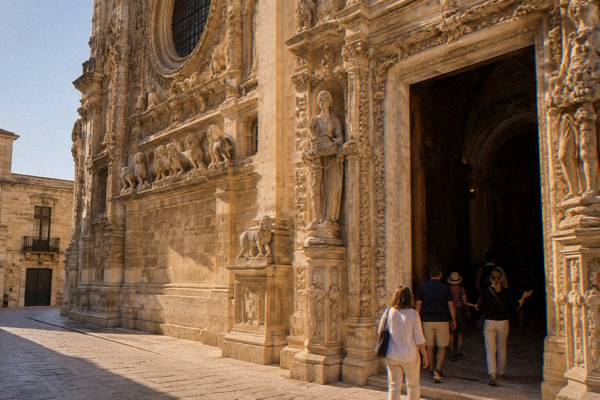
Is Lecce Very Touristy?
Is Lecce very touristy? An honest, sourced answer about crowds in Lecce: when the city fills up, where people gather, and how to see it calmly.
Lecce, the baroque capital of Salento in Puglia at the heel of Italy, is touristy in the sense that its old town has a visible visitor economy: walking tours, food tours, a combined church ticket and a steady flow of day trippers between Piazza Sant'Oronzo and the Duomo. It is not touristy in the way Italy's headline cities are, with queued museums and streets that feel like a corridor. No verified visitor total or arrivals count for Lecce exists in the sources behind this page, so nothing here attaches a number to the crowds. What the record does show is a strong seasonal rhythm, anchored on August, and a compact centre that concentrates whatever crowd there is into a handful of squares. Whether that reads as "very touristy" depends almost entirely on when you go, which is what the rest of this page works through. The Lecce Travel Guide desk covers this question with the same constraint it applies everywhere: only sourced figures, no impressions dressed up as data.
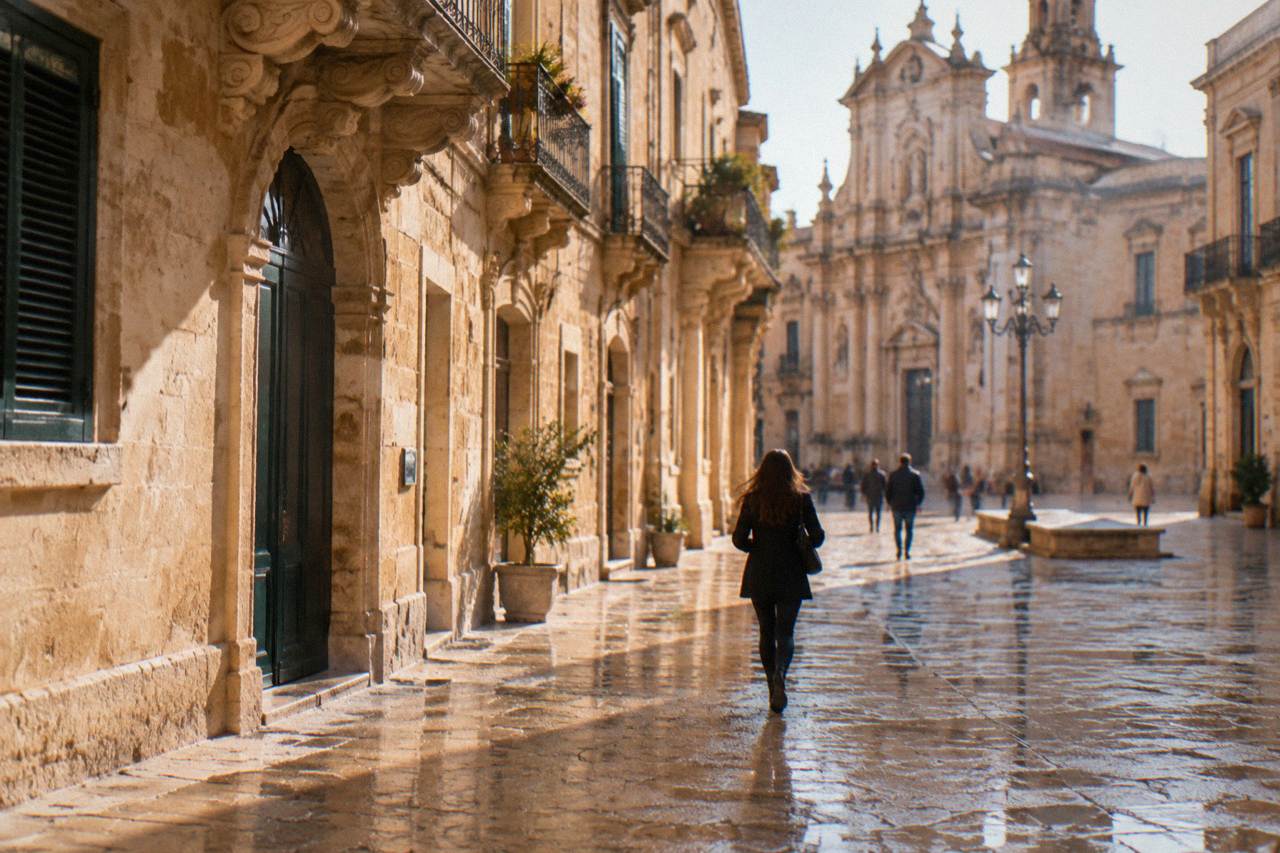
Is Lecce Very Touristy?
Lecce is moderately touristy, and the intensity swings hard with the calendar: the old town fills in August around the patron-saint feast and the Notte della Taranta season, spring and early autumn are busy but comfortable, and from November to February the streets are quiet enough that the city reads as a working provincial capital again. The historic centre is small and pedestrian-scaled, so even a modest crowd concentrates visibly around Piazza Sant'Oronzo, the Duomo and Basilica di Santa Croce. No visitor total has been verified for Lecce, so any "busier than X" ranking you may have read elsewhere is not something this guide can support. The honest answer is seasonal, not numerical.
Two structural facts shape that rhythm. First, Lecce is inland: San Cataldo, the nearest beach, is about 13 km away, so the city does not absorb a beach crowd directly the way a coastal resort does. It absorbs it indirectly, as a base and a sightseeing stop for people staying across Salento. Second, the city's biggest calendar events land in late August: the Festa dei Santi Patroni, honouring Oronzo, Giusto and Fortunato, ran 23 to 26 August in 2026, and the Notte della Taranta Concertone in nearby Melpignano was held on 22 August 2026. That week is the one stretch when the centre is unambiguously full, with processions, luminarie and a funfair in the mix.
If the question behind the question is whether Lecce is worth the crowds, the companion page is Lecce Italy worth visiting works through that separately.
When Is Lecce At Its Busiest?
August is when Lecce is busiest, a double peak: beach season across Salento plus the patronal feast and the Notte della Taranta in the last week, all landing on a small historic center. July runs close behind with the same beach-driven pressure but fewer city events, June and September are shoulder months, and from October the crowd thins. July runs close behind, with the same beach-driven pressure but fewer city events. June and September are the shoulder months, and the Salento in Bus summer shuttle network brackets them exactly, running 13 June to 13 September in 2026, with its high-frequency peak from 1 July to 31 August. From October the summer services stop, the church ticket sites switch to winter hours, and the crowd thins to a different kind of visitor altogether.
The climate explains part of the pattern. The ERA5 reanalysis for Lecce, 1991 to 2020, puts the mean daily high at about 31 C in July and August against about 12 to 13 C in January, and gives November the highest monthly rainfall at 93.7 mm while July and August stay near 15 to 18 mm. Hot, dry, reliable summers are exactly what a beach-region base city feeds on.
| Month | Mean high C | Rain mm | Crowd character |
|---|---|---|---|
| January | 12.4 | 63.1 | Very quiet, city at its own pace |
| March | 15.4 | 64.9 | Quiet, first spring visitors |
| May | 23.4 | 39.9 | Comfortable, steadily busier |
| July | 31.0 | 15.3 | Busy, beach season at full tilt |
| August | 31.3 | 18.1 | Peak, feast week and Taranta |
| September | 26.4 | 58.9 | Shoulder, sea still warm |
| November | 17.3 | 93.7 | Quiet, wettest month |
Source for the climate columns: ERA5 reanalysis, 1991-2020, a modelled grid cell rather than a station record. For the timing question in full, how many days do you need in Lecce and what is the best month to visit Puglia Italy go deeper.
Where Do The Crowds Gather In Lecce?
Crowds in Lecce gather in four places: Piazza Sant'Oronzo with the Roman Amphitheatre, Piazza del Duomo, Basilica di Santa Croce and the short shopping axis between them, while five minutes off that axis the alleys of the centro storico stay noticeably calm even in August. The Anfiteatro Romano is visible free from Piazza Sant'Oronzo, so the square is where the whole day-trip flow naturally pools. The LeccEcclesiae combined church ticket groups the Duomo, Santa Croce, San Matteo, Santa Chiara and the Antico Seminario into one circuit, which funnels ticket holders along a predictable route. The Jewish quarter and the streets east of the centre see a fraction of that footfall.
The concentration has a practical upside. Because the crowd follows the circuit, an early start or a late-afternoon start moves you against it. The chieselecce.it ticket rules let you split visits across 15 days of validity, so the churches do not all have to be done in one crowded morning. Castello Carlo V runs guided tours only, on fixed slots, which naturally caps how many people move through at once. And the Amphitheatre's post-restoration accessible entrance has its own ticketed entry, separate from the free viewing terrace above.
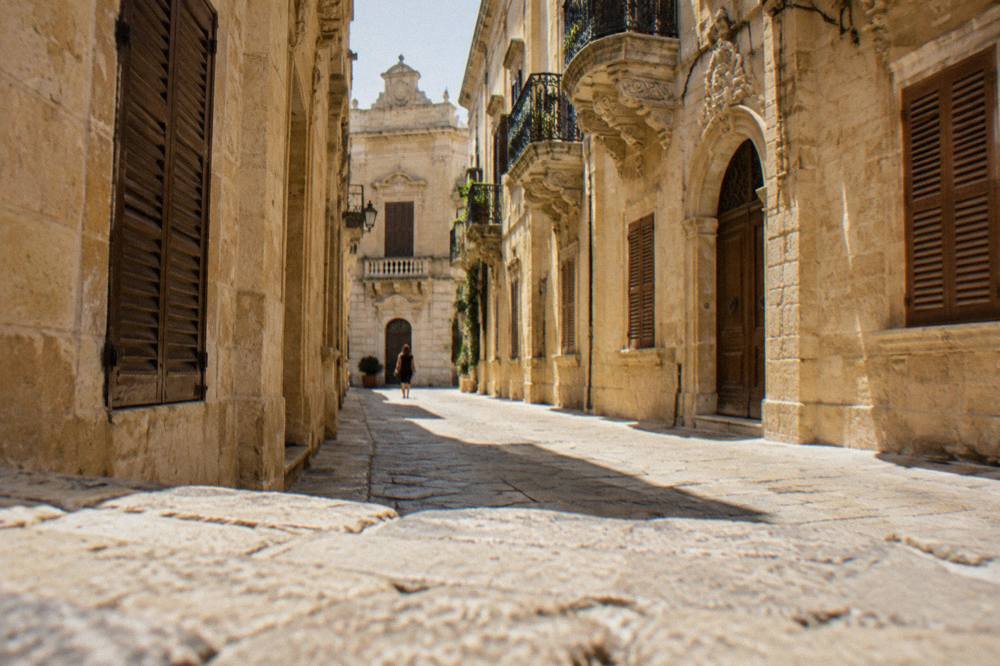
This is also where a private guide earns its keep, since a private route can be timed and routed against the flow rather than with it. The private baroque and underground tour run in Lecce works exactly that seam: facades above, excavated rooms below, on your schedule rather than a fixed departure. Check availability if that framing fits your dates.
How Does Lecce Compare As A Base With The Coastal Towns?
Lecce's advantage as a base is verified reach, not atmosphere rankings: from Piazza Sant'Oronzo it is about 44 minutes by road to Otranto, about 41 to Gallipoli, about 78 to Santa Maria di Leuca and about 34 to Porto Cesareo, with direct FSE trains to Gallipoli, Galatina and, with a change at Maglie, Otranto. This page's sources cover Lecce thoroughly and say nothing verifiable about the character, prices or ratings of the rival towns, so no ranking is offered here. What can be said is structural: Lecce sits inland at the junction of Salento's road and rail network, which is why it works as a base at all, and the coast is close in every direction.
| Destination from Lecce | Road distance | Drive time | Train option |
|---|---|---|---|
| Otranto | 46.7 km | about 44 min | FSE via Maglie |
| Gallipoli | 41.0 km | about 41 min | Direct FSE |
| Porto Cesareo | 28.0 km | about 34 min | Summer bus line 104 |
| Torre dell'Orso | 27.9 km | about 32 min | Summer bus line 101 |
| Santa Maria di Leuca | 83.2 km | about 78 min | Summer buses 107/108 |
| Galatina | 25.7 km | about 29 min | Direct FSE |
Drive figures are computed free-flow routing distances from Piazza Sant'Oronzo, not summer-traffic estimates, and August traffic on the coastal roads will not match them. The comparative question gets its own treatment on which is better Lecce or Otranto and the broader which town in Puglia is the best base page.
Is Lecce Quiet Outside August?
Outside August, yes, and dramatically so from late autumn to early spring: the summer beach shuttles stop after mid-September, the church sites switch to winter hours in October, and by November Lecce reads as a university and provincial-capital city that happens to have a baroque centre, with the wettest month of the year keeping it that way. The Università del Salento enrols about 20,774 students, and that resident population is what fills the cafes and evening streets when the visitors thin out. Winter Lecce is not a ghost town; it is simply a city occupied by its own life.
Autumn deserves a specific mention. October still carries a mean high of about 21.8 C per the ERA5 reanalysis, the sea off Puglia sits at about 20 to 22 C, and the crowd level has already dropped. December brings its own draw in the Fiera dei Pupi, the traditional papier-mache Christmas fair, which followed an early-to-24-December pattern in 2025, with 2026 dates to be confirmed. None of this is "touristy" in the August sense; it is a different, calmer register entirely.
How To See Lecce Without Feeling The Crowd
The workable tactics are timing, geography and ticket structure: walk the core squares before mid-morning or after the evening passeggiata begins, spend midday in the quiet eastern alleys or an underground site, and use the 15-day LeccEcclesiae validity to split churches across days instead of doing all five in one busy morning. Museo Faggiano, a compact archaeological house-museum open every day 9:30 to 20:00 for 5 euro, absorbs a crowd of about one group at a time, which is its charm. Parco archeologico di Rudiae, on the edge of town, takes weekend guided visits by booking, and sees nothing like the centre's footfall.
Evening reshuffles everything. Summer openings at the church sites run to 21:00 in the high season, and the stones of pietra leccese change character under artificial light. The practical pages on getting around Lecce and the wider guide to things to do in Lecce carry the mechanics; the point here is that crowd density in this city is a solvable problem rather than a fixed condition.
A food-led route is the other crowd-friendly move, since tasting stops are indoors and sequenced. The street-food walk covering Lecce's food traditions is one option among the trio below.
Common Questions About Lecce And Tourists
Is Lecce Very Touristy?
Moderately, and seasonally. August is genuinely busy, driven by the beach season and the late-August patronal feast and Notte della Taranta. From late autumn to early spring the city is quiet. No verified visitor total exists, so treat any number you see elsewhere with caution.
Is Lecce overcrowded like Florence or Venice?
This page's sources cover Lecce only and support no comparison ranking with other cities. What can be said is structural: Lecce's historic centre is compact and the crowd concentrates in four or five squares, thinning out a few streets away.
What is the quietest time to visit Lecce?
November through February, with the caveat that November is the wettest month at 93.7 mm of rain per the ERA5 reanalysis, 1991-2020. October and late September are the sweet spot of warmth without the August peak.
Does Lecce get cruise-ship crowds?
No cruise port serves Lecce. It is an inland city about 13 km from the nearest beach at San Cataldo, reached overland by train, bus or car, with Brindisi airport as the air gateway.
Is August a bad time to visit Lecce?
It depends on what you want. August brings the Festa dei Santi Patroni and the Notte della Taranta season, which many visitors plan around deliberately, but it also brings the year's peak crowd and the highest lido and accommodation pressure across Salento. Confirm prices and availability at booking.
Are the main sights in Lecce hard to get into in summer?
Not structurally. The LeccEcclesiae ticket is valid 15 days across its church sites, and Castello Carlo V runs fixed guided-tour slots that cap entry naturally. Book the castle tour ahead in peak weeks and split the churches across mornings.